
Table of Contents
Table of Contents
A Kafka cluster can be declared “backed up” while the recovery path still loses the thing applications use to make progress: a trustworthy position in the log. A copy of record bytes does not prove that topics, partitions, consumer group offsets, credentials, and client endpoints can be reconstructed together. It also does not prove that a consumer can resume without skipping or duplicating work.
That gap appears during a regional outage, a destructive configuration change, or a failed migration. The team has a storage copy, but nobody can answer which offset a consumer should use, how long replay will take, or whether producers will reconnect to the promoted cluster. A useful GCP Kafka disaster recovery plan treats those answers as testable contracts. The thesis is straightforward: a DR claim is credible only when restore, replay, and client failover produce evidence against the workload’s RPO and RTO.
1Start with a recovery contract, not a backup product
RPO and RTO are promises about a workload, not properties of a storage bucket. Recovery point objective (RPO) describes how much accepted data the business can lose. Recovery time objective (RTO) describes how long the service can remain unavailable or degraded. Write both in terms an operator can observe, such as “records acknowledged before the cut line” and “the first successful consumer observation after promotion.”
A recovery contract answers four questions before a drill:
| Recovery question | Evidence to collect | Failure the evidence exposes |
|---|---|---|
| Which records must exist? | Producer IDs, event-time range, and a known cut line | Missing or partially copied records |
| Which metadata must return? | Topic and partition layout, access rules, client configuration, and cluster settings | A cluster that starts but cannot serve the workload |
| Where should consumers resume? | Committed offsets, translated offsets if used, and replay markers | Skips, duplicate processing, or an unbounded replay |
| When is service restored? | First successful produce, fetch, and application-level completion timestamps | A green infrastructure dashboard with a failed application |
A stream feeding an idempotent warehouse load can tolerate a different replay policy from a stream that triggers a payment or entitlement. Keep that policy beside the drill record, because a generic “Kafka is available” check does not define correctness.
2Separate the record path from the progress path
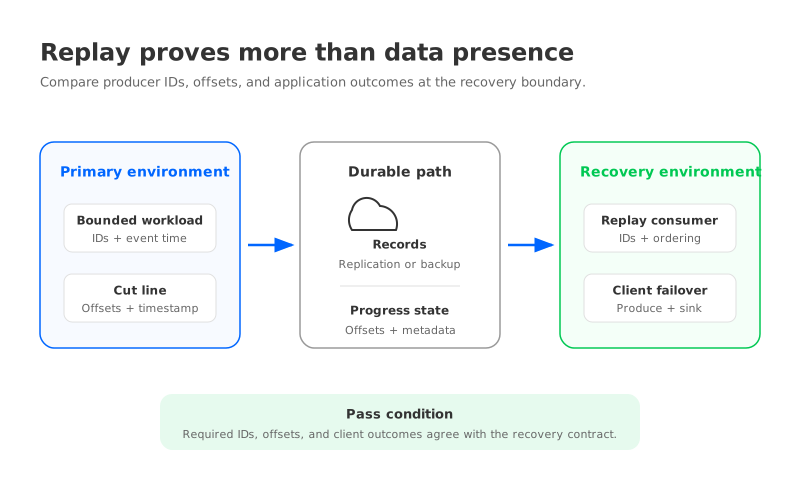
A Kafka DR design has at least two state paths. The record path contains topic data and partition ordering. The progress path contains consumer group positions and the metadata needed to interpret them. Endpoints, credentials, quotas, monitoring, and failover automation form the operational boundary around both.
Replication and backup tools can cover these paths differently. A cross-cluster replication setup may copy records continuously while translating consumer offsets, but the translation has to be validated for the exact topics, consumer groups, and cutover point. Apache Kafka’s geo-replication documentation describes the mechanisms and their boundaries; your drill must test the selected topology. A snapshot-based restore may recover a consistent data image while leaving the latest committed offsets outside that image. The mistake is treating “records copied” as proof that “applications can resume.”
On Google Cloud, the surrounding resources add more boundaries to test. Network reachability, DNS or service discovery, IAM permissions, encryption keys, and the chosen compute and storage services can fail independently of Kafka. Google’s Managed Service for Apache Kafka overview is a useful service boundary, but its documented scope still needs to be mapped to your recovery design. If the recovery cluster lives in another region, test the path from real clients or a representative client network, not only from an operator shell.
2.1What to capture before injecting failure
Create a small, traceable workload before every drill. The records should carry a producer-generated ID and an event timestamp so the team can distinguish missing records from duplicate delivery. Record the following at the cut line:
- The latest acknowledged producer sequence or application event ID for each test topic.
- The committed offset and consumer-group assignment for each test consumer.
- The topic, partition, retention, and access configuration required by the application.
- The client bootstrap or service-discovery setting that will change during failover.
3Design the drill as a sequence of observable states
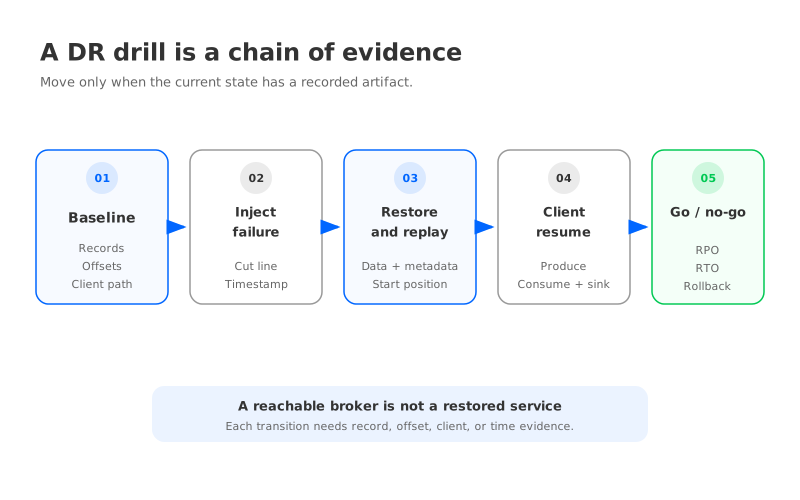
A useful drill has a failure boundary and a recovery boundary. At the failure boundary, stop or isolate the primary path in the same way the incident scenario would. At the recovery boundary, declare service restored only after a producer, a consumer, and an application-side check succeed. Every transition should leave an artifact: an offset file, a record-count comparison, a client log, or a timestamped command result.
A practical sequence looks like this:
- Baseline. Produce a bounded set of records, wait for the intended acknowledgment policy, and capture offsets and health signals.
- Cut line. Mark the last accepted event and record the wall-clock time. The cut line is the reference for the RPO calculation.
- Failure injection. Block the primary client path, stop the selected cluster resources, or apply the approved outage simulation. Keep the action reversible and scoped to the drill.
- Restore or promote. Bring up the recovery path, apply the required metadata and access configuration, and record when the endpoint becomes reachable.
- Replay. Start a test consumer from the documented offset or timestamp policy. Compare IDs and ordering with the source set, and capture duplicates separately from missing records.
- Failover validation. Switch a representative producer and consumer using the same discovery or configuration mechanism used by the application.
- Go/no-go. Compare observed RPO, RTO, record integrity, and client behavior with the contract. Leave the system in a known state and document rollback.
The order matters. A reachable broker is not a restored service, and a consumer that reads data is not necessarily at the correct position.
4Make offset continuity an explicit test
Offsets are positions within a partition, not globally unique event IDs. A restored partition can contain the expected bytes while its offset history differs from the source. A timestamp start may include records before or after the intended cut line, while a translated offset may fit one replication topology and fail in another.
Use two checks in the drill. First, verify the control-plane decision: which offset or timestamp policy did the runbook select, and why? Second, verify application-visible results: which producer IDs did the consumer process, in what order, and how did it handle a repeated ID? A consumer log that says “started successfully” cannot answer either question.
For replay, make idempotency visible. The test sink should record the producer ID and how many times it was observed. If duplicate delivery is acceptable, the sink or application must enforce that policy. If duplicates are not acceptable, the drill must show where deduplication occurs and what happens when a retry arrives after failover. Exactly-once behavior needs evidence from the chosen client, broker, and sink combination.
Client failover deserves the same scrutiny. Check the bootstrap setting, TLS material, authentication identity, service-discovery TTL, and retry behavior. A producer may keep retrying an unreachable endpoint while the recovery cluster is healthy. Capture client logs and application timestamps instead of inferring readiness from infrastructure status alone.
5Turn the drill into a scorecard
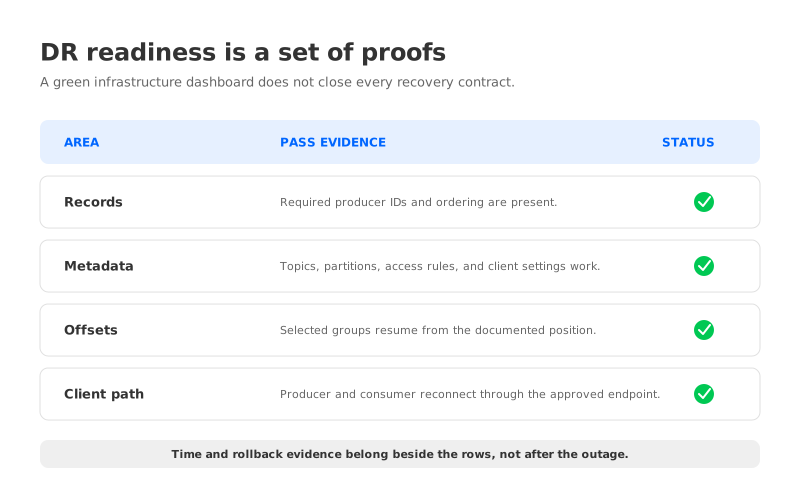
A scorecard keeps “green” from meaning five different things to five different teams. Use a row for each contract and attach a concrete artifact. Thresholds should come from the workload owner, not a generic time or loss allowance.
| Area | Pass evidence | Example owner |
|---|---|---|
| Records | Every required producer ID is present, with ordering and duplicate policy recorded | Data platform |
| Metadata | Topics, partitions, access rules, and required client settings are usable | Kafka platform |
| Offsets | Selected groups resume from the documented position or timestamp | Application team |
| Client path | Producer and consumer reconnect through the approved GCP endpoint path | SRE |
| Time | Measured RPO and RTO meet the workload contract | Incident commander |
| Rollback | Primary and recovery states can be separated without split-brain writes | Platform owner |
Treat a failed row as a design input. Missing records may point to replication lag or an incomplete snapshot. Correct records with wrong offsets point to a progress-path problem. A correct cluster that clients cannot reach points to DNS, IAM, network, or certificate handling.
6Where a shared durable stream changes the test
The neutral test applies whether Kafka runs on self-managed VMs, Kubernetes, or a managed service. The storage architecture changes the failure boundaries you should observe. In a broker-local design, replacement and recovery tests need to account for local data placement, replica movement, and the time required to make a replacement broker authoritative for its partitions.
AutoMQ is a Kafka-compatible cloud-native streaming platform that uses a Shared Storage architecture. Its S3Stream storage layer places durable stream data in object storage and uses a WAL (Write-Ahead Log) layer for write and recovery behavior. That design can make a broker replacement test a different experiment: the question is how quickly a replacement broker can assume Kafka compute responsibilities while the durable stream and metadata remain available. The answer still has to come from the drill.
For an AutoMQ evaluation, keep the same evidence contract. Produce the bounded workload, capture offsets, replace or isolate a broker, and test a client path that follows the documented deployment. Then measure replay and failover against the workload’s RPO and RTO. Do not turn shared storage into an unqualified promise of cross-region recovery; validate the object-storage location, WAL type, metadata quorum, network path, and operational automation selected for the deployment.
7FAQ
7.1Is a GCP Kafka backup enough for disaster recovery?
A backup is one input to recovery. It is enough only when a restore test proves that records, metadata, offsets, identities, client endpoints, and application behavior meet the workload contract.
7.2Should a DR drill replay from offsets or timestamps?
Use the policy your workload can explain and verify. Offsets are precise within a partition history, while timestamps are useful when the source and target offset spaces differ. In both cases, compare producer IDs and application outcomes. The drill should record why the starting point was selected.
7.3Does cross-region replication remove the need for restore tests?
No. Replication can reduce the amount of data that must be copied during an outage, but it does not prove offset continuity, client failover, access permissions, or rollback. A replication lag metric is evidence for one part of the contract.
7.4What should failover testing include on Google Cloud?
Include the actual client network path, service discovery, IAM identity, encryption configuration, and regional resource dependencies used by the application. A recovery cluster that only works from an operator workstation is not ready for production traffic.
The first question in a DR review is still the one teams tend to skip: what exactly must resume, from which position, and by when? Write that contract, inject the failure, and keep the artifacts. If a GCP Kafka recovery plan cannot show record integrity, offset continuity, and client behavior together, it is a diagram, not evidence. To evaluate a Kafka-compatible shared-storage path with the same workload, start with AutoMQ Open Source.


