
Table of Contents
Table of Contents
A multi-region Kafka design often starts with a request that sounds like one requirement: “Keep our data in the right region and survive a regional outage.” Those are related goals, but they do not produce the same topology. Residency describes where records and supporting state may be stored. Availability describes what can continue when a region or network path fails. Recovery describes how producers, consumers, offsets, and operators resume after the failure. A design that satisfies one can still fail the other two.
That distinction matters on Google Cloud because each path has its own placement and routing rules. A Kafka cluster may be regional while clients, connectors, backups, and audit logs use different services or projects. The Managed Service for Apache Kafka overview and locations documentation are useful starting points, but they do not turn a business residency policy into a ready-made failover plan.
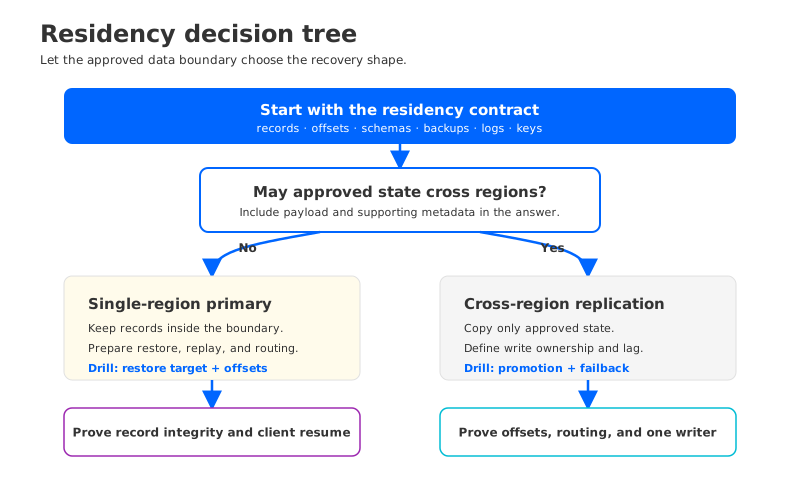
The practical thesis is simple: choose the residency boundary first, then select a replication and routing design whose failure behavior you can demonstrate with records, offsets, and client evidence.
1Separate residency from availability before choosing a topology
Start by writing down what “residency” covers for the workload. It may include record payloads, topic names, consumer offsets, schemas, backups, encryption keys, connector staging files, logs, and support telemetry. A policy that mentions “customer data” without naming these categories leaves the architecture team guessing. Google’s data residency and sovereignty guidance explains the provider-level concepts; your review still needs to map each Kafka artifact to an approved location and service.
Availability is a different question: which operations must keep working when a region is unavailable? Some applications need local reads to continue while writes pause. Others can accept a controlled interruption and recover from a second cluster. A consumer that reads from a replicated topic may be available while an application that requires the original offset history is not. Put the business operation beside the technical contract so the failover decision has a clear owner.
A useful requirements table looks like this:
| Requirement | Decision to record | Evidence for approval |
|---|---|---|
| Record residency | Regions where payloads may be stored or copied | Storage location, replication policy, and retention settings |
| Metadata residency | Location of offsets, schemas, ACLs, and cluster metadata | Service configuration and export or backup path |
| Write availability | Whether one or more regions accept writes | Producer routing rule and conflict policy |
| Read availability | Which consumers may read during a regional event | Client endpoint, topic mapping, and access test |
| Recovery contract | RPO, RTO, replay, and failback behavior | Time-stamped drill artifacts and owner sign-off |
Do not fill the table with generic “high availability” language. If the policy forbids a record copy outside one region, active/active replication may be disallowed even when it improves recovery time. If the workload needs uninterrupted writes, a single-region primary with a cold backup may be inadequate. The conflict is a design input, not a documentation problem.
2Three topology families and the trade-offs they expose
The first topology is a single regional cluster with a remote backup or restore target. All Kafka writes stay inside the residency boundary, and the client path has one regional route to trace. Recovery depends on the backup mechanism, the time to provision or restore the target, and the ability to reconstruct metadata and offsets. This model can be appropriate when the policy favors a narrow data boundary and the workload can tolerate a recovery window.
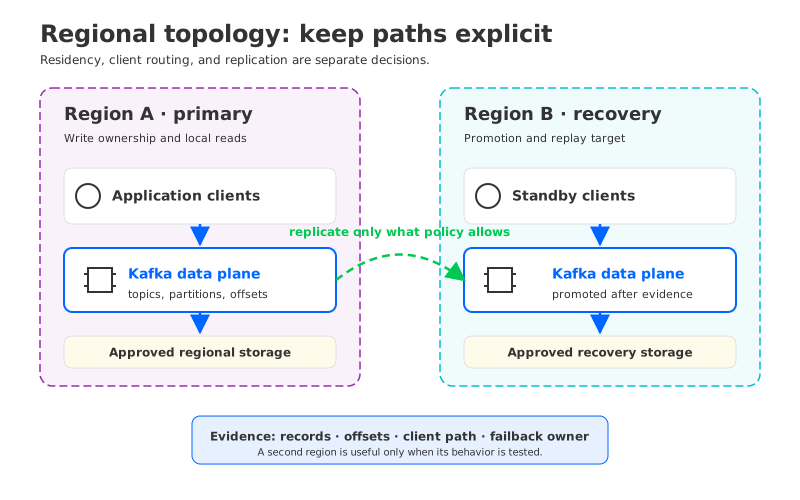
The second topology is active/passive replication. One region accepts writes while a second region receives a copy or a replay stream. The passive region can be prepared with topics, permissions, and capacity, but clients still need an explicit promotion and routing procedure. Cross-region transfer becomes part of the cost and residency review. Apache Kafka’s geo-replication documentation describes the replication mechanisms and their boundaries; test the selected mode with your topic, offset, and authentication configuration.
The third topology is active/active. Producers and consumers use more than one regional path, often with partition, tenant, or workload ownership used to reduce write conflicts. It can reduce dependence on a single region, but it makes ordering, duplicate delivery, idempotency, and failback harder to explain. A global endpoint does not solve those semantics. It only decides where a connection goes.
Choose the smallest topology that satisfies the contract. A second region that exists on a diagram but has no tested consumer offsets or destination permissions is a recovery liability. A complex active/active design that cannot state which region owns a key or partition is an application consistency problem disguised as network resilience.
3Routing is part of the data path, not a DNS footnote
Regional Kafka failover is visible to clients through a chain of decisions: bootstrap addresses, DNS or service discovery, VPC routes, firewall rules, TLS names, authentication identities, and retry settings. Trace that chain from a real producer and consumer network. An operator shell in a management project is not a substitute for the application path.
For each client class, document four states:
- Normal: which region receives the connection and which topics it serves.
- Degraded: what happens when the preferred region is reachable but Kafka operations fail.
- Failover: which endpoint or configuration changes, who authorizes it, and how long caches may retain the old answer.
- Failback: how the client returns to the preferred region without creating two writers for the same ownership scope.
A routing rule should name the failure signal that triggers it. “Route to the nearest region” is not enough when the nearest region is serving stale metadata or when a cross-region route violates residency policy. Record the expected client log, the endpoint observed, and the first successful produce or fetch after a switch.
Network placement also affects cost. Google Cloud’s VPC network pricing distinguishes transfer paths and regions; pricing depends on the services, direction, and location pair involved. Keep the measured bytes for Kafka replication, client failover traffic, connector traffic, and backups separate. A single “cross-region cost” line hides the traffic that the architecture can actually change.
4Replication evidence must include progress, not only records
A replicated record is not proof that an application can resume. Consumers need topic and partition identity, committed offsets or a documented replay point, credentials, schemas, and destination permissions. If a replication tool translates offsets, retain the mapping and test it for every consumer group that matters. If the recovery plan starts from timestamps or application event IDs, record the duplicate and missing-record policy.
Use a bounded workload for the drill. Mark a cut line, capture producer acknowledgments and consumer positions, then compare the target by producer-generated IDs. Keep the following artifacts together:
- record IDs before and after the cut line;
- topic, partition, retention, and ACL configuration;
- committed offsets or the selected replay marker;
- client endpoint, TLS, and authentication evidence;
- replication lag and the last successful transfer time; and
- application-level completion, not only broker health.
This sequence catches a common false positive: the recovery cluster is healthy, but consumers start from the wrong position and either skip records or repeat side effects. The same test also exposes a routing gap when the promoted endpoint works from the platform team’s network but not from the application VPC.
5Turn a regional outage into an observable drill
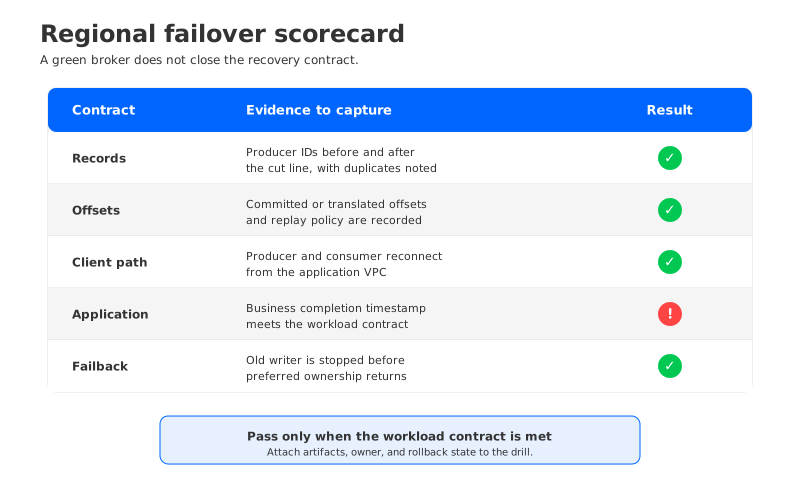
Google Cloud’s disaster recovery planning guide frames recovery around scenarios, dependencies, and tested procedures. Apply that discipline to Kafka with a regional failure matrix. Start with a reversible simulation, and declare recovery only when the application contract is met.
| Drill stage | What to inject or change | Evidence that closes the stage |
|---|---|---|
| Baseline | Produce and consume a bounded workload in the primary region | IDs, offsets, endpoints, and timestamps |
| Regional loss | Isolate the selected region or block its client path | Alert, cut line, and last accepted record |
| Promotion | Enable the recovery cluster or replay target | Target metadata, permissions, and replication state |
| Client switch | Apply the approved endpoint or routing change | Producer and consumer logs from their real networks |
| Replay | Resume from offsets, timestamps, or event IDs | Missing, duplicate, and ordered record results |
| Failback | Restore preferred ownership and stop the old writer | One-writer evidence and rollback record |
The scorecard should report RPO and RTO by workload, together with the boundary that was tested. Do not turn a successful drill into a universal service guarantee. A test that excludes connectors, schema access, or encryption keys proves less than its green dashboard suggests.
6Where a customer-controlled Kafka deployment fits
The neutral framework points to a specific architectural need when region ownership is part of the requirement: the team needs Kafka protocol compatibility, explicit placement of compute and durable storage, and enough control over networks and identities to test both normal routing and failure routing in its cloud account.
AutoMQ BYOC is one deployment model to evaluate against that contract. AutoMQ is a Kafka-compatible cloud-native streaming platform with a Shared Storage architecture. Its data plane and storage choices can be reviewed in the customer cloud, which gives an architecture team a concrete place to inspect region placement, object-storage boundaries, network routes, and IAM. That does not remove the need to verify the selected GCP regions, replication method, WAL type, metadata quorum, and failover automation for the release under review.
Keep the two paths separate during evaluation. Kafka clients reach the AutoMQ data plane; the control plane manages environment and lifecycle actions. The object-storage location and any cross-region replication are deployment decisions that must be documented with the same residency and transfer evidence used for other topologies. Use the current AutoMQ environment documentation to confirm the supported deployment path before running the drill.
7FAQ
7.1Does multi-region Kafka always mean active/active?
No. A single regional primary with a tested recovery target, active/passive replication, and active/active ownership are different choices. Select the least complex topology that meets the workload’s residency, availability, and recovery contracts.
7.2Can DNS provide regional Kafka failover?
DNS can participate in routing, but it does not copy records, translate offsets, grant permissions, or prevent two writers. Test DNS behavior together with client retries, TLS names, Kafka metadata, and application ownership.
7.3Does replication satisfy data residency?
Only when the copied records and supporting state are allowed in the destination region or service. Review payloads, metadata, backups, logs, schemas, keys, and connector staging data separately.
7.4What should a GCP Kafka failover test prove?
It should show the record cut line, target metadata and permissions, client reconnection from real networks, replay or offset continuity, application completion, and a controlled failback. A healthy recovery broker is one signal, not the whole contract.
A multi-region Kafka diagram earns approval when every arrow has an owner, a location rule, and a failure test. Start with the residency boundary, choose the routing and replication behavior that follows from it, then measure what consumers and producers actually do when a region disappears. If a customer-controlled Kafka-compatible data plane belongs in that comparison, start an AutoMQ BYOC evaluation with the requirements table and drill scorecard attached.


