
Table of Contents
Table of Contents
Kafka security on Google Cloud breaks most often at the boundary between two systems that both look secure in isolation. The GCP project has IAM, VPC firewall rules, Cloud KMS, Secret Manager, private connectivity, and audit logs. Kafka has TLS, SASL, ACLs, listener configuration, broker-to-broker encryption, and topic-level permissions. A production design has to make those controls meet without leaving an unowned gap.
That gap is where architecture reviews get uncomfortable. A platform team may say the Kafka cluster is private because it sits inside a VPC. A security team may say the project is locked down because IAM roles are scoped. Both statements can be true while a producer reaches the wrong listener, a connector holds a long-lived secret, a consumer group reads a regulated topic, or telemetry crosses a control plane boundary nobody documented.
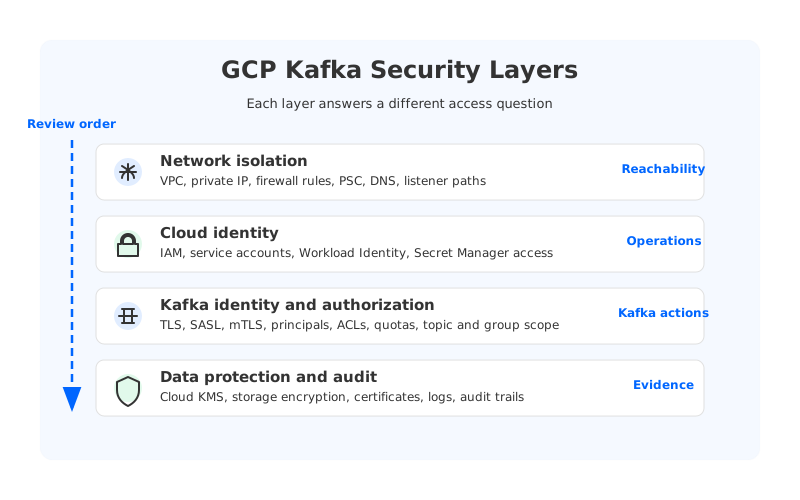
The better question is not "is Kafka secure on GCP?" It is "which layer enforces which control, and which identity is evaluated there?" Network controls decide which paths exist. IAM decides who can operate cloud resources. Kafka authentication and authorization decide what a client principal can do. Encryption protects data in transit and at rest. The data plane boundary decides where customer data, metadata, logs, and operational access actually flow.
1Kafka Security Layers on Google Cloud
GCP Kafka security needs a layered model because no single control plane can express every decision. Google Cloud IAM can grant a service account permission to read a Secret Manager secret, but Kafka does not automatically treat that service account as a topic principal. A firewall rule can block traffic to a broker port, but it cannot decide whether a user may produce to payments.raw.
| Layer | Primary control | What it should answer |
|---|---|---|
| Cloud network | VPC, subnets, firewall rules, routes, Private Service Connect, Cloud NAT | Which systems can reach Kafka endpoints at all? |
| Cloud identity | IAM, service accounts, Workload Identity, organization policies | Who can operate infrastructure, read secrets, use keys, or change routing? |
| Kafka identity and authorization | TLS, SASL, mTLS, OAuth/OIDC patterns, ACLs, quotas | Which Kafka principal can produce, consume, administer, or join a group? |
| Data protection and audit | Cloud KMS, storage encryption, Secret Manager, Cloud Audit Logs, Kafka logs | How are data, keys, secrets, and administrative actions protected and inspected? |
The table prevents a common mistake: treating cloud IAM as a replacement for Kafka authorization. IAM is essential for service accounts, keys, disks, secret stores, and automation. Kafka still needs an application-level authorization model because topics, transactional IDs, consumer groups, and cluster operations are Kafka resources. The same separation applies to managed services and BYOC platforms: a provider control plane is not automatically part of the customer data path, and that boundary should be explicit.
2Network Isolation and Private Connectivity
The first useful GCP Kafka security decision is to remove public reachability from the default path. Brokers, controllers, connector workers, schema services, and observability endpoints should normally sit behind private IPs, private DNS, and explicit firewall rules. In a self-managed Kafka deployment, each listener needs a purpose: internal broker traffic, application client traffic, administrative access, and monitoring should not share the same exposure model.
Private connectivity patterns usually fall into four groups:
- VPC-local access works when producers, consumers, and Kafka run in the same VPC or tightly controlled peered networks.
- Private Service Connect is relevant when a Kafka service is exposed as a private endpoint to another VPC or consumer project.
- Shared VPC helps centralize network administration across service projects.
- VPN or Cloud Interconnect is common when on-premises systems or another cloud must reach Kafka on GCP.
The network review should trace exact paths: producer to bootstrap, producer to every advertised broker, broker to broker, connector to source and sink, operator to admin API, and metrics agent to observability backend. Kafka's advertised.listeners deserve special attention because a private cluster can still advertise an endpoint that clients resolve through the wrong path.
3Authentication, Authorization, and IAM Mapping
Identity is where Kafka on GCP security becomes easy to overstate. A producer may run as a GCP service account, retrieve a client certificate or SASL secret from Secret Manager, connect to Kafka as a Kafka principal, and receive topic permissions through Kafka ACLs. That path contains at least three identities: the cloud workload identity, the secret access identity, and the Kafka application identity.
Good designs make those identities traceable:
- The GCP service account identifies the workload or deployment unit, not a broad team.
- Secret access is scoped to the exact credential material needed by that workload.
- The Kafka principal maps to an application, connector, or platform component with a clear owner.
- Kafka ACLs are granted by topic, group, transactional ID, and operation rather than through broad cluster-level permissions.
Apache Kafka supports SSL/TLS, SASL mechanisms, and ACL-based authorization. mTLS can work well when certificate automation is mature. SASL/SCRAM is operationally straightforward but puts pressure on secret rotation. OAuth-based patterns can align with centralized identity systems, but they require careful broker and client support. IAM has a different job: controlling who can create infrastructure, modify firewall rules, read credentials, use KMS keys, view logs, operate Kubernetes resources, or access managed service APIs.
| Actor | GCP identity | Secret/key access | Kafka principal | Kafka permission |
|---|---|---|---|---|
| Payment producer | Payment writer service account | Read producer credential only | User:payment-writer | Produce to payment topics |
| Fraud consumer | Fraud service account | Read consumer credential only | User:fraud-reader | Read selected topics and join fraud groups |
| Connector worker | Connector runtime service account | Read connector-specific secrets | User:connect-cluster-a | Use connector and internal topics |
| Platform operator | Privileged human or break-glass identity | Time-bound access where possible | Admin principal | Cluster administration under change control |
This mapping exposes shortcuts quickly. If every row uses the same secret, Kafka principal, or project editor role, the architecture is not ready for a serious review.
4Encryption and Secret Management
Encryption for Kafka on GCP has two audiences. Security architects care whether data is protected in transit and at rest. Kafka operators care whether encryption can be enabled without breaking throughput, compatibility, rotation, or recovery. Both matter because a configuration nobody can rotate will age badly.
Client-to-broker TLS should be the default for production, and inter-broker encryption should be enabled when plaintext replication is not acceptable. The operational burden is certificate lifecycle: issuance, distribution, expiration, revocation, and truststore updates. At rest, the answer depends on where bytes live: broker disks, connector workers, buckets, snapshots, backups, metadata stores, or cloud-native storage layers.
Cloud KMS can centralize key management for GCP resources and customer-managed encryption keys where supported. Secret Manager can hold passwords, SCRAM credentials, connector secrets, certificates, or trust material, but storing a secret is not lifecycle management. Rotation still needs a process that updates clients and brokers in the right order, without leaking credentials into CI logs, Terraform state, images, startup scripts, or wiki pages.
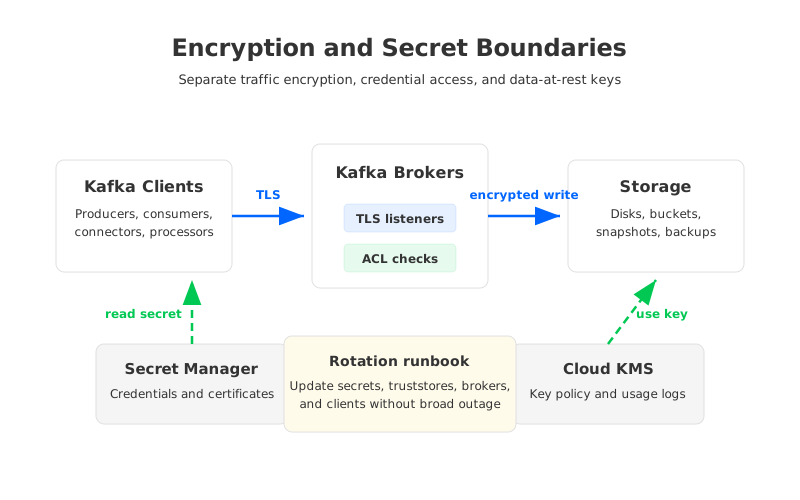
The most useful review questions are concrete: which paths use TLS, where certificates are renewed, which disks and buckets hold Kafka data, which principals can use KMS keys, which CI/CD systems can read secrets, and how rotation works without a broad client outage.
5Data Plane Boundaries in Managed, SaaS, and BYOC Models
"Managed Kafka on GCP" can hide very different security boundaries. A fully hosted SaaS service may run the control plane and data plane in the provider's cloud account. A self-managed cluster puts both operations and data in your environment. A BYOC model may place the data plane in the customer's cloud account while a vendor control plane manages lifecycle, upgrades, or observability access according to the product design.
That distinction matters because Kafka is the data path for production events, often including regulated records, identifiers, telemetry, and business-critical state. Security teams need to know which entity can see data, move data, stop the cluster, or collect logs. The control plane/data plane boundary should be drawn before vendor evaluation.
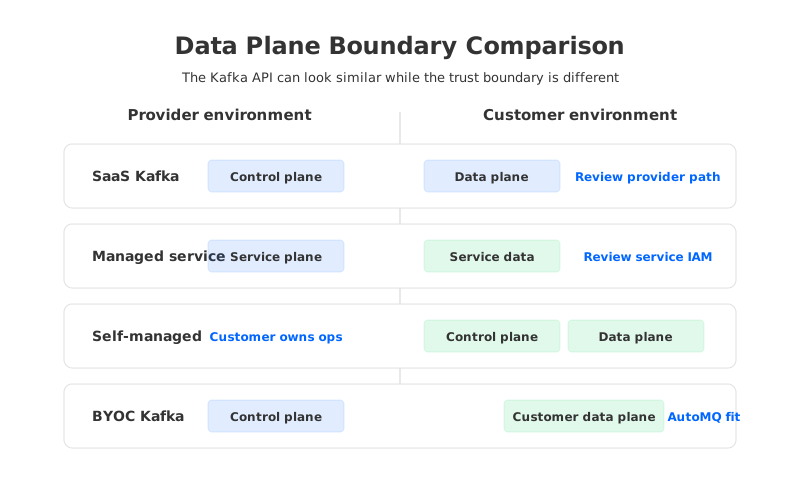
| Deployment model | Control plane | Data plane | Security review focus |
|---|---|---|---|
| Fully hosted SaaS Kafka | Provider environment | Provider environment | Provider access, residency, private connectivity, compliance artifacts |
| Cloud managed service | Cloud/provider service plane | Service-managed infrastructure | IAM integration, service networking, encryption options, visibility |
| Self-managed Kafka on GCP | Customer environment | Customer environment | Patching, secrets, broker hardening, incident response |
| BYOC Kafka platform | Vendor control plane plus customer-authorized access | Customer cloud/VPC/project, depending on design | Control plane permissions, telemetry scope, data path location |
AutoMQ fits the BYOC category when deployed as a Kafka-compatible cloud-native streaming platform. The security-relevant point is not a blanket compliance promise. It is the architectural boundary: the control plane is used for management, while the data plane can run in the customer's own cloud environment, and the customer environment data path can remain within customer-controlled infrastructure. BYOC still requires diligence around IAM roles, network routes, object storage permissions, key policies, telemetry, support access, and upgrades, but it gives reviewers a sharper question: what exactly can the control plane do, and what data leaves the customer environment?
6Monitoring, Audit, and Incident Response
Prevention is not enough. GCP provides Cloud Audit Logs for many resource-level actions, VPC Flow Logs for network behavior, and Cloud Logging/Monitoring for service telemetry. Kafka adds broker logs, authorizer logs, authentication failures, controller events, quota signals, and consumer group changes. Useful signals include failed authentication, authorization denials, ACL changes, topic changes, secret access, KMS usage by unexpected principals, unusual network sources, and sudden changes in lag or egress. If a provider control plane collects metrics or logs, classify that telemetry explicitly because metadata can still reveal business activity.
7A Practical GCP Kafka Security Checklist
The checklist below is not a substitute for threat modeling, but it forces ownership decisions into the open.
| Area | Production question | Evidence to keep |
|---|---|---|
| Network | Are broker, admin, connector, and monitoring endpoints reachable only through intended private paths? | VPC diagram, firewall rules, listener/DNS mapping |
| IAM | Are cloud permissions scoped by workload and operational role? | IAM policy export, service account inventory |
| Kafka auth | Does every application have a distinct Kafka principal? | TLS/SASL config, principal naming convention |
| Kafka authorization | Are ACLs granted by topic/group/operation with least privilege? | ACL export, owner mapping, review cadence |
| Encryption | Is TLS enabled on required paths, and is at-rest encryption documented? | TLS config, certificate lifecycle, KMS/key policy |
| Secrets | Can secrets be rotated without a platform-wide outage? | Secret Manager policy, rotation runbook |
| Data boundary | Is it clear where customer data, metadata, logs, and telemetry flow? | Control plane/data plane diagram, telemetry classification |
| Audit | Can the team reconstruct an admin or data-access incident? | Cloud Audit Logs, Kafka logs, authorizer logs |
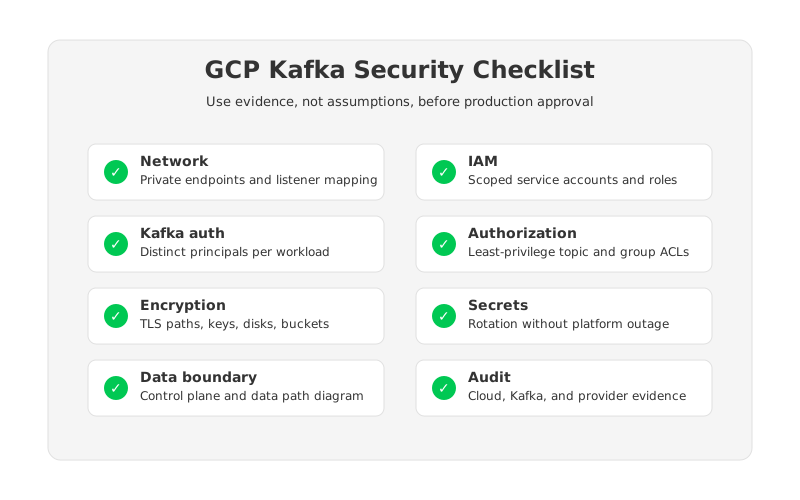
The hardest row is the data boundary. Teams can usually fix a firewall rule or narrow an ACL once they see the problem. It is harder to fix an architecture where the data path, support path, telemetry path, and control path were blended together from the beginning. For Kafka-compatible BYOC architectures such as AutoMQ, pay special attention to the control plane/data plane boundary and the customer environment data path; those details determine whether the design matches your security and compliance model.
8References
- Google Cloud: Private Service Connect overview
- Google Cloud: IAM overview
- Google Cloud: Cloud KMS documentation
- Google Cloud: Secret Manager documentation
- Google Cloud: VPC firewall rules
- Apache Kafka documentation: Security
- AutoMQ Docs: Install AutoMQ on Google Cloud
- AutoMQ Docs: Security overview
9FAQ
9.1Does GCP IAM replace Kafka ACLs?
No. GCP IAM controls access to cloud resources such as service accounts, secrets, keys, logs, and networking. Kafka ACLs control Kafka resources such as topics, consumer groups, transactional IDs, and cluster operations. Production designs usually need both.
9.2Should Kafka brokers on GCP have public IP addresses?
Most internal production clusters should avoid public broker reachability and use private networking. If a public endpoint is required, treat it as a special case with listener separation, strict authentication, narrow authorization, monitoring, and a documented rationale.
9.3What is the difference between TLS and SASL in Kafka security?
TLS encrypts network traffic and can authenticate clients when mutual TLS is used. SASL is an authentication framework for mechanisms such as SCRAM or OAuth-based patterns. Kafka authorization still maps the authenticated principal to permissions.
9.4How should Kafka IAM on GCP be designed?
Separate cloud identity from Kafka identity. Use GCP IAM for infrastructure, secret, and key access. Use Kafka principals and ACLs for topic, group, and cluster permissions. Maintain a mapping table so every workload has a clear owner.
9.5Why do data plane boundaries matter for Kafka security?
Kafka carries application data, operational events, and often regulated records. The data plane boundary shows where that data flows and who can access the systems that process it. SaaS, managed, self-managed, and BYOC models can differ materially even when the Kafka API looks the same.
9.6How does AutoMQ relate to GCP Kafka security?
AutoMQ is a Kafka-compatible cloud-native streaming platform that can be deployed in a BYOC model. The security-relevant point is control plane/data plane separation: the data plane can run in the customer's cloud environment, so teams can evaluate the customer environment data path separately from lifecycle management. Permissions, telemetry, and access should still be reviewed for each deployment.


