
Table of Contents
Table of Contents
An Apache Kafka upgrade on Google Cloud is complete only when clients still behave, the cluster has room for the transition, and the team can recover from a failed step. Changing a broker image or selecting a maintenance window is one operation inside that larger contract. The risk sits at the boundaries: client and broker versions, partition movement, storage pressure, credentials, and the point at which rollback stops being safe.
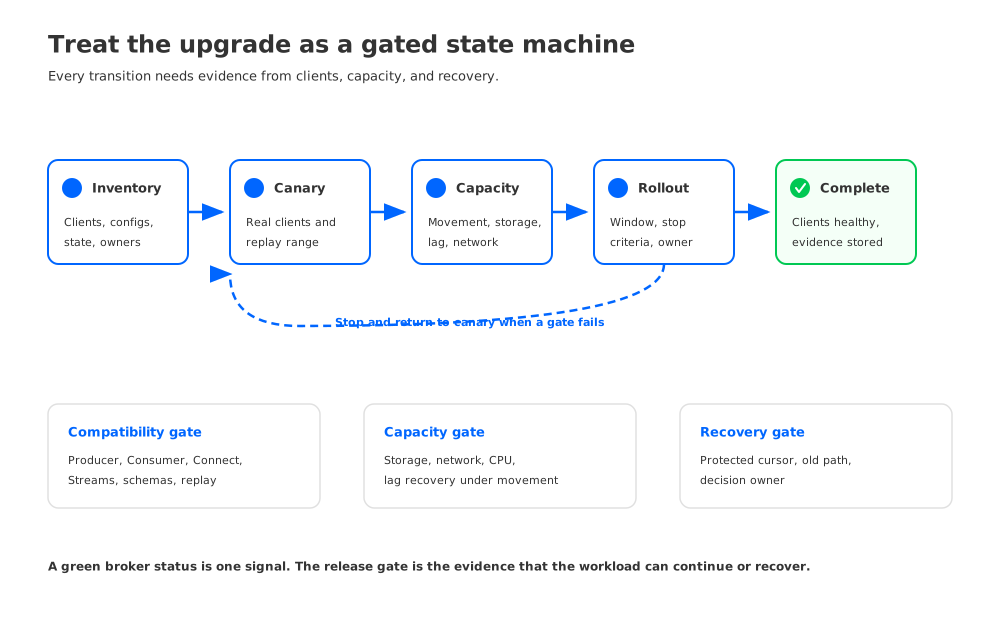
The right plan treats an upgrade as a sequence of evidence gates. Inventory the compatibility surface, run a representative canary, prove capacity during the most expensive phase, and define a rollback point before production traffic moves. Google Cloud's Managed Service for Apache Kafka overview and release notes describe the provider's current service boundary. Apache Kafka's upgrade documentation explains the protocol and metadata behaviors that still belong in your test plan.
1The upgrade contract has four independent surfaces
Teams often use “Kafka upgrade” to mean a broker version change. That shorthand hides several contracts that can fail independently. A producer can connect while a Streams application fails to initialize. A rolling change can complete while reassignment traffic exhausts disk or network headroom. A rollback can look available until metadata or data format changes make the old state unusable.
Write the contract before choosing a sequence. The worksheet should name the current and target broker versions, every client and connector, the storage and network assumptions, the maintenance constraints, and the evidence that permits the next step. Keep provider-managed behavior separate from application-owned behavior so a green provider status does not stand in for application readiness.
| Surface | Questions to answer | Evidence before rollout |
|---|---|---|
| Protocol and clients | Which producer, Consumer, Admin, Connect, and Streams clients connect? Which settings and authentication mechanisms are required? | A client inventory mapped to supported target versions and a test run using production-like configuration |
| Data and metadata | Which Topic configurations, Partition counts, consumer groups, transactions, and schemas are used? | A replay and rebalance test that records offsets, errors, and application output |
| Capacity and storage | What headroom remains for replicas, logs, caches, and temporary movement? | A workload-shaped load test with disk, network, CPU, and consumer lag measurements |
| Recovery | Which state can be restored, and where is the rollback boundary? | A tested snapshot, export, or rebuild path with an owner and a time limit |
This separation prevents a common false positive: the broker health check passes, so the team assumes the upgrade is safe. The next question is whether the clients and recovery path can prove the same claim.
2Compatibility testing starts with the clients that matter
Compatibility is a matrix, not a single version comparison. Start with the applications that publish and consume the most important Topics, then add the clients that are easy to forget: Kafka Connect workers, schema clients, stream processors, command-line tools, and administrative jobs. Record the client library version, JVM or runtime, security protocol, serializer, partitioning behavior, and any feature flags that alter requests.
Test the behaviors that hold application state. A producer test should cover acknowledgements, retries, idempotence, compression, and a representative partition key. A Consumer test should cover group join, rebalance, offset commit, pause and resume, and a controlled restart. A Connect or Streams test should run its real task or topology far enough to expose state-store, schema, and offset assumptions. A successful metadata request is useful, but it is not evidence that these paths work.
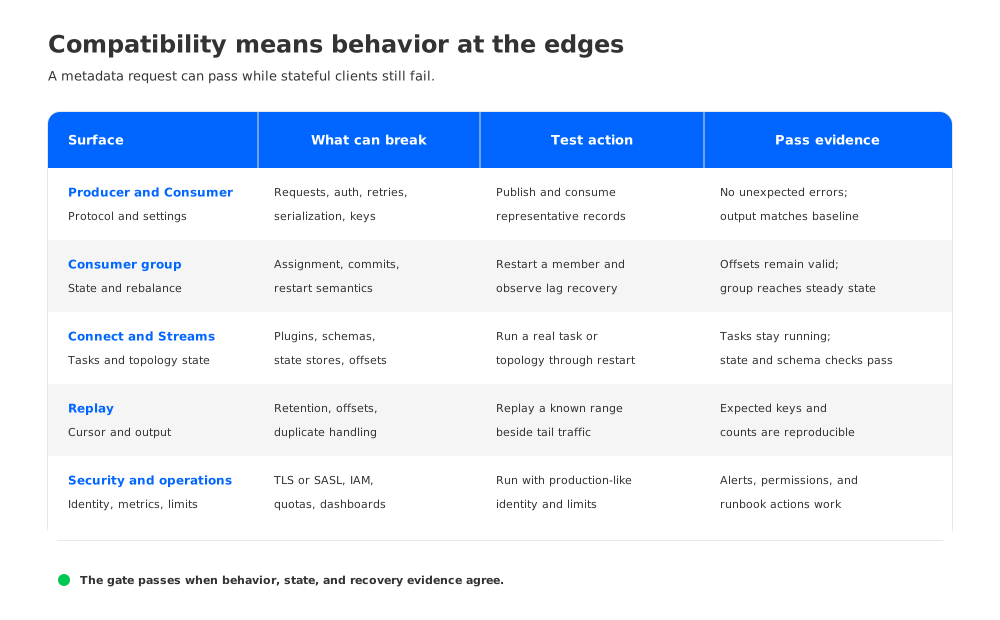
Use a canary cluster or isolated workload to test the target version while the current production path remains available. The canary should contain representative Topic configurations and realistic record sizes. Capture baseline and target observations with the same dashboards and test data, so a change in error rate or lag is visible as a difference rather than an isolated value with no context.
The gate is behavioral: every required client completes its read and write path, consumer groups recover from a restart, and the canary can replay a known range. If one client depends on an unsupported request or configuration, keep that finding visible. The upgrade plan can then name the client change or defer the rollout without turning a compatibility gap into an incident.
3Capacity is a transition problem, not a steady-state number
Kafka capacity plans are usually written for normal traffic. Upgrades add work that normal traffic models omit. Brokers may need to fetch or rebuild replicas, retain extra log segments, warm caches, or serve catch-up reads while clients reconnect. A cluster that looks comfortable at steady state can lose its margin during a rolling change.
Measure the transition path with the same signals used for production operations:
- Storage headroom: leave room for log retention, replica movement, snapshots, and temporary duplication. Track both bytes and the rate at which the free space changes.
- Network headroom: separate client traffic from replication, recovery, and object-storage traffic. A single aggregate number can hide the stream that saturates first.
- Compute headroom: watch broker request queues, CPU, memory, and page-cache or data-cache pressure while a broker leaves and rejoins the cluster.
- Consumer recovery: record lag growth and drain time after a restart. A rollout that restores broker health but leaves an important Consumer group behind is not complete.
Set the gate against workload evidence rather than a generic percentage. If the canary cannot sustain the planned movement and recover its lag within the agreed operating window, stop before production. Capacity is a release criterion because it determines whether an otherwise compatible change can finish without a second incident.
For self-managed Kafka on GKE, this also means checking Persistent Disk attachment and zone placement, StatefulSet behavior, and the storage class used by each broker. The existing Kafka on Google Cloud with GKE deployment guide explains why Kubernetes rescheduling does not remove broker-local storage constraints. Those constraints affect upgrade order and recovery time even when the application contract is unchanged.
4Rollback is a gate with an expiry
Rollback plans often stop at “restore the old image.” That action may be unsafe after a broker has written metadata or log data that the previous version cannot read. The plan needs an explicit boundary: which steps are reversible, which state is copied or exported, and when the team must complete forward recovery instead of reverting.
Define the boundary before the first production change:
- Freeze the evidence. Record broker, client, Topic, Partition, consumer-group, schema, security, and storage settings. Capture the exact artifact versions used by the canary.
- Name the rollback trigger. Use observable conditions such as client errors, failed rebalances, unbounded lag, storage pressure, or a recovery test that no longer reaches its target. Avoid a vague “if issues occur.”
- Protect the cursor. Preserve consumer-group offsets and the replay range needed to compare output before and after the change. A rollback that loses the cursor creates a second problem.
- Test the old path. Validate that the previous broker artifact and configuration can start against the preserved state in an isolated environment. If it cannot, the plan is forward recovery, not rollback.
- Assign the decision. One operator owns the stop or continue call, and one person verifies application output. Both roles should have access to the same dashboards and runbook.
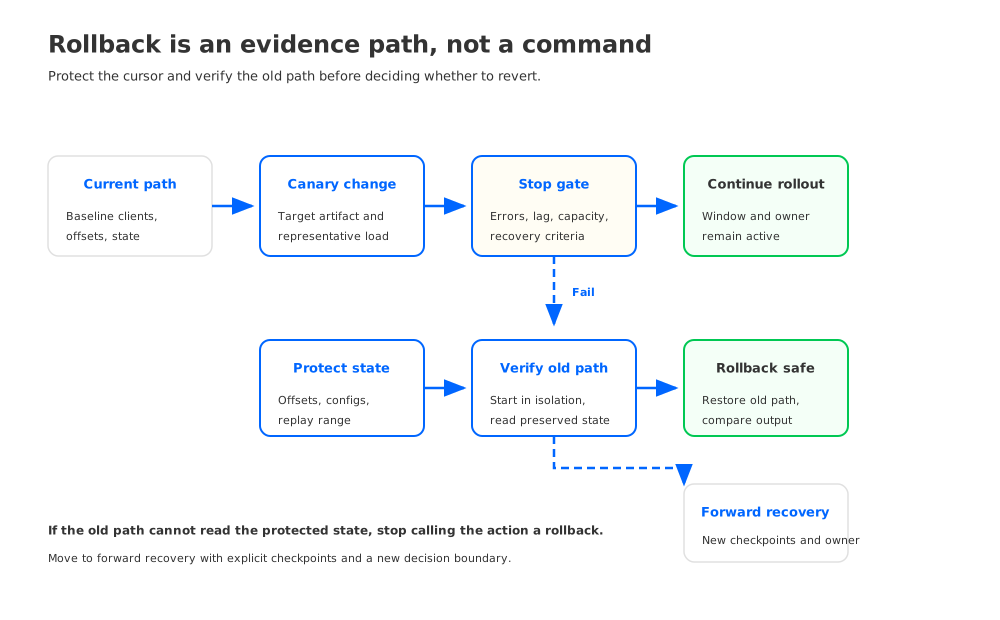
The rollback gate should close when the target version has changed an irreversible state or when the preserved evidence is no longer trustworthy. At that point, repeating the old deployment command creates the appearance of control without restoring the original contract. A forward recovery plan can still be safe, but it needs its own checkpoints and an owner.
5Maintenance windows need application evidence
Provider-managed Kafka changes and self-managed rolling changes have different mechanics, but neither removes the need for an application window. Check the current service policy, maintenance behavior, supported Kafka versions, and release notes when the change is scheduled. Google Cloud documents may change as the service evolves, so the runbook should link to the source pages and record the date of the verification rather than copying a version promise into a permanent checklist.
The maintenance window should include more than broker work. Reserve time to watch client error rates, consumer lag, rebalance duration, connector task state, schema requests, storage pressure, and any GCP quota or IAM signal that can block a node from returning. A window with no stop criteria is an appointment, not a release plan.
The GCP Kafka replacement guide is useful when the upgrade is also a platform change. Its compatibility boundary can help separate application work from infrastructure work, which makes the rollback decision easier to explain to teams that own different parts of the system.
6Where AutoMQ fits in the upgrade decision
If the upgrade exposes a structural constraint, such as broker-local storage making every capacity change a data-movement event, the team can evaluate a different storage architecture while keeping the Kafka client contract. AutoMQ is a Kafka-compatible cloud-native streaming platform built on a Shared Storage architecture. AutoMQ Brokers keep the Kafka-facing compute and protocol layer, while S3Stream writes durable stream data to S3 storage through the selected WAL storage and Data caching path.
That architecture changes which capacity and rollback evidence matters. The client matrix still needs to run. The canary still needs to prove offsets, ordering, consumer recovery, and connector behavior. The infrastructure tests also need to cover object-storage access, WAL configuration, cache behavior, network boundaries, and broker replacement in the target GCP environment. The AutoMQ architecture overview and GKE deployment guide describe the layers to verify.
AutoMQ is therefore relevant when protocol continuity is part of the upgrade contract and the team wants to test separation of compute and storage. It does not remove the need for a canary or a rollback gate. It gives the team another architecture to compare against the evidence gathered from the existing GCP Kafka path.
7FAQ
7.1Does a managed Kafka service make upgrades automatic?
Managed services can change who performs infrastructure work, but the current maintenance and version policy still defines what the application team must test. Read the provider documentation and release notes for the target service, then verify client behavior and recovery in a canary.
7.2Which clients belong in an upgrade compatibility test?
Include every client that depends on Kafka behavior: producers, Consumers, Admin clients, Connect workers, stream processors, schema tooling, and recovery jobs. Prioritize by business impact, then run the real authentication, serializer, partitioning, and offset paths.
7.3How much capacity headroom is enough?
There is no universal number. Measure the storage, network, compute, and Consumer lag behavior while the canary performs the same movement and restart actions expected in production. Stop when the transition cannot complete within the operating window your team has agreed to support.
7.4When is rollback no longer safe?
Rollback is no longer safe when the old version cannot read the changed state, when the cursor or recovery evidence is missing, or when the team cannot verify the old path in isolation. Mark that boundary before the rollout and switch to a forward recovery plan when it is crossed.
An upgrade is a controlled change only when its proof survives the uncomfortable steps: a client reconnects, a partition moves, capacity tightens, and a recovery decision has to be made. Keep compatibility, capacity, and rollback as separate gates, then connect them with evidence. If a GCP Kafka upgrade keeps exposing broker-local storage as the limiting factor, start an AutoMQ evaluation with the same client matrix and recovery runbook.


