
Table of Contents
Table of Contents
Choosing Kafka on Google Cloud is rarely a binary choice between "managed" and "self-managed." A platform team may start with Confluent Cloud for the broadest managed Kafka ecosystem. A cloud architecture team may look at Google Cloud Managed Service for Apache Kafka because procurement, identity, networking, and support already sit inside Google Cloud. A data infrastructure team may still run Kafka on GKE or Compute Engine for deep control over brokers, disks, topology, and operations. All can be described as Kafka on GCP, but they put responsibility, data, cost, and migration risk in different places.
That is why the first decision should not be a feature checklist. It should be a boundary question: where should the control plane, data plane, storage layer, network edge, and operational burden live? Once that boundary is clear, the vendor comparison becomes less emotional and more useful.
1Short Answer by Priority
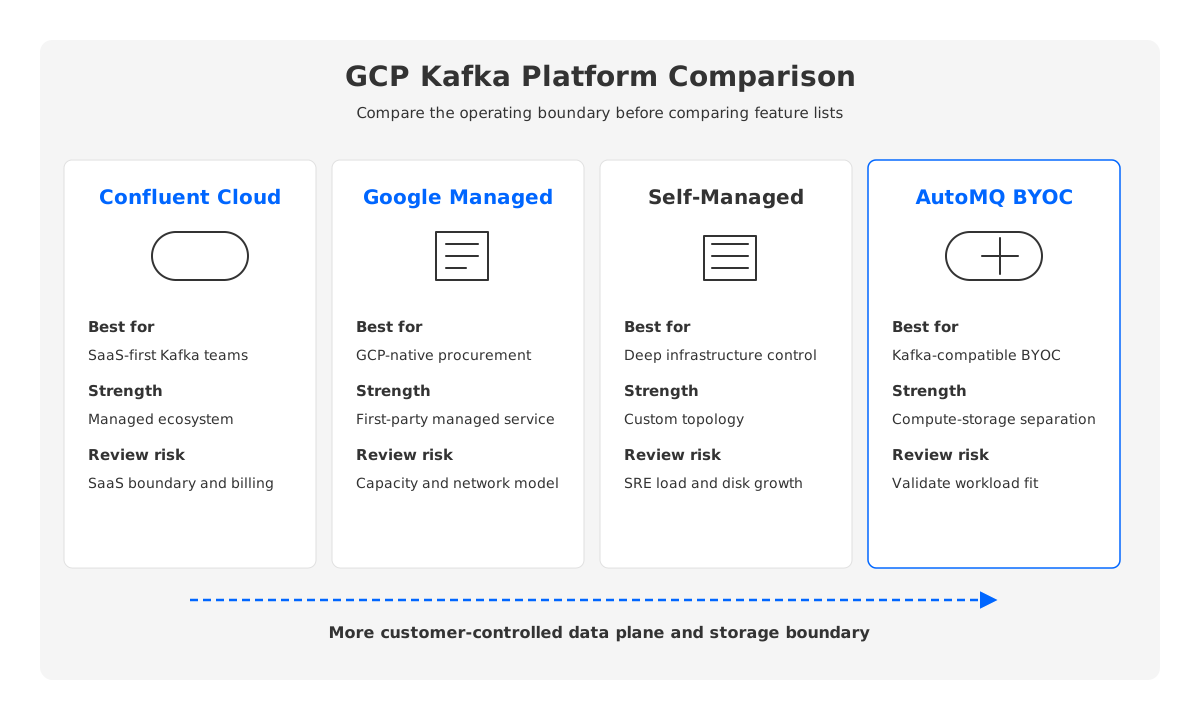
If your priority is a SaaS-first Kafka platform with a mature ecosystem of managed connectors, Stream Governance features, and global managed-service coverage, Confluent Cloud on GCP is usually the first option to evaluate. It is designed for teams that want Kafka capabilities delivered primarily as a vendor-operated cloud service.
If your priority is a Google Cloud-native managed service, Managed Service for Apache Kafka is the more direct GCP path. It keeps the buying motion, service integration, and cloud operations model close to Google Cloud, which matters when platform teams already standardize on Google Cloud IAM, Private Service Connect, Cloud Logging, Terraform, and internal approval workflows.
If your priority is maximum infrastructure control, self-managed Kafka on GKE or Compute Engine remains viable. You choose VM families, disks, operators, rack-awareness rules, upgrade windows, and custom security controls. The trade-off is straightforward: the team owns the operating complexity it preserves.
If your priority is Kafka compatibility plus data-plane control in your own cloud environment, AutoMQ belongs in the same evaluation. AutoMQ is a Kafka-compatible cloud-native streaming platform that separates broker compute from durable storage, making it a BYOC-style option for teams that want the Kafka ecosystem without tying long-lived data to broker-local disks.
2The Boundary Question Matters More Than the Label
"Managed Kafka" is an overloaded phrase. It can mean a SaaS platform operated by a Kafka vendor, a cloud-provider managed service, a Kubernetes operator inside your own cluster, or a managed control plane attached to infrastructure you own. The label hides the questions architects actually need to answer.
Use the boundary model below before comparing products:
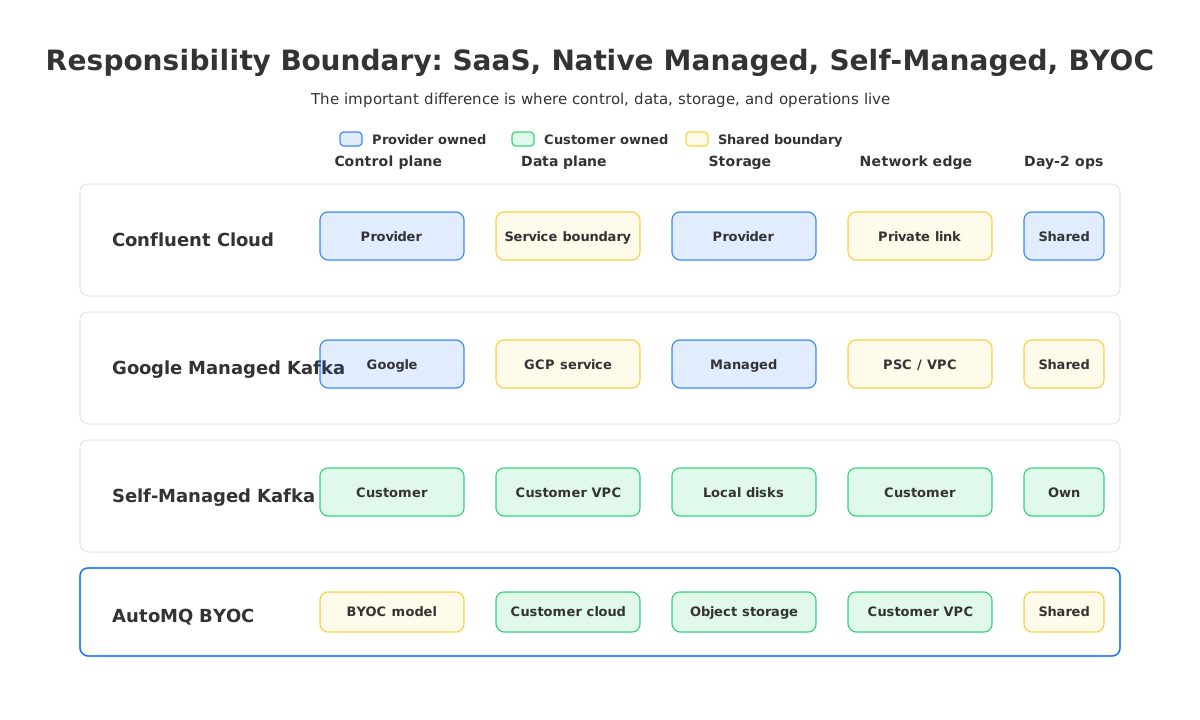
The decision usually turns on five boundaries:
- Control plane: Who provisions clusters, changes capacity, rolls upgrades, exposes APIs, and owns service automation?
- Data plane: Where do brokers run, which network sees client traffic, and who can inspect or operate that runtime?
- Storage layer: Is durable Kafka data tied to broker-local disks, a vendor service boundary, or object storage in the customer's cloud?
- Network edge: How do producers and consumers connect across VPCs, regions, private links, service attachments, or public endpoints?
- Day-2 operations: Who owns incident response, partition growth, topic governance, client tuning, cost reviews, and migration runbooks?
Two teams can choose different answers and both be rational. A central platform group with a small Kafka team may trade data-plane control for SaaS convenience. A regulated enterprise may prefer tighter cloud-account ownership. A high-retention streaming platform may care less about who clicks the upgrade button and more about whether storage growth forces broker and disk expansion.
3Confluent Cloud on GCP
Confluent Cloud on GCP is the managed Kafka path most teams already know. It provides Apache Kafka-compatible clusters across major clouds, and its official documentation describes several cluster types with different capacity and networking characteristics. Confluent also offers managed connectors, governance capabilities, private networking options, and a vendor-operated control plane.
That operating model is attractive when Kafka is a platform dependency rather than the platform team's core specialty. Instead of building a full broker operations practice, the team can focus on application integration, data contracts, topics, client behavior, and downstream pipelines. For organizations already using Confluent tooling or connectors, the ecosystem around the cluster is part of the buying decision.
The trade-off is boundary control. Confluent Cloud is a SaaS platform, so architects should inspect how the chosen cluster type handles networking, private connectivity, data location, service limits, capacity, support responsibilities, and billing. On GCP, private connectivity commonly leads teams to study Private Service Connect early because the network path shapes security review, latency expectations, data movement, and cost allocation.
Confluent Cloud is strongest when SaaS operations, ecosystem breadth, cross-cloud consistency, and Kafka specialist support dominate the decision. SaaS is not the problem. The problem is discovering strict requirements around data-plane ownership, cloud-account isolation, storage architecture, or custom operations after the team has already committed.
4Google Cloud Managed Service for Apache Kafka
Google Cloud Managed Service for Apache Kafka is the native managed Kafka option for GCP teams. Google describes it as a fully managed service for Apache Kafka that lets teams run Kafka clusters without managing broker infrastructure directly. For organizations trying to keep their cloud platform inside Google Cloud's operating model, that difference is meaningful.
The value is not only technical. Native cloud services often fit existing approval paths better: billing rolls into the cloud account, network design follows familiar GCP constructs, observability aligns with existing operations, and support conversations stay around Google Cloud. In large organizations, that can matter as much as broker lifecycle automation.
Google's pricing and documentation also make the workload model explicit. Managed Kafka cost depends on service-specific capacity, storage, and networking dimensions, including private connectivity considerations such as Private Service Connect. Architects still need to model producer throughput, partitions, retention, consumer fanout, availability zones, and growth.
Google Cloud managed Kafka tends to fit when:
- The organization wants a Kafka-compatible managed service inside its GCP vendor relationship.
- Internal cloud platform teams already operate through Google Cloud-native controls and observability.
- Procurement and security teams prefer a first-party cloud-provider service over a separate SaaS vendor.
- The workload does not require unusually customized broker operations or storage architecture.
Cloud-native procurement does not automatically solve Kafka economics. A retention-heavy workload, a high-fanout analytics stream, or a topology with cross-zone read paths still needs a workload-based cost model. Managed infrastructure reduces operational toil; it does not erase the physics of data written, stored, replicated, and read.
5Self-Managed Kafka on GKE or Compute Engine
Self-managed Kafka on GCP remains the most controllable path. A team can run brokers on Compute Engine, use persistent disks, place nodes across zones, run operators on GKE, tune JVM and broker settings, design rack awareness, and control upgrade timing. For mature Kafka operators, that control can be useful rather than burdensome.
The problem is that self-managed Kafka turns every architectural choice into an operational responsibility. Broker disk sizing, rebalance planning, partition reassignment, controller behavior, certificate rotation, monitoring, backup strategy, and incident response all need owners. Kubernetes can help with automation, but it does not make stateful Kafka storage disappear.
Self-managed Kafka fits specialized requirements: strict topology control, custom tooling, unusual security constraints, internal platform standardization, or teams that already have a Kafka SRE practice. It is weaker when the organization wants Kafka outcomes but does not want to staff Kafka operations. A VM-and-disk estimate looks different after paging, upgrades, reassignments, and delayed projects are included.
6AutoMQ as a Kafka-Compatible BYOC Option
The previous three paths leave a gap. Confluent Cloud maximizes SaaS convenience. Google Cloud managed Kafka keeps the service native to GCP. Self-managed Kafka maximizes control but keeps the operational burden. Many teams want a fourth shape: keep Kafka clients and ecosystem tools, keep the data plane in their own cloud environment, and avoid broker-local-disk coupling.
AutoMQ is designed around that shape. It is Kafka-compatible, so existing Kafka clients and ecosystem patterns remain relevant, but its architecture separates compute from durable storage. Brokers act more like elastic compute nodes, while durable data is backed by cloud object storage. On GCP, that makes AutoMQ a BYOC-style path to evaluate when Kafka storage and broker lifecycle are too tightly coupled for cloud economics.
The architecture is especially relevant in three cases. First, long retention makes local broker disks a budget and operations constraint. Second, elastic workloads make traditional broker scaling expensive because adding or replacing brokers often implies data movement. Third, data-control requirements make a full SaaS data-plane boundary difficult, even if the team wants managed-service ergonomics.
This does not mean every GCP Kafka team should choose AutoMQ. A SaaS-first organization may prefer Confluent Cloud. A Google Cloud standardization effort may prefer Managed Service for Apache Kafka. A team with deep in-house Kafka expertise may stay self-managed. AutoMQ is strongest when Kafka compatibility, BYOC control, object-storage-backed durability, and elastic operations all matter.
7Comparison Table
The table below is a practical starting point for architecture review. It avoids a single score because a single score usually hides the factor that actually decides the project.
| Dimension | Confluent Cloud on GCP | Google Cloud Managed Kafka | Self-Managed Kafka on GCP | AutoMQ on GCP |
|---|---|---|---|---|
| Operating model | SaaS Kafka platform operated by Confluent | First-party managed Kafka service in Google Cloud | Customer-operated brokers and infrastructure | Kafka-compatible BYOC model with separated compute and storage |
| Data-plane boundary | Vendor service boundary; confirm cluster and networking model | Google Cloud managed service boundary | Customer VPC or Kubernetes environment | Customer cloud environment, depending on deployment design |
| Storage model | Service-managed Kafka storage model | Service-managed Kafka storage model | Broker-local disks or customer-designed tiering | Object-storage-backed durable data with stateless broker direction |
| Best strength | Managed ecosystem and Kafka specialist platform | GCP-native procurement and operations fit | Maximum customization and control | Kafka compatibility plus data control and elastic storage architecture |
| Main review risk | SaaS boundary, networking, and billing assumptions | Capacity, storage, network, and service limits | SRE load, upgrades, disk growth, reassignment work | Validating BYOC deployment, latency, and workload fit |
| Migration fit | Strong when teams already use Confluent ecosystem | Strong when teams standardize on GCP services | Strong when teams can operate the target themselves | Strong when teams want Kafka compatibility without local-disk coupling |
The pattern behind the table is simple. Confluent Cloud asks, "Do you want the Kafka platform as a SaaS product?" Google Cloud managed Kafka asks, "Do you want Kafka as a native GCP managed service?" Self-managed Kafka asks, "Do you want to own everything?" AutoMQ asks, "Do you want Kafka-compatible streaming with cloud-native storage separation inside your cloud boundary?"
8How to Choose Without Getting Trapped in Vendor Language
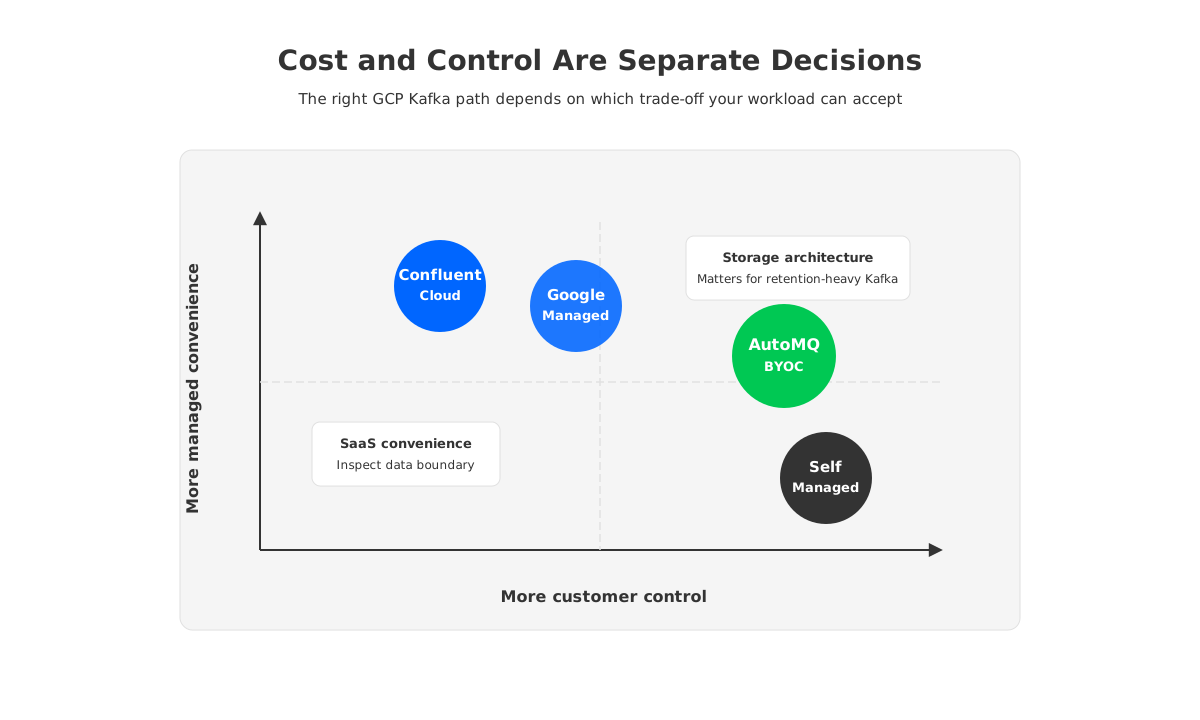
Start with workload facts, not product labels. Write down sustained throughput, peak throughput, partition count, retention, consumer fanout, availability target, producer and consumer locations, private connectivity requirements, and expected growth. Then map those facts to the boundary model. If the biggest risk is operations, SaaS or cloud-provider managed Kafka may be the best path. If the biggest risk is storage growth and broker data movement, storage architecture deserves more weight.
Next, test migration blast radius. A Kafka-to-Kafka migration is usually less disruptive than moving from Kafka semantics to a different messaging model, but it still has real work: topic configuration, ACLs, client bootstrap changes, offsets, connector state, observability, and rollback. Confluent Cloud, Google Cloud managed Kafka, self-managed Kafka, and AutoMQ can all preserve the Kafka protocol directionally, but networking, authentication, compatibility, and tooling still need staging validation.
Finally, separate procurement convenience from architecture fit. Procurement convenience affects time to value, support, and approval risk. Architecture fit affects the next three years of operating cost, scaling behavior, and incident response. A strong decision memo should make both visible.
For teams comparing GCP Kafka vs Confluent Cloud, the right answer is rarely universal. Choose Confluent Cloud when the managed Kafka ecosystem and SaaS operating model are the point. Choose Google Cloud managed Kafka when native GCP alignment is the point. Choose self-managed Kafka when control is worth the operational cost. Evaluate AutoMQ when your team wants Kafka compatibility, data-plane ownership, and a storage architecture that is built for cloud elasticity rather than broker-local disk expansion. If that last boundary is where your current Kafka plan feels strained, review the AutoMQ documentation and run a workload-based comparison before committing to a platform.
9References
- Google Cloud Managed Service for Apache Kafka overview
- Google Cloud Managed Service for Apache Kafka pricing
- Google Cloud Managed Service for Apache Kafka networking
- Google Cloud Pub/Sub documentation
- Confluent Cloud cluster types
- Confluent Cloud networking overview
- Confluent Cloud billing overview
- Apache Kafka documentation
- AutoMQ documentation: What is AutoMQ?
- AutoMQ BYOC Kafka data streaming
10FAQ
10.1Is Confluent Cloud on GCP the same as Google Cloud managed Kafka?
No. Confluent Cloud on GCP is a SaaS Kafka platform operated by Confluent. Google Cloud Managed Service for Apache Kafka is a first-party Google Cloud managed service. They differ in control plane, procurement model, networking boundary, support path, and service packaging.
10.2When should a GCP team choose Confluent Cloud?
Choose Confluent Cloud when the team values a SaaS-first Kafka platform, managed connectors, governance capabilities, and a Kafka specialist operating model.
10.3When should a GCP team choose Google Cloud Managed Service for Apache Kafka?
Choose Google Cloud managed Kafka when native GCP alignment matters most: cloud-provider procurement, Google Cloud operational workflows, private networking patterns, account-level billing, and platform standardization. Still model capacity, storage, retention, and networking before committing.
10.4Is self-managed Kafka on GKE still worth considering?
Yes, mainly for teams that need deep control and have the SRE capacity to operate Kafka well. The team owns upgrades, reassignments, disk growth, monitoring, incidents, and cost governance.
10.5Where does AutoMQ fit in a GCP Kafka comparison?
AutoMQ fits when a team wants Kafka compatibility and data-plane control while changing Kafka's storage architecture. Its object-storage-backed design is most relevant for retention-heavy, elastic, or cost-sensitive workloads where broker-local storage becomes a constraint.


