
Table of Contents
Table of Contents
Searches for "GCP Pub/Sub Kafka" usually start from a practical frustration, not from a taxonomy problem. A team has Kafka somewhere in the stack, Google Cloud is becoming the preferred landing zone, and someone asks whether Pub/Sub can remove the operational burden. That question is reasonable because Pub/Sub is a Google Cloud native messaging service, while Kafka clusters still need capacity planning, partition design, broker upgrades, storage management, and incident runbooks.
The trap is that "replace Kafka" can mean two different things. It can mean replacing a messaging service that applications use to exchange events. It can also mean replacing Kafka's contract: topics with partitions, consumer offsets, replay from retained logs, Kafka Connect, Kafka Streams, and a large ecosystem of client behavior that production systems already depend on. Pub/Sub can be a strong replacement for the first category. It is not automatically a replacement for the second.
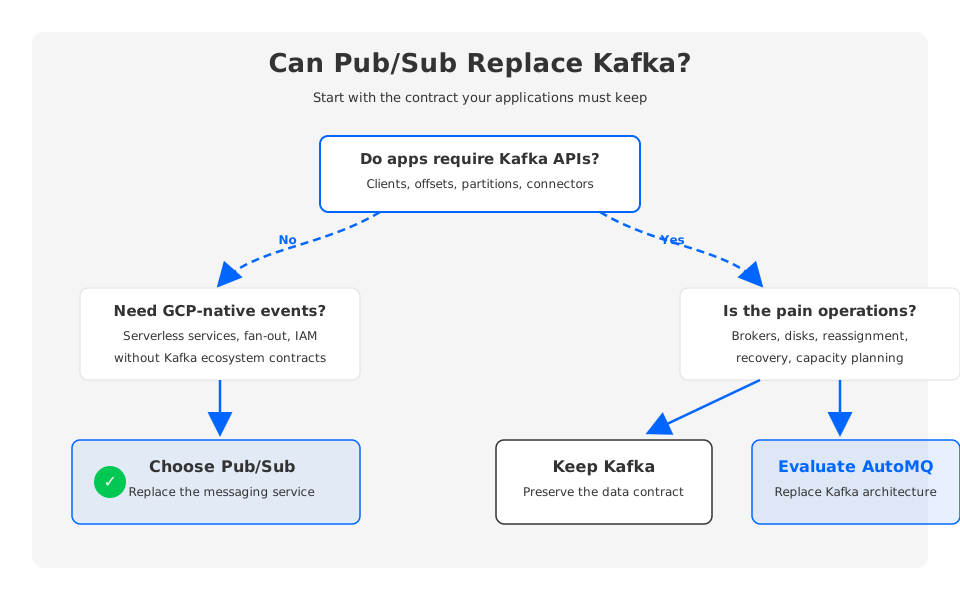
The clean way to evaluate Pub/Sub versus Kafka is to separate cloud service fit from semantic compatibility. Google Cloud's own guidance compares Pub/Sub and Managed Service for Apache Kafka as different services for different workload shapes, rather than treating one as a drop-in replacement for the other. That distinction matters for architects and SREs because a wrong decision here does not fail at hello-world scale. It fails when a backfill, connector migration, consumer replay, or multi-cloud data contract arrives six months later.
1Why Teams Compare Pub/Sub and Kafka on GCP
Pub/Sub is attractive because it removes many cluster-level concerns from the application team. You publish messages, create subscriptions, and let the service handle delivery to subscribers. For event notification, workload decoupling, and GCP-native integration, that operating model is often exactly what teams want. It narrows the operational surface area to IAM, topics, subscriptions, schemas, dead-letter handling, retry behavior, and observability.
Kafka asks teams to think in a different shape. A Kafka topic is an append-only log split into partitions, and consumers advance through that log by offsets. That model is powerful because it makes replay, independent consumer progress, stream processing, and connector-driven pipelines natural. It also exposes more design choices: partition count, retention, compaction, replication, consumer group behavior, broker storage, and cluster scaling.
The comparison becomes uncomfortable when teams use the same word, "messaging," for both models. Pub/Sub is usually evaluated as managed messaging. Kafka is often embedded as a streaming data backbone. Those are related domains, but the failure modes and migration risks are different.
| Question | Pub/Sub fit | Kafka fit |
|---|---|---|
| Do you need GCP-native fan-out for service events? | Strong fit | Possible, but often more infrastructure than needed |
| Do existing applications use Kafka clients? | Requires application changes or a bridge | Native contract |
| Do consumers need durable replay by offset? | Possible through Pub/Sub replay features, but not Kafka offset semantics | Native behavior through retained logs and offsets |
| Do you rely on Kafka Connect or Kafka Streams? | Requires redesign or connector bridge | Native ecosystem fit |
| Do you need a cross-cloud Kafka contract? | Not the main design center | Stronger fit |
This table is not a verdict. It is a scope control tool. If the workload is a GCP-native event distribution problem, Pub/Sub deserves serious consideration. If the workload is a Kafka estate with applications, connectors, stream processors, and operational assumptions around offsets, the replacement target is larger than the service endpoint.
2When Pub/Sub Can Replace Kafka
Pub/Sub can replace Kafka when the application contract is message delivery rather than Kafka compatibility. A common example is microservice event notification: one service emits an event, several downstream services subscribe, and no team expects to seek to an arbitrary Kafka offset or preserve a Kafka client API. In that world, Pub/Sub's managed service model is a feature, not a compromise.
It is also a strong fit when the surrounding system is already deeply tied to Google Cloud. If producers and consumers are Cloud Run services, Cloud Functions, Dataflow jobs, or workloads using Google Cloud IAM and monitoring, Pub/Sub often reduces integration friction. Teams can design around topics and subscriptions instead of operating brokers, disks, and partitions.
Pub/Sub is especially compelling when these conditions line up:
- The event stream is primarily for asynchronous notification, not a long-lived analytical log. Consumers need delivery and retry behavior more than they need Kafka-style offset control.
- Producers and consumers can adopt Pub/Sub client libraries or service integrations without breaking upstream contracts. The migration is an application change, not an infrastructure swap.
- Replay needs are bounded and match Pub/Sub's snapshot and seek model. You want to recover from processing problems, not rebuild a Kafka offset-based processing contract.
- Ordering requirements are scoped and can be designed around Pub/Sub ordering keys. You are not trying to preserve Kafka partition assignment as part of the application behavior.
In these cases, replacing Kafka with Pub/Sub is less about "Kafka versus Pub/Sub" and more about admitting that the workload never needed the full Kafka contract. That is a good outcome. Removing unnecessary infrastructure is a real architectural win.
3When Kafka Semantics Are Still Required
Kafka becomes harder to replace when downstream systems treat the log itself as the contract. This is common in data platforms, CDC pipelines, fraud systems, audit trails, ML feature pipelines, and stream processing applications. The producer does not merely send a message. It appends to a durable stream that many consumers can read at their own pace, replay, and process with tooling built around Kafka.
The first red flag is client compatibility. If dozens of services already use Kafka producer and consumer clients, a Pub/Sub migration changes application code, operational behavior, and failure handling. A thin bridge may help, but it cannot erase the difference between a Kafka partition log and a Pub/Sub topic plus subscriptions. Bridges also become another system to monitor, scale, and reason about during incidents.
The second red flag is ecosystem dependency. Kafka Connect is a common way to move data between databases, warehouses, search systems, and object storage. Kafka Streams and other stream processors build applications around topic input, topic output, state stores, offset progress, and changelog behavior. If those components are central to your platform, Pub/Sub is not replacing a queue. It is asking the platform to change its data contract.
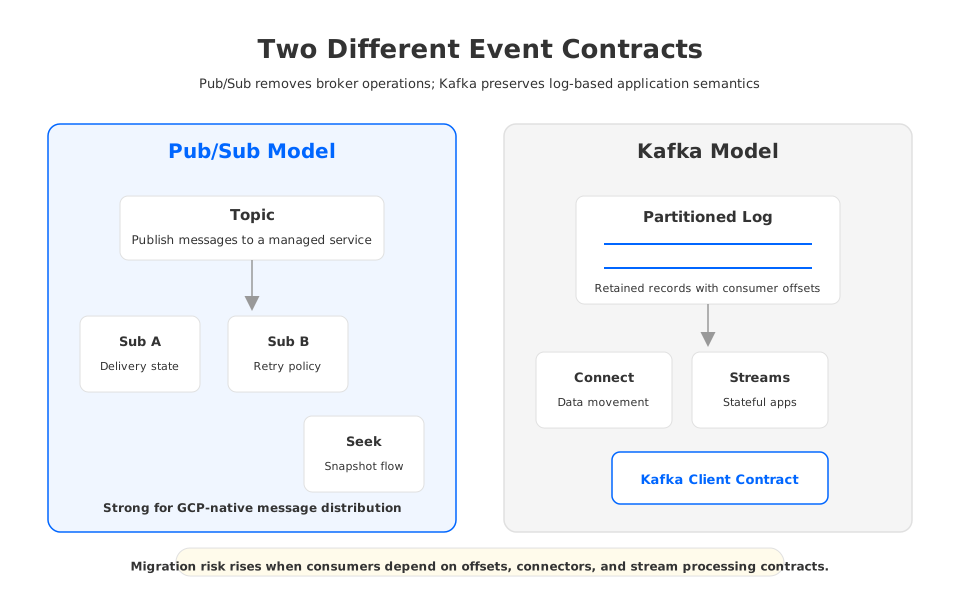
The third red flag is replay semantics. Pub/Sub supports replay through snapshots and seek, and that is useful for recovery. Kafka's replay model is different because consumers track offsets over retained topic logs. Many data teams use that behavior to reprocess a topic from a known position, onboard a new consumer group, rebuild derived state, or compare old and new processing logic. Pub/Sub may support the business outcome in some cases, but the operational playbook changes.
Ordering deserves the same care. Pub/Sub can deliver ordered messages when ordering keys are used, while Kafka ordering is scoped to partitions. Neither system gives a magical global order across all data. The question is whether your applications already encode assumptions around Kafka partitions, keys, consumer groups, and rebalancing. If they do, Pub/Sub is a migration project, not a transparent replacement.
4Service Replacement vs Architecture Replacement
There are two honest paths for a team that wants less Kafka operations on GCP. One path is service replacement: change applications to Pub/Sub and redesign the platform around Google Cloud messaging. The other path is architecture replacement: keep the Kafka protocol and ecosystem, but change the way Kafka infrastructure is operated.
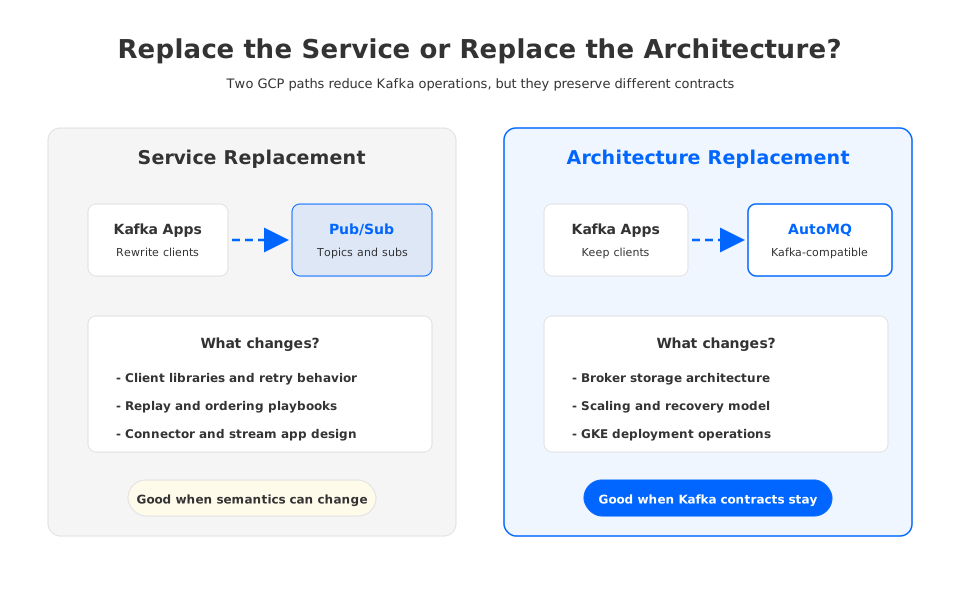
This distinction is where Kafka-compatible platforms become relevant. If the pain is that Kafka is too operationally heavy, Pub/Sub is one answer. If the pain is that brokers, disks, replicas, reassignment, and recovery are too operationally heavy, changing away from Kafka semantics may be the wrong lever.
AutoMQ fits the second path. It is a Kafka-compatible cloud-native streaming system that keeps Kafka protocol compatibility while moving durable storage away from broker-local disks and toward shared object storage. On GCP, that architecture can be deployed on Google Kubernetes Engine with Google Cloud infrastructure, while applications continue to speak Kafka rather than being rewritten to Pub/Sub. The goal is not to claim that every Pub/Sub candidate should run Kafka. The goal is to avoid forcing a semantic migration when the real problem is Kafka infrastructure.
This matters most for teams that already have a mature Kafka estate. They may have years of connector configurations, consumer group conventions, schema practices, operational dashboards, and incident response procedures. Replacing that with Pub/Sub may still be the right strategic move, but it should be chosen for product and platform reasons, not because Kafka brokers are painful to manage.
5A Practical Decision Checklist
The fastest way to make the decision is to ask what must remain stable. If application behavior, integration tooling, and replay playbooks can change, Pub/Sub has room to replace Kafka. If those contracts must remain stable, look at Managed Service for Apache Kafka, self-managed Kafka on GCP, or a Kafka-compatible architecture such as AutoMQ.
Use this checklist during architecture review:
- Start with the client contract. If producers and consumers must keep Kafka APIs, Pub/Sub is not a drop-in replacement.
- Map replay requirements in operational terms. "We need replay" is too vague; specify whether teams need snapshots, retained logs, offset resets, new consumer group backfills, or state rebuilds.
- Inventory Kafka ecosystem dependencies. Connectors, Kafka Streams apps, schema workflows, and monitoring conventions often define the real migration scope.
- Identify the cloud strategy. A GCP-native application platform may favor Pub/Sub, while a multi-cloud data backbone may favor Kafka compatibility.
- Separate operational pain from semantic pain. If Kafka semantics are still useful but broker operations are the issue, evaluate architectures that reduce broker state and data movement.
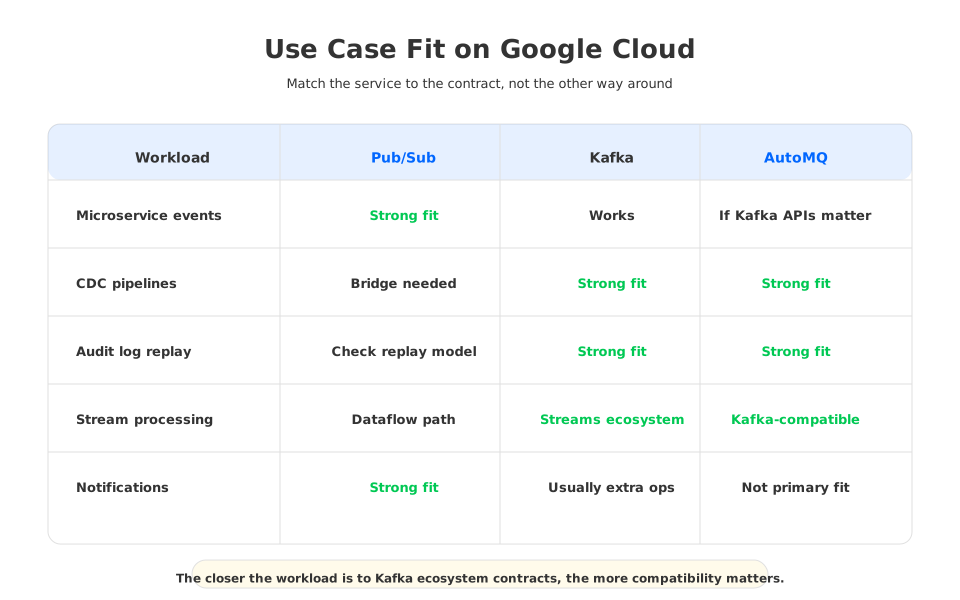
The checklist also helps prevent a common procurement mistake: comparing service names instead of comparing change budgets. Pub/Sub may have a cleaner operating model, but the migration budget lives in application rewrites, connector redesign, stream processing changes, runbook updates, and production validation. Kafka-compatible options may preserve more of that investment, but they still require platform evaluation, performance testing, and operational readiness work.
6What to Test Before You Decide
A proof of concept should test the awkward parts, not the happy path. Publishing and consuming a few messages will make both Pub/Sub and Kafka look fine. The real signal comes from failure, replay, schema changes, consumer growth, and operational handoff.
For Pub/Sub, test subscription behavior, ordering keys, retry policy, dead-letter topics, snapshot and seek workflows, IAM boundaries, and the monitoring signals your SRE team will use during an incident. For Kafka or Kafka-compatible systems, test partition strategy, consumer group rebalances, offset reset workflows, connector behavior, broker or pod failure, storage growth, and recovery under load. If AutoMQ is in the evaluation set, include a GKE deployment test and verify that existing Kafka clients and tools behave as expected.
The proof of concept should end with a written migration map:
- Which application contracts change?
- Which operational runbooks change?
- Which data recovery workflows change?
- Which teams need retraining?
- Which metrics become the source of truth during incidents?
That map often decides the architecture before a pricing spreadsheet does. A lower infrastructure bill is not helpful if the migration turns a stable data platform into a year-long application rewrite. The reverse is also true: keeping Kafka compatibility is not valuable if the workload is a GCP-native event notification system that can use Pub/Sub cleanly.
7The Bottom Line
Pub/Sub can replace Kafka when the workload needs managed message distribution and can adopt Pub/Sub semantics. Kafka is still the better fit when the platform depends on Kafka APIs, offsets, retained logs, connectors, stream processing, or a cross-cloud event streaming contract. The interesting middle ground is where teams like Kafka's semantics but dislike Kafka's infrastructure burden.
That middle ground is where a Kafka-compatible architecture deserves evaluation. AutoMQ is one option for teams that want to keep Kafka clients and ecosystem behavior while reducing the operational weight of broker-local storage. If your GCP migration question started as "Can Pub/Sub replace Kafka?", the sharper question is this: are you trying to replace the messaging service, or are you trying to replace the architecture that made Kafka hard to operate?
For teams that land on the second answer, review the AutoMQ architecture overview and the GKE deployment guide alongside your Pub/Sub and Managed Service for Apache Kafka evaluation. The right choice is the one that preserves the contracts your platform needs and removes the operations your team should no longer carry.
8References
- Google Cloud: Choose Pub/Sub or Managed Service for Apache Kafka
- Google Cloud Pub/Sub overview
- Google Cloud Pub/Sub ordering messages
- Google Cloud Pub/Sub replay overview
- Google Cloud Pub/Sub exactly-once delivery
- Google Cloud Managed Service for Apache Kafka overview
- Apache Kafka documentation
- Apache Kafka Connect documentation
- Apache Kafka Streams documentation
- AutoMQ architecture overview
- AutoMQ deployment on Google Cloud GKE
9FAQ
9.1Can Google Cloud Pub/Sub replace Kafka?
Yes, when the workload needs managed event distribution and applications can adopt Pub/Sub semantics. It is a stronger fit for GCP-native service events, asynchronous notifications, and pipelines that do not depend on Kafka clients, offsets, Kafka Connect, or Kafka Streams.
9.2Is Pub/Sub Kafka-compatible?
No. Pub/Sub is not a Kafka-compatible service. Applications that use Kafka producer and consumer APIs need code changes, a bridge, or a Kafka-compatible platform.
9.3When should I keep Kafka on GCP?
Keep Kafka, Managed Service for Apache Kafka, or a Kafka-compatible alternative when existing systems depend on Kafka APIs, partitioned logs, consumer offsets, replay from retained topics, Kafka Connect, Kafka Streams, or cross-cloud consistency.
9.4Where does AutoMQ fit in a Pub/Sub versus Kafka decision?
AutoMQ fits when the team wants to reduce Kafka infrastructure operations without rewriting applications to Pub/Sub. It keeps Kafka compatibility while using a cloud-native architecture that separates broker compute from durable shared storage.


