
Table of Contents
Table of Contents
Search for "Google Cloud Kafka" and you are usually asking one of three questions. You may want to run Apache Kafka on Google Cloud. You may want a Google-native messaging service for Kafka-like event distribution. Or you may want Kafka APIs and ecosystem compatibility without operating brokers yourself. Those questions sound similar, but they lead to different architectures, cost models, and migration paths.
The mistake is treating Kafka and Pub/Sub as interchangeable queue names. Apache Kafka is a distributed event log with partitions, offsets, consumer groups, and a large ecosystem around Kafka Connect, Kafka Streams, and client libraries. Google Cloud Pub/Sub is a global messaging service with topics and subscriptions designed to reduce infrastructure management and integrate tightly with Google Cloud services. Managed Service for Apache Kafka sits in the middle: it keeps Apache Kafka semantics while moving much of the cluster operation into a Google-managed service.
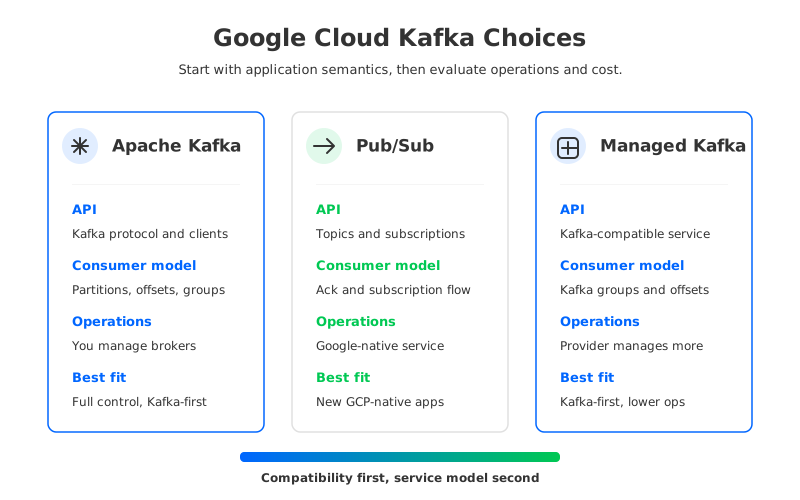
That distinction matters because the right answer is rarely "use Kafka" or "use Pub/Sub" in the abstract. A payment event pipeline that depends on Kafka offsets, replay, and Connect sink behavior has different requirements from a cloud-native notification service that primarily needs elastic fan-out. The useful decision is not product-first. It is semantics-first.
1The Three Meanings of Google Cloud Kafka
"Google Cloud Kafka" can mean self-managed Apache Kafka on GKE or Compute Engine, Google-managed Apache Kafka, or a Kafka alternative such as Pub/Sub for workloads that do not require Kafka compatibility. Each path solves a different version of the same operational problem: how to move event data reliably while controlling infrastructure burden.
Self-managed Kafka gives you the most control. You decide broker sizing, storage type, networking, version upgrades, retention policy, and failure handling. That control is valuable, but it also keeps disk capacity planning, partition placement, replica movement, controller health, and upgrades on your team.
Managed Service for Apache Kafka reduces that operational surface while preserving the Apache Kafka API. Google describes it as a fully managed service for Apache Kafka clusters, which means teams can keep Kafka clients and common Kafka workflows while outsourcing more of the cluster lifecycle to Google Cloud.
Pub/Sub starts from a different premise. Google Cloud documentation positions Pub/Sub as a messaging service based on topics and subscriptions, with features such as delivery controls, message ordering, schemas, retention, and exactly-once delivery support for supported subscription modes. It is a cloud service with its own model, and that model can be the right fit when the application does not need Kafka protocol compatibility.
| Option | Primary fit | What you keep | What changes |
|---|---|---|---|
| Self-managed Kafka on GCP | Teams that need full Kafka control | Kafka APIs, broker control, custom tuning | You operate the cluster lifecycle |
| Managed Service for Apache Kafka | Kafka-first teams reducing operations | Kafka APIs and ecosystem compatibility | Google manages more infrastructure tasks |
| Pub/Sub | GCP-native messaging and event distribution | Cloud-native service integration | Kafka clients, offsets, and broker semantics do not carry over directly |
| Kafka-compatible shared storage | Kafka-first teams rethinking cloud cost and elasticity | Kafka protocol and ecosystem patterns | Broker storage is decoupled from local disks |
The first-order choice is plain: if you need Kafka semantics, choose a Kafka-compatible path. If you mainly need Google-native messaging with less cluster thinking, evaluate Pub/Sub. If you need Kafka compatibility but want less operational work, evaluate managed Kafka.
2Kafka and Pub/Sub Solve Different Problems
Kafka's core abstraction is an ordered log split into partitions. Producers append records to topics, consumers read records by offset, and consumer groups coordinate which consumers read which partitions. This model gives teams explicit control over replay, lag, offset commits, and partition-level parallelism.
Pub/Sub uses topics and subscriptions. A publisher sends messages to a topic, and subscribers receive messages through one or more subscriptions. Ordering can be enabled with ordering keys, retention is configured through topic and subscription settings, and delivery behavior is controlled through subscription configuration. The knobs are not Kafka knobs: a Kafka consumer group rebalance, an offset reset, and a Pub/Sub subscription seek are related ideas, not identical mechanisms.
The semantic gap becomes visible in four places:
- Ordering and parallelism. Kafka gives ordering within a partition. Pub/Sub can provide ordering by ordering key when configured, but the application design must align with Pub/Sub's delivery model.
- Replay and offsets. Kafka consumers track offsets in a log. Pub/Sub supports message retention and seek operations, but an existing Kafka offset workflow does not migrate as a one-line configuration change.
- Consumer coordination. Kafka consumer groups are part of the Kafka client model. Pub/Sub subscriptions provide fan-out and delivery control, but they do not behave like Kafka consumer groups.
- Ecosystem dependencies. Kafka Connect, Kafka Streams, ksqlDB-style patterns, and many vendor integrations assume Kafka APIs. Pub/Sub has its own integrations and client libraries.
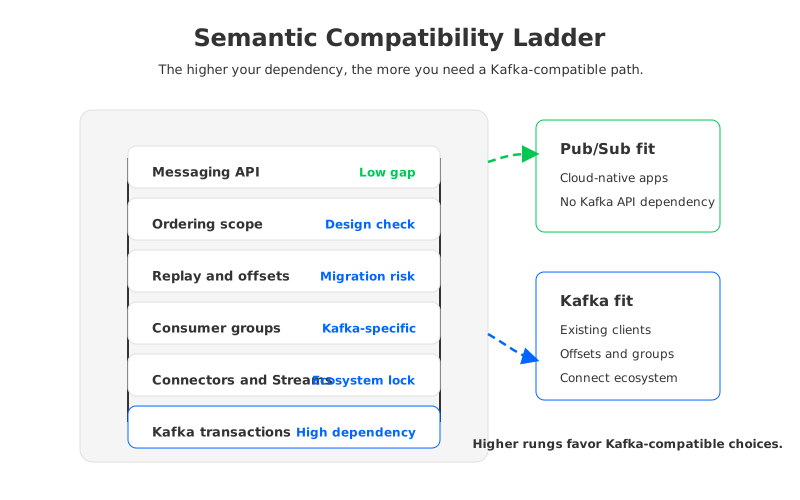
This is why "Kafka vs Pub/Sub on GCP" is not a generic feature checklist. Existing Kafka clients create a migration problem. A new Google Cloud application creates an architecture problem. Broker toil creates an operating model problem.
3Ecosystem and Connector Gravity
Kafka's ecosystem is a major reason teams search for managed Kafka instead of a generic messaging service. Kafka Connect provides a standard framework for source and sink connectors. Kafka Streams lets Java applications build stream processing logic on Kafka topics. Many observability, governance, schema, and data platform tools assume Kafka as the interface.
That ecosystem gravity can outweigh infrastructure convenience. If your data platform already has connectors into warehouses, object storage, databases, search systems, and stream processors, moving to Pub/Sub means evaluating every integration point. Some may have Pub/Sub-native alternatives. Others may require custom bridges.
Managed Kafka on GCP is strongest when the ecosystem decision is already made. It lets platform teams reduce cluster management while keeping the application contract familiar. Existing producers and consumers still need testing, network planning, and security configuration, but the migration is closer to Kafka-to-Kafka than Kafka-to-Pub/Sub.
4Where Managed Kafka on GCP Fits
Managed Service for Apache Kafka is a natural answer when the team wants Kafka, but not the full burden of self-managing Kafka infrastructure. It is especially relevant for organizations standardizing on Google Cloud while preserving Kafka client compatibility.
The value shows up in operational boundaries:
- Cluster lifecycle. Provisioning, updates, and infrastructure management move closer to a service workflow.
- Kafka compatibility. Existing Kafka clients, tools, and pipelines remain the center of the architecture.
- Cloud integration. Networking, identity, and monitoring can fit more naturally into the Google Cloud environment.
- Team focus. Platform engineers spend less time on broker maintenance.
Managed Kafka does not remove every Kafka decision. You still need to design topics, partitions, quotas, retention, security, client behavior, and observability. You also need to understand the pricing model. Google Cloud's pricing page for Managed Service for Apache Kafka separates service costs such as vCPU, memory, storage, and networking-related charges by configuration and region, so a low-ops Kafka path still needs a FinOps review.
The more important point is architectural: managed Kafka changes who operates the brokers, but it does not fundamentally change Kafka's relationship between compute, storage, replication, and scaling. A managed service can reduce toil without eliminating every cloud cost driver that made Kafka expensive in the first place.
5Where Kafka-Compatible Shared Storage Fits
Some teams arrive at Google Cloud Kafka with a sharper question: they want Kafka compatibility, but they also want to change the economics of running Kafka in the cloud. Traditional Kafka stores partitions on broker-local disks and uses replication across brokers for durability and availability. In cloud environments, that couples compute scaling, storage capacity, and replica movement.
Kafka-compatible shared storage takes a different route. The architecture keeps Kafka protocol compatibility but moves durable data away from broker-local disks into shared object storage. Brokers become more stateless, so scaling and recovery can rely less on copying partition data between machines. This is where AutoMQ fits naturally: it is a Kafka-compatible streaming platform that uses object storage as the durable storage layer.
This is not the same choice as Pub/Sub. Pub/Sub changes the application model. AutoMQ targets teams that still want Kafka APIs, Kafka Connect-style integration, and Kafka operational semantics, but want the cloud infrastructure shape to look less like disk-bound broker fleets.
The decision is clearest when you separate two questions:
| Question | Managed Kafka answer | Shared-storage Kafka-compatible answer |
|---|---|---|
| Who operates the Kafka control plane and brokers? | A managed service reduces operational ownership | Deployment model varies; the architecture aims to reduce broker statefulness |
| Do applications keep Kafka APIs? | Yes | Yes |
| Does the storage model still center on broker-local disks? | Typically yes, depending on service architecture | Durable data moves to shared object storage |
| What problem is being optimized? | Operational burden | Cloud elasticity, recovery, and storage economics while keeping Kafka semantics |
Neither answer is universally superior. A team with moderate throughput and a strong preference for a Google-managed service may choose Managed Service for Apache Kafka. A team with large retained streams, frequent scaling events, or multi-cloud control requirements may evaluate Kafka-compatible shared storage more aggressively.
6Scenario-Based Recommendation Table
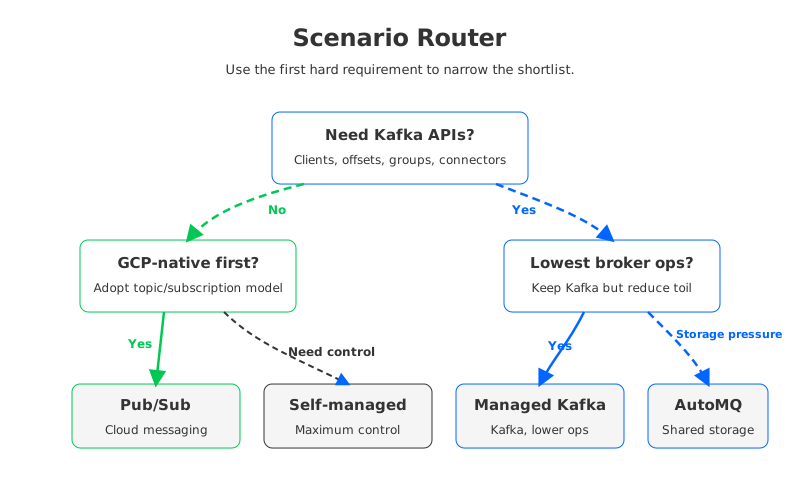
By this point, the decision becomes a routing problem. Start with compatibility, then evaluate operations and cost. That order prevents the expensive mistake of choosing a low-ops service and later discovering that the application semantics do not fit.
| Scenario | Recommended path | Why |
|---|---|---|
| Existing Kafka applications moving to GCP | Managed Kafka or Kafka-compatible shared storage | Kafka APIs, offsets, and connectors likely matter more than service simplicity |
| New GCP-native application with no Kafka dependency | Pub/Sub | The application can adopt Pub/Sub's topic/subscription model from the start |
| Platform team wants less broker toil but familiar Kafka | Managed Service for Apache Kafka | It preserves Kafka while shifting more operations to Google Cloud |
| High-retention or scaling-sensitive Kafka workload | Kafka-compatible shared storage such as AutoMQ | Decoupling durable storage from brokers can reduce data movement pressure |
| Multi-cloud or BYOC-oriented data platform | Kafka-compatible platform | Kafka APIs provide portability that a cloud-native messaging API may not |
| Simple event notification or fan-out | Pub/Sub | Kafka's partition and offset model may be unnecessary overhead |
The table is not a substitute for a proof of concept. It is a way to choose the right proof of concept. If the workload is Kafka-first, test real clients, connectors, retention, failover, and cost assumptions. If the workload is GCP-native-first, test Pub/Sub ordering, acknowledgement, retry, dead-letter handling, and replay.
7Cost and Operations Questions to Ask Before You Choose
Pricing pages tell you unit prices; they do not tell you how partition count, retention, replica factor, cross-zone traffic, client fan-out, or scaling will behave under pressure.
Ask these questions before committing:
- What must be replayed, and for how long? Long retention changes the storage profile for Kafka-compatible systems and the retention configuration for Pub/Sub.
- How much of the workload is cross-zone or cross-region? Kafka replication and consumer placement can create network charges and operational trade-offs.
- How often will the cluster scale? Disk-bound Kafka clusters can turn scaling into data movement. Shared-storage designs aim to reduce that coupling.
- Which integrations are mandatory? A connector-heavy estate usually favors Kafka-compatible paths unless Pub/Sub-native integrations cover the same requirements.
- Who owns incident response? Managed services reduce infrastructure ownership, but client retries, lag, and backpressure still need operators who understand the system.
This is also where AutoMQ should be evaluated without turning the decision into a product slogan. If your GCP Kafka search is really about keeping Kafka while escaping broker-local disk constraints, AutoMQ belongs in the comparison. If your workload does not need Kafka compatibility at all, Pub/Sub may be the cleaner route.
8A Practical Selection Framework
A good selection process starts with the application contract. Write down what existing services assume about Kafka: client protocol, topic naming, partition ordering, offset reset behavior, consumer group behavior, connector dependencies, and operational dashboards. If those assumptions are deep, keep the evaluation inside Kafka-compatible options first.
Then evaluate cloud operating model. Teams that prefer Google-managed infrastructure should test Managed Service for Apache Kafka and Pub/Sub against their workload shape. Teams that need BYOC, multi-cloud consistency, or deeper control over data placement should include Kafka-compatible platforms such as AutoMQ in the shortlist.
Finally, test failure and recovery before celebrating the happy path. Produce enough data to make retention meaningful. Restart clients, scale consumers, and reset replay positions. Measure not only throughput, but also the human steps required to recover the system.
The phrase "Google Cloud Kafka" hides a real decision: keep Kafka semantics, adopt a GCP-native messaging model, or keep Kafka while changing the storage architecture underneath it. Once you name that decision clearly, the shortlist gets smaller and the proof of concept gets sharper. If Kafka compatibility and cloud elasticity are both hard requirements, review AutoMQ's architecture and GCP deployment options alongside Google-managed Kafka choices rather than treating all managed messaging services as the same category.
9References
- Google Cloud Pub/Sub documentation
- Google Cloud Pub/Sub ordering messages
- Google Cloud Pub/Sub message retention and replay
- Google Cloud Pub/Sub exactly-once delivery
- Google Cloud Managed Service for Apache Kafka overview
- Google Cloud Managed Service for Apache Kafka pricing
- Apache Kafka documentation
- Apache Kafka Connect documentation
- Apache Kafka Streams documentation
- AutoMQ documentation
- AutoMQ architecture overview
10FAQ
10.1Is Pub/Sub a replacement for Kafka on Google Cloud?
Pub/Sub can replace Kafka for some messaging workloads, especially when applications are designed around Google Cloud's topic and subscription model. It is not a drop-in replacement for Kafka clients, consumer groups, offsets, Kafka Connect, or Kafka Streams.
10.2Does Google Cloud offer managed Kafka?
Yes. Google Cloud offers Managed Service for Apache Kafka for teams that want Apache Kafka compatibility with more of the cluster lifecycle managed by Google Cloud.
10.3When should I choose Kafka instead of Pub/Sub?
Choose a Kafka-compatible path when your applications depend on Kafka clients, partition-level ordering, offset-based replay, consumer groups, Kafka Connect, Kafka Streams, or Kafka-centered tooling.
10.4Where does AutoMQ fit in a GCP Kafka evaluation?
AutoMQ fits when the team wants Kafka compatibility but also wants to rethink the cloud storage and scaling model. Its shared-storage architecture moves durable data to object storage and makes brokers more stateless.
10.5Should a new application on GCP start with Pub/Sub or Kafka?
Start with the semantics. If the application mainly needs cloud-native event delivery, fan-out, and Google Cloud integration, evaluate Pub/Sub first. If it needs Kafka's log, offset, and ecosystem behavior, start with Kafka-compatible options.


