
Table of Contents
Table of Contents
GCP teams evaluating Kafka usually have two different questions tangled together. One is about infrastructure: "Can Google Cloud run Kafka for us so we do not operate brokers ourselves?" The other is about application semantics: "Can we replace Kafka with a cloud-native messaging service and avoid Kafka entirely?" Those questions sound similar in a planning meeting, but they lead to different migration paths, cost models, and operational risks.
Google Cloud Managed Service for Apache Kafka answers the first question. It runs open source Apache Kafka as a managed Google Cloud service, so teams can keep Kafka clients, topics, consumer groups, offsets, and much of the surrounding ecosystem. Pub/Sub answers the second question. It is a global Google Cloud messaging service with its own APIs, delivery model, ordering keys, subscription types, and pricing dimensions. AutoMQ belongs in the evaluation when the team wants Kafka compatibility and cloud-storage economics together, especially when retained data and broker-local storage are becoming the bottleneck.
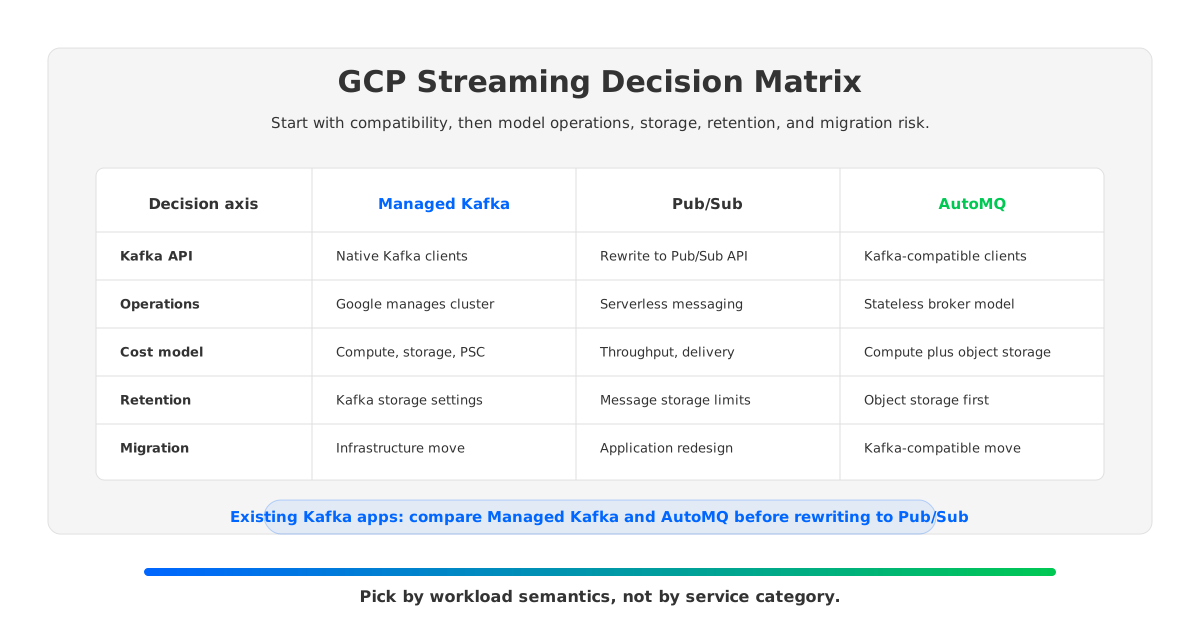
The practical decision is not whether Pub/Sub is "better" than Kafka or whether managed Kafka is "more native" than a BYOC architecture. It is whether the workload is already shaped around Kafka semantics, how much rewrite risk the team can absorb, and whether the cost pressure comes from operations, storage, retention, network paths, or migration overlap.
1Quick Answer
If you already run Kafka applications on GCP or plan to migrate Kafka workloads into GCP, start with protocol compatibility. A workload that depends on Kafka producers, consumers, Connect connectors, Streams applications, offset behavior, partitioning, ACLs, or Kafka observability should not be treated as a generic messaging workload. Managed Service for Apache Kafka and AutoMQ keep the Kafka-facing contract much closer to the application. Pub/Sub can still be a good target, but it is a redesign, not a bootstrap-server swap.
| Workload question | Google Cloud Managed Kafka tends to fit when... | Pub/Sub tends to fit when... | AutoMQ is worth evaluating when... |
|---|---|---|---|
| Existing Kafka apps | The team wants Google-managed open source Kafka | The team is willing to rewrite around Pub/Sub APIs and semantics | The team wants Kafka compatibility with shared-storage architecture |
| Greenfield eventing | Kafka ecosystem compatibility is still a requirement | Cloud-native messaging is the primary goal | Kafka compatibility may become important later |
| Long retention | Managed Kafka storage and long-term storage pricing fit the model | Retention is short or message storage pricing is acceptable | Retained Kafka data should move toward object storage economics |
| Scaling operations | Google-managed broker provisioning and rebalancing are preferred | The team wants a serverless messaging abstraction | The team wants stateless brokers and less data movement during scaling |
| Data control | Google Cloud service boundary is acceptable | Pub/Sub service semantics and regional controls fit | BYOC-style control and Kafka compatibility both matter |
That table should be read from left to right only after the workload is classified. A CDC pipeline with Debezium, a payments event stream with strict ordering assumptions, and a notification fan-out system may all be called "streaming," but they do not want the same platform.
2Kafka Protocol Compatibility vs Messaging Semantics
Kafka compatibility is not a checkbox that stops at "can publish messages." Kafka applications often rely on a cluster of behaviors: partition assignment, consumer group rebalancing, offset commits, compaction, transactional APIs, Connect tasks, schema tooling, and operational metrics. When these behaviors matter, replacing Kafka with a different messaging service changes application logic and runbooks at the same time.
Google Cloud's own guidance separates the decision clearly: if you are already using Kafka and want a managed, secure, reliable solution on Google Cloud, Managed Service for Apache Kafka is the recommended path. That recommendation is not a criticism of Pub/Sub. It is an acknowledgment that Pub/Sub is a different service with different strengths.
Pub/Sub uses topics and subscriptions, supports features such as ordering keys and exactly-once delivery for eligible pull subscriptions, and integrates deeply with Google Cloud. Those are valuable capabilities. They are also not the same as Kafka partitions and consumer groups. Pub/Sub ordering is scoped by ordering key and includes documented tradeoffs around availability, latency, and hot keys. Exactly-once delivery is regional and subscription-type dependent. For many messaging workloads, that is fine. For a Kafka migration, it means the team must validate application semantics, not only throughput.
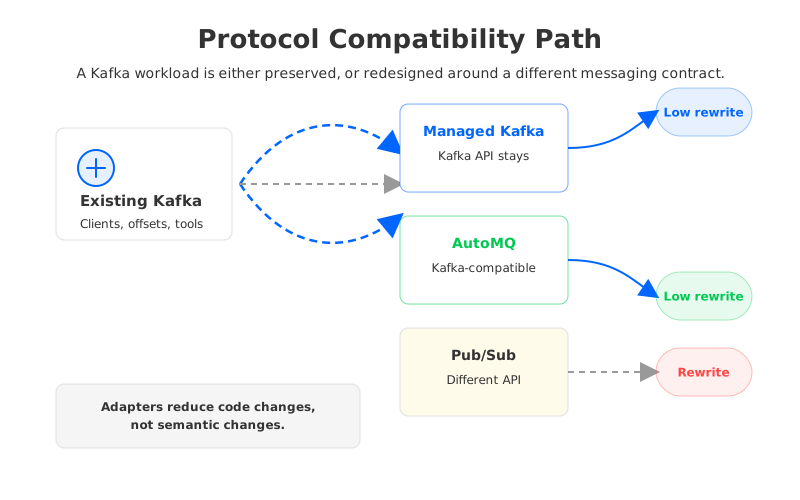
AutoMQ takes a different path from Pub/Sub. It keeps the Kafka protocol and ecosystem surface while changing the storage layer underneath. AutoMQ documentation describes compatibility with Apache Kafka clients and ecosystem components, and its architecture uses shared storage with stateless brokers rather than tying durable data to broker-local disks. That makes the migration question closer to "does our Kafka workload behave correctly on this Kafka-compatible implementation?" rather than "can we redesign the workload around another messaging API?"
3Cost and Storage Model
The cost comparison becomes clearer when you stop looking for a single platform price and split the bill into drivers. Managed Service for Apache Kafka pricing includes compute capacity, local storage, long-term storage, inter-zone transfer, and Private Service Connect-related charges. Google Cloud's pricing page also shows that the total cost depends on publish volume, consume volume, and storage duration. In other words, it is still a Kafka-shaped cost model, even though Google automates broker provisioning, storage management, and rebalancing.
Pub/Sub pricing starts from a different model. The public pricing page describes throughput costs for publishing and delivery, data transfer costs for traffic crossing zone or region boundaries, and storage costs for retained messages. That can be attractive for eventing workloads where the team does not want to size brokers at all. It can also surprise teams that compare only ingestion and forget subscriptions, fan-out, filtered messages, transforms, export paths, and retained message storage.
AutoMQ should be modeled as a Kafka-compatible architecture with object storage as the primary data repository and a WAL layer for low-latency writes and recovery. On GCP, the key publication-safe nuance is deployment model: AutoMQ documentation states that AutoMQ Open Source cannot directly run on Google Cloud Storage through the AWS S3 SDK, while AutoMQ BYOC supports GCP Cloud Storage. That distinction matters because "object storage-backed Kafka" is not automatically the same deployment story on every cloud.
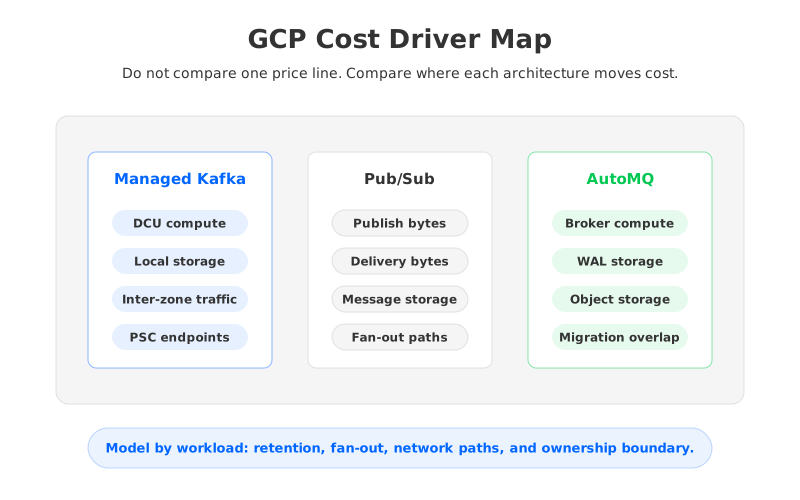
A useful worksheet separates five lines before any vendor conclusion:
- Compute: vCPU and memory for Kafka clusters, agents, brokers, connectors, or service capacity. Bursty workloads and always-on workloads behave differently here.
- Durable storage: local storage, long-term storage, object storage, WAL media, and retention duration. This is where Kafka logs with long retention expose architectural differences fastest.
- Traffic and fan-out: producer ingress, consumer delivery, subscription fan-out, inter-zone paths, cross-region paths, and Private Service Connect processing. Messaging systems often look inexpensive until consumer fan-out is included.
- Service boundary fees: managed service charges, endpoint charges, vendor fees, support, and committed-use discounts. These belong in the same worksheet as infrastructure, not in a separate procurement tab.
- Migration overlap: source and target systems often run in parallel during validation and cutover. A clean architecture comparison can still produce a messy bill for a few months.
The safest cost answer is region-specific and date-stamped. As of May 21, 2026, Google Cloud pricing pages and AutoMQ deployment guidance should be checked again before publication or procurement because service dimensions can change faster than architecture tradeoffs.
4Operations and Scaling
Managed Service for Apache Kafka reduces direct Kafka operations without removing the Kafka mental model. The team sizes the cluster by total vCPU and RAM, and Google automates broker provisioning, storage management, and rebalancing. That is a meaningful simplification compared with self-managed Kafka on Compute Engine. It still leaves the team thinking in Kafka terms: partitions, topics, client quotas, consumer lag, upgrades, authentication, authorization, Connect, and incident response.
Pub/Sub removes more of the infrastructure vocabulary. There are no Kafka brokers to size, no broker disks to rebalance, and no partition reassignment workflow. For greenfield Google Cloud applications, that is often the point. The tradeoff is that operational control moves to Pub/Sub concepts: subscriptions, acknowledgment deadlines, delivery attempts, ordering keys, locational endpoints, quotas, and service-specific monitoring.
AutoMQ changes the Kafka operations model by separating compute from storage. Stateless brokers make scaling and recovery closer to compute operations because durable data is not owned by a specific broker disk. That does not eliminate operational work. Teams still need deployment automation, cloud storage configuration, security boundaries, monitoring, and workload validation. The difference is that scaling no longer has to be dominated by moving retained Kafka data between broker-local disks.
This is where the three-way comparison becomes useful. Managed Kafka asks, "How much Kafka operation can Google absorb for us?" Pub/Sub asks, "Can we stop operating Kafka-shaped infrastructure by changing the application contract?" AutoMQ asks, "Can we keep Kafka compatibility while changing the storage architecture that made operations heavy?"
5Migration Risk
Migration risk is lowest when the target preserves the assumptions your applications already make. For existing Kafka workloads, Managed Service for Apache Kafka has the most familiar application contract because it is still Apache Kafka. The work shifts toward cluster creation, networking, IAM and Kafka ACLs, authentication choices, data replication, connector migration, and cutover validation.
Pub/Sub migration risk is different. Google provides guidance for migrating from Kafka to Pub/Sub, but the migration is a semantic conversion. Producers and consumers need Pub/Sub client libraries or adapters, ordering and delivery assumptions must be revisited, and operational dashboards need to be rebuilt around Pub/Sub metrics. That may be the right investment for applications that want a cloud-native messaging service. It is the wrong framing for teams hoping to preserve Kafka behavior with minimal application change.
AutoMQ migration risk sits between those two extremes. It is Kafka-compatible, so the application rewrite surface can be much smaller than a Pub/Sub migration, but it is not identical to running the same managed Kafka service. A serious proof of concept should test producer acknowledgments, consumer lag, rebalance behavior, Connect jobs, ACLs, TLS, schema dependencies, observability, failure recovery, and rollback. Compatibility reduces migration risk; it does not remove the need to test.
For a production migration, the deciding artifact is not a comparison table. It is a cutover plan with measured behavior:
- Which clients, connectors, and Kafka APIs are in use today?
- Which topics require ordering, compaction, transactions, or long retention?
- How will offsets and consumer groups be validated before cutover?
- What traffic runs in parallel, and for how long?
- What rollback path exists if latency, lag, or delivery behavior changes?
- Who owns incidents across the source cluster, target platform, network, and downstream consumers?
That list usually exposes whether Pub/Sub is a redesign project, Managed Kafka is an infrastructure migration, or AutoMQ is a Kafka-compatible architecture migration.
6Scenario Recommendations
Choose Google Cloud Managed Service for Apache Kafka when the workload is already Kafka-shaped and the team wants Google Cloud to manage the cluster lifecycle. This is the most direct path for Kafka applications that need protocol continuity and prefer a GCP-native service boundary. It is especially reasonable when the cost model is acceptable, storage retention is moderate, and the team wants to keep Kafka operational knowledge rather than retrain every application team around Pub/Sub.
Choose Pub/Sub when the workload is greenfield eventing, cloud integration, notification fan-out, or asynchronous messaging that does not need Kafka APIs. Pub/Sub is often a better fit when the team wants a Google Cloud-native service with push, pull, export, filtering, and managed delivery semantics. It becomes less attractive as a "Kafka replacement" when the workload depends deeply on Kafka partitions, Connect, Streams, compaction, or existing operational tooling.
Choose AutoMQ for evaluation when the team wants Kafka compatibility but the traditional broker-and-disk model is the part creating pain. Long retention, expensive scaling, rebalancing delays, and BYOC-style data control are the signals to investigate it. On GCP, teams should be explicit about the AutoMQ deployment model and GCS support rather than assuming every open-source object-storage configuration maps directly to Google Cloud Storage.
The most common mistake is forcing one answer across every workload. A GCP platform team may reasonably use Pub/Sub for greenfield cloud-native application events, Managed Service for Apache Kafka for conventional Kafka estates, and AutoMQ for Kafka workloads where storage architecture and scaling economics have become the constraint. The decision is cleaner when each workload is judged by compatibility need, retention profile, fan-out pattern, and ownership boundary.
7Sources
- Google Cloud Managed Service for Apache Kafka overview
- Google Cloud Managed Service for Apache Kafka pricing
- Choose Managed Service for Apache Kafka or Pub/Sub
- Migrate from Kafka to Pub/Sub
- Pub/Sub pricing
- Pub/Sub message ordering
- Pub/Sub exactly-once delivery
- AutoMQ compatibility with Apache Kafka
- AutoMQ stateless broker
- AutoMQ WAL storage
- AutoMQ object storage configuration
8FAQ
8.1Is Google Cloud Managed Service for Apache Kafka the same as Pub/Sub?
No. Managed Service for Apache Kafka is a Google Cloud service for running open source Apache Kafka clusters. Pub/Sub is a Google Cloud messaging service with its own APIs, subscriptions, delivery behavior, ordering model, and pricing dimensions. Both can move event data, but they are not interchangeable for applications that depend on Kafka APIs and semantics.
8.2Should existing Kafka applications migrate to Pub/Sub?
They can, but it should be treated as an application redesign. Pub/Sub may be a strong target when the team wants cloud-native messaging and is willing to revisit client libraries, ordering, delivery guarantees, monitoring, and runbooks. If the goal is to preserve Kafka clients and ecosystem tools, Managed Service for Apache Kafka or a Kafka-compatible platform such as AutoMQ is usually the safer evaluation path.
8.3When is AutoMQ relevant on GCP?
AutoMQ is relevant when the team wants Kafka compatibility but does not want durable Kafka data tied to broker-local disks. It is especially worth evaluating for long-retention workloads, scaling-heavy clusters, BYOC control requirements, or teams comparing object-storage-backed Kafka architectures. On GCP, validate the deployment model carefully because AutoMQ BYOC supports GCP Cloud Storage while AutoMQ Open Source has specific object-storage protocol constraints.
8.4Is Pub/Sub lower cost than managed Kafka on GCP?
Not automatically. Pub/Sub and Managed Service for Apache Kafka charge for different things. Pub/Sub analysis should include publish and delivery throughput, subscriptions, storage, data transfer, and feature-specific usage. Managed Kafka analysis should include compute, storage, long-term storage, inter-zone transfer, Private Service Connect, and migration overlap. The right answer depends on region, retention, fan-out, and workload shape.
8.5What should I test before choosing a platform?
Test the behaviors your applications depend on: producer acknowledgments, ordering, consumer lag, offset handling, redelivery behavior, connector jobs, authentication, authorization, observability, failure recovery, and rollback. For Pub/Sub, test the rewritten application path. For Managed Kafka and AutoMQ, test Kafka client compatibility and operational behavior under real traffic.


