
Table of Contents
Table of Contents
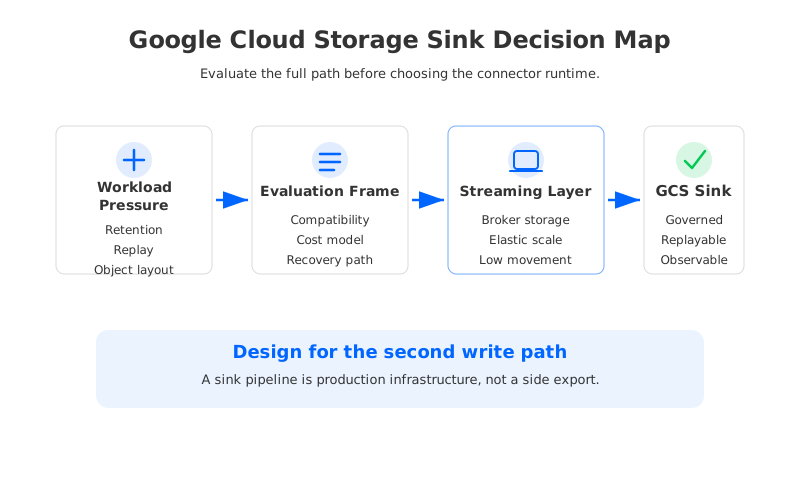
Teams rarely search for google cloud storage kafka sink because they want another connector definition. They search for it when an event stream has become part of the data platform contract. Raw events need to land in Google Cloud Storage for analytics, machine learning features, compliance retention, or lakehouse ingestion, and the Kafka-compatible layer in the middle has to keep serving producers and consumers while that sink path is being built.
That is where a small integration choice turns into an architecture decision. A sink connector can write objects to a bucket, but the production question is wider: how do you preserve ordering where it matters, replay safely, control file layout, avoid runaway cloud cost, and keep ownership clear between the streaming team and the data lake team? If the Kafka cluster underneath the connector is hard to scale or expensive to retain, the sink pipeline inherits that pressure.
1Why teams search for google cloud storage kafka sink
A Google Cloud Storage sink pipeline usually appears at the boundary between real-time systems and batch-oriented data platforms. Product services emit events into Kafka-compatible topics. Analytics, feature engineering, fraud detection, and audit workflows want those events in object storage because buckets are durable, inexpensive for large retained datasets, and easy for many downstream tools to read. The sink is the bridge between those two operating models.
The bridge has to carry more than bytes. It carries delivery semantics, schema evolution, partition layout, retry behavior, and backfill expectations. A connector that writes files every few minutes may be enough for one dashboard and completely wrong for a compliance pipeline that needs predictable object naming and deterministic replay. The first design mistake is treating the sink as a peripheral integration instead of a second write path with its own SLO.
Three pressures tend to show up early:
- Retention pressure. Teams want enough history in the stream to replay into Google Cloud Storage after schema or connector changes, but broker-local disks make long retention a capacity and rebalancing problem.
- Connector pressure. Kafka Connect workers need stable offsets, schemas, credentials, and error handling; a failure in the sink path should not force application producers to slow down.
- Cost pressure. The data path may cross zones, write many small objects, or duplicate data across broker replicas before the data even reaches a bucket.
The right question is not "which connector can write to Google Cloud Storage?" The sharper question is "what streaming operating model lets this sink remain boring when volume, retention, and replay windows grow?"
2The integration constraint behind the pipeline
Kafka Connect gives teams a standard way to run source and sink integrations around Kafka topics. That standardization matters because connector workers can manage task parallelism, offsets, retries, and transformations without every application team writing its own export code. For a Google Cloud Storage sink, the connector layer usually maps topic partitions into object files, batches records by time or size, and commits progress after data has been flushed.
Those mechanics create a dependency on the health of the upstream stream. If a topic partition cannot retain enough history, replay becomes a race against log deletion. If broker storage fills up during a downstream outage, the connector team may have to choose between losing replay capacity and adding emergency broker capacity. If partition reassignment moves large amounts of data across zones, a scale-up meant to help the sink can create more operational noise.
Traditional Kafka was designed around a shared-nothing model: each broker owns local log segments, and durability comes from replicating partitions across brokers. That model is proven, but it ties storage capacity, compute capacity, and recovery behavior together. A sink pipeline that wants longer replay windows may require more disks even when compute is idle. A spike in producer traffic may require more brokers even when most of the pressure is temporary. A maintenance event can involve moving data because partition ownership and local storage are coupled.
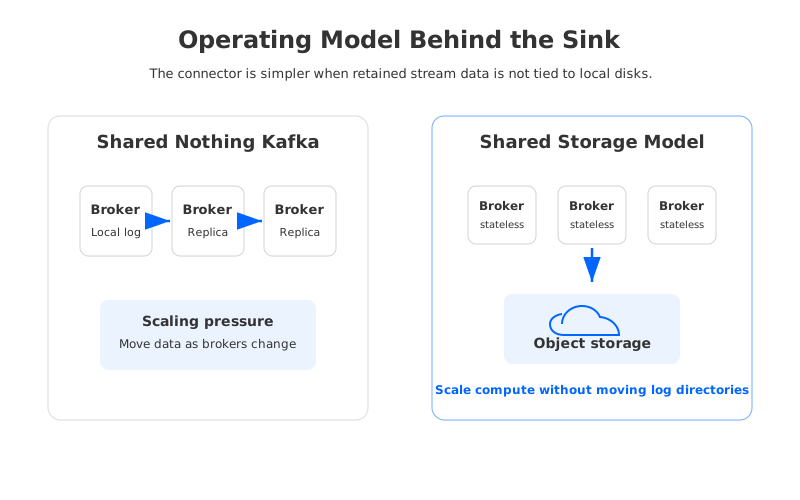
Google Cloud Storage changes the downstream side of the equation, but it does not automatically change the upstream side. The bucket can retain large datasets, support lifecycle policies, and serve many analytics readers. The Kafka-compatible layer still has to absorb writes, preserve consumer progress, and keep enough history to recover the sink after failures. When teams miss that distinction, they optimize object storage while leaving the most fragile part of the pipeline unchanged.
3Connector, schema, replay, and stream processing trade-offs
The sink design starts with data shape. Some teams export raw JSON to make the first pipeline easy, then discover that object storage is now full of loosely governed files that every downstream reader interprets differently. Others enforce Avro, Protobuf, or JSON Schema early, which adds coordination but gives the lake team a stronger contract. The right choice depends on how many consumers will read the bucket and how often schemas change.
Delivery semantics are the next trade-off. Kafka producers can use idempotence and transactions for stronger write guarantees inside Kafka, and Kafka Connect can track offsets for connector progress. A Google Cloud Storage sink still has to deal with object-level behavior: partial writes, retries, file naming, compaction strategy, and duplicate handling in downstream jobs. Most production teams design the bucket layout so reprocessing is possible and duplicate files can be detected or overwritten by deterministic paths.
The stream-processing layer adds another decision point. If the pipeline only needs to archive events, a connector may be enough. If it needs enrichment, joins, deduplication, or windowed aggregation before the data lands in Google Cloud Storage, Apache Flink, Kafka Streams, or another processing engine may sit between the input topic and the sink topic. That extra stage can improve data quality, but it also introduces state, checkpointing, and another recovery path.
| Decision area | What to verify | Why it matters for the sink |
|---|---|---|
| Topic retention | Replay window, compaction policy, and delete policy | The sink must recover after connector outages or schema fixes. |
| File layout | Prefixes, partitioning fields, object size, and time buckets | Downstream query cost and discoverability depend on object organization. |
| Schema contract | Registry policy, compatibility mode, and failure handling | A schema break can stop the sink or poison the bucket. |
| Worker isolation | Connector task count, credentials, network path, and quotas | The export path should fail independently from application producers. |
| Backfill path | Offset reset process, duplicate strategy, and rollback plan | Replays are normal operations, not one-off emergencies. |
This table is intentionally less exciting than most architecture diagrams. Production sink pipelines fail in unglamorous places: an object prefix becomes too expensive to scan, a connector retries the same poison record forever, or a retention policy deletes the clean replay window the team was counting on. The architecture should make those failures visible and reversible.
4Evaluation checklist for data platform teams
A useful evaluation starts with the boundaries between teams. Application owners care about producer latency and topic contracts. The streaming platform team cares about brokers, partitions, quotas, and upgrades. The data platform team cares about bucket layout, governance, and downstream compute. A Google Cloud Storage sink crosses all three, so ownership needs to be explicit before the first production topic is connected.
Use this checklist to pressure-test the design:
- Compatibility. Confirm that existing Kafka clients, schemas, topic settings, and connector APIs can move without application rewrites.
- Cost model. Separate broker compute, broker storage, inter-zone traffic, connector workers, object storage operations, and downstream query cost.
- Elasticity. Check whether scaling the stream requires data movement or only metadata and compute changes.
- Governance. Define schema compatibility, bucket prefixes, IAM boundaries, retention, encryption, and audit requirements together.
- Recovery. Practice connector restarts, offset resets, bad-record quarantine, replay, and rollback before the pipeline carries regulated data.
- Observability. Track lag, task failures, retry volume, object write latency, object count, and downstream freshness from one dashboard.
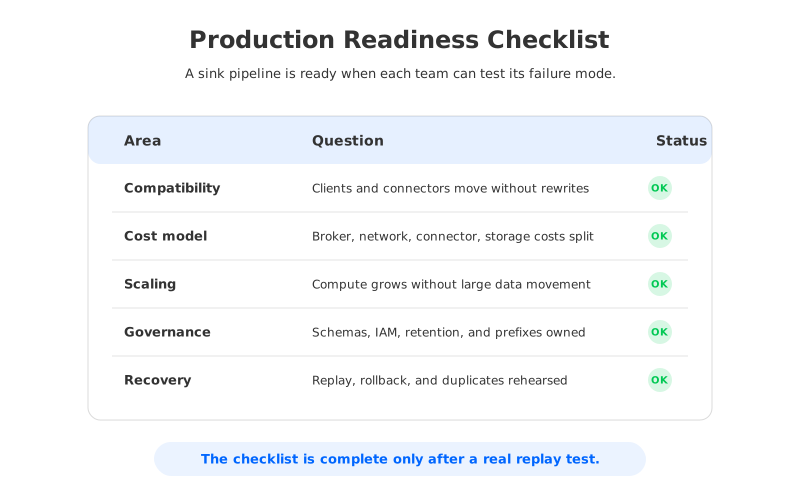
The most revealing part of this checklist is the cost model. Many teams account for the bucket and connector workers, then undercount the cost of keeping the upstream stream healthy. Broker-local retention, replica traffic, and data movement during rebalancing are not connector costs on paper, but they are real costs of running the sink. A design that looks efficient at the connector layer can still be expensive at the streaming layer.
5How AutoMQ changes the operating model
Once the evaluation reaches storage coupling, the useful architectural requirement becomes clear: the Kafka-compatible layer should keep Kafka protocol semantics while making retained data less dependent on broker-local disks. That is the point where AutoMQ enters the discussion naturally. AutoMQ is a Kafka-compatible cloud-native streaming platform that uses shared storage architecture, stateless brokers, and object-storage-backed durability to separate compute from storage while preserving Kafka APIs and ecosystem compatibility.
In a shared storage model, brokers still serve Kafka clients and coordinate partition leadership, but durable data is not treated as broker-local property. AutoMQ uses S3Stream and WAL storage in front of object storage so brokers can acknowledge writes with a durable path and then compact stream data into shared storage. The operational effect is that scaling and recovery rely more on metadata, ownership, and cache behavior than on moving large log directories between brokers.
For a Google Cloud Storage sink pipeline, that changes the trade-off in several practical ways. Longer replay windows no longer imply the same broker-local disk expansion. Broker replacement is less tied to local data recovery. Compute can scale with request load while storage grows in object storage. In multi-zone cloud deployments, reducing broker-to-broker data replication and data movement can also reduce the network tax that usually hides behind "standard Kafka operations."
This is not a reason to ignore connector design. You still need schema discipline, deterministic bucket layout, bad-record handling, and a tested replay process. The difference is that the streaming platform no longer amplifies every sink requirement into a broker storage project. The connector team can focus on export correctness, while the platform team has a cleaner path for retention, scale, and recovery.
AutoMQ also matters for organizational boundaries. In BYOC-style deployments, customers can keep the data plane in their own cloud account while using a Kafka-compatible interface for applications. For data teams that already standardize around object storage and cloud-native governance, that deployment boundary can be easier to explain than a streaming platform that constantly asks for larger disks, more replicas, and manual partition movement.
6A practical migration path
The safest migration treats the sink as a production data product, not a connector installation. Start with one topic whose downstream consumers can tolerate a controlled replay. Define the object path and schema policy first, then run the connector in parallel with existing exports until object counts, freshness, and downstream reads match expectations. Only after that should the team expand to high-volume topics or compliance-sensitive datasets.
A migration scorecard helps keep the process honest:
| Readiness signal | Low-risk answer | Risky answer |
|---|---|---|
| Replay window | Retention covers the full backfill and validation period | Retention is shorter than the expected fix cycle |
| Schema evolution | Compatibility policy is enforced before export | Sink discovers schema breaks after files are written |
| Object layout | Prefixes match query and lifecycle patterns | File names are connector defaults nobody owns |
| Platform scaling | Compute and storage can scale independently | More sink volume means more broker-local data movement |
| Rollback | Offset reset and duplicate strategy are rehearsed | Rollback depends on deleting bucket contents manually |
The scorecard is also a useful buying framework. A managed connector catalog may reduce integration work, but it does not automatically solve replay, retention, or broker scaling. A cloud-native Kafka-compatible platform may reduce storage coupling, but it still needs disciplined connector operations. The production answer is usually a combination: a predictable connector runtime, a governed bucket contract, and a streaming layer that does not turn every replay into an infrastructure event.
7CTA
If your search for google cloud storage kafka sink started with a connector question, use it as a chance to review the streaming layer underneath the connector. The durable part of the pipeline is not only the bucket; it is the full path from producers, through Kafka-compatible storage, through connector offsets, into governed objects. To see how a shared-storage Kafka-compatible architecture changes that path, review the AutoMQ architecture guide: Explore AutoMQ shared storage architecture.
8References
- Apache Kafka Documentation, Kafka Connect: https://kafka.apache.org/documentation/#connect
- Apache Kafka Documentation, Producer idempotence configuration: https://kafka.apache.org/documentation/#producerconfigs_enable.idempotence
- Apache Kafka KIP-405: Kafka Tiered Storage: https://cwiki.apache.org/confluence/display/KAFKA/KIP-405%3A+Kafka+Tiered+Storage
- Google Cloud, Create a Cloud Storage sink connector: https://docs.cloud.google.com/managed-service-for-apache-kafka/docs/connect-cluster/create-cloud-storage-connector
- Google Cloud Storage, bucket locations: https://docs.cloud.google.com/storage/docs/locations
- AutoMQ Docs, Architecture overview: https://docs.automq.com/automq/architecture/overview?utm_source=blog&utm_medium=reference&utm_campaign=aivk-0064
- AutoMQ Docs, Compatibility with Apache Kafka: https://docs.automq.com/automq/what-is-automq/compatibility-with-apache-kafka?utm_source=blog&utm_medium=reference&utm_campaign=aivk-0064
- AutoMQ Docs, Table Topic overview: https://docs.automq.com/automq-cloud/table-topic/overview?utm_source=blog&utm_medium=reference&utm_campaign=aivk-0064
9FAQ
9.1Is a Google Cloud Storage Kafka sink the same as Kafka tiered storage?
No. A sink connector exports topic data into Google Cloud Storage for downstream use, often as files organized by topic, partition, time, or business fields. Tiered storage changes how Kafka stores older log segments for the broker itself. Both use object storage, but they solve different problems and have different operational contracts.
9.2Do I need stream processing before writing to Google Cloud Storage?
Not always. If the goal is raw archival or simple ELT staging, a connector can be enough. If the data needs enrichment, deduplication, joins, privacy filtering, or windowed aggregation before it reaches the bucket, add a stream-processing layer and treat its state and checkpointing as part of the recovery design.
9.3What is the biggest production risk in a Google Cloud Storage sink pipeline?
The biggest risk is usually weak replay planning. Connectors fail, schemas change, and downstream consumers ask for corrected files. The pipeline is much easier to operate when topic retention, object naming, offset reset, duplicate handling, and rollback are tested before the first critical dataset is exported.
9.4Where does AutoMQ fit in this architecture?
AutoMQ fits under the connector layer as a Kafka-compatible streaming platform. Its shared storage architecture and stateless brokers help reduce the coupling between retained stream data and broker-local disks, which is useful when sink pipelines need longer replay windows, elastic capacity, and lower operational overhead.


