
Table of Contents
Table of Contents
Searching for a Google managed Kafka alternative does not always mean your team dislikes managed services. More often, it means the managed-service label did not answer the harder questions: how much Kafka compatibility do you need, who controls the data plane, what happens when retention grows, and how painful will migration be when the first architecture assumption is wrong?
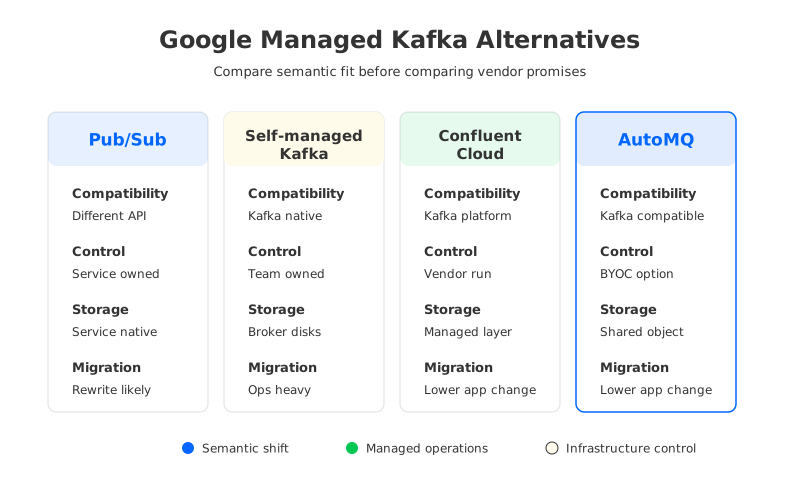
That matters because "Kafka on Google Cloud" can mean several different things. It can mean Google's Managed Service for Apache Kafka. It can mean Pub/Sub, which is a Google Cloud-native messaging service rather than a Kafka-compatible log. It can mean Confluent Cloud, a third-party managed Kafka and data streaming platform available on Google Cloud. It can mean self-managed Kafka on GKE or Compute Engine. It can also mean a Kafka-compatible system such as AutoMQ, where the Kafka API remains but the storage architecture changes.
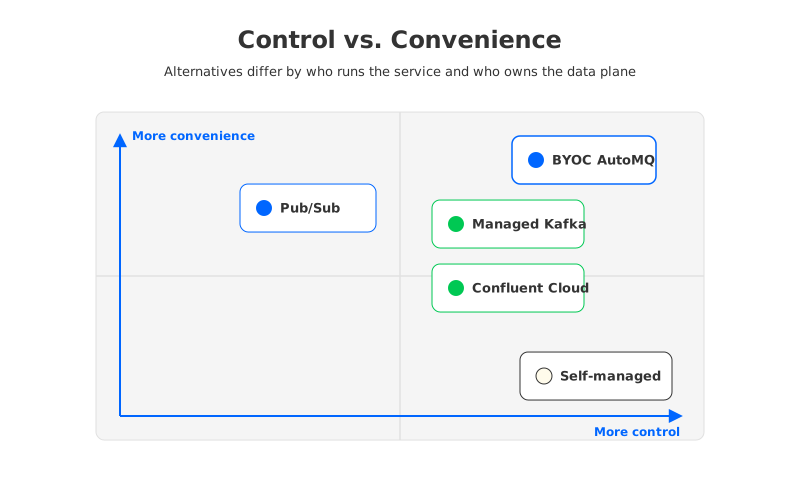
The choice is not managed versus unmanaged. The sharper question is which trade-off you want to buy.
1Why Teams Look Beyond Managed Kafka
Managed Kafka is attractive because it removes a painful slice of cluster operations. Teams no longer want to spend nights planning broker replacements, tuning disks, handling failed nodes, or treating partition reassignment as a production event. For many workloads, that is enough reason to use a provider-operated Kafka service.
The second-order questions show up later. A managed Kafka service can still preserve the operational shape of traditional Kafka: brokers, partitions, replication, storage sizing, network paths, upgrades, quotas, and cluster-level capacity decisions. Some of those decisions move from your runbook to the provider's control plane, but they do not disappear from the architecture. If the workload is storage-heavy, bursty, cross-zone, or migration-sensitive, the managed wrapper may not be the main cost driver.
Teams usually start comparing alternatives for five reasons:
- Application compatibility. Existing producers, consumers, Kafka Connect jobs, stream processors, schemas, and lag dashboards may assume Kafka semantics. Replacing Kafka with a non-Kafka service can be a product rewrite, not an infrastructure migration.
- Cloud control. Security teams may need network boundaries, identity controls, private connectivity, audit paths, and data residency that match the company's Google Cloud account model.
- Cost shape. Kafka cost is not only a line item for a service. It includes broker capacity, storage, replication, network traffic, retention, over-provisioning, observability, and human time.
- Elasticity. Some workloads have bursty traffic or long retention. If scaling still depends on data movement or broker-local storage, the cluster can feel less elastic than the cloud around it.
- Exit risk. A service can reduce operational work while increasing dependency on provider-specific APIs, pricing, networking, or migration paths.
These concerns do not make Google's managed Kafka service a bad choice. They make it a choice that deserves the same evaluation discipline as any production data platform.
2Evaluation Criteria for Google Managed Kafka Alternatives
The comparison should start with semantics, not pricing. Pricing matters, but a lower monthly bill is useless if the migration breaks ordering, replay, or stream-processing contracts. Kafka is not a generic queue; it is a partitioned log with offsets, consumer groups, retention, replication, and an ecosystem built around those concepts.
Use this framework before you talk to vendors or size clusters:
| Criterion | What to Ask | Why It Matters |
|---|---|---|
| Kafka compatibility | Can existing Kafka clients, connectors, and tools keep working? | Determines whether migration is infrastructure work or application redesign. |
| Data-plane control | Where does data live, and whose cloud account owns the network path? | Affects security review, procurement, audit, and incident response. |
| Storage architecture | Are durable logs tied to broker-local disks or shared cloud storage? | Drives scaling, recovery, retention, and data movement. |
| Elastic scaling | Can compute scale without moving large volumes of log data? | Separates cloud elasticity from traditional broker operations. |
| Cost model | Which costs grow with throughput, retention, replication, or zones? | Prevents surprises after production traffic arrives. |
| Migration path | Can you cut over, mirror, validate, and roll back without rewriting clients? | Reduces launch risk for production Kafka estates. |
The table has a bias: it treats architecture as a first-class buying criterion. That is intentional. A service comparison that stops at "managed operations" misses the fact that Kafka's storage model is often where cost and elasticity problems begin.
3Alternative 1: Pub/Sub
Google Pub/Sub is the cleanest answer when the workload is Google Cloud-native messaging and does not need Kafka compatibility. It is designed around topics, subscriptions, acknowledgement, delivery controls, filtering, retention, and integration with services such as Dataflow, Cloud Run, Cloud Functions, and BigQuery-oriented pipelines. For greenfield applications inside Google Cloud, that model can remove a large amount of platform work.
The trade-off is semantic change. Pub/Sub is not a Kafka cluster with a different control plane. Kafka applications read partitions by offset, coordinate consumer groups, reason about partition-level ordering, and often depend on Kafka Connect or Kafka Streams. Pub/Sub applications reason about subscriptions, acknowledgements, delivery attempts, and service-managed scaling. Both models move events, but they encode different contracts.
Choose Pub/Sub when your team can answer yes to most of these questions:
- The application can be designed around Pub/Sub topics and subscriptions rather than Kafka topics and offsets.
- Ordering requirements fit Pub/Sub ordering-key behavior instead of Kafka partition ordering.
- Google Cloud service integration is more valuable than Kafka ecosystem portability.
- Replay and backfill procedures can be rebuilt around Pub/Sub retention and seek controls.
- Migration does not require preserving Kafka clients, Kafka Connect, or Kafka Streams unchanged.
Pub/Sub is often the right alternative when you are replacing a messaging problem. It is a risky shortcut when you are trying to preserve a Kafka platform contract.
4Alternative 2: Self-Managed Kafka on GKE or Compute Engine
Self-managed Kafka gives you maximum control. You choose broker sizing, disk type, network placement, security controls, version cadence, configuration, observability, and automation. On Google Cloud, teams commonly place Kafka on GKE or Compute Engine so they can align it with existing Kubernetes, Terraform, network, and incident-management practices.
The price of that control is operational ownership. Kafka remains sensitive to partition count, broker disk pressure, replication, controller health, client behavior, and rebalancing. Long retention increases storage pressure. Multi-zone replication increases traffic and failure-mode complexity. Scaling a cluster is not the same as scaling stateless compute, because broker-local data must be managed.
Self-managed Kafka makes sense when your organization has a mature Kafka platform team and strict requirements that managed services cannot satisfy. It is harder to justify when the team is using self-management because the alternatives were evaluated only at a feature-list level. A custom-run Kafka estate can become a private managed service that your SRE team funds with pager time.
5Alternative 3: Confluent Cloud on Google Cloud
Confluent Cloud is a strong candidate when the requirement is managed Kafka plus a broader Kafka ecosystem. It provides a managed data streaming platform built around Kafka, with surrounding capabilities for connectors, governance, stream processing, and enterprise operations. For teams already invested in Confluent tooling or looking for a vendor-managed Kafka experience across clouds, it often belongs on the shortlist.
The evaluation still needs discipline. Ask how the service maps to your Google Cloud network, identity, data-governance, and cost requirements. Ask what cluster type or deployment model fits your workload. Ask how connector, governance, observability, support, and data-transfer costs are represented in the commercial model. A platform can reduce engineering work while adding procurement and integration complexity.
The main distinction from Pub/Sub is compatibility. Confluent Cloud is a Kafka-centered path, so it is usually a smaller application migration than moving to a non-Kafka service. The main distinction from self-managed Kafka is control. You are buying a managed platform, not building your own. That trade-off is attractive when your team wants Kafka semantics and vendor-run operations more than low-level infrastructure ownership.
6Alternative 4: AutoMQ
At this point, the real pattern is visible: teams want Kafka compatibility, but they do not always want traditional Kafka's broker-local storage model. That is where AutoMQ fits as a Kafka-compatible, cloud-native streaming system that separates compute from durable storage. Existing Kafka clients and ecosystem tools can remain relevant, while the durable log is backed by shared object storage rather than being bound to broker disks.
This is a different alternative from "another managed Kafka service." AutoMQ changes the storage architecture underneath the Kafka API. Stateless brokers make scaling and recovery less dependent on moving large amounts of log data between machines. Object-storage-backed shared storage changes the retention and durability conversation because durable data is no longer coupled to each broker's local disk footprint. In BYOC-style deployments, teams can also keep infrastructure and data-plane control aligned with their own cloud account and VPC strategy.
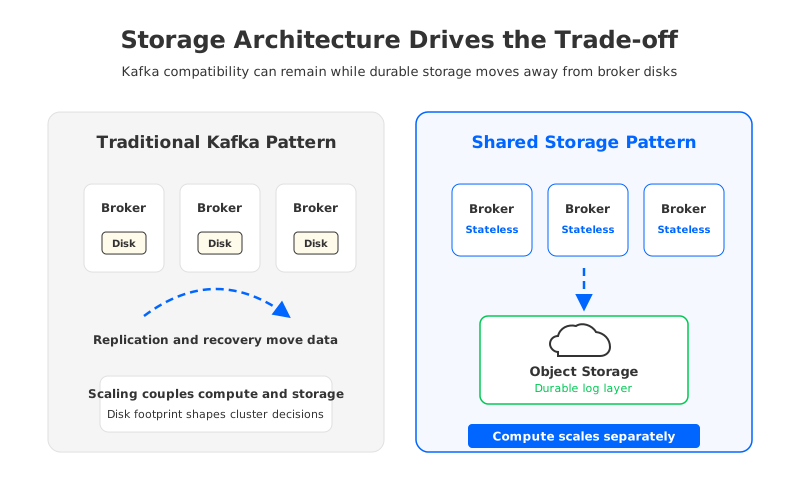
The architectural difference matters most in workloads where traditional Kafka operations become expensive or slow:
- Long retention topics where local disks dominate sizing decisions.
- Bursty workloads where compute demand changes faster than data placement can follow.
- Multi-zone clusters where replication and recovery paths affect both cost and operations.
- Migration projects where teams need Kafka compatibility without inheriting every broker-local storage trade-off.
AutoMQ is not a reason to ignore managed Kafka or Pub/Sub. It is a reason to separate two questions that often get blurred together: do you need Kafka semantics, and do you need Kafka's traditional storage architecture?
7Decision Checklist Before You Commit
A useful evaluation does not begin with a vendor demo. It begins with a workload inventory. Pick three representative topics: one high-throughput topic, one long-retention topic, and one operationally sensitive topic. For each, document partition count, retention, producer rate, consumer groups, replay requirements, ordering assumptions, connector dependencies, and current incident history.
Then ask each alternative the same questions:
| Question | Pub/Sub | Self-Managed Kafka | Confluent Cloud | AutoMQ |
|---|---|---|---|---|
| Can existing Kafka clients stay? | Usually no | Yes | Yes | Yes |
| Who owns operations? | Google Cloud | Your team | Confluent | Deployment-dependent |
| Where is durable log storage modeled? | Service-native | Broker disks | Managed Kafka platform | Shared object storage |
| Is application migration small? | Workload-dependent | Yes if already Kafka | Usually yes | Usually yes |
| Is low-level control high? | Low | High | Medium | Medium to high |
| Is it designed for Google Cloud-native service integration? | High | Team-built | Platform-dependent | Deployment-dependent |
This matrix is a starting point, not a verdict. Pub/Sub wins when the workload should be redesigned around Google Cloud-native messaging. Self-managed Kafka wins when control is worth the operational burden. Confluent Cloud wins when a managed Kafka platform and ecosystem breadth are the priority. AutoMQ wins consideration when the team wants Kafka compatibility but sees broker-local storage as the wrong long-term foundation.
The final decision should include a proof of concept that tests failure recovery, replay, scaling, private connectivity, observability, and cost under realistic traffic. A small hello-world cluster tells you almost nothing about a production event-streaming platform.
8A Practical Recommendation
If your team is comparing alternatives to Google managed Kafka, start by deciding whether you are replacing Kafka semantics or replacing Kafka operations. Pub/Sub is compelling when you can replace the semantics. Managed Kafka platforms are compelling when you want to keep Kafka semantics and outsource operations. Self-managed Kafka is compelling when control outweighs operational cost. AutoMQ is compelling when Kafka compatibility still matters, but the storage layer is the part you most want to change.
That distinction keeps the conversation honest. The wrong alternative is rarely wrong because it lacks features. It is wrong because it solves a different problem than the one your workload actually has. If the bottleneck is application compatibility, preserve the Kafka contract. If the bottleneck is broker-local storage, evaluate architectures that move durable data to shared cloud storage. If the bottleneck is Google Cloud service integration, Pub/Sub may be the cleaner path.
For teams that want to preserve Kafka clients while testing a shared-storage architecture, the next step is to review AutoMQ's architecture and deployment model for Google Cloud: AutoMQ architecture and deploying AutoMQ on Google Cloud GKE. Use the same workload inventory and proof-of-concept tests you would apply to any other alternative.
9References
- Google Cloud Managed Service for Apache Kafka overview
- Google Cloud Managed Service for Apache Kafka pricing
- Google Cloud: Choose between Pub/Sub and Managed Service for Apache Kafka
- Google Cloud Pub/Sub overview
- Apache Kafka documentation
- Confluent Cloud documentation
- AutoMQ architecture overview
- AutoMQ on Google Cloud GKE
10FAQ
10.1Is Pub/Sub a Google managed Kafka alternative?
Pub/Sub can be an alternative for Google Cloud-native messaging, but it is not a Kafka-compatible replacement. It uses topics, subscriptions, acknowledgements, and managed delivery controls rather than Kafka partitions, offsets, and consumer-group semantics. Treat it as a redesign option when the application can move to the Pub/Sub model.
10.2When should I use self-managed Kafka on GCP?
Use self-managed Kafka when your team needs deep infrastructure control and has the operational maturity to run Kafka in production. It can fit strict networking, configuration, or platform requirements, but the team owns broker capacity, storage, failures, upgrades, monitoring, and incident response.
10.3How is AutoMQ different from a traditional managed Kafka service?
AutoMQ is Kafka-compatible, but its architecture separates brokers from durable log storage by using shared object storage. Traditional Kafka deployments usually tie durable data to broker-local disks. That difference can change scaling, recovery, retention, and data-movement trade-offs while preserving Kafka-facing application compatibility.
10.4What should a proof of concept include?
Test more than producer and consumer connectivity. Include private networking, authentication, topic creation, connector behavior, consumer lag, replay, broker or node failure, scale-out, scale-in, retention growth, observability, and cost under traffic that resembles production. The goal is to validate the operating model, not only the API.


