
Table of Contents
Table of Contents
Teams search for connector cost allocation kafka when Kafka Connect has stopped being a sidecar and started acting like shared production infrastructure. One CDC connector feeds search indexing, analytics, and customer support workflows. Another sink connector writes curated events into a lakehouse. A third source connector runs inside a regulated account, uses private networking, and carries data whose schema changes can break downstream consumers. Finance asks which team should pay. Platform engineering asks a harder question: which technical behavior created the bill?
The answer is rarely "the connector." Connector cost is the visible edge of a larger system. Kafka Connect workers consume CPU and memory, source systems impose read limits, Kafka brokers absorb writes and replay traffic, retained records occupy storage, schema failures create reprocessing work, and network placement can turn a clean integration into an expensive path across accounts, Availability Zones, or regions.
The useful frame is this: connector cost allocation is a governance problem before accounting. A fair model needs workload signals, schema ownership, replay rules, network locality, and architecture that does not hide durable data movement behind one shared cluster bill.
1Why teams search for connector cost allocation kafka
Connector cost allocation usually appears after the first wave of integrations succeeds. Early connectors are approved for delivery speed: move database changes, publish operational events, land records in object storage, or send telemetry to analytics. The team celebrates because applications no longer need custom point-to-point sync jobs. Then the connectors multiply.
The second wave changes the economics. A connector may be owned by a data integration team, but its topic is consumed by five product teams. A source task may read from one database, while replay after a downstream incident is caused by another consumer. A schema change may come from the source owner, while repair lands on the platform team.
Ordinary cloud cost allocation tags are not enough. Tags can identify a worker node, Kubernetes namespace, bucket, or account. They do not explain whether a cost was created by source read volume, task parallelism, retained Kafka bytes, consumer fanout, catch-up reads, cross-zone traffic, schema quarantine, or support work.
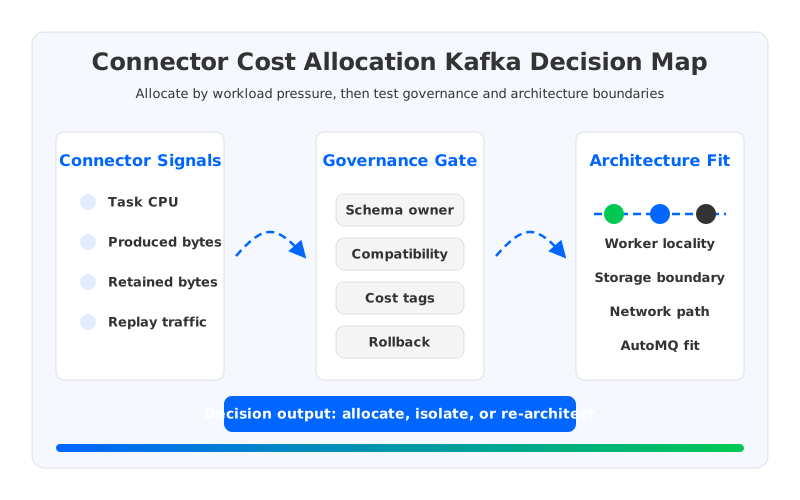
The allocation model has to answer four technical questions:
- Who owns the data contract? A connector that moves incompatible records can create cost through retries, dead-letter queues, backfills, and manual repair even when task CPU looks normal.
- Who owns the workload pressure? Produced bytes, retained bytes, replay volume, and consumer fanout should not all be charged to the team that happened to deploy the connector.
- Who owns the platform margin? Worker isolation, broker headroom, observability, secrets management, schema registries, and incident response protect many tenants at once.
- Who owns the architecture multiplier? Broker-local replication, partition movement, cross-AZ paths, and storage coupling decide how expensive valid connector demand becomes.
Once those questions are explicit, chargeback becomes a discussion about which decisions a team can control.
2The production constraint behind the problem
Apache Kafka gives connector-heavy platforms a strong foundation. Topics and partitions provide durable ordered logs. Offsets let consumers and connector tasks track progress. Consumer groups coordinate parallel consumption. Kafka Connect standardizes source and sink integration through workers, connectors, and tasks. Connector platforms need recovery, not only delivery.
Kafka Connect exercises the whole platform. A source connector that catches up after a pause can create a write burst, broker cache pressure, retained data growth, schema validation load, and downstream lag. A sink connector that falls behind can extend retention because source topics need enough history for safe replay. A failed schema rollout can turn normal traffic into quarantine storage and manual offset decisions.
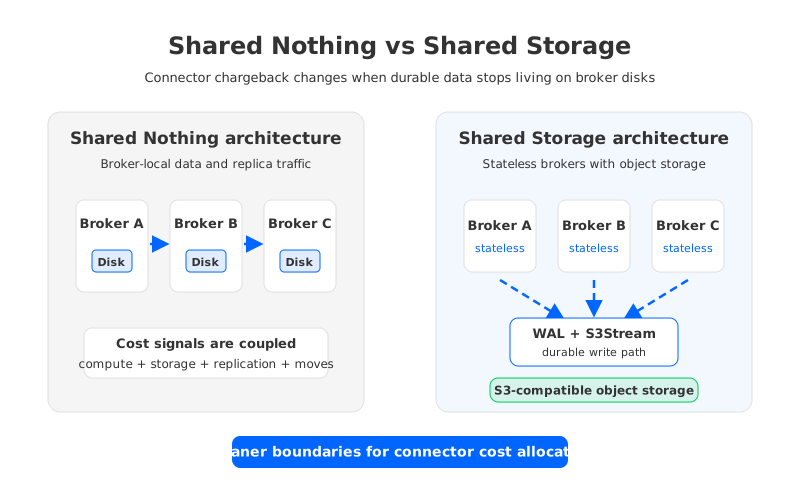
Traditional Kafka adds another layer through its Shared Nothing architecture. Each broker owns local persistent log segments for assigned partitions, and reliability depends on replication between brokers. When connector traffic grows, cost can appear as attached disk, broker headroom, inter-broker replication, partition reassignment, and operational time. Even when the connector is small, the data it writes can pin broker capacity because durable data and compute live together.
That coupling matters for allocation. If a connector writes a high-volume CDC stream with long retention, should the source team pay for broker compute kept online because retained partitions live on those brokers? If consumers replay data every Monday, should replay cost be charged to the connector owner, consumer owner, or platform pool? If schema errors create backfills, should the bill follow the data producer, schema approver, or repair owner?
There is no universal answer, but the platform must expose the signals. Without connector metrics, topic metrics, schema events, consumer lag, network paths, and cloud cost dimensions in one review, allocation defaults to whoever owns the deployment object. That is easy to calculate and usually wrong.
3Architecture options and trade-offs
Before evaluating vendors, separate the connector platform into layers. Worker placement decides where tasks run and which systems they can reach. Kafka compatibility decides whether clients, connectors, offsets, transactions, and tooling behave as expected. Storage architecture decides whether retained data, scaling, recovery, and replication remain tied to broker-local disks. Governance decides whether schema and ownership changes are visible before incidents.
The common patterns have different allocation consequences:
| Pattern | What it makes easy | Cost allocation risk |
|---|---|---|
| Shared Connect cluster for many teams | Centralized operations and reusable plugins | Noisy connectors can hide behind shared worker and broker pools |
| Per-team Connect workers | Clearer ownership and isolation | Duplicate platform overhead, inconsistent controls, and scattered observability |
| Source-local workers | Better source network locality and credential boundaries | Kafka write paths and schema controls can become harder to standardize |
| Kafka-local workers | Simpler Kafka access and platform control | Remote source access, private endpoint cost, and source-side governance complexity |
| Broker-local Kafka storage | Familiar Kafka operating model | Retention, replication, and reassignment costs stay coupled with broker capacity |
| Shared Storage architecture | Cleaner separation of compute and retained data | Requires validation of WAL, object storage, cache behavior, and deployment boundaries |
This table is not a ranking. A small platform may prefer a shared Connect cluster because operational simplicity matters. A regulated platform may prefer per-domain workers because secrets, data classes, and audit trails need hard boundaries. A high-volume CDC estate may discover that retained Kafka data and replay behavior are the real cost drivers.
Schema governance belongs in the same discussion because it determines who can create downstream cost. A field rename, key change, timestamp semantic change, or delete-event behavior change can force consumer updates, replay jobs, and cleanup. If the platform charges only for connector runtime, it rewards teams for ignoring contract cost.
A stronger model separates measured workload usage, shared platform overhead, and architecture multipliers such as broker-local replication, storage coupling, cross-zone paths, migration tooling, and dual-run periods. Many teams try to allocate an architecture multiplier instead of asking whether it should exist in the next platform generation.
4Evaluation checklist for platform teams
A useful connector cost allocation program starts with evidence engineers can verify. Do not divide the invoice by connector count. Begin with a route-level checklist that shows whether the integration is measurable, governable, and recoverable.
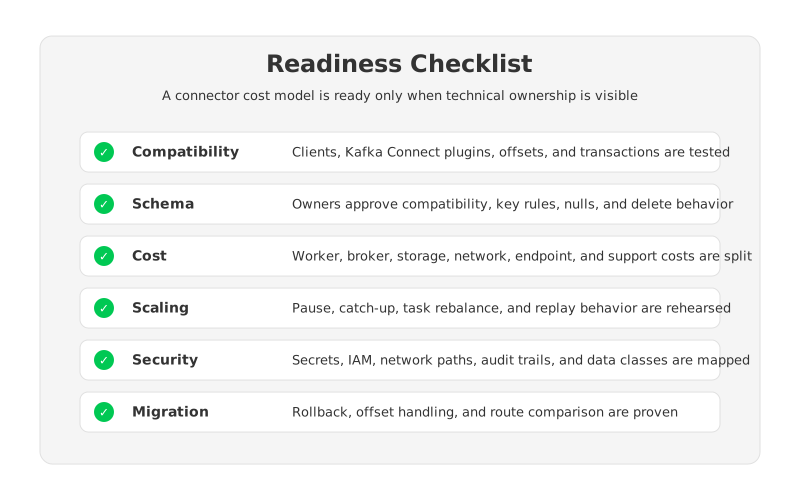
The checklist should include seven checks.
- Compatibility: Validate Kafka clients, connector plugins, serializers, Admin API usage, topic configuration, offset behavior, consumer group behavior, and transaction requirements. Compatibility is workload-specific; a bootstrap test is not enough.
- Schema ownership: Name the team that owns the event contract, the team that approves compatibility changes, and the team that handles invalid records. Include keys, headers, timestamps, null behavior, tombstones, and delete semantics.
- Workload ledger: Track task CPU and memory, produced bytes, retained bytes, read fanout, replay volume, dead-letter volume, and partition footprint by connector route or domain.
- Network locality: Map source, worker, broker, schema registry, secret store, sink, object storage, and observability endpoints across accounts, Virtual Private Clouds (VPCs), regions, and Availability Zones.
- Scaling and backlog recovery: Rehearse pause, resume, task rebalance, source throttling, broker pressure, consumer catch-up, and sink outage scenarios. Cost spikes often appear during recovery, not steady state.
- Security and audit: Separate source credentials, connector credentials, Kafka credentials, schema permissions, and cloud IAM. Record configuration changes and manual offset actions.
- Migration and rollback: Define how to dual-run, compare records, freeze schema changes, preserve or rewind offsets, quarantine records, and roll back without double-applying side effects.
The checklist also prevents a common organizational failure. Data integration, platform, finance, security, and schema owners often measure different signals. Connector cost allocation only works when those signals are reviewed together.
For a first implementation, keep the model plain. Allocate worker runtime to the connector owner, produced and retained bytes to the data product or source domain, and measurable fanout or replay cost to consumer domains. Pool baseline platform overhead by policy. Review architecture multipliers separately, because those are design choices.
5How AutoMQ changes the operating model
After that neutral evaluation, AutoMQ becomes relevant as a Kafka-compatible streaming platform that changes the storage layer while keeping Kafka-facing semantics familiar. AutoMQ uses Shared Storage architecture: brokers handle protocol processing, leadership, caching, and scheduling, while durable data is persisted through S3Stream with WAL storage and S3-compatible object storage.
That matters because it separates cost boundaries that traditional Kafka tends to blend together. Retained connector data can be discussed as object storage and retention. Broker compute can be discussed as traffic, cache, and request handling. Scaling and broker replacement do not need to be framed primarily as moving broker-local durable logs.
AutoMQ BYOC is also relevant to governance boundaries. In AutoMQ BYOC, the control plane and data plane run inside the customer's cloud account and VPC. AutoMQ managed Kafka Connect deploys workers inside the user's VPC, with task management through the AutoMQ Console or Terraform. That boundary helps teams evaluate credentials, private access, audit logs, data movement, and cost allocation inside their own cloud controls.
The architecture does not eliminate governance work. Schema checks still need owners. Connectors still need plugin validation, secret rotation, isolation policy, and observability. Consumers still need idempotency and replay discipline. AutoMQ changes the infrastructure bottleneck under those practices: stateless brokers, object-storage-backed durability, WAL options, Self-Balancing, and zero cross-AZ traffic designs can reduce cost created by broker-local storage and replica movement rather than actual workload demand.
For migration, evaluate route by route. Choose one connector domain with clear ownership, representative volume, and real consumers. Validate Kafka clients and Connect plugins, run legacy and target paths in parallel, compare records, test offset continuity, and rehearse rollback. If the route only works on the happy path, the platform is not ready for broad connector chargeback.
6A decision matrix for the first production route
Use a small scorecard before rolling the allocation model across all connectors: 0 means unknown, 1 means manually reviewed, and 2 means tested with evidence.
| Dimension | 0 points | 1 point | 2 points |
|---|---|---|---|
| Kafka contract | Basic connectivity only | Produce and consume tested | Clients, offsets, Connect, and transactions validated |
| Schema control | No named owner | Manual compatibility review | Automated checks with approval and quarantine path |
| Workload ledger | Worker cost only | Worker plus Kafka topic metrics | Worker, Kafka, schema, network, replay, and storage signals joined |
| Cost boundary | Split by deployment owner | Split by connector domain | Split by workload driver plus shared platform policy |
| Recovery | Restart tested | Pause and resume tested | Backlog, replay, rebalance, and sink outage rehearsed |
| Rollback | Manual judgment | Stop procedure documented | Offset, schema, route, and side-effect rollback proven |
A route scoring below 8 should not become the template for cost allocation. It may still run in production, but chargeback will create disputes because the platform cannot show enough evidence. A score of 8-10 can support limited allocation if gaps are visible. A score of 11-12 is strong enough to become a reusable pattern that preserves Kafka semantics, keeps governance enforceable, exposes cost drivers, and reduces operational work when the route fails.
7FAQ
7.1What is connector cost allocation in Kafka?
Connector cost allocation assigns the cost of Kafka Connect workloads and their downstream platform impact to the teams, applications, or data domains that create them. A strong model includes worker runtime, produced bytes, retained bytes, consumer fanout, replay volume, schema failures, network paths, and shared platform operations.
7.2Why is connector count a weak allocation method?
Connector count ignores workload shape. One low-volume connector with many consumers and long retention can create more Kafka cost than several small connectors. Another connector may look small during steady state but become costly during catch-up or replay. Allocation should follow measured pressure, not object count.
7.3Where do schema checks affect cost?
Schema checks affect cost by preventing invalid records, consumer breakage, dead-letter growth, backfills, and manual offset repair. A schema change that breaks consumers can create more operational cost than the connector task itself, so the allocation model should name schema owners and approval rules.
7.4Does Kafka Connect solve connector cost governance by itself?
No. Kafka Connect provides the runtime framework for source and sink connectors. It does not define cost ownership, schema approval, data classification, cloud network boundaries, replay policy, or chargeback rules. Those belong to the platform operating model.
7.5When should AutoMQ be evaluated for connector cost allocation?
Evaluate AutoMQ when valid connector demand is being amplified by broker-local storage, replication traffic, slow reassignment, multi-AZ cost pressure, or unclear deployment boundaries. Start with one connector route and test compatibility, schema policy, backlog recovery, rollback, and cost visibility before broad migration.
8Closing
The original search term points to a practical governance problem: a connector is easy to deploy, but hard to price fairly after it becomes shared infrastructure. Build the ledger first, prove the schema and rollback controls, and then compare whether the storage architecture still makes valid workload demand unnecessarily expensive. If your team is ready to test a Kafka-compatible shared-storage model inside your cloud boundary, review AutoMQ deployment options against one production connector route before scaling the pattern.


