
Table of Contents
Table of Contents
Teams usually search for multi cloud connector routing kafka after a connector plan has become a platform boundary problem. One connector moves CDC from a database in AWS to a Kafka topic consumed in another cloud. Another lands operational events in a regional lakehouse. A third must stay inside a regulated account, use private networking, and reject schema changes that would break consumers. At that point, connector routing is where Kafka semantics, cloud network design, schema governance, and incident response meet.
The hard part is not drawing arrows between clouds. The hard part is proving that every arrow has an owner, contract, schema policy, cost boundary, and rollback path. Kafka gives teams familiar primitives: topics, partitions, offsets, consumer groups, transactions, and Kafka Connect. Multi-cloud connector routing asks a stricter question: can those semantics survive cloud-specific identity, network, storage, and compliance boundaries without turning every route into a special case?
1Why teams search for multi cloud connector routing kafka
Multi-cloud routing usually starts with a business request. A data product needs events from a SaaS platform in one region. A fraud system wants a low-latency feed in another cloud. An acquisition needs to bridge two Kafka estates before teams converge on one platform. The search term is clumsy because the problem is clumsy: "connector routing" means different things to application, data integration, security, and SRE teams.
For the connector owner, routing means where a source or sink task runs, which Kafka cluster it talks to, and how offsets are managed. For the platform team, routing means whether traffic crosses an Availability Zone, region, cloud account, or public internet boundary. For governance teams, routing means whether schema contracts, classification, encryption, and audit trails are enforced before data leaves its origin. For finance teams, routing means whether network transfer, endpoints, connector compute, retention, and broker capacity are visible as separate cost drivers.
That is why a connector architecture that works in one cloud can become fragile across multiple clouds. The first route often succeeds because one engineer knows every credential, topic, and endpoint. The second route introduces a different schema registry or stricter IAM model. By the fifth route, the team has either a platform pattern or a collection of exceptions.
2The production constraint behind the problem
Kafka is often treated as the stable center of the integration design, and that is mostly fair. Apache Kafka defines durable records in topics and partitions, tracks read position through offsets, coordinates parallel consumption with consumer groups, and supports transactional behavior for workloads that need atomic writes. Kafka Connect builds on that foundation with source and sink connectors, task execution, offset tracking, and integration with external systems.
The production constraint is that connector routing exercises the operating model behind the API. High-volume CDC can create broker write pressure, local storage growth, replication traffic, and consumer catch-up pressure. Remote fan-out can create network paths that are expensive, hard to observe, or outside the original compliance review. A route that crosses schema domains can break consumers even when every connector task reports healthy.
Traditional Kafka uses a Shared Nothing architecture. Each broker owns local log storage for assigned partitions, and reliability depends on replication between brokers. This architecture is proven, but it makes capacity and recovery local-data problems. Broker replacement, partition reassignment, and backlog recovery involve placement and movement of broker-owned data. In a multi-cloud connector fabric, those mechanics become part of every routing decision.
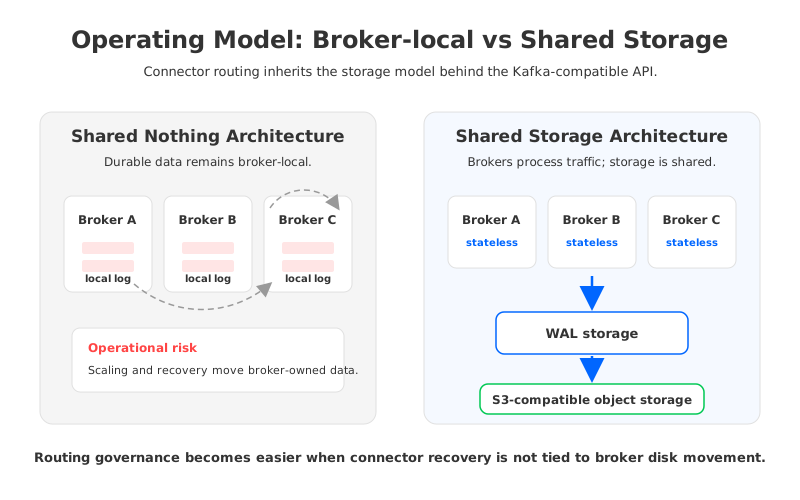
Tiered Storage can help with long retention by moving older log segments to remote storage. It should not be confused with a full operating model change. The hot path, local broker responsibilities, and reassignment pressure still matter. A sudden connector backlog still tests how quickly the platform can absorb writes, serve catch-up reads, and keep leaders healthy while other tenants continue.
3Architecture options and trade-offs
Before choosing a platform, teams should separate three questions that often get blended together. What Kafka contract must be preserved? Where should connector workers run? What storage and network model should carry the load when routes grow or fail? Treating them as one question usually leads to vague diagrams and weak runbooks.
| Architecture option | What it protects | What it exposes |
|---|---|---|
| Single primary Kafka cluster with cross-cloud connectors | Centralized governance and fewer Kafka estates | Cross-cloud network paths, noisy connector workloads, and shared broker capacity risk |
| Per-cloud Kafka clusters with bridge routes | Locality for producers, consumers, and cloud controls | More topic mapping, schema coordination, offset handoff, and failure modes |
| Connector workers near the data source | Lower source-side network exposure and simpler source credentials | More routing rules into Kafka and more places to observe connector task health |
| Connector workers near the Kafka platform | Centralized operations and cleaner Kafka access | Remote source access, possible egress costs, and cloud-specific identity complexity |
| Kafka-compatible shared storage platform | Familiar Kafka clients with a different storage operating model | Requires validation of WAL, object storage, metadata, and cache behavior |
The table is not a maturity ladder. A single primary cluster can work when most applications are in one cloud and remote feeds are low volume. Per-cloud clusters can work when data sovereignty or latency dominates. Source-local connectors reduce credential sprawl, while Kafka-local connectors simplify ownership. The wrong answer hides the trade-off until an incident.
Schema governance belongs in this architecture discussion, not in a late-stage review. A connector can move bytes while violating the data contract. If the route changes serialization, nullability, key semantics, timestamps, tenant identifiers, or delete behavior, downstream systems can fail after the connector has committed offsets. Schema checks should run before routing is production-ready, with an owner who can approve or reject evolution.
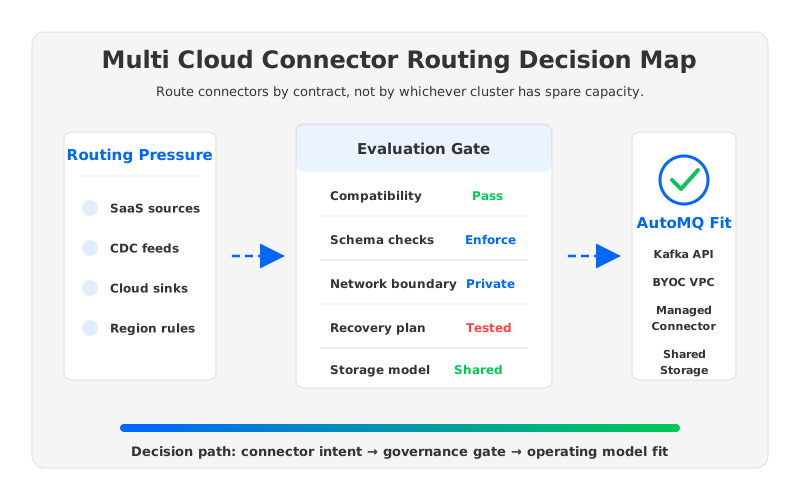
Cost deserves early treatment. Multi-cloud connector routing can create cost in worker compute, Kafka broker capacity, retention, cross-Availability Zone traffic, inter-region transfer, endpoints, observability, and object storage requests. Cloud pricing pages show service charges, but not how often your architecture triggers those meters. A design that forces every connector write through a remote broker leader differs from one that keeps producers, workers, and read paths inside the intended locality boundary.
4Evaluation checklist for platform teams
A stronger evaluation artifact is not a vendor comparison slide. It is a route readiness checklist the team can apply to every connector path. It should be concrete enough for an engineer to run tests, a security reviewer to trace boundaries, and an incident commander to understand rollback.
Use these checks before declaring a route production-ready:
- Kafka compatibility. Validate client libraries, connector plugins, Admin API calls, topic settings, consumer group behavior, offset handling, and transaction requirements. "Kafka-compatible" should mean workload-compatible, not only bootstrap-compatible.
- Schema and contract control. Define where schemas are registered, how compatibility is checked, who approves breaking changes, and what happens to invalid records. Include keys, headers, delete events, and tenant identifiers.
- Network locality. Map producer, connector worker, Kafka broker, schema registry, secret store, and sink endpoints to cloud accounts, regions, Availability Zones, VPCs, and private endpoints. Mark which paths can cross a boundary and why.
- Cost accountability. Separate connector compute, Kafka compute, storage, network transfer, endpoint, observability, and support costs. The goal is knowing which meter moves when traffic doubles.
- Scaling and backlog recovery. Test what happens when the connector is paused, resumes with a backlog, and competes with active producers and consumers. Include catch-up reads, task rebalances, schema failures, and worker scale-out.
- Security and access. Treat connector credentials as production secrets with rotation, least privilege, audit logging, and environment separation. A cross-cloud route should not rely on a broad service account from a PoC.
- Rollback and freeze controls. Decide how to stop a route, rewind or preserve offsets, quarantine invalid records, freeze schema evolution, and resume from a checkpoint. Rehearse rollback before the first high-volume topic.
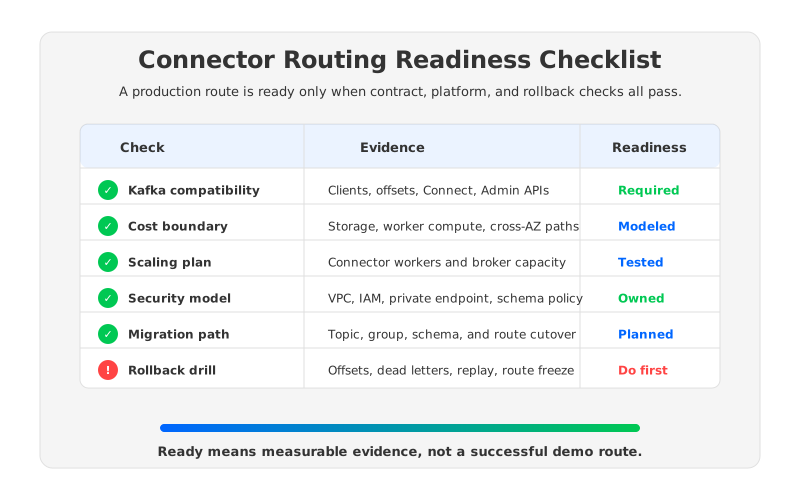
This checklist tends to reveal that many connector decisions are made at the wrong layer. A data team may choose a plugin because it supports the source API, only to discover that the platform cannot isolate workers by tenant. A platform team may choose a cluster topology because it simplifies Kafka operations, only to discover that schema ownership is split across clouds. The fix is an operating model where connector lifecycle, Kafka capacity, schema governance, and cloud boundaries are designed together.
5How AutoMQ changes the operating model
After neutral evaluation, AutoMQ becomes relevant as a Kafka-compatible streaming platform that changes the storage layer underneath familiar Kafka semantics. AutoMQ preserves Kafka protocol and ecosystem compatibility while using Shared Storage architecture: durable data is stored in S3-compatible object storage, and brokers are stateless compute nodes rather than owners of local persistent logs.
That architectural change matters because it reduces operations tied to broker-local data movement. AutoMQ Brokers handle Kafka protocol processing, partition leadership, cache, and scheduling. S3Stream writes data through WAL storage and persists it to object storage. When the platform scales, replaces a broker, or reassigns partition ownership, the operation is closer to changing compute ownership than copying large local logs. Connector backlog recovery still needs testing, but recovery pressure is less entangled with broker disk evacuation.
AutoMQ BYOC also fits the governance side. In AutoMQ BYOC, the control plane and data plane run inside the customer's cloud account or VPC, and AutoMQ managed Kafka Connect can deploy connector workers in that environment. Connector workers, Kafka instances, cloud IAM, private endpoints, and observability can be reviewed inside the customer's boundary. The platform still needs schema policy, secret rotation, and rollback drills, but those controls can attach to one operating model instead of scattered scripts.
There is also a routing-specific cost implication. AutoMQ's object-storage-backed Shared Storage architecture and zero cross-AZ traffic design can reduce broker-to-broker replication traffic and cross-AZ data paths in supported deployments. Cloud-provider network pricing still has to be verified for actual regions and endpoints. The better question becomes whether connector workers, clients, brokers, and storage access stay inside the intended locality boundary.
Migration is the final reason this matters. Teams rarely rebuild connector estates from scratch. They need to move topics, consumer groups, schemas, and routes with controlled risk. AutoMQ Kafka Linking is designed for migration scenarios where byte-level topic data and consumer progress continuity matter, while Kafka compatibility helps preserve clients and tooling. For connector-heavy platforms, start with one route, one rollback procedure, and one schema domain. Once that route is boring, the pattern can expand.
6A practical scorecard for the first route
Pick one route important enough to expose real constraints but small enough to fix quickly. A good candidate is a CDC source or operational event feed with clear consumers, known schema ownership, and enough volume to exercise Kafka capacity. Avoid the most politically sensitive route. The first production pattern should teach the team how the platform behaves, not force a high-stakes migration while the runbook is still being written.
Score the route on a simple scale:
| Dimension | 0 points | 1 point | 2 points |
|---|---|---|---|
| Kafka contract | Unknown client and offset behavior | Basic produce and consume tested | Client, offset, transaction, and Connect behavior validated |
| Schema governance | No compatibility rule | Manual review | Automated checks with named owner |
| Network boundary | Public or unclear path | Private path documented | Private path tested with failure and cost visibility |
| Backlog recovery | Not tested | Restart tested | Pause, catch-up, rebalance, and replay tested |
| Rollback | Manual inspection | Stop procedure exists | Offset, schema, and route rollback rehearsed |
| Observability | Connector logs only | Connector and Kafka metrics | Connector, Kafka, schema, network, and sink metrics correlated |
A route scoring below 8 is not ready for broad reuse. A route scoring 8-10 may be acceptable for low-risk workloads if gaps are understood. A route scoring 11-12 is a reusable pattern. The route earns production readiness through evidence, not a successful demo.
The same scorecard keeps platform debates concrete. Traditional Kafka, Kafka with Tiered Storage, managed Kafka services, and Kafka-compatible shared storage platforms can all be evaluated against the same route. Which option gives this team the strongest contract with the least exception handling?
7FAQ
7.1Is multi-cloud connector routing the same as multi-cluster replication?
No. Multi-cluster replication moves Kafka records between clusters. Multi-cloud connector routing is broader: it decides where connectors run, how they reach Kafka, how schemas are enforced, how offsets and retries are handled, and which cloud boundaries data may cross. Replication can be one part of the route, but not the whole operating model.
7.2Where should schema checks run?
Schema checks should run before records are treated as valid for the route. That often means producer-side validation, connector-level validation, or a schema registry gate before the connector commits progress. The route should name who approves schema evolution and what happens to invalid records.
7.3Does Kafka Connect solve the governance problem by itself?
Kafka Connect provides the connector framework, task model, and integration pattern. It does not define data classification, schema ownership, cloud network boundaries, secret rotation, cost accountability, or rollback procedures. Platform teams still need governance around the Connect runtime.
7.4When does Shared Storage architecture matter most?
It matters most when connector traffic creates operational pressure on Kafka storage and scaling. If routes generate large backlogs, long retention, frequent partition movement, or multi-tenant contention, broker-local storage can become part of the routing risk. Shared Storage architecture changes that operating model by separating broker compute from durable data storage.
7.5How should teams start evaluating AutoMQ for connector routing?
Start with one route and test the full contract: Kafka clients, Connect plugin behavior, schema checks, network locality, backlog recovery, and rollback. If the goal is to evaluate a Kafka-compatible shared storage platform in a customer-controlled cloud boundary, review AutoMQ BYOC and managed Kafka Connect as part of that route-level test. For a next step, visit AutoMQ Cloud and map one production connector path before scaling the pattern.


