
Table of Contents
Table of Contents
Searching for snowflake reverse etl kafka usually means the warehouse is no longer the end of the data path. Customer scores, entitlement changes, fraud signals, renewal risk, inventory state, and model features may be shaped in Snowflake, but the systems that act on those facts live elsewhere. The question is not whether a table can be exported. It is whether the exported facts can become a production stream without losing schema control, lineage, access boundaries, replay safety, and operational ownership.
That pressure changes the architecture conversation. A batch reverse ETL tool can move rows from Snowflake into a CRM or support system. A Kafka-backed activation path has a different job: publish governed operational facts into topics that many applications can consume at their own pace. Once those applications depend on the data, the platform team has to think about offsets, Consumer group recovery, schema compatibility, connector failure modes, and the cost of replaying old records after a downstream outage.
The useful frame is this: Snowflake reverse ETL over Kafka is not a connector selection problem. It is a product boundary for activated data. The connector extracts or subscribes to changes, Kafka carries durable events, schemas define what consumers are allowed to assume, and the streaming platform determines whether growth turns into local disk pressure, data movement, cross-AZ traffic, and manual rebalancing.
1Why Teams Search for snowflake reverse etl kafka
Most teams arrive at this search after analytics data has crossed into operational territory. A sales workflow may need account fit scores. A risk service may need a customer state transition. A personalization service may need a product usage segment. These are not dashboard queries. They are facts that become inputs to software, and software needs contracts more than it needs another export schedule.
Kafka is attractive in that moment because it gives applications a durable, replayable stream rather than a point-to-point sync. Consumers can commit offsets, recover from outages, and read at different speeds. Kafka Connect can standardize connector deployment and task management, while schema tooling can enforce compatibility before a bad field change reaches production. Those mechanics matter because reverse ETL has a habit of starting as a growth-team workflow and ending as a platform dependency.
The first governance mistake is to publish raw warehouse tables as if every consumer wants the same shape. They do not. A Snowflake table is often optimized for analytical modeling, joins, and BI ownership. A Kafka topic used for activation should be optimized for an event contract: a stable key, a clear timestamp, idempotent semantics, and fields that map to a business fact consumers can reason about.
Good activation topics tend to have a few shared properties:
- They publish facts, not table accidents.
customer_risk_score_changedis easier to govern than a periodic dump of every column in a modeled table. - They keep keys and timestamps boring. Consumers need deterministic partitioning, deduplication, and freshness checks more than clever naming.
- They treat schema changes as releases. Adding an optional field is different from changing the meaning of an existing field, and both should be visible before deployment.
- They define replay behavior upfront. If an application reprocesses 30 days of events, it should not create duplicate tickets, emails, or entitlements.
That list is not glamorous, but it is where production reliability lives. Reverse ETL breaks quietly when ownership is vague: analytics owns the model, platform owns Kafka, application teams own consumers, and nobody owns the contract between them.
2The Production Constraint Behind the Problem
The hard part is not sending data out of Snowflake. The hard part is keeping the activation path trustworthy as the number of consumers, topics, schemas, and recovery scenarios grows. Once applications depend on Kafka topics derived from Snowflake, the platform has to support both steady tailing reads and catch-up reads after outages. It also has to preserve enough history for replay without forcing every broker to carry local storage sized for the worst week of business activity.
Traditional Kafka runs on a Shared Nothing architecture. Each broker owns local persistent data, and partitions are replicated across brokers for durability. That model has served Kafka well, but it makes cloud operations sensitive to disk sizing, broker placement, and reassignment work. If reverse ETL topics are small, the pain can stay hidden. If activation becomes a shared layer for sales, support, fraud, AI features, and customer lifecycle systems, local storage and data movement start to show up in places the original project plan did not mention.
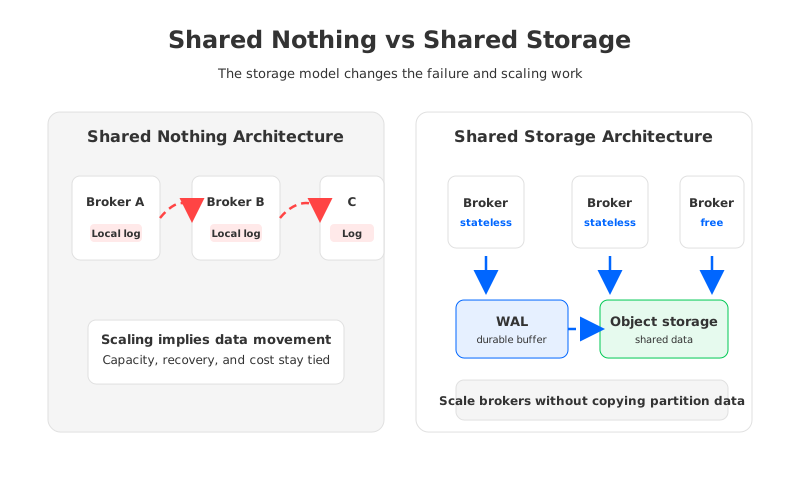
The storage model affects governance because recovery and change control depend on replay. A schema rollback is safer when consumers can re-read a known range. A connector incident is easier to handle when lag and offsets are visible. A downstream release is less risky when the team can pause, validate, and resume without losing data. When every scaling or recovery event also involves broker-local data movement, the platform team has to coordinate storage operations with application recovery.
This is where Snowflake reverse ETL becomes a streaming platform evaluation. The connector path asks, "Can I move this data?" The platform path asks, "Can I keep moving it when schemas change, consumers fall behind, retention grows, and teams ask for more topics?"
3Architecture Options and Trade-Offs
There are three common ways to wire Snowflake activation into Kafka-compatible streaming. None is universally right. The correct answer depends on latency, ownership, schema discipline, network boundaries, and how much operational work the platform team is willing to absorb.
| Pattern | Where it fits | Main trade-off |
|---|---|---|
| Scheduled extract to Kafka | Operational facts can tolerate batch intervals | Simple to reason about, but freshness and duplicate handling need explicit design |
| Change-driven source pipeline | Applications need fresher updates from modeled tables | Better freshness, but schema drift and task failure handling become production concerns |
| Stream-to-table and table-to-stream loop | Teams want analytics and operations to share one governed data product | Stronger governance potential, but ownership boundaries must be clear |
The decision should start with contracts rather than tooling. If the warehouse table changes every week because analysts are improving a model, do not expose that table directly to application teams. Put a stable event schema in front of it. If consumers trigger side effects, treat replay as a destructive operation until idempotency has been proven. If data crosses account, VPC, or cloud boundaries, make that boundary part of the architecture diagram rather than an implementation detail.
Schema checks deserve their own gate. A production reverse ETL pipeline should verify whether changes are backward compatible for existing consumers, whether required fields remain populated, whether enum values have a documented expansion path, and whether null behavior is intentional. The most useful schema review meeting is the one that prevents a consumer incident without becoming a weekly argument between analytics and application teams.
Governance also has a cost dimension. Long retention and replay-heavy workloads can make a Kafka cluster look quiet during normal operation and expensive during recovery. Cross-Availability Zone (AZ) traffic can rise when producers, brokers, and consumers are spread across zones without careful routing. Private connectivity, encryption, object storage, and marketplace procurement may all be valid requirements, but each one should be modeled before the platform is called production-ready.
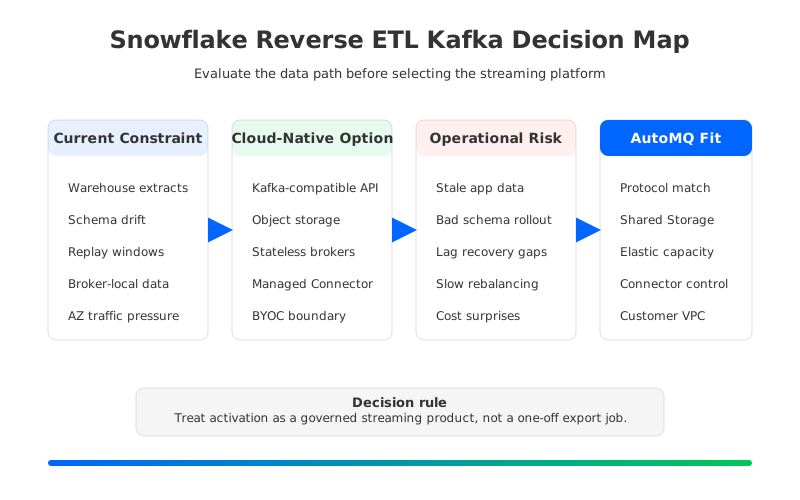
The matrix is a practical forcing function. If the left column is full of constraints and the team can only answer with connector settings, the architecture is not ready. If the team can answer with compatibility, storage, governance, network, and rollback controls, the reverse ETL path is becoming a platform.
4Evaluation Checklist for Platform Teams
Use the checklist below before treating Snowflake-derived Kafka topics as an application dependency. It is intentionally concrete because vague readiness language hides the exact failures that hurt later.
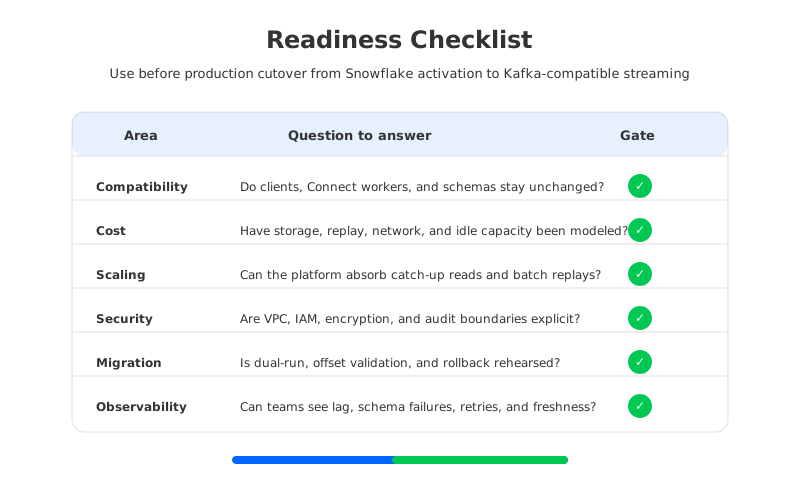
Start with compatibility. Existing Kafka clients, Kafka Connect workers, serializers, and monitoring tools should not require application rewrites. The Apache Kafka documentation describes the consumer model around partitions, offsets, and Consumer groups; your platform should preserve those expectations because consumers will build recovery logic around them. If a platform claims Kafka compatibility, verify it against the clients and connector versions you actually run.
Then test the schema path with real mistakes. Add a nullable field. Rename a field in a staging schema and confirm the check fails. Change an enum value. Send a record with a missing business key. The goal is not to prove that the happy path works. The goal is to decide which team gets paged, which deployment is rolled back, and which consumers can continue reading when the source model changes.
Cost and scaling checks need the same discipline. Model write throughput, read fanout, retention, expected replay windows, and the largest catch-up read the business can create. If activation powers customer-facing workflows, the worst case is rarely the average day. It is the hour after a downstream outage, a backfill, or a schema rollback when many consumers ask Kafka to replay history at the same time.
Security and compliance should be treated as architecture inputs, not review paperwork:
- Keep Snowflake credentials, connector secrets, and Kafka credentials under separate scopes. A warehouse reader should not automatically become a topic administrator.
- Document the VPC, subnet, PrivateLink or private endpoint, and object storage boundaries. The diagram should show where customer data moves and where metadata moves.
- Require audit logs for schema changes, connector configuration changes, topic ACL changes, and manual replay operations.
- Define retention and deletion policy by data class. Activation data can contain customer attributes that should not live forever by default.
Finally, rehearse migration and rollback before the first production cutover. Run the legacy path and the replacement path in parallel, compare record counts and keys, verify offsets, and prove that consumers can pause and resume without double-applying side effects. A rollback plan that has not been rehearsed is an optimistic note in a runbook.
5How AutoMQ Changes the Operating Model
After the neutral evaluation, the architectural requirement becomes clear: a Snowflake reverse ETL Kafka platform should keep Kafka semantics stable while reducing the storage and scaling work that usually follows replay-heavy, multi-consumer workloads. AutoMQ fits that category as a Kafka-compatible, cloud-native streaming platform that replaces broker-local persistent storage with Shared Storage architecture on S3-compatible object storage.
The important change is not a different application protocol. AutoMQ preserves Kafka-facing APIs and ecosystem compatibility, so producers, consumers, Kafka Connect, and observability tools can continue to operate against Kafka semantics. The change is below that surface. Brokers become stateless brokers, durable data is stored through S3Stream using WAL storage and object storage, and partition ownership can move without copying the full partition data set between brokers.
For Snowflake reverse ETL, that changes the operating model in four practical ways. First, replay and retention planning are less tied to broker-local disk reservations. Second, scaling decisions can focus more on compute capacity and less on data migration windows. Third, BYOC deployment keeps control plane and data plane components inside the customer's cloud boundary, which matters when Snowflake, Kafka, object storage, and applications are all governed under the same account or network policy. Fourth, Managed Connector support gives platform teams a way to manage connector deployment with the same boundary thinking they apply to Kafka clusters.
There is still work to do. AutoMQ does not remove the need for event contracts, schema review, idempotent consumers, access control, or observability. It changes the infrastructure bottleneck underneath those practices. That distinction matters because a storage architecture cannot fix a bad data contract, but a good data contract can still fail operationally if the platform cannot absorb replay, retention growth, and scaling events.
The cleanest adoption path is to start with one activation domain. Pick a Snowflake-derived fact that already has application demand, define a stable topic contract, run it through schema checks, and test replay with a real consumer. Then evaluate the platform on the boring things: client compatibility, connector lifecycle, lag visibility, rollback, network cost, and the amount of broker storage work created by growth.
6FAQ
6.1Is Snowflake reverse ETL over Kafka the same as CDC?
No. CDC usually captures database changes close to the source transaction log. Snowflake reverse ETL usually publishes modeled or enriched analytical facts from the warehouse into operational systems. The two can use similar streaming mechanics, but the ownership and schema questions are different.
6.2Should every Snowflake table become a Kafka topic?
No. Publish operational facts that consumers can depend on. A modeled warehouse table may change for analytical reasons, while a Kafka topic used by applications needs a stable contract, key strategy, and replay behavior.
6.3Where should schema checks run?
Run them before records reach production consumers. In practice, that means validating connector configuration, schema compatibility, required fields, key rules, and representative records in staging before promotion.
6.4When should a team consider AutoMQ for this pattern?
Consider AutoMQ when the team wants Kafka-compatible semantics but expects retention, replay, scaling, multi-AZ deployment, or BYOC boundaries to become operating constraints. It is most relevant when reverse ETL is becoming a shared platform dependency rather than a single sync job.
7Closing
The original search term points to a real production question: can Snowflake-derived data become an application-grade stream without turning every schema change or replay into a platform incident? The answer depends less on the export mechanism than on contracts, ownership, storage architecture, and rollback discipline. If you are evaluating that path, compare your readiness checklist against the AutoMQ deployment options and test one governed activation topic end to end.


