
Table of Contents
Table of Contents
Teams search for compliance ready byoc streaming when a streaming platform stops being an engineering utility and becomes part of the control environment. Apache Kafka already gives teams a durable event log, Consumer groups, offsets, Connect, security controls, and a large client ecosystem. The harder question is whether the platform can prove where data lives, who controls the infrastructure, how policy changes reach runtime, and how migration or failover can be audited.
BYOC (Bring Your Own Cloud) raises that bar because it changes the ownership conversation. A regulated platform team wants the data path inside its cloud account, its VPC (Virtual Private Cloud), its identity boundary, and its regional controls. Security reviewers want private network paths, customer-owned keys, scoped permissions, evidence capture, and an exit path that does not break producers or consumers. Compliance-ready streaming is not a product label. It is a workflow that connects architecture decisions to reviewable evidence.
1Why teams search for compliance ready byoc streaming
The search usually starts after a first wave of Kafka adoption succeeds. Product teams have built event-driven services, data teams have attached lakehouse pipelines, and security teams have discovered that every topic is a potential policy surface. A table can often be reviewed after ingestion. A stream can fan out to many consumers before a human notices that a field, header, schema version, or retention rule is wrong.
That difference makes governance more operational. A streaming control has to work while producers write, consumers commit offsets, connectors move data, and SREs handle incidents. A weekly access review is useful, but it does not prove whether a consumer group read a restricted topic during a deployment window. A schema registry is useful, but it does not prove whether a topic's network route, storage class, and rollback plan satisfy the compliance boundary.
The practical definition is narrower and more useful:
Compliance-ready BYOC streaming means the platform can run Kafka-compatible workloads inside a customer-controlled environment while producing reviewable evidence for data residency, access, change management, migration, recovery, and cost exposure.
This definition separates governance from paperwork. A team can have excellent policy documents and still run a streaming platform that is difficult to review when too many responsibilities are coupled to the same broker fleet.
2The production constraint behind the problem
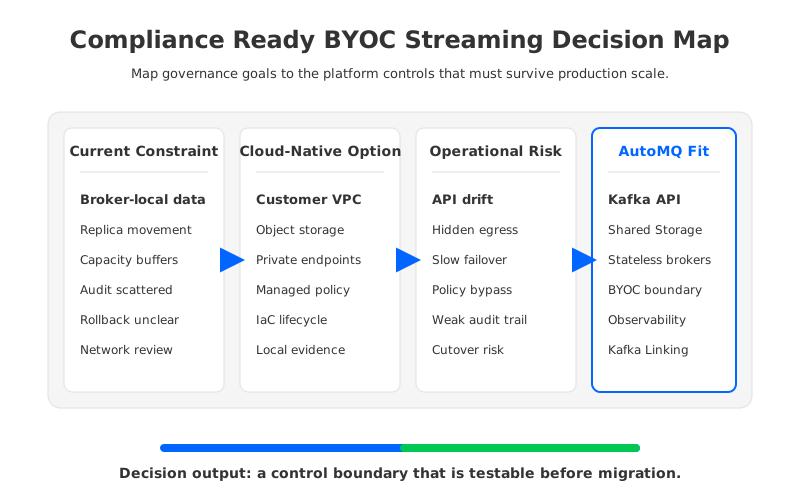
Traditional Kafka uses a Shared Nothing architecture. Each broker owns local or attached log storage, and replication distributes partition copies across brokers for durability and availability. That proven design also means a broker is not merely compute. It is protocol endpoint, storage owner, replica participant, recovery unit, capacity boundary, and operational risk surface at the same time.
That coupling shows up in compliance workflows. When retained data grows, teams add or resize broker storage. When brokers are replaced, partition reassignment and replica catch-up can affect SLOs. When workloads span multiple Availability Zones (AZs), replication and client placement become cost and audit concerns. For regional isolation, the review cannot stop at topic names and ACLs; it has to include where durable bytes live and how they move during scaling or failure.
Kafka's ecosystem gives teams valuable building blocks: offsets for read progress, transactions and idempotent producers for stronger delivery semantics, Kafka Connect for integration, ACLs for access control, KRaft for metadata coordination, and Tiered Storage for moving older segments to remote storage. These controls matter, but they do not by themselves turn broker-local storage into a customer-governed BYOC operating model.
The deeper constraint is that compliance workflows need clean boundaries: who can access the control plane, who can touch the data plane, which cloud services store records, which network paths carry traffic, which operations require elevation, and which logs prove the change. A broker fleet that also owns the durable log makes those questions harder to isolate.
3Architecture options and trade-offs
A compliance-ready streaming architecture should be evaluated as a set of operating boundaries, not as a checklist of feature names. A fully managed service can reduce operations, but it may place the data plane or control plane outside the customer's preferred account boundary. A self-managed Kafka cluster can maximize control, but it also pushes patching, scaling, failover testing, capacity planning, and audit evidence onto the platform team.
BYOC sits between those poles. It is attractive when the team wants cloud provider ownership, private network placement, and customer-side resource visibility without rebuilding every lifecycle workflow from raw infrastructure. The review has to be precise because "in your cloud" can mean different things. Does the control plane run inside the customer environment? Does the data plane accept private access only? Which buckets, disks, endpoints, identities, and logs are customer-owned? Who can perform maintenance?
Use the following matrix to keep the review grounded:
| Evaluation area | What to verify | Why it matters for compliance-ready BYOC streaming |
|---|---|---|
| Kafka compatibility | Producer, Consumer, Admin, transaction, ACL, connector, and tooling behavior. | Application teams should not rewrite governance-critical paths during migration. |
| Data residency | Region, AZ, bucket, disk, backup, and log locations for both data plane and control plane. | Data location must be provable, not inferred from a deployment label. |
| Network boundary | Private endpoints, routing tables, DNS, load balancers, and cross-AZ paths. | Network design affects exposure, cost, and audit scope. |
| Cost model | Compute, storage, WAL, object requests, connectivity, traffic, monitoring, and support. | Hidden transfer or endpoint costs can undermine a clean architecture. |
| Recovery model | Broker failure, AZ impairment, storage behavior, metadata recovery, and rollback. | Recovery must not violate residency or access rules. |
| Migration path | Topic sync, offsets, dual running, cutover, backout, and evidence. | Compatibility reduces risk, but cutover remains governed. |
| Team boundary | Which tasks belong to platform, security, networking, FinOps, and vendor support. | Compliance fails when operational ownership is ambiguous. |
This matrix prevents a common mistake: treating governance as a layer above the streaming platform. Governance is partly inside runtime behavior. If scaling requires large data movement, the scaling workflow needs evidence. If private connectivity uses paid per-GB processing, cost review needs measurement. If object storage is the durable foundation, bucket policies and retention controls belong in the streaming architecture review.
4Evaluation checklist for platform teams
The first pass should test whether the platform can keep familiar Kafka semantics while changing the infrastructure model. Start with client behavior because it is the most visible migration risk. Producers, consumers, admin tools, stream processing jobs, connectors, schema workflows, ACL automation, and observability integrations should be tested against the versions and configurations in use. Broad Kafka compatibility can still require work around a specific transaction pattern, connector plugin, or security integration.
The second pass should test the infrastructure boundary. For BYOC, draw two paths: the management path and the data path. The management path covers console access, lifecycle APIs, operator permissions, metrics, logs, upgrades, and support access. The data path covers client traffic, broker traffic, storage writes and reads, replication or shared-storage behavior, and connector access to private systems. Customer records should stay in the customer-controlled data path, and maintenance access should be scoped and logged.
A third pass should test failure and migration. A migration rehearsal should prove topic synchronization, offset behavior, cutover, rollback, and evidence capture. A failure rehearsal should prove broker replacement, metadata recovery, storage assumptions, and alert routing. The output should be a review packet, not a chat transcript.
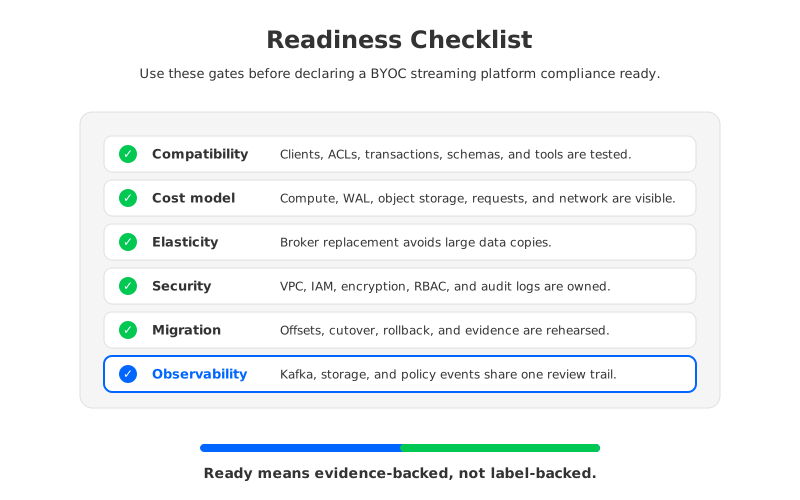
At this point, a platform team can score readiness without pretending every workload is identical:
5How AutoMQ changes the operating model
Once the evaluation reaches storage ownership, broker replacement, and BYOC control boundaries, AutoMQ becomes relevant as a Kafka-compatible cloud-native streaming platform built around Shared Storage architecture. The architecture moves durable stream storage away from broker-local disks and into S3-compatible object storage through S3Stream, with WAL (Write-Ahead Log) storage used for low-latency persistence and recovery.
That shift changes the operating model in ways compliance teams can reason about. AutoMQ Brokers remain Kafka protocol endpoints, but they are stateless brokers rather than long-lived owners of durable partition data. Scaling or replacing broker compute no longer has to mean copying large local logs between brokers. The durable storage boundary becomes customer-controlled object storage and WAL choice, while the broker fleet becomes replaceable compute.
The distinction from Tiered Storage is important. Tiered Storage can offload older segments to remote storage, but the broker still owns the hot local log. Shared Storage architecture changes the source-of-truth model. Object storage is not only a cold archive; it is the primary durable repository, supported by WAL and cache for write and read behavior. For governance, storage policy, bucket access, object retention, and recovery assumptions become first-class controls.
AutoMQ BYOC and AutoMQ Software also matter because deployment boundary is part of the compliance answer. In AutoMQ BYOC, the control plane and data plane run in the customer's cloud account and VPC, with customer-owned resources and private data-plane access. AutoMQ Software targets private data center environments. Those boundaries let teams map streaming responsibilities to cloud account controls, network policy, IAM, encryption, RBAC (Role-Based Access Control), SSO (Single Sign-On), observability, and maintenance authorization.
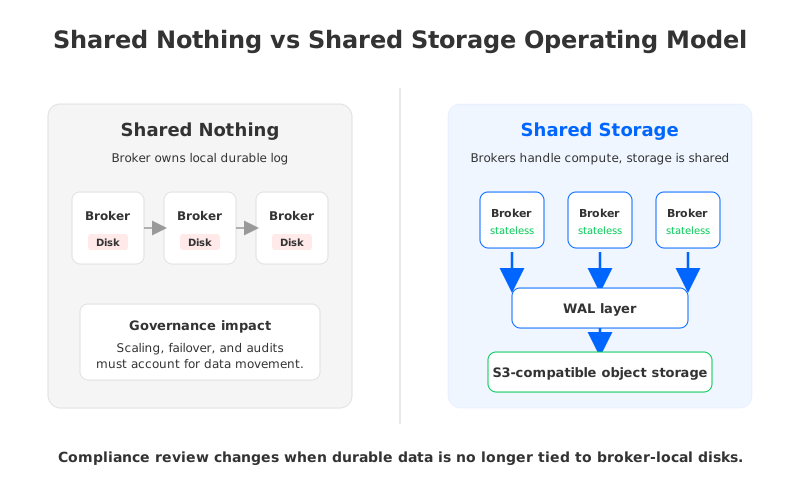
This does not remove the need for engineering review. It changes what the review should inspect. Instead of asking only how many brokers are needed for peak traffic and retention, the team can separately inspect broker compute, WAL medium, object storage, cache behavior, metadata, private endpoints, and operational authorization. Broker changes become tests of leadership, ownership metadata, and runtime traffic while durable data remains in the governed storage boundary.
Migration should still be treated as a governed change. AutoMQ Open Source recommends MirrorMaker2 for cluster migration. AutoMQ commercial editions provide Kafka Linking for byte-to-byte message synchronization with offset consistency, which is relevant for lower-disruption cutover. Either way, the workflow should require topic inventory, offset validation, cutover criteria, rollback criteria, evidence capture, and a defined point when the legacy cluster stops being the recovery baseline.
6A practical readiness scorecard
The final decision should be written as a scorecard because compliance-ready streaming is a team contract. Platform engineering owns runtime behavior, security owns access and key policy, networking owns routes, FinOps owns cost attribution, and data governance owns topic classification, schema rules, retention, and downstream use. A BYOC architecture works when these teams can review the same evidence from different angles.
Score each gate as green, yellow, or red:
- Compatibility gate: Green means workload-specific tests pass for clients, connectors, security, transactions, and admin paths. Red means the team is relying on generic compatibility claims.
- Boundary gate: Green means control plane, data plane, storage, network, and support paths are documented with customer-owned resources and permissions. Red means data or privileged operations cross an unapproved boundary.
- Recovery gate: Green means broker failure, AZ events, storage failures, metadata recovery, and rollback are rehearsed. Red means recovery depends on untested assumptions.
- Cost gate: Green means compute, storage, requests, connectivity, traffic, monitoring, and support are visible. Red means transfer or endpoint costs appear only after production.
- Migration gate: Green means dual running, offset validation, cutover, rollback, and audit evidence have been tested. Red means migration is treated as a one-way deployment.
Back to the original search: compliance ready byoc streaming is not asking for another governance slogan. It is asking for an architecture that can be inspected under production conditions. If your Kafka estate makes every compliance question collapse into broker storage, replica movement, and manual runbooks, include a shared-storage BYOC option in the next review. A useful next step is to map your current control packet against the AutoMQ BYOC deployment boundary and test one representative migration path.
For teams ready to compare this model with their own Kafka estate, start with an AutoMQ environment review through the AutoMQ Cloud Console.
7FAQ
7.1Is compliance-ready BYOC streaming the same as self-managed Kafka?
No. Self-managed Kafka can provide strong control, but the team owns the full operational burden. Compliance-ready BYOC streaming keeps customer-controlled boundaries while making lifecycle operations, evidence capture, migration, and recovery reviewable.
7.2Does Kafka compatibility eliminate migration risk?
No. Kafka compatibility protects the application contract, but migration still needs workload-specific testing for producers, consumers, admin APIs, ACLs, transactions, connectors, offsets, observability, and rollback.
7.3Why does Shared Storage architecture matter for compliance?
It separates durable stream data from broker-local disks. That makes storage ownership, retention, access policy, broker replacement, and recovery easier to review as distinct controls.
7.4Where should AutoMQ appear in a platform evaluation?
After the team has defined compatibility, boundary, cost, recovery, governance, and migration requirements. AutoMQ is most relevant when Kafka compatibility, customer-controlled deployment, stateless brokers, and object-storage-backed durability match the workload's constraints.
8References
- Apache Kafka Introduction
- Apache Kafka Authorization and ACLs
- Apache Kafka Connect Overview
- Apache Kafka Tiered Storage
- AutoMQ Kafka compatibility
- AutoMQ Shared Storage architecture
- AutoMQ WAL storage
- AutoMQ migration overview
- AWS EC2 data transfer pricing
- AWS PrivateLink pricing
- AWS gateway endpoints for S3 and DynamoDB
- Amazon S3 durability FAQ


