
Table of Contents
Table of Contents
Teams searching for government streaming controls kafka are usually past the whiteboard stage. They already know Kafka can move operational data between agencies, mission systems, analytics platforms, and case-management applications. The harder question is whether the platform can prove control while traffic keeps moving: who can produce, who can consume, where records reside, which schema changes are allowed, and how operators recover when policy changes go wrong.
That pressure is different from ordinary streaming data governance. Public-sector and regulated teams have to treat the streaming layer as part of the control environment, not only as an integration bus. A batch warehouse can quarantine a dataset after ingestion. A Kafka topic can fan out a bad record before a human review catches it. A platform team therefore needs a workflow that connects policy intent to runtime behavior, audit evidence, and rollback.
The thesis is simple: government streaming controls should be evaluated as platform workflows, not as isolated Kafka settings. ACLs, schemas, offsets, retention, encryption, and network boundaries matter, but each control only becomes reliable when the underlying architecture can scale, recover, and migrate without turning every change into a storage operation.
1Why Teams Search for government streaming controls kafka
The search phrase is awkward because the real problem is awkward. A governance lead might call it data residency. A security architect might call it least privilege and evidence collection. A Kafka platform owner might call it topic ownership, Consumer group review, offset reset policy, or connector isolation. They are describing the same concern: streaming controls must hold up under live traffic.
Apache Kafka gives teams a strong protocol and ecosystem foundation. The official documentation defines the core mechanics that governance teams end up reviewing: Producers write records to topics, Consumers coordinate through Consumer groups, offsets mark read progress, transactions support atomic writes across partitions, Kafka Connect moves data between systems, and KRaft manages metadata without ZooKeeper. These are not abstract concepts in a control review. They define where ownership, authorization, replay, and failure recovery decisions show up.
The uncomfortable part is that many governance workflows are written as if data movement has little operational cost and changes are rare. In a large Kafka estate, neither assumption holds. Classification updates, agency boundaries, traffic spikes, and migrations can require topic changes, capacity expansion, offset preservation, cutover, and rollback windows. Each step is both a governance decision and an operations event.
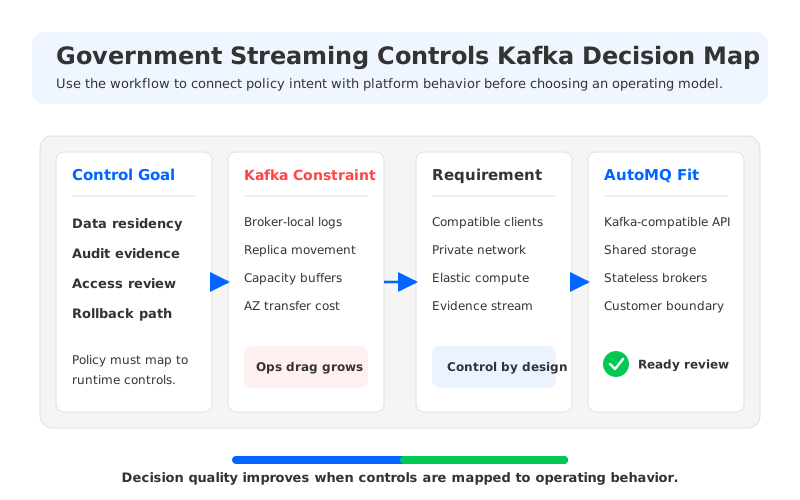
That is why a useful evaluation starts with workflow questions rather than vendor questions. Can the team map a policy to a topic, schema, identity, network path, storage boundary, and observable signal? Can the platform absorb change without days of broker rebalancing? Can auditors see evidence without screenshots? Can operators reverse a change without losing offset continuity or producing duplicates?
2The Production Constraint Behind the Problem
Traditional Kafka uses a Shared Nothing architecture. Each broker owns local persistent storage, and partitions are replicated between brokers for durability and availability. This model is historically reasonable: Kafka was designed around append-only logs, local disk throughput, and broker-level replication. The same design becomes harder to operate when a government platform team wants strict boundaries, elastic capacity, and predictable review workflows in cloud environments.
The first constraint is storage locality. When durable data is tied to broker-local disks, changes to broker placement, partition distribution, and capacity often imply data movement. Partition reassignment is not only scheduling; it can become a long-running storage operation. Governance then has to account for transition state, copied data, and broker or Availability Zone failure during the change.
The second constraint is capacity reservation. Government workloads often have uneven traffic: case processing, emergency response spikes, budget-cycle analytics, public-service portals, or cross-agency feeds. If brokers carry durable local state, teams tend to overprovision storage and compute together. They do it because scaling too late is risky, but every governance review then drifts into cost and capacity planning.
The third constraint is cross-zone replication. Cloud providers charge for some types of data transfer between Availability Zones in the same Region. AWS, for example, publishes a rate for data transferred across Availability Zones through EC2-related resources in each direction, while data transferred between certain resources in the same Availability Zone is free. The exact bill depends on the service path and Region, but the architectural lesson is stable: if the streaming platform copies broker replicas across zones, network cost becomes part of the governance model.
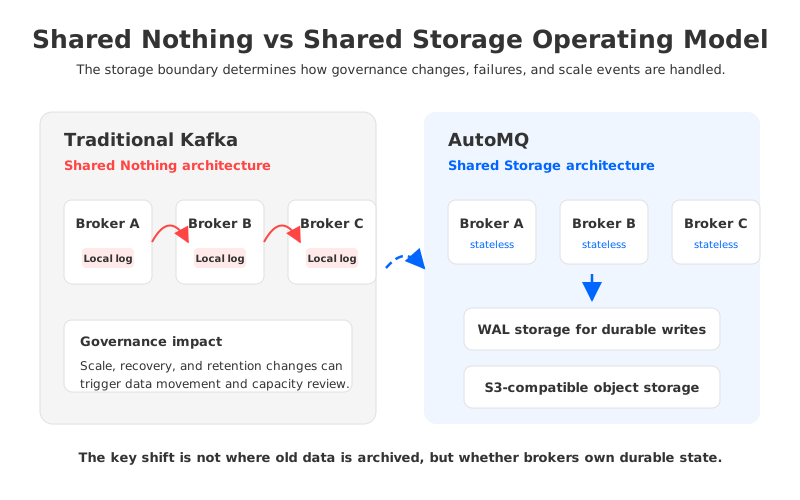
These constraints do not mean Kafka is a poor foundation. They mean a platform team should separate Kafka protocol compatibility from Kafka's traditional storage operating model. The protocol can remain familiar while the storage layer changes the blast radius of scale, recovery, and compliance-driven reconfiguration.
3Architecture Options and Trade-offs
The neutral evaluation starts with the options a platform team can defend in front of security, operations, and application owners. One option is to keep a conventional Kafka deployment and invest in stronger operating discipline: stricter topic templates, schema review, ACL automation, capacity forecasts, and runbooks for reassignment. This is viable when traffic is predictable, governance domains are stable, and the team already has deep Kafka operations capacity.
A second option is to use managed Kafka infrastructure and push more operations to a provider. That can reduce maintenance, but it does not remove data residency, private connectivity, identity, connector, and audit questions. Platform teams still need to know where data flows, what metadata leaves the environment, how support access works, and whether the deployment boundary matches agency requirements.
A third option is a Kafka-compatible platform with a cloud-native storage model. The important word is compatible. Existing clients, topic semantics, Consumer group behavior, offsets, and Kafka Connect integrations are difficult to replace in one step. A platform that keeps Kafka-facing behavior while changing storage ownership can make scale and recovery primarily a compute scheduling problem.
The trade-off table should be explicit:
| Evaluation area | What to ask | Why it matters for controls |
|---|---|---|
| Compatibility | Do existing Kafka clients, Consumer groups, offsets, transactions, and connectors work without application rewrites? | Governance should not require every application team to change code before the platform can improve controls. |
| Cost model | Which costs are driven by storage, broker compute, cross-zone traffic, and reserved headroom? | A control that requires overprovisioning can become politically fragile. |
| Elasticity | Does scaling require partition data movement, or mainly compute and metadata changes? | Emergency workloads and policy-driven segmentation should not wait for long storage operations. |
| Security boundary | Where are the control plane, data plane, object storage, keys, and network endpoints located? | Public-sector reviews care about ownership and reachability, not only feature names. |
| Auditability | Which events, metrics, logs, schema changes, and access decisions are retained as evidence? | Controls need durable proof, not manual recollection. |
| Migration risk | Can topics, offsets, producers, consumers, and rollback windows be tested before cutover? | Platform upgrades fail when rollback is vague. |
This table prevents a common failure mode: choosing a platform for its governance features, then discovering that routine operations still require disruptive broker work. The control plane can look sophisticated while the data plane keeps the old bottleneck.
4Evaluation Checklist for Platform Teams
A government streaming controls checklist should start with boundaries. Identify which account, VPC (Virtual Private Cloud), Region, object store, encryption keys, identity provider, and audit pipeline own each part of the platform. AWS PrivateLink and VPC endpoints show the network primitives reviewers often expect: private connectivity, explicit endpoint reachability, and S3 gateway endpoints that avoid public internet paths for S3 access from a VPC.
Then move from boundaries to runtime controls. Kafka ACLs answer who can perform specific operations, but they do not answer whether a topic carries restricted data, whether a schema change breaks a downstream workflow, or whether a connector can export to a sink. Data contracts close part of that gap by defining event structure, ownership, compatibility rules, and policy gates.
The review should also include failure and replay. Offsets are powerful because they let Consumers track progress independently, reset when needed, and recover from lag. They are risky when no one owns reset authority or when rollback is described only as "reconsume the topic." For regulated workloads, replay needs a named owner, a retention window, a masking or classification rule where required, and an evidence trail that explains why replay happened.
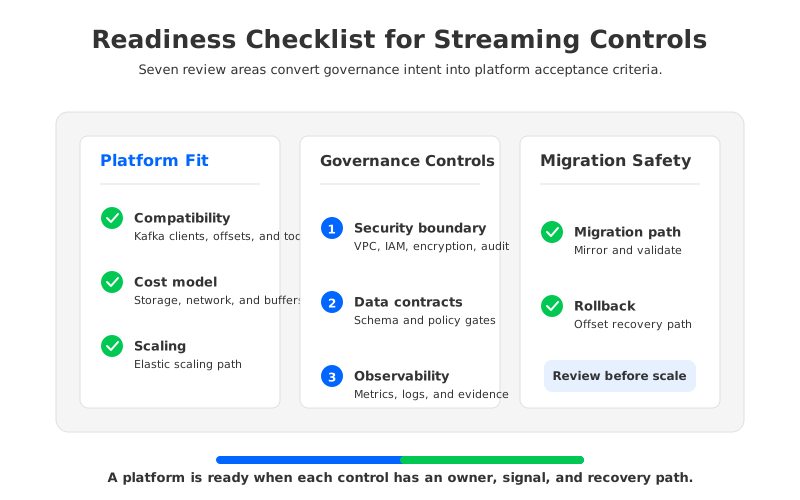
Use this acceptance checklist before approving a production platform:
- Compatibility is tested with real Producers, Consumers, Consumer groups, transactions, admin tools, Kafka Connect jobs, and monitoring integrations.
- Data residency is mapped to account, Region, Availability Zone strategy, object storage bucket, key ownership, and private network path.
- Governance workflows define owners for topic creation, schema evolution, data classification, ACL review, connector approval, offset reset, retention change, and replay.
- Cost review includes storage, compute, cross-zone traffic, object storage requests, private connectivity, monitoring, and required capacity buffers.
- Recovery review covers broker failure, zone impairment, object storage access failure, bad schema publication, connector misconfiguration, and migration rollback.
- Evidence review identifies which logs, metrics, configuration events, schema history, and access decisions are retained for audit.
This checklist is intentionally practical. It does not ask whether the platform claims to support governance. It asks whether the operating team can demonstrate control when something changes.
5How AutoMQ Changes the Operating Model
After the neutral framework is clear, AutoMQ becomes relevant as an architecture option rather than a slogan. AutoMQ is a Kafka-compatible, cloud-native streaming platform that keeps Kafka protocol and API semantics while moving durable log storage from broker-local disks into Shared Storage architecture backed by S3-compatible object storage. AutoMQ Brokers are stateless brokers: they handle Kafka requests, leadership, caching, and scheduling, but durable data is not bound to local disks.
That distinction changes the governance workflow. If a broker fails, the platform does not have to rebuild durable state from another broker's local copy before the control boundary is stable again. Added brokers can take traffic without first receiving large partition replicas. If a segmentation project requires topic movement or capacity change, the review can focus on ownership, metadata, network boundaries, and workload validation instead of bulk data relocation.
AutoMQ's S3Stream layer writes through WAL (Write-Ahead Log) storage and stores long-term stream data in S3-compatible object storage. WAL storage is the durable write path, while object storage becomes the shared persistence layer. Different deployment forms can use different WAL choices, so platform teams should evaluate latency, durability domain, and operational responsibility for the specific edition and cloud environment. The governance point is not that every environment has the same storage setting; it is that durable stream data is no longer owned by an individual broker's local disk.
Deployment boundaries matter as much as storage architecture. AutoMQ BYOC runs control plane and data plane components inside the customer's cloud account and VPC, while AutoMQ Software is designed for customer-operated private environments. For government and regulated teams, that means the evaluation can include customer-owned network boundaries, object storage, encryption configuration, IAM policies, observability pipelines, and operational authorization. The platform discussion becomes concrete: which components run inside the reviewed environment, which metadata is exchanged, and which data paths remain under customer control.
AutoMQ also fits the migration side of the checklist. Kafka compatibility reduces application rewrite pressure, so migration planning can focus on topic mapping, offset continuity, dual-running, validation, and rollback. Where AutoMQ commercial editions provide tooling such as Kafka Linking, teams should still define the source of truth, verify offsets, test consumers, measure lag, freeze incompatible schema changes, and document rollback criteria before production traffic moves.
The bigger lesson is architectural. Government streaming controls at scale are easier to operate when brokers are not the unit of durable storage ownership. Once compute and storage are separated, many control actions become smaller, more reviewable changes: update ownership, add compute, redirect traffic, verify evidence, and roll back by procedure. That is the operating model platform teams are really searching for when they type government streaming controls kafka.
If you are evaluating Kafka-compatible streaming for a public-sector or regulated environment, use the checklist above against your live operating model, not only against feature pages. To see how AutoMQ's Shared Storage architecture and customer-controlled deployment boundaries fit that review, start with the AutoMQ technical overview or request a BYOC walkthrough: evaluate AutoMQ for your Kafka platform.
6FAQ
6.1Is government streaming controls kafka only about access control?
No. Access control is one layer. A complete control workflow also includes topic ownership, schema policy, data classification, retention, replay authority, connector approval, network boundaries, encryption, observability, and rollback. Kafka ACLs are necessary, but they are not the whole governance model.
6.2Can a Kafka-compatible platform support existing government streaming workloads without rewriting applications?
That depends on the platform's compatibility scope. Review client behavior, Consumer groups, offsets, transactions, admin APIs, Kafka Connect, monitoring integrations, and operational tools. Compatibility should be validated with representative workloads before production migration.
6.3Why does storage architecture affect governance?
Storage architecture determines what happens during scale, failure recovery, retention changes, and partition movement. If durable data is tied to broker-local disks, governance-driven changes can trigger data movement. If durable data is in shared object storage and brokers are stateless, many changes become compute, metadata, and policy operations instead.
6.4How should teams evaluate AutoMQ for regulated environments?
Start with deployment boundary, data path, network path, encryption ownership, IAM model, observability, and migration workflow. Then validate Kafka compatibility and workload behavior. AutoMQ BYOC and AutoMQ Software are most relevant when the customer needs control over the environment where control plane and data plane components run.
7References
- Apache Kafka documentation
- Apache Kafka: Consumer groups and offsets
- Apache Kafka: Message delivery semantics and transactions
- Apache Kafka: Kafka Connect
- Apache Kafka: KRaft operations
- AutoMQ architecture overview
- AutoMQ S3Stream overview
- AutoMQ WAL storage
- AutoMQ native compatibility with Apache Kafka
- AWS PrivateLink documentation
- AWS gateway endpoints for Amazon S3
- Amazon EC2 On-Demand Pricing: data transfer


