
Table of Contents
Table of Contents
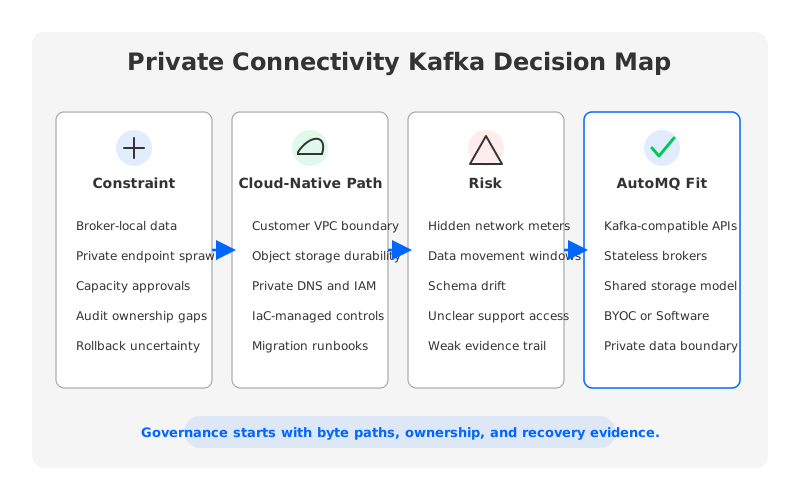
Teams rarely search for private connectivity kafka because they need a definition of private networking. They search because a production streaming platform has reached the point where security review, network design, Kafka operations, and application ownership have collided. A producer runs in one account, a fraud service consumes from another, a data lake sink needs restricted access, and the security team wants proof that business data does not cross a public path. The hard part is governing the pattern when every additional topic, connector, Consumer group, and migration adds another byte path to explain.
That makes private connectivity a workflow problem, not only a network feature. AWS PrivateLink, Azure Private Link, and Google Cloud Private Service Connect can all help teams expose services privately inside cloud networks, but the Kafka platform still has to answer a broader question: who owns the data path from producer to broker, broker to storage, broker to consumer, connector to sink, and region to region? If that answer lives only in diagrams, the platform will drift. The goal is to turn private connectivity for Kafka into a repeatable governance system: documented paths, bounded ownership, measurable cost, tested recovery, and clear migration evidence.
1Why teams search for private connectivity kafka
The phrase usually appears when a platform has already become important enough to be reviewed by more than the Kafka team. Security wants private routing and identity boundaries. Compliance wants data residency, encryption, audit logs, and support-access evidence. FinOps wants to know whether private endpoints, inter-zone transfer, NAT, load balancing, or cross-region replication sit outside the streaming platform invoice. Application teams want the same Kafka client behavior they already depend on: topics, partitions, offsets, transactions, Consumer groups, and Kafka Connect integrations.
Those groups are not asking the same question, but they are looking at the same system. A private endpoint can satisfy a network-control requirement while leaving the storage model, replication path, observability export, and support boundary unresolved. A managed service can reduce broker operations while moving the data plane into a provider-controlled environment. A self-managed cluster keeps infrastructure in the customer's account but adds operational burden. A BYOC or private software deployment improves boundary control only when the team can govern the cloud resources it now owns.
The first governance step is to draw the byte path before choosing the product pattern:
- Application path: Which producers, consumers, stream processors, and connectors talk to Kafka, and from which VPC, VNet, subnet, account, project, or region?
- Durability path: Where does durable log data live, which identity can read it, and how is encryption at rest enforced?
- Operations path: Which metrics, logs, support channels, and emergency access mechanisms exist, and what evidence do they produce?
- Migration path: How will topics, offsets, ACLs, schemas, connectors, and rollback behavior be validated before cutover?
This is where many reviews become too shallow. Teams mark "private connectivity" as passed because bootstrap servers are reachable through private networking. Kafka is more than a bootstrap address. It is a retained log with replay, fan-out, replication, client compatibility, schema discipline, and long-running operational state.
2The production constraint behind the problem
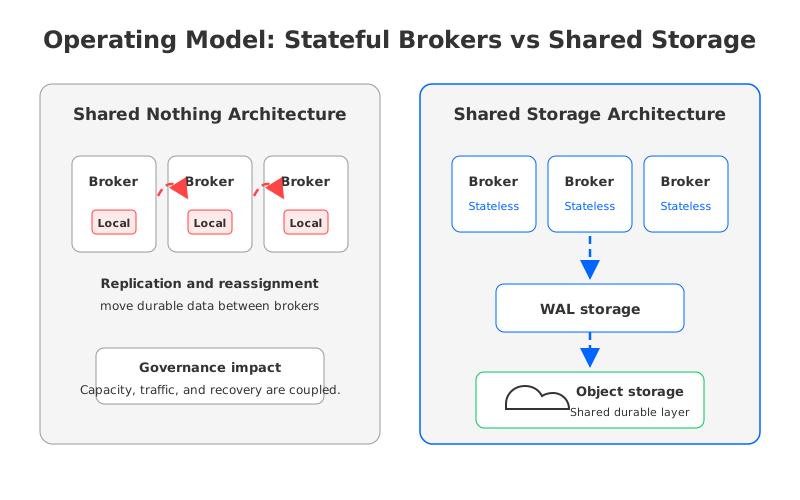
Traditional Apache Kafka uses a Shared Nothing architecture: each broker owns local or attached storage for its partitions, and durability is maintained through replicas across brokers. This model is proven, but it turns storage placement into an operational fact that private connectivity cannot hide. When a broker fails, scales, or is replaced, the platform must reconcile not only client access but also partition leadership, replica placement, disk capacity, and data movement.
In a regulated cloud environment, that coupling creates governance work. If the team expands the cluster, someone must approve compute and disk growth. If partitions move, someone must understand the data-transfer path. If retention grows, disk sizing and broker balance change. If consumers multiply, read fan-out can change network flows. Private connectivity can keep the client path off the public internet, but it does not change the fact that durable data is bound to broker-local storage.
That is why the architecture review should separate two concerns that often get merged:
| Review question | What private connectivity answers | What Kafka architecture still decides |
|---|---|---|
| Can clients reach Kafka over private network paths? | Endpoint placement, DNS, routing, firewall rules, and identity controls. | Whether brokers, storage, and consumers create additional data movement. |
| Can sensitive data stay inside the required boundary? | Which networks and accounts can initiate traffic. | Where durable logs, replicas, backups, and observability exports live. |
| Can the platform scale under governance? | Whether additional endpoints can be provisioned consistently. | Whether scaling requires broker-local capacity planning or large partition movement. |
| Can auditors reconstruct behavior? | Network logs and endpoint policy evidence. | Kafka ACLs, schemas, offsets, retention, operational logs, and support access records. |
The table is deliberately not a vendor ranking. It keeps the review honest. Private connectivity is one layer of the control system; Kafka's storage and operations model is another layer. Teams that do not separate those layers often discover the gap during migration, renewal, or an incident.
3Architecture options and trade-offs
A useful evaluation starts with patterns rather than brand names. The first pattern is traditional self-managed Kafka in the customer's network. It offers maximum infrastructure control and familiar Apache Kafka behavior, but it leaves the platform team responsible for brokers, disks, patching, balancing, scaling, monitoring, and recovery. It can be the right model when the team has deep Kafka operations capacity and wants to own every cloud primitive.
The second pattern is managed Kafka with private networking. It reduces operational work and may provide strong enterprise controls, but the governance boundary depends on the provider's data-plane model, support process, audit surfaces, regions, and connectivity options. It fits when the organization accepts provider-operated infrastructure and values managed operations over direct infrastructure control.
The third pattern is customer-controlled cloud deployment: BYOC for public cloud, or private software deployment for data center and dedicated environments. This model keeps more resources inside the customer's cloud account or private environment while shifting the evaluation toward IAM, object storage policies, private DNS, operations, observability export, and support authorization. It fits regulated teams that want a Kafka-compatible platform without sending the data plane into a fully external service boundary.
The fourth pattern is a Shared Storage architecture. Instead of treating broker disks as the center of durability, durable stream data lives in shared object storage, and brokers act closer to compute nodes. This does not remove the need for private connectivity. It changes what private connectivity has to govern. The byte path is no longer dominated by broker-to-broker replica movement and disk-bound reassignment; the review shifts toward object storage access, WAL storage, cache behavior, metadata, and client locality.
The strongest architecture reviews compare these patterns under the same workload: write throughput, read fan-out, retention, partition count, region plan, availability-zone plan, connector inventory, schema ownership, observability, and migration window. A platform that looks attractive for a small private endpoint proof of concept may look different after historical replay, multiple Consumer groups, recovery drills, and audit evidence export.
4Evaluation checklist for platform teams
The checklist should force each team to sign off on its own risk instead of letting "Kafka" absorb every concern. Compatibility belongs to platform engineering because Apache Kafka client behavior matters. Network path ownership belongs to cloud and security teams because private routing is a cloud control. Data contracts belong to data governance because a private pipe does not make bad schemas safe. Cost belongs to FinOps because private connectivity, transfer, storage, and over-provisioned capacity can appear in different bills.
Start with compatibility. Verify client versions, authentication mechanisms, authorization model, Kafka Connect usage, transactions, idempotent producers, offset reset behavior, and admin tooling. Apache Kafka's own documentation is still the baseline for core semantics such as Consumer groups, offsets, transactions, KRaft, and Kafka Connect. A Kafka-compatible platform should be evaluated against the behaviors your applications actually use, not only a generic produce-and-consume test.
Then move to governance evidence. The following questions produce artifacts that auditors, platform owners, and incident responders can review:
- Network evidence: Can the team show endpoint inventory, routing tables, DNS records, security groups or firewall rules, and flow logs for producer and consumer paths?
- Data evidence: Can the team show where durable records, WAL storage, object storage, backups, logs, and metrics reside?
- Contract evidence: Can topic ownership, schema expectations, compatibility rules, and data classification be linked to change management?
- Recovery evidence: Can the team demonstrate broker replacement, scaling, replay, rollback, and migration cutover without relying on undocumented manual steps?
- Cost evidence: Can the model separate compute, storage, private connectivity, inter-zone transfer, inter-region transfer, observability, and support?
This is also the right place to test private connectivity failure modes. What happens if an endpoint is misconfigured, a VPC route changes, a connector needs another network boundary, or a Consumer group replays several days of data after a downstream outage? A governance workflow that cannot answer those questions before production will answer them during an incident.
5How AutoMQ changes the operating model
After the neutral evaluation framework is clear, AutoMQ becomes relevant as a Kafka-compatible, cloud-native streaming platform built around Shared Storage architecture. It keeps Apache Kafka protocol compatibility while replacing broker-local log storage with S3Stream, WAL storage, and S3-compatible object storage. In that model, AutoMQ Brokers are designed as stateless brokers, and durable stream data sits in shared object storage rather than being tied to a specific broker disk.
For private connectivity governance, that changes the operating model in three ways. First, scaling and broker replacement become less entangled with durable data movement. The platform still needs capacity planning, but the review is no longer centered on moving retained partition data between broker disks. Second, storage governance becomes more explicit: object storage policies, encryption, IAM, bucket access, and WAL type become part of the evidence model. Third, deployment boundary choices become clearer. AutoMQ BYOC fits customer cloud environments; AutoMQ Software fits private data centers or IDC-style environments.
This does not make governance automatic. AutoMQ still has to be configured within the customer's network, identity, storage, monitoring, and support model. The difference is a cleaner separation between Kafka-compatible compute behavior and durable storage governance. That separation matters when the same review has to satisfy security, compliance, platform engineering, and FinOps without routing every decision through broker-local disks.
For teams building a schema or data-contract program, the same logic applies. A private network path proves reachability control; it does not prove that records are well-formed, classified, or safe to replay downstream. Topic ownership, schema rules, ACLs, audit logs, and connector governance still belong in the platform workflow. AutoMQ's Kafka-compatible surface lets teams keep familiar client and ecosystem patterns while evaluating whether the storage and deployment boundary reduce operational friction.
6Readiness scorecard
A practical scorecard should fit on one page. If it takes a separate workshop to explain, it will not survive a launch review. Use it to decide whether the platform is ready for production, ready for a pilot, or still missing evidence.
| Dimension | Ready signal | Risk signal |
|---|---|---|
| Compatibility | Critical producers, consumers, admin tools, and connectors pass behavior tests. | Testing only covers a simple produce-and-consume path. |
| Cost | Private connectivity, transfer, storage, compute, and observability are modeled separately. | The team compares only vendor invoices or broker instance prices. |
| Scaling | Broker replacement and capacity changes have tested runbooks. | Scaling depends on large data movement windows or manual balancing. |
| Security | Network, IAM, encryption, ACL, and audit evidence are reviewable. | Private endpoints exist, but storage and support access are unclear. |
| Migration | Topics, offsets, schemas, ACLs, and rollback are validated before cutover. | Migration is treated as a one-way bootstrap change. |
| Observability | Metrics, logs, flow evidence, and alert ownership are defined. | No team can reconstruct a failed private path after the fact. |
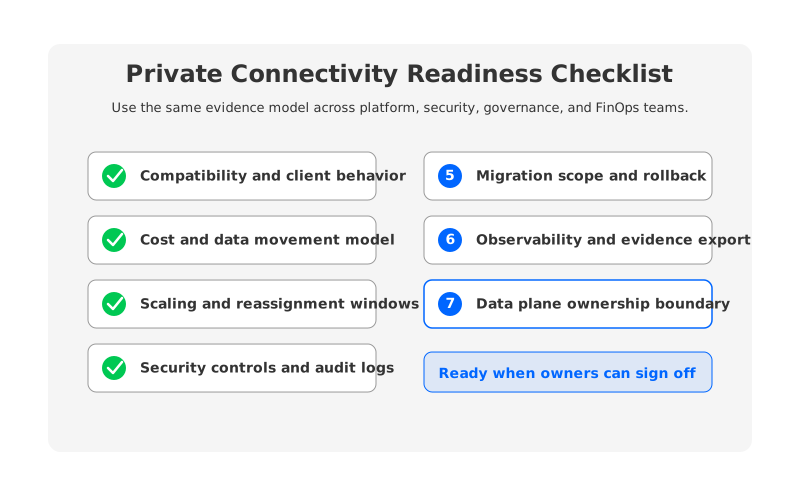
The scorecard should produce a decision, not a discussion backlog. If the major blocker is private routing, fix the network pattern. If the blocker is schema discipline, fix data contracts. If the blocker is broker-local storage, slow reassignment, or unclear data-plane ownership, evaluate whether a Kafka-compatible Shared Storage architecture changes the constraint enough to justify a pilot.
7FAQ
7.1Is private connectivity enough to make Kafka compliant?
No. Private connectivity helps control network reachability, but compliance also depends on encryption, IAM, ACLs, data residency, schema governance, audit logs, support access, retention, deletion, and incident response evidence.
7.2How should teams evaluate private connectivity Kafka cost?
Model the full byte path: private endpoints or service attachments, data processing, inter-zone transfer, inter-region transfer, NAT or load balancing if used, storage, compute, observability, support, and migration overlap. Use current cloud-provider pricing for the chosen region before publishing an estimate.
7.3Does a Shared Storage architecture remove the need for private connectivity?
No. It changes what the private connectivity model governs. Client access, object storage access, WAL storage, observability export, support channels, and downstream systems still need explicit network and identity controls.
7.4When should AutoMQ enter the evaluation?
Evaluate AutoMQ when the team needs Kafka-compatible APIs, customer-controlled deployment boundaries, object-storage-backed durability, and an operating model where brokers are not the long-term home for durable partition data.
7.5What makes a strong first pilot workload?
Choose a workload that exposes the real constraint without risking the most critical path. Good candidates include a high-retention topic, a connector-heavy data product, a replay-heavy analytics stream, or a workload where private connectivity already slows releases.
If your private connectivity review keeps expanding into storage, scaling, replay, and data-plane ownership, use that as the signal. Test one workload against a Kafka-compatible Shared Storage architecture and compare the evidence trail, not only the endpoint design. Start with the AutoMQ Cloud Console when you are ready to map the deployment boundary.
8References
- Apache Kafka documentation
- AWS PrivateLink documentation
- Azure Private Link overview
- Google Cloud Private Service Connect documentation
- AutoMQ architecture overview
- AutoMQ S3Stream shared streaming storage overview
- AutoMQ compatibility with Apache Kafka
- AutoMQ BYOC environment overview
- AutoMQ inter-zone traffic overview


