
Table of Contents
Table of Contents
Searches for governed connector catalog kafka usually start with a visible problem: a data team needs more sources, more sinks, and more self-service without letting every pipeline become a one-off integration project. The first screen of the evaluation is often a catalog. Does it support PostgreSQL CDC, MySQL, Snowflake, S3, Elasticsearch, Databricks, Iceberg, and the custom systems that never appear in vendor screenshots? That question matters, but it is not enough for production.
A connector catalog becomes a governance problem when the same platform has to serve many teams. The source owner cares about credentials and data minimization. The platform team cares about worker lifecycle, offset state, private networking, and blast radius. The consumer team cares about replay, schema evolution, and latency during incidents. A long catalog can still fail those tests if the streaming platform underneath it treats every growth event as a broker capacity event.
The practical thesis is simple: a governed Kafka connector catalog is not a list of integrations. It is an operating model for data movement, recovery, security, and cost control across Kafka-compatible pipelines.
1Why teams search for governed connector catalog kafka
The search phrase sounds narrow because it names a catalog, but the underlying intent is broad. Teams are trying to make Kafka-based integration repeatable. They may already use Apache Kafka Connect, which the Apache Kafka documentation describes as a framework for moving large data sets into and out of Kafka. They may also run Debezium, custom source connectors, sink connectors, and organization-specific transformation logic. At small scale, a shared wiki of supported connectors and a few worker clusters can be enough.
The model changes once Kafka becomes the default path between operational systems and analytics systems. A platform team starts getting requests that look similar on paper but behave differently in production:
- A CDC pipeline needs predictable offset handling because replaying from the wrong point can duplicate changes downstream.
- A sink pipeline needs strict credential boundaries because the connector can write into a regulated store.
- A replay-heavy analytics pipeline needs retention and catch-up capacity because downstream systems fail or reprocess historical data.
- A regional data-sharing pipeline needs private network placement because data cannot leave a customer-controlled environment.
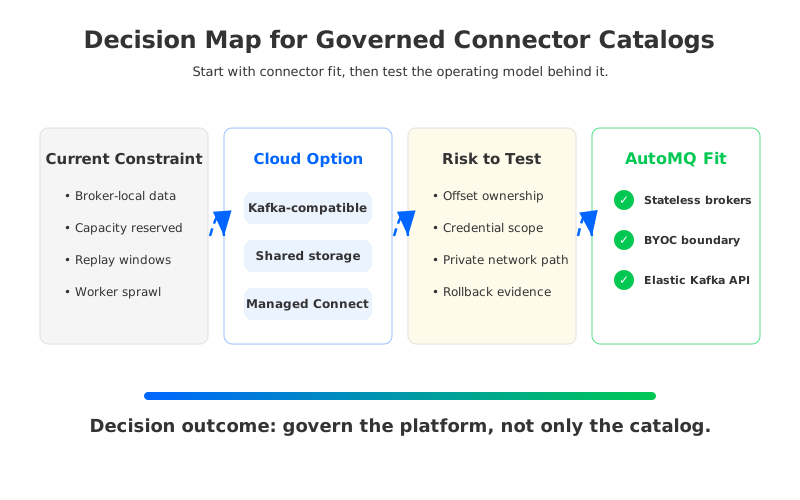
These are not only connector questions. They are platform questions. A governed catalog should document which connectors are approved, which plugin versions are allowed, where secrets live, how offsets are inspected, what metrics define health, and how a pipeline rolls back after a failed deployment. The catalog is the interface. The architecture behind it determines whether those controls are enforceable.
2The production constraint behind the problem
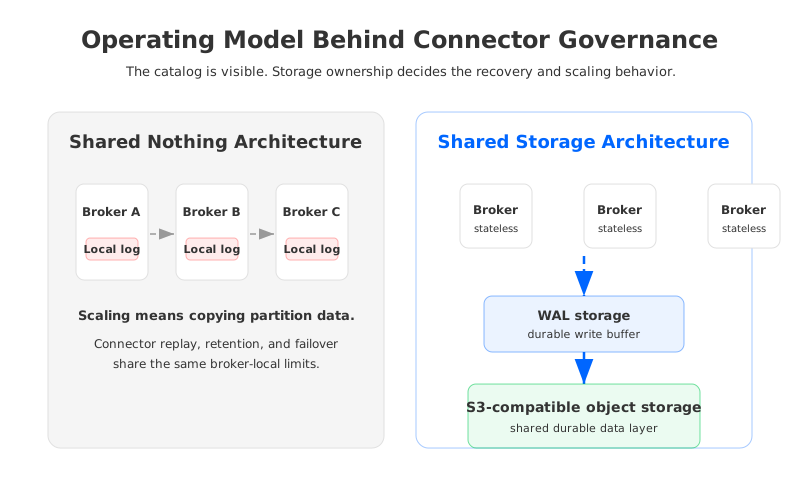
Traditional Kafka runs on a Shared Nothing architecture. Each broker owns local storage for the partitions assigned to it, and replication moves partition data between brokers for durability. That design has served Kafka well for years because it keeps the log close to the broker and makes each broker responsible for its own data. It also means capacity planning is tied to the broker-local storage model.
Connector-heavy environments put pressure on exactly that model. Source connectors write continuously, sink connectors consume continuously, and operational teams often keep longer retention so downstream systems can replay after an outage or rebuild. The pipeline team may think it is adding a connector, but the Kafka team sees additional partitions, additional write throughput, additional retention, additional consumer lag risk, and additional recovery load.
The mismatch shows up in several ways:
- Broker-local storage makes scale-out and scale-in operationally expensive because partition data may need to move as ownership changes.
- Multi-availability-zone deployments can turn replication and read paths into recurring network-cost concerns.
- Replay windows require enough retained data and enough read capacity for catch-up traffic, not only enough connector workers.
- Connector governance depends on observability across workers, topics, consumer groups, offsets, credentials, and broker capacity.
Apache Kafka Tiered Storage can move older log segments to remote storage, and that can be useful for retention economics. It does not make brokers stateless. Hot data, partition leadership, and operational movement still matter. For governed connector catalogs, that distinction is important because the catalog does not only ask, "Can we store old data?" It asks, "Can we change, recover, and audit this pipeline without turning every incident into a storage migration?"
3Architecture options and trade-offs
There are four common ways teams approach Kafka connector governance. None is universally right. The right choice depends on what the team needs to control: connector runtime, Kafka storage, cloud boundary, operational staffing, or all of them together.
| Option | What it optimizes | Governance risk to test |
|---|---|---|
| Self-managed Kafka Connect on existing Kafka | Maximum control over workers, plugins, and deployment patterns | Platform team owns worker lifecycle, broker capacity, offset troubleshooting, and scaling discipline |
| Managed connector runtime with existing Kafka | Faster deployment for supported connectors | Catalog coverage may improve while broker storage, retention, and replay constraints remain unchanged |
| Fully managed streaming platform | Less infrastructure ownership | Network boundaries, pricing units, private connectivity, custom plugins, and migration paths need careful review |
| Kafka-compatible cloud-native platform | Keep Kafka APIs while changing the broker storage model | Compatibility, connector support, observability, and operational ownership must be validated before cutover |
The table is deliberately not a feature checklist. A feature checklist tends to reward the broadest catalog, even when the real bottleneck is the operating model. A production decision should ask how the platform behaves during change: adding a connector, scaling worker tasks, rotating credentials, expanding retention, backfilling a sink, failing a broker, or moving a pipeline between environments.
Compatibility deserves special attention. Kafka-compatible does not only mean a producer can write and a consumer can read. Connector environments use admin APIs, topic settings, offset storage topics, connector status topics, client libraries, authentication mechanisms, and monitoring conventions. If those behaviors change, governance becomes a migration project rather than a platform upgrade.
Cost is the second trap. Connector catalogs are often evaluated by engineering teams, while the cost impact appears later in cloud bills and staffing load. A sink that replays several terabytes after a downstream outage may stress storage reads. A CDC rollout across many teams may create retention requirements that were never budgeted. A private-network connector path may require specific routing or endpoint design. The decision should model steady-state traffic and failure-mode traffic together.
4Evaluation checklist for platform teams
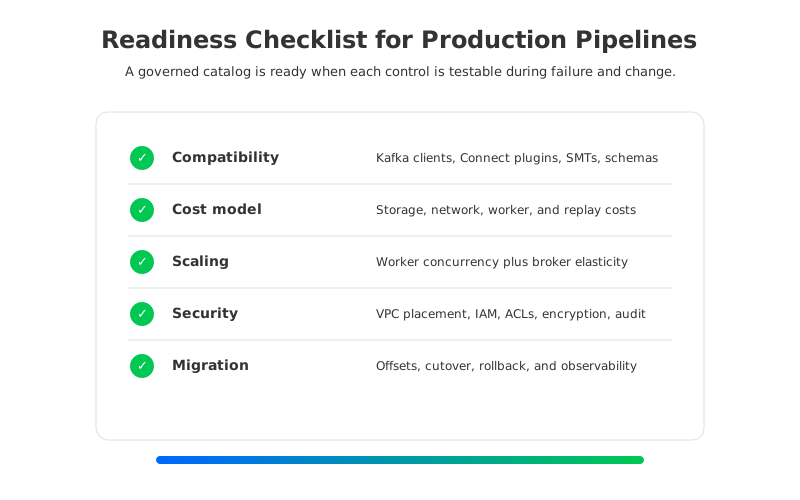
A governed catalog is ready for production when the platform team can answer the same set of questions for every approved connector. The goal is not to slow down data integration. The goal is to make approval meaningful, so the next team can launch a pipeline without rediscovering the same failure modes.
Use this checklist before standardizing on a Kafka-compatible connector platform:
- Connector and plugin compatibility: Which connector versions are approved? Are Single Message Transforms, converters, serializers, and schema workflows supported? Can custom plugins be uploaded, reviewed, and pinned?
- Offset and state control: Where are connector offsets stored? Who can inspect, reset, or migrate them? How do source offsets, Kafka offsets, and sink-side checkpoints line up during rollback?
- Security boundary: Where do workers run? Which VPC (Virtual Private Cloud), subnet, IAM role, service account, ACL, and secret store are involved? Can each connector be scoped to least privilege?
- Cost and capacity: Which costs scale with records, retained bytes, connector tasks, cross-zone traffic, object storage requests, replay reads, and worker compute?
- Scaling behavior: What happens when the source grows, a sink slows down, or a connector requires more tasks? Does broker capacity need to be changed manually?
- Recovery workflow: Can the team rehearse worker failure, broker failure, downstream outage, connector redeploy, and full rollback without depending on undocumented tribal knowledge?
- Observability: Are connector task status, errors, lag, consumer groups, topic throughput, broker health, storage behavior, and network paths visible in one operating view?
The checklist should be written into the catalog itself. If a connector is approved only for one network zone, one credential pattern, or one replay window, that constraint should be visible before a team deploys it. Governance fails when constraints live in incident notes instead of the catalog.
5How AutoMQ changes the operating model
Once the evaluation reaches broker storage, the architecture category matters. AutoMQ is a Kafka-compatible, cloud-native streaming platform built around Shared Storage architecture. It keeps Kafka protocol and API compatibility as the application-facing contract, while moving persistent stream data away from broker-local disks and into S3-compatible object storage through S3Stream, WAL (Write-Ahead Log) storage, and data caching.
That change is relevant to connector governance because it separates two concerns that traditional Kafka often couples together. Connector workers and Kafka clients still interact through Kafka semantics: topics, partitions, offsets, consumer groups, producers, and admin operations. Brokers, however, do not have to behave like long-lived storage owners. AutoMQ Brokers are stateless brokers in the sense that durable data is stored in shared storage rather than bound to local broker disks.
For a platform team, this changes the questions around growth and recovery. Scaling the streaming layer no longer has to be treated as a large broker-local data movement project. Partition reassignment and Self-Balancing become operations over ownership, traffic, and metadata rather than bulk copying of retained log data. That does not remove the need to size connector workers or validate downstream capacity. It does reduce the chance that every connector rollout turns into a storage-placement exercise.
AutoMQ BYOC also matters for governed connector catalogs because many integration teams care where the runtime lives. In BYOC (Bring Your Own Cloud), AutoMQ control plane and data plane components run inside the customer's cloud account and VPC. AutoMQ Managed Connector extends that model to Kafka Connect operations, so connector workers can be managed through the same control plane while remaining close to customer-owned networks, IAM boundaries, and source or sink systems. That is different from treating governance as a separate SaaS control problem detached from the data path.
The practical benefit is not that every catalog entry becomes automatically safe. No platform can make a poorly scoped credential or an untested rollback plan safe. The benefit is that the platform gives governance teams a cleaner set of boundaries to reason about: Kafka-compatible APIs for applications, managed connector operations for worker lifecycle, shared object storage for durable stream data, and customer-controlled deployment boundaries for network and compliance review.
6A migration path that does not start with the catalog
Teams often start migration planning by asking whether every existing connector is available. That is understandable, but it can hide the harder sequencing problem. A connector migration changes both runtime behavior and platform behavior. If you move the connector runtime first while leaving the broker bottleneck unchanged, the catalog may look cleaner while replay and retention problems remain. If you move the broker first without validating connector state, the platform may be better but the pipeline cutover can still fail.
A better sequence starts with the pipelines that are easiest to reason about:
- Pick a connector with clear source ownership, clear sink ownership, and measurable lag.
- Capture the current topic configuration, connector configuration, offsets, schemas, ACLs, and error-handling behavior.
- Run the connector against a Kafka-compatible target in a non-production environment and compare records, offsets, task status, and restart behavior.
- Rehearse rollback before production cutover, including how producers, consumers, connector workers, and downstream stores return to the previous path.
- Add the connector to the governed catalog only after the operating runbook is proven.
This sequence avoids the false comfort of "supported connector" as the finish line. Support means the connector can run. Governance means the team knows how it runs during change.
7FAQ
7.1What is a governed connector catalog for Kafka?
A governed connector catalog is a controlled inventory of approved Kafka source and sink connectors, plugin versions, runtime policies, security boundaries, observability requirements, and recovery procedures. It turns connector adoption into a repeatable platform process instead of a collection of team-specific deployments.
7.2Is Kafka Connect enough for connector governance?
Kafka Connect provides the framework for running source and sink connectors. Governance also needs platform controls around credentials, network placement, plugin approval, offset management, worker operations, broker capacity, and rollback. Kafka Connect is part of the answer, not the whole operating model.
7.3How does Shared Storage architecture help connector-heavy Kafka environments?
Shared Storage architecture stores durable stream data in shared object storage rather than binding it to broker-local disks. For connector-heavy workloads, that can simplify broker scaling, partition reassignment, and recovery planning because retained data is not moved as local broker ownership changes.
7.4Should every team move to a managed connector platform?
No. Self-managed Kafka Connect can work well for teams with strong operational maturity, stable workloads, and clear ownership. A managed or platform-integrated model becomes more attractive when many teams need shared governance, private networking, consistent observability, and repeatable recovery.
If your connector roadmap is turning into a broker capacity, networking, and governance project, evaluate AutoMQ BYOC with the same checklist above: start from a customer-controlled deployment.


