
Table of Contents
Table of Contents
The first symptom is usually not a broken cluster. It is a pull request that creates a topic without an owner, a connector that needs broad credentials, or a schema change that waits behind a platform review for a week. The Kafka platform is working, but the workflow around it is becoming slower than the teams that depend on it.
That is why teams search for governed kafka developer workflows. They are not trying to make developers fill out more forms. They are trying to let developers create topics, schemas, ACLs, connectors, and deployment changes without turning every request into a production risk. A governed workflow should make the safe path faster than the informal path.
The difficult part is that Kafka-compatible infrastructure sits at the boundary between application autonomy and shared platform responsibility. Developers need self-service because event-driven systems move through many teams. Platform owners need controls because a topic can carry regulated data, trigger downstream SLAs, consume retention budget, and become part of a recovery plan.
1Why Teams Search for Governed Kafka Developer Workflows
Governance usually appears after a platform has already succeeded. A single application team can create topics manually, coordinate schema changes in chat, and patch consumer permissions during deployment. A shared Kafka platform cannot operate that way for long. The same action that felt harmless in a small cluster becomes a cross-team contract when producers, consumers, connectors, data catalogs, and incident responders all depend on it.
The workflow problem is not limited to topic creation. It spans schema subjects, ownership, retention, ACLs, Kafka Connect workers, consumer lag alerts, and rollback steps. Each step touches a different owner unless the platform gives teams one governed route through the system.
A good workflow answers several questions before anything reaches production:
- Who owns the stream, and who receives incidents when the data quality or lag budget fails?
- Which producers and consumers can access it, and is access tied to least-privilege ACL patterns?
- Which schema compatibility rule applies, and where is the contract documented?
- Which retention, compaction, partitioning, and alerting policies match the workload class?
- How will the object be migrated, mirrored, paused, or removed without breaking consumers?
Those questions are governance questions, but they are also developer-experience questions. If the answers are scattered across tickets and private runbooks, developers will work around the process. If the answers are encoded into a repeatable workflow, governance becomes part of delivery.
2The Governance Pressure Behind Shared Streaming Platforms
Kafka gives teams flexible primitives. Topics, partitions, consumer groups, ACLs, offsets, transactions, and Kafka Connect integrations can support many operating models. That flexibility is a strength, but it also means the platform team must decide which choices are available by default and which choices require review.
In a shared platform, the risky choices are often not dramatic. A topic with unclear ownership may remain idle until a consumer incident needs escalation. A high-retention stream may look reasonable until storage grows faster than the capacity plan. A connector with broad network access may pass a functional test while creating an audit issue. A schema compatibility mode may be acceptable for one producer and dangerous for another.
Governed workflows turn these choices into explicit controls. The platform should not ask every developer to learn every Kafka administration detail. It should present opinionated paths for common work and escalation paths for unusual work:
| Workflow object | Developer-facing action | Platform control |
|---|---|---|
| Topic | Request or declare a stream | Naming, owner, lifecycle, retention, partition policy |
| Schema | Register or evolve a contract | Compatibility mode, review boundary, data classification |
| Access | Grant producer or consumer rights | ACL template, service identity, audit record |
| Connector | Deploy a source or sink | Network boundary, secret handling, sink ownership |
| Migration | Move or mirror a stream | Compatibility test, consumer cutover, rollback plan |
Governance failures rarely stay in one layer. A weak topic workflow becomes a weak ACL workflow. A weak schema workflow becomes a replay problem. The platform has to treat them as one developer path instead of unrelated administration tasks.
3Contracts, Ownership, Access, and Audit Trade-Offs
Every governed workflow has a tension between speed and proof. Developers want a path that works during delivery pressure. Governance teams want evidence that policies were followed. Platform owners need a design that produces evidence without turning every request into a manual approval queue.
The first trade-off is ownership. Requiring an owner for every topic sounds basic, but the implementation detail matters. An owner should be a team or service group, not an individual. The workflow should write the owner into catalog metadata, alert routing, and review records at creation time. If ownership is captured only in a ticket, it will be lost when the topic outlives the request.
The second trade-off is access. Kafka ACLs can be precise, but precision is hard to maintain when topic names and identities are inconsistent. A governed workflow should generate ACLs from a small set of patterns: producer to topic, consumer group to topic, connector to source or sink, and admin actions for platform operators. Manual exceptions still need a path, but they should be visible enough to review later.
The third trade-off is schema evolution. Schema governance should not make every field change feel like a release board. It should distinguish private streams from public data contracts, backward-compatible changes from breaking changes, and production contracts from experimental work. The workflow can enforce this by tying compatibility policy to contract class.
Auditability is the fourth trade-off. The goal is to reconstruct who changed what, why the change was allowed, which policy applied, and how the change can be rolled back. A platform that cannot answer those questions will struggle during incidents, compliance reviews, and migrations.
4Evaluation Checklist for Platform Teams
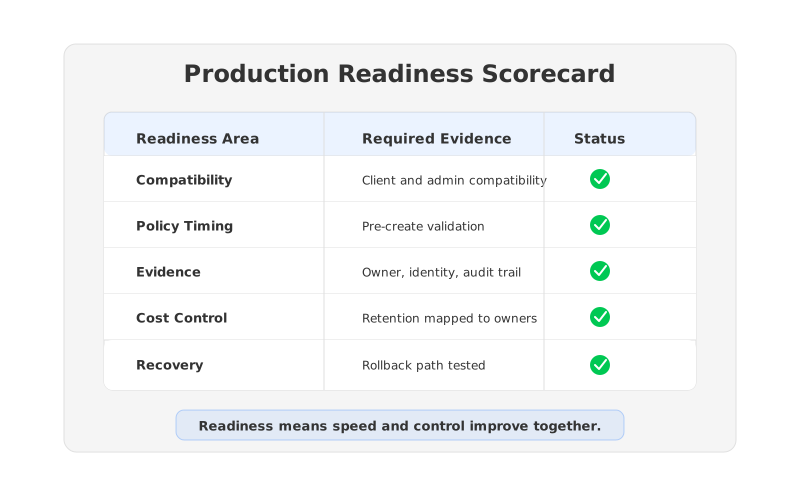
A workflow is production-ready when it improves both delivery speed and operational control. That is a higher bar than a portal with a topic form. The workflow needs to integrate with identity, catalog, schema registry, infrastructure-as-code, CI, observability, and incident response.
Use this checklist before standardizing on a Kafka-compatible platform workflow:
| Criterion | Question to ask | Failure mode |
|---|---|---|
| Compatibility | Do existing Kafka clients, tools, and admin flows keep working? | Governance becomes a migration project before it delivers value. |
| Policy timing | Are risky choices blocked before production creation? | Reviews happen after data and consumers already depend on the object. |
| Evidence | Does the workflow record owner, policy, identity, and reason? | Audits rely on chat history and tribal memory. |
| Cost control | Are retention, partitions, replay, and connector paths tied to owners? | Storage and network growth are hard to attribute. |
| Recovery | Can the platform pause, mirror, migrate, or roll back safely? | Every governance cleanup becomes a fragile consumer coordination task. |
This checklist also prevents a common mistake: treating governance as a UI problem. A self-service screen can make requests easier, but the durable value comes from the control plane behind it. The workflow must attach schema rules, ACLs, ownership, observability, and audit records as one controlled operation.
5Infrastructure Architecture Still Shapes Governance
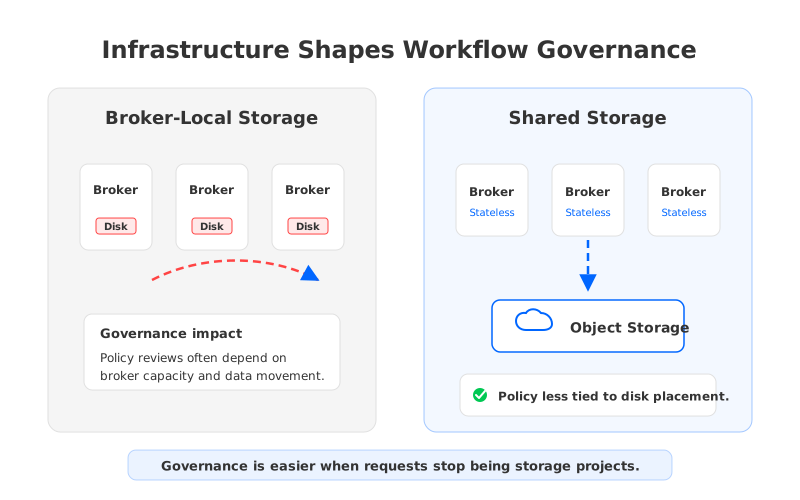
Governed developer workflows live above Kafka APIs, but they are constrained by the infrastructure model underneath. In traditional shared-nothing Kafka deployments, brokers are responsible for serving traffic and holding local persistent data. Partitions, replicas, and retention policies therefore create broker-level capacity and data-movement consequences.
That coupling changes governance behavior. Platform teams become cautious about self-service because one topic request can affect broker storage, rebalance work, cross-zone replication, and recovery time. A workflow may look well-governed on paper while still requiring manual capacity review for routine changes.
Tiered storage can reduce pressure by moving older log segments to remote storage. It does not fully remove the operational role of broker-local storage for active data and broker coordination. A governed workflow still has to consider how topic growth maps to broker capacity and failure recovery.
The neutral evaluation question is not whether governance is strict or relaxed. The better question is whether the infrastructure lets the platform make policy decisions without turning every policy decision into a storage project.
6How AutoMQ Changes the Operating Model
After the workflow requirements are clear, architecture becomes easier to evaluate. A Kafka-compatible platform should preserve Kafka clients, topic semantics, consumer groups, offsets, and operational tooling while reducing the infrastructure coupling that makes governed self-service hard to scale.
AutoMQ is a Kafka-compatible streaming system that redesigns the storage layer around shared object storage and stateless brokers. Durable data is stored in object storage, while brokers focus on serving Kafka-compatible traffic and coordinating the runtime. The important governance implication is not that platform rules disappear. The implication is that platform rules can be applied with less dependence on broker-local data placement.
For governed developer workflows, that operating model changes several decisions:
- Topic creation can be evaluated through ownership, contract class, retention, and access policy without treating every request as a broker disk-placement event.
- Capacity planning can separate compute pressure from durable storage growth more cleanly, which helps platform teams connect cost to workload owners.
- Recovery and migration planning can focus on compatibility, identity, and consumer cutover instead of long broker-local data movement as the default constraint.
- Deployment boundaries can match the organization’s cloud-control requirements because AutoMQ supports customer-controlled deployment models for Kafka-compatible infrastructure.
AutoMQ should still be evaluated with the same neutral checklist as any other platform. Teams should test client compatibility, failure behavior, observability, IAM integration, connector operations, and migration rollback. Shared storage gives platform teams a different operating model for enforcing governance without making developers wait on storage-heavy administration work.
7A Governed Workflow Reference Model
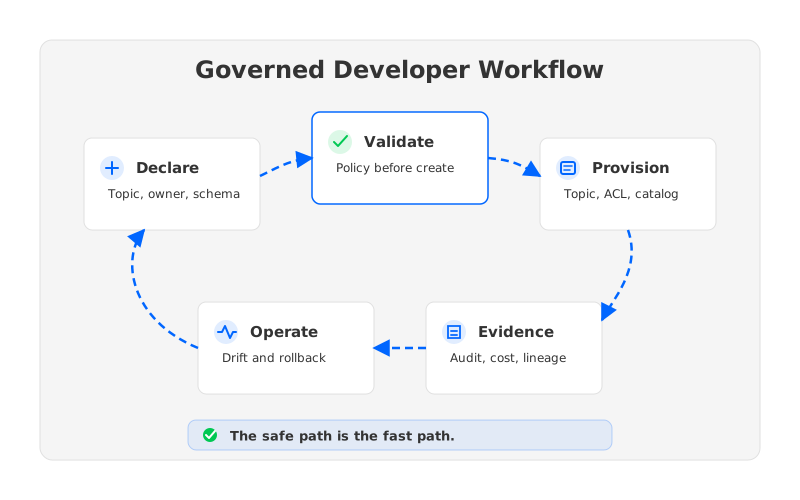
A practical workflow starts before topic creation and ends after production evidence exists. The most reliable pattern is a declared-resource model: developers submit the intended stream contract through code or a platform portal, and the platform reconciles that declaration into Kafka-compatible resources.
The flow should look like this:
- A developer declares the stream name, domain, owner group, contract class, data classification, retention class, and expected producers or consumers.
- The platform validates naming, ownership, schema policy, identity, and quota class before creating production resources.
- The workflow creates or updates the topic, schema subject, ACLs, catalog record, alert routing, and audit entry together.
- Deployment pipelines verify that producers and consumers use approved identities and contract versions.
- Operations can review drift, exceptions, cost attribution, and rollback readiness from the same source of truth.
The sequence is strict because each step reduces a different production risk. Validation prevents accidental contracts. Resource creation keeps Kafka state aligned with governance metadata. Pipeline checks prevent teams from bypassing approved identities.
8Migration Risk and Rollback Discipline
Governed workflows are easiest to design before a platform has hundreds of streams. Most teams have to retrofit governance onto existing Kafka estates, so migration should be handled as a compatibility and ownership program.
Start by classifying existing topics and consumers. Some streams are public contracts that need schema compatibility and stronger access controls. Some are private implementation streams that need owners and lifecycle rules. Some are temporary streams that should be deleted after review.
Then introduce workflow enforcement gradually. A common pattern is to make the governed path mandatory for anything created after a policy date, while legacy objects receive metadata and exceptions. Move legacy topics into the declared-resource model through migration windows, mirror paths, or consumer cutovers. The rollback plan should be explicit: which producers can return to the old path, which consumers can continue reading, and which schema rule protects both sides.
This is where Kafka-compatible infrastructure matters. A migration that preserves Kafka client behavior reduces application risk. A storage architecture that reduces broker-local data movement reduces platform risk. Both dimensions are required for a governed workflow to survive contact with production.
9The Workflow Is the Platform Product
Governance fails when it is presented as friction added after engineering is done. It works when the governed route is the easiest way to ship a production stream. Developers should receive a clear contract: declare what you need, use approved identities, follow compatibility rules, and the platform will create the surrounding resources.
Platform teams should hold themselves to the same standard. The workflow must produce reliable Kafka-compatible resources, not only policy documents. It must expose exceptions, connect ownership to cost and incident response, and support migration and rollback.
When the next topic, schema, connector, or ACL request arrives, the question should not be "who can approve this?" The question should be "does the declared workflow have enough information to make this safe?" If the answer is no, the platform needs a better control model. If the answer is yes, the developer should not have to wait.
If governed developer workflows are becoming the bottleneck for your Kafka platform, evaluate the workflow and the infrastructure together. Start with the checklist above, then test whether Kafka-compatible shared storage changes the operational constraints behind your approvals. To explore that path in a customer-controlled cloud model, start from AutoMQ Cloud with one real topic, schema, and rollback scenario.
10References
- Apache Kafka Documentation: https://kafka.apache.org/documentation/
- Apache Kafka Authorization and ACLs: https://kafka.apache.org/documentation/#security_authz
- Apache Kafka Connect Documentation: https://kafka.apache.org/documentation/#connect
- AutoMQ Architecture Overview: https://docs.automq.com/automq/architecture/overview?utm_source=blog&utm_medium=reference&utm_campaign=aivk-0045
- AutoMQ Deployment Overview: https://docs.automq.com/automq/deployment/overview?utm_source=blog&utm_medium=reference&utm_campaign=aivk-0045
11FAQ
11.1What are governed Kafka developer workflows?
Governed Kafka developer workflows are repeatable paths for creating and changing Kafka resources such as topics, schemas, ACLs, connectors, and migration plans. They combine developer self-service with controls for ownership, policy, compatibility, audit evidence, and recovery.
11.2Why do Kafka workflows need governance?
Kafka resources often become shared contracts across many teams. A topic can affect access control, SLAs, retention cost, compliance reviews, and incident response. Governance makes those responsibilities explicit early.
11.3Should Kafka topic creation be self-service?
Self-service is useful when the platform validates the request before creation and attaches metadata, ACLs, schema rules, and alerts. Uncontrolled self-service creates governance debt. Manual approval for every routine request creates delivery bottlenecks. The goal is policy-backed self-service.
11.4How does infrastructure architecture affect governance?
Traditional broker-local storage can make routine governance decisions depend on broker capacity, data movement, and recovery planning. Shared-storage Kafka-compatible architectures reduce that coupling by separating durable storage from broker compute.
11.5Where should a platform team start?
Start with one workflow that creates a topic, schema subject, ACL template, owner record, alert route, and audit entry together. Run it against a real workload with producers, consumers, and rollback requirements. Expand after the workflow proves that it can improve both developer speed and production control.


