
Table of Contents
Table of Contents
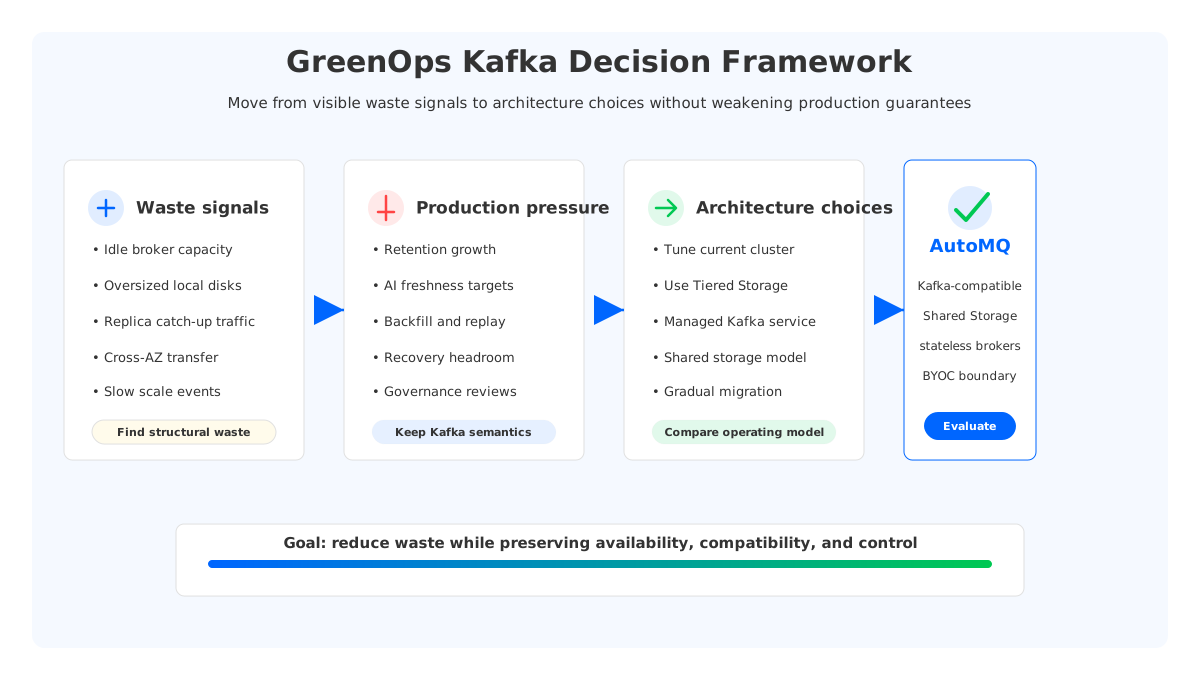
The teams searching for greenops kafka are usually not trying to make Kafka sound more virtuous. They are looking at a bill, a capacity plan, or a sustainability target and seeing the same uncomfortable pattern: streaming platforms are designed to stay on even when business demand moves in waves. Brokers keep disks provisioned. Replicas keep copying data. Consumers fall behind and catch up in bursts. Platform teams reserve capacity because the cost of being short is an incident, while the cost of being long is spread across monthly cloud spend.
GreenOps makes that waste visible, but visibility is only the first step. For Kafka, the deeper question is architectural: which parts must be always-on, which parts can scale with workload, and which costs are artifacts of broker-local disks? A useful GreenOps program does not start by asking engineers to turn off critical infrastructure. It starts by separating productive resilience from accidental overprovisioning.
1Why greenops kafka matters now
Kafka has become a foundation for fraud detection, telemetry pipelines, customer data platforms, change data capture, observability, and AI data freshness. These workloads are operationally serious, so platform teams often build for the worst hour of the week and then pay for that shape all month. The same cluster may need low-latency tail reads during business hours, large backfills during migrations, and long retention for replay or audit. Each requirement is reasonable on its own; together they create a platform that can look busy even when much of the spend is defensive.
GreenOps adds a second lens to FinOps. FinOps asks whether spend is aligned with business value. GreenOps asks whether the underlying resource consumption is necessary for the work being done. In a streaming platform, those questions overlap because idle compute, oversized disks, duplicate replication traffic, and slow rebalancing all translate into both cost and energy use. The cleanest savings usually come from removing waste at the architecture layer, not from asking every application team to shave a few partitions.
For Kafka leaders, the practical target is not a vague "greener cluster." It is a streaming backbone where capacity follows demand, retained data does not force broker sprawl, and failure recovery does not require copying large volumes of data between nodes.
2The production constraints behind the search
Always-on streaming has a different waste profile from batch analytics. A batch cluster can often be scheduled, paused, or isolated by job. A Kafka-compatible platform has to preserve client availability, ordered partitions, offset continuity, retention policies, and consumer group behavior while traffic changes underneath it. That means many common GreenOps moves need to be evaluated against production semantics, not only infrastructure utilization.
Several constraints shape the conversation:
- Storage is provisioned for retention and recovery, not only current traffic. A topic with long retention may force durable capacity even if average write throughput is modest. If storage lives on broker-local disks, retention growth often becomes broker growth.
- Replication protects availability but multiplies movement. Traditional Kafka durability depends on replicas distributed across brokers. In cloud deployments, that can also mean cross-Availability Zone data transfer, extra disk capacity, and catch-up traffic after failure.
- Elasticity can create its own work. Adding brokers helps only if traffic and partitions can move safely. When scaling requires moving partition data, teams delay it, schedule it, or overprovision to avoid it.
- Governance needs stable boundaries. A GreenOps decision that saves money by weakening regional isolation, auditability, or recovery posture is not a platform improvement. It is risk moved into another column.
The result is a familiar trap: a team sees waste, but the safe operational response is to keep capacity in place. The inefficient baseline becomes normal.
3Where traditional Kafka architecture amplifies waste
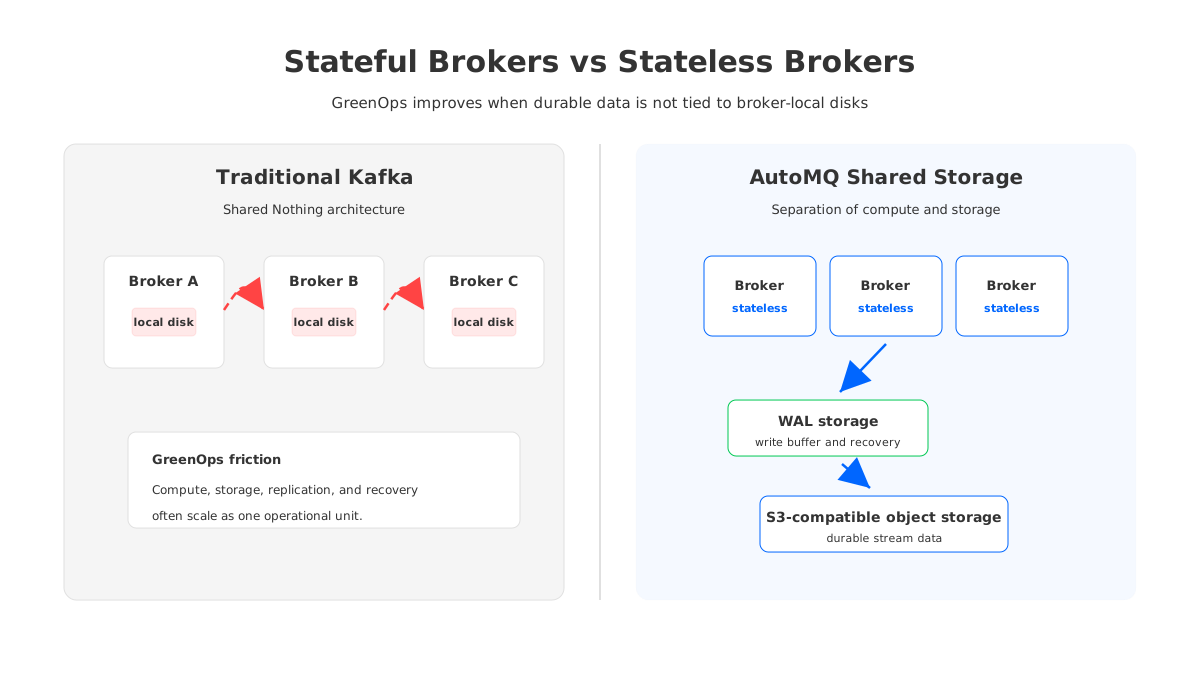
Traditional Apache Kafka uses a Shared Nothing architecture. Each Broker owns local log storage, partitions are assigned to Brokers, and durability is maintained through ISR (In-Sync Replicas). This design gives Kafka a clear operational model and mature client semantics, which is why the ecosystem around producers, consumers, offsets, transactions, Kafka Connect, and Kafka Streams remains so valuable. The same design also couples compute capacity, durable storage, and data movement in ways that matter for GreenOps.
When a Broker stores persistent data locally, scaling decisions become storage decisions. A cluster that needs more write throughput may need more nodes, but adding nodes can trigger partition movement. A cluster that needs longer retention may need more disk, but local disk is attached to Brokers, so storage growth often brings compute growth along with it. A cluster that loses a node may need replicas to catch up, which consumes network, disk, and CPU at the moment the platform is already under stress.
Tiered Storage changes part of that equation by moving older log segments to remote storage. It can be a good fit when the main problem is historical retention cost. It does not fully remove the coupling between Brokers and the active log because recent data, partition leadership, and hot-path operations still depend on broker-local resources. GreenOps teams should therefore distinguish "remote retention" from a more fundamental separation of compute and storage.
The waste is not that Kafka is badly designed. Kafka was designed around a different infrastructure assumption: local disks and broker replication were the durable substrate. In cloud environments, object storage, elastic compute, managed networking, and regional isolation create a different substrate. The mismatch appears when teams keep paying for data-center-style local persistence inside cloud pricing models.
4Architecture patterns teams usually compare
A serious GreenOps review should compare operating models rather than slogans. "Reduce brokers" is not a strategy if the remaining Brokers become harder to recover. "Move to object storage" is not enough if the write path, catch-up reads, and metadata path are not production-ready. The evaluation has to ask what work the platform performs during steady state, scale events, failures, and replay.
| Pattern | GreenOps advantage | Production trade-off to inspect |
|---|---|---|
| Tune the existing Kafka cluster | Low migration risk and immediate visibility into idle topics, retention, partitions, and quotas | Waste may remain structural if storage, compute, and replication are still tightly coupled |
| Use Tiered Storage for older data | Retention can move away from expensive broker-local disks | Hot data and operational scaling still depend on Brokers and local storage behavior |
| Adopt a managed Kafka service | Operations effort can move away from the platform team | Pricing dimensions, data-plane boundary, network charges, and feature constraints need careful review |
| Evaluate Kafka-compatible shared storage | Durable data can move to object storage while Brokers become more elastic | WAL design, compatibility, object-store behavior, and recovery semantics must be validated |
The table is not a ranking. Different teams have different constraints. A regulated financial platform may value deployment control more than convenience. A retail data platform may care most about bursty seasonal traffic. An observability pipeline may be dominated by retention and catch-up reads. The useful GreenOps question is: which architecture reduces waste without weakening the platform contract your applications depend on?
That contract includes Apache Kafka client compatibility, consumer group behavior, offset management, topic configuration, transactions where used, and ecosystem integrations. It also includes monitoring, rollback, network placement, identity, and change management. A GreenOps design that ignores these details will save money in a spreadsheet before it costs time in production.
5A practical evaluation checklist
Teams get better results when they evaluate waste as a lifecycle problem. The steady-state bill matters, but so do the events that force the platform to do extra work: a Broker replacement, a backfill, a traffic spike, a regional migration, or a retention increase. If each event requires copying durable data around the cluster, the platform will be sized for the event rather than the normal workload.
Use this checklist during an architecture review:
- Map resource coupling. Identify whether compute, storage, replication, and network scale independently. If one requirement forces all four to grow, GreenOps opportunities are limited.
- Measure the idle baseline. Track Broker CPU, memory, disk utilization, partition skew, network transfer, and consumer lag during low and high traffic windows. Idle disk and idle replica capacity are different from idle compute.
- Separate hot-path latency from retention. Long retention should not force the same resource profile as low-latency produce and tailing reads. Treat replay and catch-up reads as explicit workload classes.
- Model cross-AZ movement. In cloud deployments, replication, producer routing, consumer placement, and recovery traffic can all create inter-zone transfer. The bill may reveal architecture work that utilization dashboards hide.
- Test scale events. Measure scale-out, scale-in, partition reassignment, and Broker replacement with realistic topic counts. GreenOps fails when elasticity is too risky to use.
- Review control boundaries. Confirm where message data, metadata, logs, metrics, IAM permissions, and support access live. Sustainability work should not blur data ownership or regional controls.
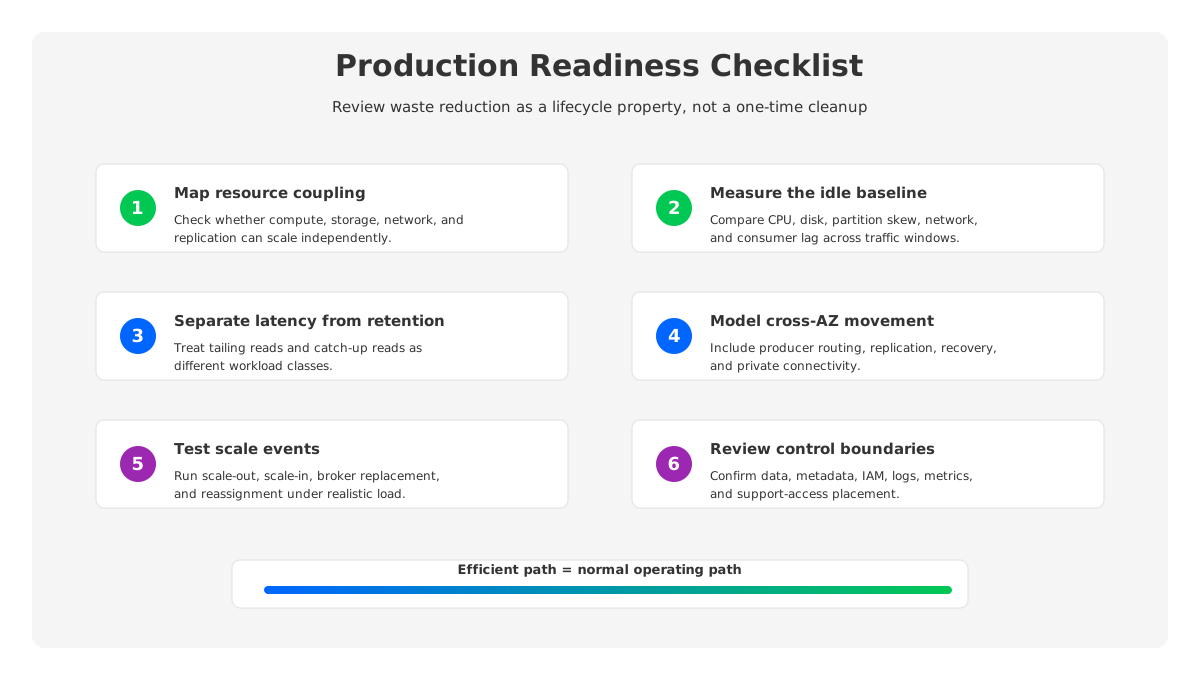
The checklist also prevents a common mistake: treating GreenOps as a one-time cleanup. Topic retention audits and right-sizing exercises are valuable, but Kafka waste often returns because teams are responding to a coupled architecture with manual governance. The durable fix is to make the efficient path the normal operating path.
6Where AutoMQ changes the operating model
Once a team has mapped the constraints neutrally, AutoMQ becomes relevant as a Kafka-compatible, cloud-native streaming platform built around Separation of compute and storage. AutoMQ preserves the Kafka protocol and ecosystem compatibility while replacing broker-local persistent storage with S3Stream, a shared streaming storage layer backed by S3-compatible object storage and WAL (Write-Ahead Log) storage.
This matters for GreenOps because the architecture changes what must remain provisioned. AutoMQ Brokers are stateless brokers: they process Kafka requests, handle partition leadership, and use shared storage for durable data instead of owning local persistent logs. Durable stream data lives in S3 storage, while WAL storage provides a persistence buffer for low-latency writes and recovery. With the durable log no longer bound to a specific Broker's disk, scaling compute does not require the same kind of data movement that dominates traditional partition reassignment.
The operating model shifts in three practical ways:
- Retention can follow object storage economics. Long-lived data is not forced to sit on broker-local disks. Teams can evaluate retention based on S3-compatible object storage behavior, request patterns, and catch-up read needs.
- Elasticity becomes more usable. Stateless Brokers are easier to replace, scale, and rebalance because durable data is not tied to local disks. That reduces the incentive to keep excess compute online for fear of slow recovery.
- Traffic placement can be designed around cloud cost. AutoMQ documents capabilities such as Self-Balancing, Seconds-level partition reassignment, and Zero cross-AZ traffic, which are directly relevant when a GreenOps program includes network waste and inter-zone transfer.
AutoMQ BYOC and AutoMQ Software also matter for teams with control requirements. In AutoMQ BYOC, the control plane and data plane run in the customer's cloud account VPC. In AutoMQ Software, they run in the customer's private data center. Those boundaries help teams evaluate cost, governance, and sustainability without giving up control over where the streaming data plane operates.
7Decision table: optimize, redesign, or migrate
GreenOps work should end with an engineering decision, not a dashboard. Sometimes the right answer is to tune the current cluster. Sometimes the right answer is to redesign the storage architecture. Sometimes the right answer is to migrate gradually while preserving client behavior and rollback options.
| Signal you observe | Likely interpretation | Next move |
|---|---|---|
| Low CPU but high disk spend | Retention is driving the architecture more than active traffic | Audit retention and evaluate Tiered Storage or shared storage |
| Frequent overprovisioning before traffic events | Elasticity exists on paper but is operationally expensive | Test scale events and partition movement under production-like load |
| High inter-zone transfer during normal writes | Replication and placement are creating hidden network waste | Review producer routing, replica placement, and architecture support for Zero cross-AZ traffic |
| Slow Broker replacement or rebalancing | Durable data is too tightly bound to nodes | Evaluate stateless broker or shared storage designs |
| Governance blocks managed-service adoption | Control boundary matters as much as operations effort | Compare self-managed, BYOC, and Software deployment models |
The point of GreenOps for Kafka is not to make the cluster smaller at any cost. It is to stop paying for infrastructure behaviors that no longer match the workload or the cloud substrate. When the durable log is tied to broker-local disks, waste often looks like "necessary headroom." When compute and storage are separated, teams can ask: what capacity is serving current work, and what capacity is only compensating for an older operating model?
If that question is showing up in your Kafka cost review, take a closer look at AutoMQ's Kafka-compatible shared storage architecture. It is a practical next step for teams that want GreenOps to become part of platform architecture, not another quarterly cleanup exercise.
8References
- Apache Kafka documentation
- Apache Kafka 3.7 documentation
- KIP-405: Kafka Tiered Storage
- Amazon S3 performance guidelines
- Amazon S3 pricing
- AutoMQ compatibility with Apache Kafka
- AutoMQ architecture overview
9FAQ
9.1What is GreenOps for Kafka?
GreenOps for Kafka is the practice of reducing unnecessary resource consumption in Kafka-compatible streaming platforms while preserving reliability, data durability, governance, and application compatibility. It focuses on waste sources such as idle compute, oversized storage, replicated data movement, cross-AZ traffic, and slow scaling loops.
9.2Is GreenOps the same as FinOps?
They overlap, but they are not identical. FinOps focuses on cloud spend accountability and business value. GreenOps focuses on reducing unnecessary resource consumption and environmental impact. In Kafka, the same architectural change can support both goals because waste usually appears as cloud cost.
9.3Does Tiered Storage solve Kafka GreenOps by itself?
Tiered Storage can reduce the cost pressure of long historical retention by moving older log segments to remote storage. It does not fully decouple Brokers from hot data, partition leadership, local storage, or operational scaling. Teams should evaluate whether their waste is mainly historical retention or a broader compute-storage coupling problem.
9.4Why does broker-local storage make GreenOps harder?
Broker-local storage ties durable data to specific nodes. That can make scaling, replacement, rebalancing, and retention changes more expensive because capacity decisions involve both compute and stored data. The cluster may remain overprovisioned because using elasticity creates operational work.
9.5How does AutoMQ fit into a GreenOps Kafka strategy?
AutoMQ is a Kafka-compatible streaming platform that uses Shared Storage architecture and stateless brokers. By moving durable stream storage to S3-compatible object storage and separating compute from storage, it helps teams evaluate Kafka elasticity, retention, recovery, and cross-AZ traffic with a different operating model.


