
Table of Contents
Table of Contents
Healthcare interoperability work is rarely blocked by a single interface. The hard part is that every interface carries clinical meaning, operational ownership, and compliance expectations at the same time. A patient admission event may update a care workflow, trigger payer authorization logic, refresh an analytics feature store, and remain available for audit review after the source system has moved on.
That is why healthcare interoperability streams kafka is a search phrase with real architecture intent. The person searching it is usually past the question of whether event streaming can move data. They are trying to decide whether Kafka-compatible infrastructure can support patient-context events, FHIR-facing integration, replay, governance, and incident recovery without turning every change window into a cross-team negotiation.
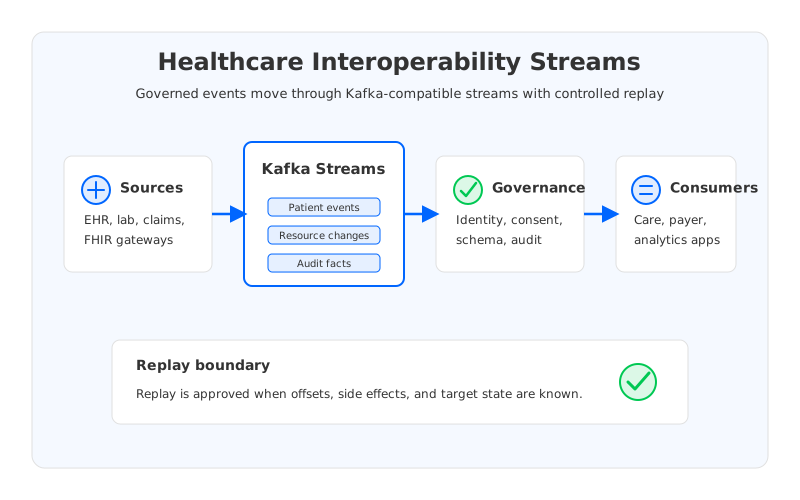
The useful starting point is not "Can Kafka stream healthcare data?" Kafka can stream almost any event shape if the producers and consumers agree on contracts. The sharper question is "Can the platform preserve meaning, access control, and recoverability while the estate keeps changing?" Once the question is framed that way, interoperability streaming becomes a governance and replay problem as much as a throughput problem.
1Why Healthcare Teams Search for Kafka Interoperability Architecture
Healthcare data moves through systems that were built for different time horizons. EHR workflows care about clinical context, claims systems care about adjudication state, lab systems care about result lifecycle, and analytics teams care about reproducible history. A streaming layer sits in the middle of those expectations, so its architecture has to respect more than message delivery.
FHIR has become a common language for healthcare interoperability, especially for API-based exchange and resource modeling. Streaming does not replace FHIR APIs; it often complements them. An event may announce that a resource changed, carry a normalized snapshot, or trigger a consumer to fetch authoritative state through a FHIR endpoint.
Kafka helps because it separates producers and consumers around durable topics, consumer groups, offsets, and retention. A care coordination system and an analytics pipeline can consume the same stream independently, pause, recover, and resume from committed positions. Those mechanics are powerful, but healthcare changes the acceptable failure mode. A replay that duplicates an operational alert is not the same as replaying clickstream data into a dashboard.
The platform team therefore needs a vocabulary that crosses domains:
- Clinical meaning: event names, schemas, resource versions, and lifecycle states must be understandable outside the producing team.
- Governance: access, consent boundaries, audit trails, and retention policies have to follow the event beyond the source system.
- Replay: consumers need a documented way to recover from offsets without duplicating patient-facing actions.
- Operations: the platform must scale, fail over, and retain data without pushing broker-placement details into clinical teams.
Those concerns are connected. Treating them as separate checklists creates the familiar failure pattern: the pipeline is fast, the schema registry is populated, the dashboards are green, and nobody can answer whether a replay will resend a patient notification or re-open a closed workflow.
2The Production Constraint Behind Healthcare Streams
Healthcare interoperability creates uneven traffic. A hospital admission surge, claims batch release, device spike, or partner backfill can change load patterns without warning the streaming team first. Traditional Kafka clusters can handle large throughput, but the operating model matters when spikes collide with retention, replay, and multi-zone durability requirements.
In a broker-local storage model, brokers own both compute and durable local data. Scaling or replacing brokers can involve partition movement, replica catch-up, storage headroom checks, and network traffic across zones. That is manageable with experienced Kafka operators, but replay windows make the cost of being wrong higher because the platform must reserve storage and recovery capacity before the outage happens.
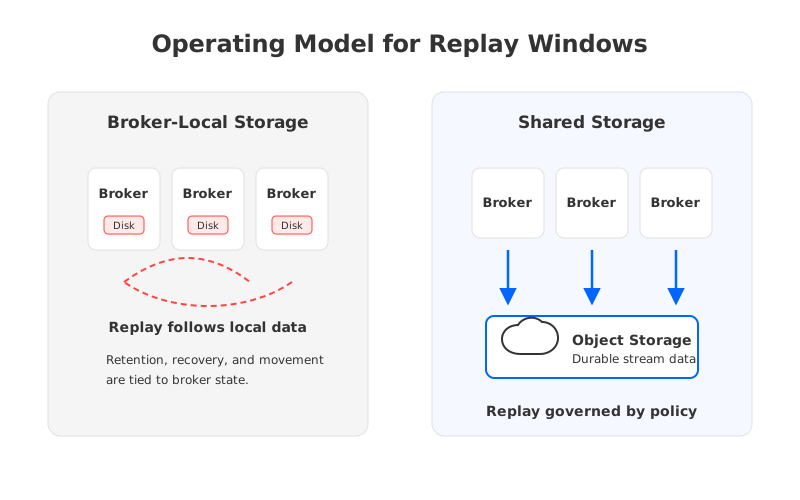
The tension is that teams want long-lived recovery options and tightly governed access at the same time. A raw event stream may contain protected health information, while a derived stream may contain enough context to become sensitive. Keeping more data improves replay and auditability, but it also expands the governance surface. Shortening retention reduces exposure but weakens recovery.
Cloud cost belongs in the same discussion. Cross-zone replication, validation consumers, backfill jobs, and parallel migration paths can create real infrastructure spend. Teams sometimes reduce replay windows or skip production-like validation because the platform has made the safe path expensive.
3Design the Event Contract Before the Pipeline
Interoperability stream design should start with the event contract, not the connector. A connector can move records, but it cannot decide whether an event represents an observation becoming available, a demographic correction, a care plan state change, or a notification request. Those distinctions affect replay and consumer responsibility.
A practical contract should answer four questions:
- What is the clinical or operational fact? The event name should describe the state transition or fact being communicated, not the internal table that emitted it.
- What is authoritative? Consumers need to know whether the payload is the source of truth, a snapshot, a pointer to a FHIR resource, or a derived signal.
- What can be replayed? Some events are safe to replay into idempotent stores; others require deduplication keys or a consumer-side suppression rule.
- Who is allowed to consume it? Topic ACLs, schema visibility, and downstream use cases should match data classification and consent boundaries.
The common mistake is to put replay semantics in runbooks while leaving the event contract silent. The operator can replay from an offset, but the downstream team may not know whether replay means "rebuild a projection," "retrigger a workflow," or "audit what happened."
Offsets give consumers a recoverable position in the log, but they are not a data correctness model. A consumer group can resume from a committed offset and still produce duplicates if the sink is not idempotent. The contract has to state which consumers may replay, which consumers must suppress side effects, and which streams are intended for immutable history.
4Governance Is Part of the Data Path
Healthcare stream governance cannot be bolted on after data starts flowing. The streaming platform carries access decisions, audit evidence, retention behavior, schema lifecycle, and recovery history. Each one affects how teams prove control.
The governance model should be concrete enough to operate:
| Governance area | Platform question | Healthcare impact |
|---|---|---|
| Identity | Which service account uses each topic? | Ties access to application ownership instead of shared credentials. |
| Classification | Which topics contain sensitive data? | Drives retention, masking, routing, and approval requirements. |
| Schema lifecycle | Who approves resource shape changes? | Prevents silent contract drift. |
| Replay authorization | Who can reset offsets or run a backfill? | Keeps recovery actions from becoming unreviewed data redistribution. |
| Auditability | Where are actions recorded? | Supports incident review and compliance evidence. |
| Environment boundary | Where does data reside? | Aligns deployment with organizational controls. |
Governance failures often look like operational shortcuts. A temporary consumer is never removed. A replay job uses elevated credentials. A broad topic grants access to an application that needs a narrow derived signal. These are platform governance gaps, not Kafka limitations.
Kafka-compatible infrastructure can support strong controls, but teams have to design them as first-class objects: topic naming, ACL patterns, schema ownership, consumer identity, retention classes, and replay workflows.
5Replay Architecture: Restore State Without Repeating Harm
Replay is one of the strongest reasons to use Kafka in interoperability architecture. A durable log lets teams rebuild derived stores, recover from consumer defects, and validate platform migrations without asking every source system to resend history. That power needs boundaries because healthcare consumers often have side effects outside the stream.
The first replay boundary is the difference between projection rebuild and workflow reactivation. Rebuilding a read model or analytics table from the log is usually safer. Reactivating outreach, care tasks, claims submissions, or partner callbacks may create external consequences, so those consumers need idempotency keys, deduplication windows, or a separated command topic.
The second boundary is source authority. If the stream carries snapshots, replay can rebuild a point-in-time projection. If the stream carries change notices that require a FHIR lookup, replay depends on current source state rather than original event state.
The third boundary is retention. Operational notification streams, audit streams, derived analytics streams, and integration backfill streams do not need the same replay window. The platform should make those classes visible so the cost, access, and recovery implications are reviewed before production.
A useful replay runbook says less about commands and more about invariants: source topic, consumer group, offset or timestamp boundary, target state, allowed side effects, approval owner, and verification signal. Without that, the team has a restart procedure rather than a recovery plan.
6Architecture Options and Trade-offs
Healthcare interoperability teams usually evaluate streaming architecture across three layers: integration for EHR, FHIR, HL7, claims, device, and partner interfaces; stream processing for normalization and enrichment; and the Kafka-compatible platform for durable topics, consumer groups, retention, governance hooks, scaling, and recovery.
The evaluation should include at least seven dimensions:
| Dimension | What to inspect | Why it matters |
|---|---|---|
| Compatibility | Kafka clients, Connect behavior, consumer groups, transactions, and ACLs | Integration estates should not be rewritten during platform changes. |
| Durability model | Broker-local disks, tiering, or shared object storage | Replay and recovery depend on where durable stream data lives. |
| Elasticity | How compute and storage scale during bursts | Backfills and analytics rebuilds can create temporary load. |
| Governance | Identity, network boundaries, audit logs, schema control, and replay approval | Sensitive streams need enforceable ownership. |
| Cost boundary | Cross-zone traffic, storage, validation, and backfills | Safe operations should not be discouraged by avoidable cost. |
| Migration risk | Client compatibility, offsets, and rollback | Migration must be routine rather than exceptional. |
| Observability | Lag, freshness, errors, target acceptance, and validation | Technical health and workflow health are related but not identical. |
This framework points to a platform requirement: preserve Kafka behavior at the client boundary while reducing broker lifecycle and storage-placement work. When every retention change, broker replacement, or backfill job becomes a storage planning exercise, the platform starts competing with the interoperability work it was meant to enable.
7How AutoMQ Changes the Operating Model
AutoMQ fits into this evaluation as a Kafka-compatible streaming system built around shared storage and stateless broker operation. It keeps the Kafka protocol surface familiar while moving durable stream data to object storage and reducing broker-local state. For healthcare interoperability, the point is not to make governance automatic. The point is to make the infrastructure layer less likely to interfere with governance and replay decisions.
In a shared-storage design, compute and storage scale more independently. Brokers can be treated more like elastic compute, while object storage provides durable backing for stream data. The team still has to define contracts, access rules, and side-effect boundaries, but those decisions are less tied to local disk placement.
AutoMQ's architecture is also relevant to cloud network economics. Healthcare platforms often run across availability zones, and validation or migration workflows can create temporary parallel consumers. AutoMQ documentation describes deployment patterns designed to reduce inter-zone traffic in supported environments.
No streaming platform fixes a vague event contract. If a team cannot explain which events are replayable, which consumers have side effects, and which identities can access sensitive streams, a storage architecture change will not solve the core risk. Once those rules are clear, AutoMQ is relevant for Kafka-compatible behavior, elastic capacity, object-storage-backed durability, and customer-controlled deployment boundaries.
For an initial evaluation, choose one stream with real governance and replay pressure but a manageable blast radius. Run production-like data contracts, ACLs, schemas, consumers, and replay drills. Compare retention planning, broker operations, cloud traffic, recovery steps, and audit evidence alongside throughput.
8Production Readiness Checklist
The final readiness gate should be strict because healthcare streaming incidents rarely stay inside the platform team. They affect integration owners, clinical workflows, analytics consumers, security reviewers, and sometimes external partners. Writable topics and low consumer lag are not enough.
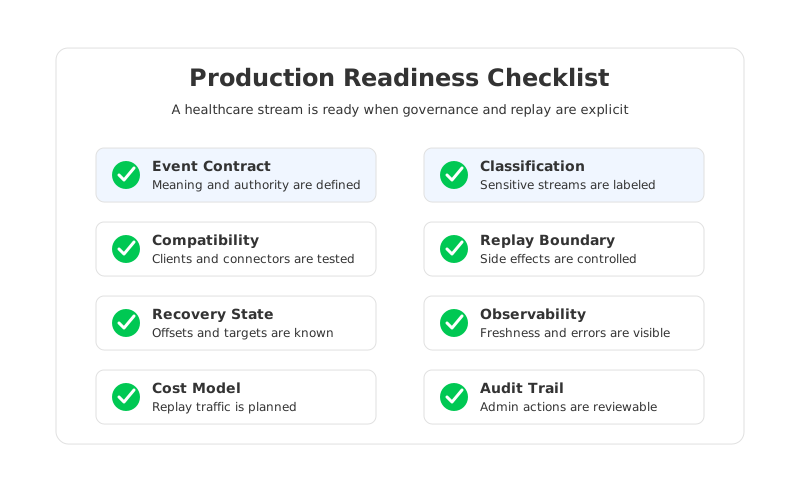
Use this checklist before promoting a healthcare interoperability stream:
- Event contract: the topic describes a clear fact, and consumers know whether the payload is authoritative, derived, or a pointer.
- Classification: sensitivity, retention, masking, and allowed consumers are documented before data flows.
- Compatibility: clients, connectors, schemas, serializers, and consumer groups are tested against the target platform.
- Replay boundary: each consumer is labeled as rebuild-safe, side-effecting, or replay-restricted.
- Recovery state: offsets, timestamps, source positions, and target state are captured for rollback and forward recovery.
- Observability: dashboards show lag, freshness, errors, target acceptance, and validation signals.
- Cost model: retention, cross-zone traffic, backfills, and validation consumers are planned.
- Audit trail: admin actions, replay approvals, access changes, and incident decisions are reviewable.
The discipline is not bureaucracy for its own sake. It is how a platform team proves that event streaming is safe enough to become part of healthcare interoperability. Kafka gives teams durable logs, independent consumers, and replayable positions; healthcare demands contracts, governance, and operational evidence around those mechanics.
If your team is evaluating Kafka-compatible infrastructure for healthcare interoperability, replay, and cloud cost control, review AutoMQ's architecture or talk with the team: contact AutoMQ.
9References
- HL7 International: FHIR overview
- ASTP/ONC: Interoperability
- Centers for Medicare & Medicaid Services: Interoperability and Patient Access
- Apache Kafka documentation: Consumer configuration and consumer groups
- Apache Kafka documentation: Kafka message delivery semantics
- Apache Kafka documentation: Kafka Connect
- AutoMQ documentation: AutoMQ overview
- AutoMQ documentation: Technical advantage overview
- AutoMQ documentation: Eliminate inter-zone traffic
10FAQ
10.1What are healthcare interoperability streams in Kafka?
Healthcare interoperability streams are Kafka or Kafka-compatible topics that carry healthcare events between EHR systems, FHIR-facing services, analytics platforms, care workflows, payer systems, and partner integrations. The architecture has to define contracts, access rules, replay behavior, and audit evidence because records often carry sensitive context.
10.2Does Kafka replace FHIR APIs in healthcare architecture?
No. FHIR provides resource models and API-based exchange patterns, while Kafka-compatible streaming provides durable event distribution, independent consumers, offsets, retention, and replay. Many architectures use streams to announce changes or distribute normalized events while FHIR APIs remain the authoritative access path for some resources.
10.3Why is replay risky in healthcare event streaming?
Replay is risky when consumers create side effects such as patient notifications, care tasks, partner callbacks, or claims actions. Rebuilding a projection is usually safer than reactivating workflows. Side-effecting consumers need idempotency, deduplication, or explicit replay restrictions.
10.4Where does AutoMQ fit in healthcare interoperability planning?
AutoMQ becomes relevant after the team has defined event contracts, governance, replay boundaries, and recovery requirements. Its Kafka-compatible shared-storage architecture can reduce broker-local storage coupling, support elastic capacity, and provide object-storage-backed durability while preserving familiar Kafka client behavior.


