
Table of Contents
Table of Contents
When Kafka throughput grows into the backbone for event streams, logs, CDC, and AI/ML pipelines, the question "What is an alternative to Confluent?" becomes too broad. A team moving a few business events per second needs a different answer from a team absorbing write-heavy telemetry, replaying large retention windows, and adding consumers for model training or analytics.
At high throughput, the replacement criteria are not only feature coverage or Kafka API compatibility. The hard questions are architectural: how much durable storage is coupled to each broker, how much data moves when capacity changes, how hot reads are served, how partition movement behaves under pressure, and how pricing maps to sustained ingress, egress, retention, and operational headroom.
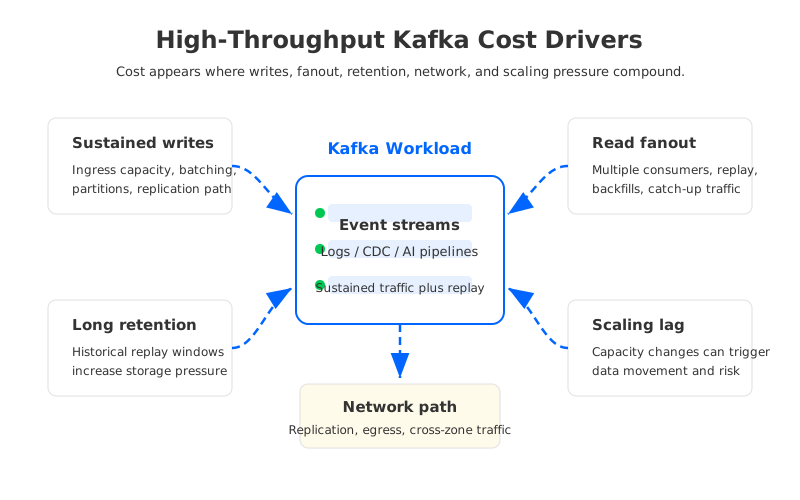
Confluent Cloud is a mature managed Kafka service, and its documentation is explicit that cluster type, CKU capacity, networking, storage, and add-on services all matter. That transparency is useful. It also gives architects a practical checklist for deciding when a Confluent Cloud alternative should be evaluated for high-throughput workloads instead of chosen from a generic vendor comparison.
1Why High-Throughput Kafka Changes the Replacement Criteria
High-throughput Kafka systems usually fail evaluation frameworks built for ordinary service-to-service eventing. A platform team may start with producer throughput, but the real workload includes consumer fanout, replay traffic, backfills, compaction, retention, and burst capacity. The same topic can serve a fraud pipeline, a lakehouse sink, an operational dashboard, and an AI feature pipeline.
Apache Kafka's own operational model explains why this matters. Partitions are the unit of parallelism, replication provides durability and availability, and partition reassignment is the tool used to move partitions across brokers during expansion or balancing. In a traditional broker-local storage model, the broker is both compute and durable storage owner. When the cluster needs to scale, recover, or rebalance, the system may need to move substantial log data between brokers, not merely update placement metadata.
That coupling is acceptable for many workloads. It becomes expensive when high throughput and long retention arrive together. SRE teams then face a pattern that feels familiar:
- Producers need sustained write capacity, not only short benchmark peaks.
- Consumers create read amplification through fanout, replay, and catch-up.
- Retention grows because downstream jobs and compliance users want longer windows.
- Scaling decisions require spare capacity before the next traffic step arrives.
- Partition movement competes with production traffic when the cluster is already busy.
This is why a high-throughput Confluent alternative should be evaluated as a storage and scaling architecture, not only as a managed Kafka endpoint.
2Cost Drivers at High Throughput
Confluent Cloud pricing is organized around the resources and services a workload consumes, including cluster capacity, storage, networking, connectors, stream processing, and related platform features. For Dedicated clusters, Confluent uses Confluent Unit for Kafka, or CKU, as a unit of capacity. Confluent's cluster documentation also distinguishes cluster types and capacity behavior, which is exactly the kind of boundary architects should examine before committing a high-throughput workload.
The practical cost model for high-throughput Kafka is broader than "price per broker" or "price per GB." Four cost drivers tend to dominate.
| Cost driver | Why it grows | What to ask a Confluent alternative |
|---|---|---|
| Sustained writes | More producers, larger records, higher partition counts | Can write capacity scale independently from long-term storage? |
| Read fanout | More consumers, replay jobs, CDC sinks, AI/ML pipelines | Are hot reads served without overloading durable storage or brokers? |
| Retention | Longer replay windows and compliance requirements | Is older data stored on cost-effective object storage? |
| Capacity changes | Peaks, new partitions, broker replacement, rebalancing | Does scaling require large data movement? |
The dangerous line item is often operational headroom. Kafka teams rarely run production clusters at the mathematical maximum of measured throughput. They keep spare broker, disk, network, and partition capacity because one consumer lag event or traffic spike can turn a healthy cluster into a recovery project.
2.1Writes, Reads, Retention, and Network Fanout
Write throughput is only the first leg of the triangle. A log ingestion system may be append-heavy during the day, then replay-heavy after an incident. A CDC platform may have predictable writes but unpredictable catch-up traffic when a downstream warehouse connector restarts. AI/ML pipelines add another pattern: bulk historical replay for features or retraining while online consumers still need low-latency access.
In broker-local Kafka architectures, high retention increases the amount of data bound to brokers. Replication improves durability and availability, but it also means additional copies need to be stored and moved according to the replication design. If the workload also requires multi-zone deployment, the network path becomes part of the architecture decision, not a billing detail to check later.
This does not make Confluent the wrong choice. It means a Confluent Cloud alternative has to prove that its architecture changes one of the expensive variables rather than restating that Kafka is scalable. For high-throughput workloads, the useful question is: which data must remain hot and broker-adjacent, and which data should live in a durable shared storage layer?
2.2Peak Capacity and Scaling Lag
High-throughput Kafka teams often know their next bottleneck before they hit it: partitions approaching operational limits, brokers carrying uneven traffic, disks filling faster than expected, or consumer lag becoming more expensive after every downstream use case. Traditional scaling work often involves planning, reassignment, and validation rather than a quick capacity dial.
Kafka's partition reassignment tooling exists for good reasons. It lets operators expand clusters, move partitions, and rebalance load. But the workflow also reveals the architectural cost of local storage: when data ownership moves, the system has to coordinate the movement of the logs and replicas attached to that ownership. During a high-throughput period, that background work can be as important as the new capacity itself.
For an alternative platform, the requirement is not "never rebalance." The requirement is that scaling should be primarily a compute and metadata operation where possible, with durable data already in a shared layer. That is the architectural distinction that changes the SRE experience.
3What to Demand From a Confluent Alternative
A serious alternative to Confluent for high-throughput Kafka should be held to a higher bar than a demo-compatible endpoint. Kafka compatibility matters because application teams need existing producers, consumers, Kafka Connect connectors, Kafka Streams jobs, Schema Registry integrations, and operational habits to remain useful. But compatibility alone does not answer the throughput problem.
The evaluation should start with workload mechanics:
- What is the sustained ingress rate, and what peak multiplier must the platform absorb?
- How many independent consumer groups read the same data during normal operation?
- How often do teams replay historical data, and how far back do they replay?
- What retention period is needed for operations, compliance, analytics, or ML?
- What happens when a broker is replaced or capacity is added under load?
- Where does data reside, and who controls the cloud account, VPC, network path, and encryption boundary?
These questions separate "managed Kafka convenience" from "cloud-native Kafka architecture." A managed service can remove operational toil while preserving the coupling between compute and storage. A shared-storage architecture changes the coupling itself.
For teams already using Confluent Cloud, this avoids a false binary. The decision is not whether Confluent is good or bad. It is whether a specific workload has crossed into a zone where local-disk assumptions, long retention, read amplification, and data movement dominate the cost and operations profile.
4How AutoMQ Handles High-Throughput Kafka Architecture
The architectural pattern that deserves attention here is Kafka-compatible shared storage. AutoMQ is one implementation of that pattern: it keeps Kafka protocol compatibility while reworking the storage layer around object storage, a write-ahead log design, caching, and stateless brokers.
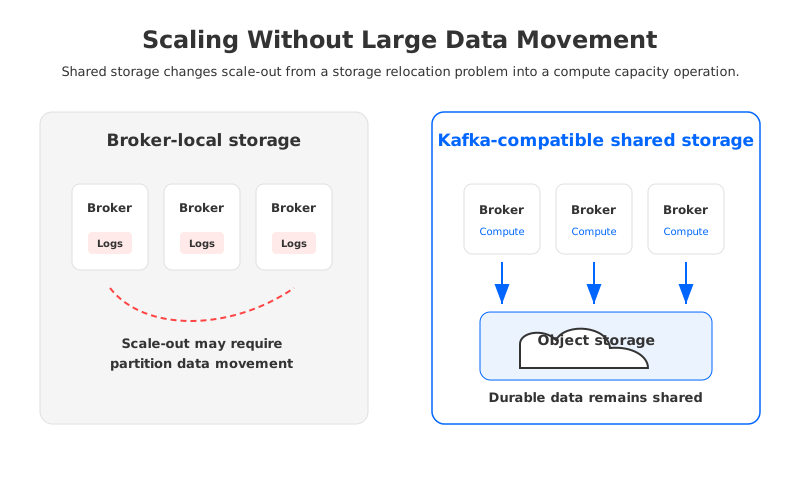
The core idea is straightforward. Durable log data is moved away from broker-local disks and into object storage such as S3-compatible storage. Brokers focus on serving Kafka protocol traffic and coordinating access to shared data instead of acting as the long-term owner of local log files. For workloads with long retention, this can reduce the pressure to keep growing broker-attached storage only because older data must remain replayable.
AutoMQ's S3Stream architecture is built around object-storage-backed streams. Its WAL path is designed for fast writes before data is persisted into object storage, and its cache layer is used to serve hot reads without treating every read as a cold object storage fetch. Those details matter for high-throughput workloads because object storage alone is not enough. A useful platform must absorb writes, keep hot data close enough for active consumers, and still make older data durable and economical.
Stateless brokers are the other important piece. When broker compute is less tied to durable local log ownership, adding capacity, replacing instances, and moving partition service responsibility can avoid the same volume of broker-to-broker data copying associated with local-disk architectures.
The result is not a magic exemption from capacity planning. Network throughput, partition design, client batching, consumer behavior, and cloud limits still matter. The difference is that the architecture gives teams more direct levers:
- Store long-retention data on object storage instead of sizing every broker for historical data.
- Use WAL and cache layers to handle the write path and hot read path deliberately.
- Scale broker compute for active traffic without treating every scaling event as a storage migration.
- Keep Kafka-compatible clients and ecosystem components while changing the storage economics underneath.
That is where AutoMQ can be a practical Confluent Cloud alternative for high-throughput teams. It is most relevant when the workload's pain is not "we need someone else to run Kafka," but "our throughput, retention, fanout, and scaling patterns make the current storage model costly or slow to change."
5Evaluation Checklist
Before replacing Confluent or adding a second Kafka-compatible platform, run the evaluation against a workload shape, not an average cluster. Averages hide the behavior that breaks high-throughput systems: peak ingest, replay storms, consumer catch-up, backfill windows, and partition movement during incidents.
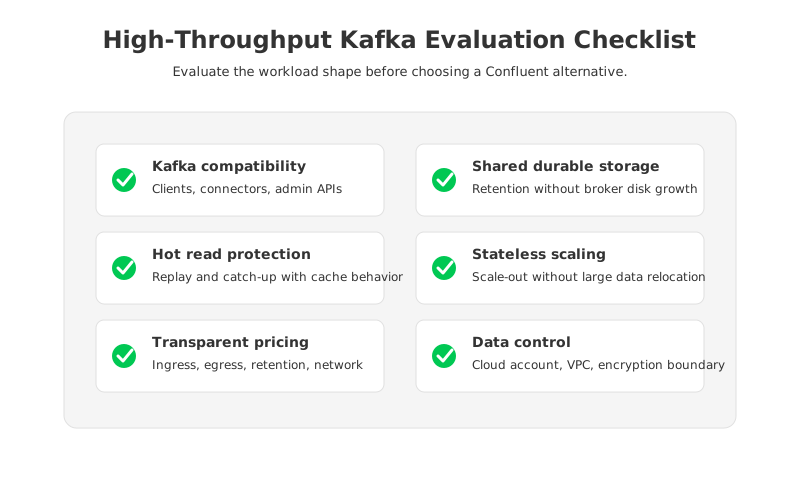
A practical test plan should include at least three scenarios.
First, measure the normal steady state. Use realistic producer batching, compression, record size, partition count, replication expectations, and consumer fanout. Do not treat an empty-cluster producer benchmark as proof of production readiness.
Second, measure replay and catch-up. High-throughput Kafka platforms are often judged during incidents, not during steady state. Restart downstream consumers, replay from older offsets, and observe whether the platform protects active workloads while serving historical reads.
Third, test capacity change under load. Add broker capacity, replace nodes, increase partitions where appropriate, and observe how much data movement occurs and whether foreground client latency or throughput is affected. If the alternative claims stateless scaling, this is where the claim should become visible.
The final decision should fit into a simple checklist:
| Requirement | Why it matters | Evidence to request |
|---|---|---|
| Kafka protocol compatibility | Limits application migration risk | Client, connector, and admin API validation |
| Shared durable storage | Reduces broker-local retention pressure | Architecture docs and failure testing |
| Hot read protection | Prevents replay from punishing active consumers | Cache behavior and replay tests |
| Stateless scaling | Reduces data movement during capacity changes | Scale-out and node replacement tests |
| Transparent pricing | Prevents surprise cost at sustained throughput | Pricing model tied to ingress, egress, retention, and network |
| Data control | Matters for regulated logs, CDC, and ML data | Deployment model, VPC/account ownership, encryption |
The useful evaluation artifact is not a vendor scorecard. It is a workload-specific runbook: traffic assumptions, retention assumptions, replay assumptions, scaling operations, failure scenarios, and the evidence required before the platform becomes production-critical.
6Making the Decision
Confluent remains a strong option when teams want a broad managed data streaming platform, integrated ecosystem services, and an established operational experience. For some organizations, those benefits outweigh the storage and scaling tradeoffs. Evaluating an alternative is about avoiding a general platform decision for a workload whose economics are dominated by high throughput.
AutoMQ should be on the shortlist when three conditions are present together: the workload is Kafka-compatible rather than Kafka-adjacent, long retention or replay is materially affecting cost, and scaling broker capacity needs to become less dependent on moving durable data. In that situation, shared storage, WAL/cache design, and stateless brokers are the reason to evaluate the platform.
The decision should end where the search began: with the workload. If event streams, logs, CDC, and AI/ML pipelines are pushing Kafka beyond ordinary managed-service convenience, the right Confluent alternative is the one that changes the storage and scaling equation while preserving the Kafka interfaces your teams already rely on.
7References
- Confluent Cloud cluster types and CKU capacity
- Confluent Cloud billing and usage documentation
- Confluent pricing
- Apache Kafka operations documentation
- Apache Kafka design documentation
- Apache Kafka tiered storage documentation
- AutoMQ documentation
- AutoMQ GitHub repository
8FAQ
8.1What is the best Confluent alternative for high-throughput Kafka?
There is no universal answer. For high-throughput workloads, evaluate alternatives by sustained ingress, consumer fanout, retention, replay behavior, scaling operations, Kafka compatibility, and pricing transparency. AutoMQ is worth evaluating when shared object storage and stateless brokers directly address the workload's storage and scaling pressure.
8.2Is Kafka compatibility enough when replacing Confluent?
No. Kafka compatibility reduces migration risk for clients and ecosystem tools, but high-throughput workloads also need evidence around storage architecture, hot read behavior, replay performance, capacity changes, and operational control.
8.3Why does object storage matter for high-throughput Kafka?
Object storage can reduce pressure on broker-local disks for long-retention data. The platform still needs a write path and cache design that protect active traffic, which is why WAL and cache behavior should be part of the evaluation.
8.4When should a team stay with Confluent Cloud?
Confluent Cloud can be a strong fit when the priority is a mature managed streaming platform with integrated services and the workload's throughput, retention, and scaling profile fits its operating and pricing model. A workload-specific test is better than a generic vendor preference.
8.5Should benchmarks decide the platform?
Benchmarks help only when the environment is public, repeatable, and close to the production workload. For this topic, a replay and scale-out test under load is often more useful than a single peak throughput number.


