
Table of Contents
Table of Contents
Teams rarely search for "hosted Kafka" because they want a vocabulary lesson. They search because someone has asked a practical question: can we get Kafka without owning every broker upgrade, disk alarm, network route, and incident bridge? Then the vendor pages start using overlapping words: hosted Kafka, managed Kafka, Kafka as a Service, cloud Kafka, serverless Kafka, BYOC Kafka, private cloud Kafka, and self-managed Kafka.
Those terms sound like a maturity ladder, but they are not standardized product categories. Two providers can both say "managed Kafka" while making different promises about who operates the brokers, where the data plane runs, who pays the cloud bill, how private connectivity works, and what happens during a failure. For architects, SRE leaders, procurement teams, and CTOs, the safer question is not "Which term is correct?" It is "Which responsibility boundary are we buying?"
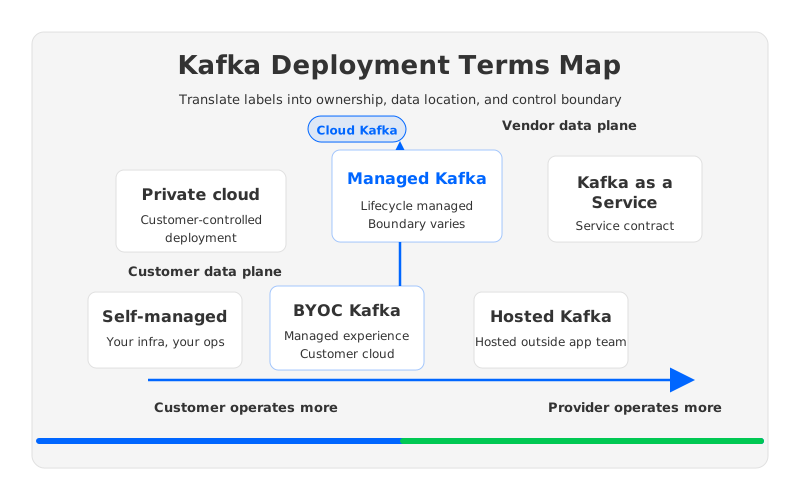
This article uses the terms the market actually uses, but translates each one into the three decisions that matter in production: who operates Kafka, where data lives, and how much control the customer keeps.
1Why Kafka deployment terms are confusing
Kafka started as software that teams deployed themselves. In that world, the language was simple: you ran brokers on VMs, bare metal, or Kubernetes, and your team owned cluster operations. Cloud adoption changed that. Providers began offering Kafka in several forms: infrastructure hosting, fully managed clusters, Kafka-compatible endpoints, serverless abstractions, BYOC deployments, and private software distributions.
The confusion comes from three patterns. Marketing terms are broader than architecture terms: "cloud Kafka" may mean SaaS, a cloud-provider service, or Kafka-compatible software in your own Kubernetes cluster. Providers also use "managed" at different layers: provisioning and patching may be handled, while connectors, schema governance, topic design, capacity planning, or recovery remain yours. Finally, Kafka compatibility is not identical to Kafka operations. Azure Event Hubs, for example, documents an Apache Kafka endpoint, but Event Hubs is still a different service model from running an Apache Kafka cluster.
The useful mental model is a responsibility map.
| Term | Common meaning | The question to ask |
|---|---|---|
| Hosted Kafka | Kafka infrastructure runs outside your direct operational team | Who owns broker operations and incident response? |
| Managed Kafka | A provider automates cluster lifecycle and operations | Which layers are managed, and which remain yours? |
| Kafka as a Service | Kafka is consumed through a service contract or cloud console | Is it Apache Kafka, Kafka-compatible, or an abstraction? |
| Cloud Kafka | Kafka or Kafka-compatible streaming on cloud infrastructure | Which cloud account and network host the data plane? |
| BYOC Kafka | Managed experience with data plane in your cloud account | What access does the vendor need, and who pays infrastructure cost? |
| Private cloud Kafka | Kafka platform deployed in customer-controlled environments | How much operational responsibility stays internal? |
| Self-managed Kafka | Customer runs Kafka software directly | Does the team have the skills and economics to operate it well? |
No label answers the full question by itself. The label is only a hint.
2Hosted Kafka explained
"Hosted Kafka" usually means someone else provides the infrastructure on which Kafka runs. It is useful but imprecise: the offer may include only infrastructure hosting, or it may include lifecycle operations, monitoring, upgrades, support, scaling, private networking, and compliance features.
For professional buyers, "hosted" should trigger operational due diligence:
- Does the provider run brokers, metadata, storage, monitoring, and patching?
- Is the cluster single-tenant or multi-tenant?
- Are Kafka protocol features, admin APIs, Kafka Connect, Kafka Streams, transactions, quotas, and ACLs supported as expected?
- Where does the data reside, and can the customer choose the region, network path, and encryption model?
- What happens if a broker, disk, availability zone, or provider control plane fails?
Hosted Kafka can reduce infrastructure work, but the term alone does not prove that the service is fully managed or Kafka-compatible in the way your applications require.
3Managed Kafka explained
"Managed Kafka" is the most common umbrella term for a Kafka service where a provider takes responsibility for much of the cluster lifecycle. Confluent Cloud describes itself around fully managed data streaming built on Kafka. Amazon MSK is documented by AWS as a managed service that makes it easier to build and run applications using Apache Kafka. Google Cloud Managed Service for Apache Kafka uses similar managed-service language for Apache Kafka clusters on Google Cloud. Aiven also positions its Apache Kafka offering as a managed cloud service.
In practical terms, managed Kafka often covers:
- Cluster creation, broker provisioning, and basic lifecycle management.
- Monitoring, alerting, patching, and version upgrades.
- Storage scaling, broker replacement, and operational automation.
- Security integrations such as encryption, authentication, and network access controls.
- Support processes and service-level commitments.
But "managed" does not mean "the customer has no Kafka decisions left." Production teams still own partition counts, message keys, producer acknowledgments, retry behavior, retention policy, consumer group design, schema discipline, disaster recovery posture, and cost allocation. A provider can supply guardrails and automation, but not every workload-specific tradeoff.
The main split inside managed Kafka is where the control plane and data plane live.
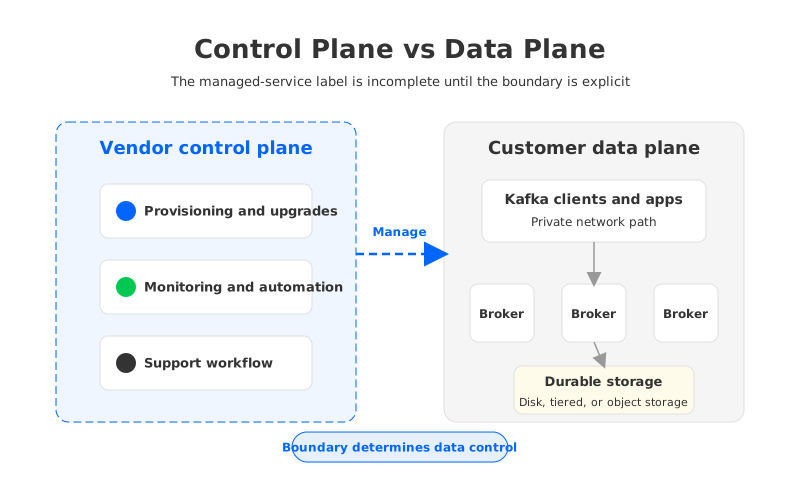
In a SaaS model, the vendor typically runs both the control plane and the data plane in provider-managed infrastructure. The customer connects over public or private networking and consumes Kafka as a service. This can be fast to adopt, especially when the provider also offers connectors, stream processing, schema management, governance, and observability.
In a cloud-provider model, a hyperscaler integrates Kafka with its own identity, networking, billing, monitoring, and regional infrastructure. Amazon MSK and Google Cloud Managed Service for Apache Kafka sit in this category. Procurement may be simpler, but architecture still depends on provider-specific boundaries, instance models, networking patterns, and pricing dimensions.
In a BYOC model, the provider may manage a control plane or operational workflow while the data plane runs in the customer's own cloud account or VPC. Redpanda Cloud BYOC and WarpStream BYOC are examples of this public language in the market. The tradeoff is different: the customer keeps stronger data locality and infrastructure ownership, while the provider still reduces operational work.
4Kafka as a Service and cloud Kafka explained
"Kafka as a Service" usually means Kafka is consumed through a service interface rather than operated as raw software. It is close to "managed Kafka," but buyers often use it in procurement terms: console, contract, service bill, and provider-owned operating model.
The phrase can hide important technical differences. Some Kafka as a Service products run Apache Kafka. Some are Kafka-compatible implementations. Some expose a Kafka endpoint over a different streaming backend. Some are serverless abstractions that remove broker sizing but may change assumptions around throughput, partitioning, retention, or ecosystem behavior.
"Cloud Kafka" is even broader. It can refer to:
- A SaaS Kafka platform such as Confluent Cloud.
- A hyperscaler service such as Amazon MSK or Google Cloud Managed Service for Apache Kafka.
- A Kafka-compatible service with a different storage architecture.
- Kafka deployed by the customer on cloud VMs or Kubernetes.
- A BYOC product where the vendor control plane and customer data plane are separated.
For early-stage searchers, "cloud Kafka" is useful. For platform selection, it is too vague. Translate it into deployment questions: provider, account boundary, network path, storage architecture, billing owner, data residency, operational owner, and migration path.
One example is storage. Traditional Kafka binds brokers tightly to local disks, which ties replication, recovery, scaling, and retention cost to broker-local data movement. Newer Kafka-compatible architectures separate compute from storage and place durable log data in object storage. AutoMQ is an example in this category: it keeps Kafka protocol compatibility while using object-storage-backed shared storage and stateless brokers. In a BYOC or software deployment, a team can combine a managed-style operating experience with a customer-environment data plane rather than treating "managed" and "customer-controlled" as opposites.
The point is not that every workload needs a storage-layer redesign. The point is that cloud Kafka terminology should not stop at "hosted versus managed." It should include the architecture that determines scaling behavior, recovery time, and cost structure.
5BYOC and private cloud Kafka explained
BYOC, or bring your own cloud, is a response to a common enterprise constraint: the team wants less Kafka operational toil, but it cannot move the data plane into a vendor account without deeper review. Data residency, private networking, regulatory posture, procurement controls, and cloud-commit economics all matter.
In a typical BYOC model, the customer owns the cloud account, VPC or VNet, and infrastructure bill. The vendor provides a control plane, automation, observability, upgrades, or support workflows. The exact access model differs by provider and must be reviewed carefully. The critical distinction is that the data plane can remain in the customer's environment while management is still simplified.
Private cloud Kafka may mean Kafka or Kafka-compatible software deployed on customer-managed Kubernetes, VMs, or private infrastructure. The vendor may provide software, support, and a console, but the customer often retains more responsibility for operations, security policy, and internal integration.
AutoMQ's public product language is useful for understanding these boundaries. AutoMQ Open Source refers to the open-source Kafka-compatible project. AutoMQ BYOC and AutoMQ Software address customer-controlled deployment models. AutoMQ Cloud and AutoMQ Console describe the managed experience and operational interface. The terminology separates Kafka compatibility, deployment location, management plane, and data-plane ownership.
That is what many enterprise teams mean by "managed Kafka but in our cloud": less operational burden without dissolving the existing cloud boundary.
6Self-managed Kafka still has a place
Self-managed Kafka is not obsolete. It remains valid when a team has strong Kafka expertise, mature platform engineering, clear internal cost allocation, and workloads that require unusual customization.
The risk is assuming that self-managed Kafka is automatically less expensive because there is no provider fee. The real cost includes on-call time, upgrades, storage over-provisioning, broker replacement, data rebalancing, cross-zone traffic, security maintenance, incident response, and opportunity cost.
The comparison should be honest:
| Model | Control | Operational burden | Data-plane ownership | Typical concern |
|---|---|---|---|---|
| Self-managed Kafka | High | High | Customer | Toil, skill depth, recovery, upgrades |
| Hosted Kafka | Medium | Medium to low | Varies | Ambiguous responsibility boundary |
| Managed Kafka SaaS | Lower to medium | Low | Vendor | Data location, pricing dimensions, vendor boundary |
| Cloud-provider managed Kafka | Medium | Low to medium | Cloud-provider model | Cloud-specific limits and cost structure |
| BYOC Kafka | Medium to high | Low to medium | Customer | Shared responsibility and access model |
| Private cloud Kafka | High | Medium to high | Customer | Internal operations and support discipline |
There is no universal winner. There is only a model that fits your risk profile.
7How to choose the right model
The cleanest selection process starts with constraints, not vendors. Developers may care about compatibility and provisioning; SREs about failure modes and recovery; procurement about contracts and committed spend; CTOs about lock-in, data strategy, and architecture.
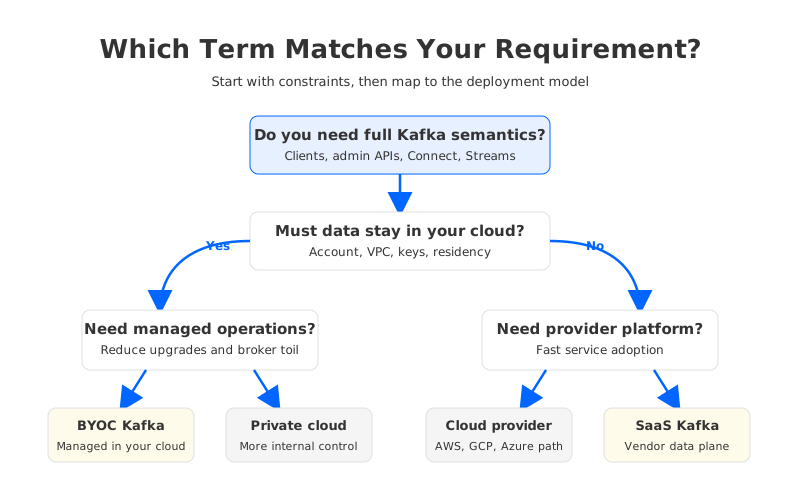
Use five questions to narrow the field.
-
Do applications require full Apache Kafka semantics and ecosystem compatibility? Validate clients, admin APIs, Kafka Connect, Kafka Streams, transactions, consumer groups, ACLs, quotas, and observability integrations.
-
Must the data plane stay in your cloud account, region, or private network? If yes, examine BYOC, private cloud, or self-managed models before SaaS.
-
Is the team reducing toil or redesigning Kafka economics? Conventional managed Kafka may reduce upgrades and broker operations; storage growth, rebalancing, cross-zone replication, and slow recovery require architecture review.
-
Who should own incidents? Define responsibility during broker failure, region disruption, capacity exhaustion, certificate expiration, client misconfiguration, connector failure, and data loss investigation.
-
How reversible is the decision? Kafka compatibility, standard clients, open tooling, and clear export paths reduce switching cost.
These questions produce a more useful answer than arguing over terminology. Lightweight ingestion may fit a Kafka endpoint or serverless abstraction. Cloud-standardized teams may choose Amazon MSK or Google Cloud Managed Service for Apache Kafka. Teams that want a rich SaaS streaming platform may choose Confluent Cloud. Regulated enterprises that want managed operations inside their own cloud boundary may evaluate BYOC options, including Kafka-compatible architectures such as AutoMQ, Redpanda Cloud BYOC, or WarpStream depending on workload requirements.
8A practical definition you can use internally
Here is a simple way to align stakeholders:
Hosted Kafka means Kafka infrastructure is hosted outside the application team's direct operational ownership. Managed Kafka means a provider takes responsibility for defined lifecycle and operational tasks. Kafka as a Service means Kafka is consumed through a service contract or platform interface. Cloud Kafka means the deployment runs on cloud infrastructure, but the cloud account and data plane still need to be specified. BYOC Kafka means the managed experience and customer cloud boundary coexist. Private cloud Kafka means customer-controlled deployment with more internal responsibility. Self-managed Kafka means your organization runs the platform directly.
That vocabulary keeps procurement, architecture, security, and SRE teams in the same conversation. It also prevents a late-stage surprise: discovering that the selected "managed Kafka" service does not match the desired data-plane boundary, operational responsibility, or Kafka compatibility requirement.
The label should start the discussion. The responsibility model should decide it.
9References
- Confluent Cloud documentation
- Amazon MSK developer guide
- Google Cloud Managed Service for Apache Kafka overview
- Azure Event Hubs for Apache Kafka overview
- Aiven for Apache Kafka documentation
- Redpanda Cloud BYOC documentation
- WarpStream BYOC documentation
- AutoMQ documentation
10FAQ
10.1Is hosted Kafka the same as managed Kafka?
Not always. Hosted Kafka usually means Kafka infrastructure is run outside the customer's direct operational team. Managed Kafka implies a provider owns defined lifecycle tasks such as provisioning, patching, monitoring, upgrades, and support. Some hosted offers are fully managed; others are closer to infrastructure hosting.
10.2Is Kafka as a Service always Apache Kafka?
No. Some services run Apache Kafka, some implement Kafka-compatible APIs, and some expose a Kafka endpoint on a different streaming backend. Always verify client compatibility, admin APIs, Kafka Connect, Kafka Streams, transactions, consumer behavior, and migration requirements.
10.3What is the difference between cloud Kafka and BYOC Kafka?
Cloud Kafka means the service runs on cloud infrastructure. BYOC Kafka is more specific: the data plane runs in the customer's cloud account or network while the provider may supply management, automation, and support. BYOC is often chosen when data locality and cloud-boundary control are important.
10.4When should a team choose self-managed Kafka?
Self-managed Kafka fits teams with strong Kafka expertise, mature platform automation, and a clear reason to keep maximum control. It is less attractive when the organization mainly wants to reduce upgrade work, disk operations, rebalancing effort, and on-call load.
10.5Where does AutoMQ fit in this terminology?
AutoMQ fits the Kafka-compatible cloud-native streaming category. Its BYOC and Software models show that a managed-style experience and a customer-controlled data plane can coexist, while its architecture separates broker compute from object-storage-backed durable data.


