
Table of Contents
Table of Contents
Kafka retention starts as a storage setting and turns into an economics problem. A team extends retention because investigation, replay, backfills, or compliance workflows need older events. Then the cluster grows, hot brokers carry rarely read data, rebalances take longer, and cloud network charges start to look less like noise and more like a design review.
That is why the phrase hot cold tier economics kafka is more than a storage keyword. It is a signal that the team has reached the point where retention can no longer be evaluated as a single line in retention.ms or retention.bytes. The real question is whether the platform can keep Kafka-compatible behavior while letting hot serving capacity, cold historical capacity, and operational risk scale on different curves.
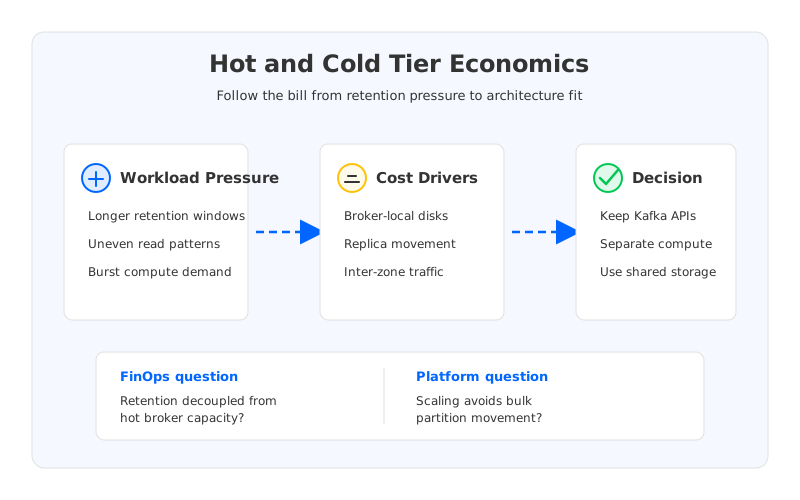
The trap is that Kafka makes retention feel local. A broker owns partitions, partitions are backed by log segments, and the local disk is where operational decisions become physical. This model is mature and trusted, but its cost model was not designed around elastic cloud primitives, object storage economics, and availability-zone billing boundaries.
1Why teams search for hot cold tier economics kafka
The search usually appears after a practical conflict. Application teams want longer replay windows, analytics teams want historical events near the streaming layer, and compliance teams want explainable retention policies. Platform teams then have to decide whether to grow broker disks, add brokers, enable tiered storage, change topic-level retention, or migrate to a Kafka-compatible architecture with a different storage model.
Those choices are not interchangeable. More broker disk keeps the operating model familiar, but it couples retention growth to broker capacity. More brokers add compute headroom, but they can also introduce more partition placement work. Tiered storage moves older segments to remote storage, but local storage still matters for hot reads, leader traffic, and operational behavior. A shared-storage Kafka-compatible system changes the premise: brokers no longer need to be the long-term home of the log.
Every option has a reasonable story. Disk is predictable. Remote tiers are familiar to teams that already use object storage. Shared storage can reduce data movement, but it requires the team to understand write-ahead logging, recovery paths, and cloud storage dependencies. The right decision comes from mapping workload pressure to cost drivers rather than treating retention as a feature checkbox.
2The cost drivers behind hot and cold retention
Retention economics are shaped by four forces that appear in different parts of the bill and the operating calendar. Storage price is the easiest one to see, but broker overprovisioning, cross-zone replication, catch-up reads, and rebalancing work often decide whether a design remains sustainable.
| Driver | What changes as retention grows | Why it matters |
|---|---|---|
| Hot serving capacity | Brokers need enough local resources for active producers and consumers | Compute and disk are often scaled together even when only one is under pressure |
| Cold retention footprint | Older log segments occupy storage for replay, audit, or backfill | Infrequently read data should not force the same infrastructure shape as hot traffic |
| Network movement | Replication, reassignment, and consumer placement can cross zone boundaries | Cloud networks make data movement a recurring economic variable |
| Operational recovery | Failures and scaling events require data to become available again | Recovery time affects capacity planning and change windows |
This table is intentionally broader than storage pricing. A cluster can use cost-effective storage and still be expensive to operate if scaling requires large data movement or if cold reads disturb hot traffic. FinOps needs the unit economics, but SREs need the failure behavior behind those units.
That is where traditional Kafka retention creates tension. A broker is not merely a compute process. It is also a storage owner, a replication participant, and a recovery boundary. When cold data grows on the same nodes that serve hot traffic, the platform team inherits a planning problem: either keep more local capacity than the hot path needs, or accept that operational events will take longer as the retained footprint grows.
3Storage, network, and compute trade-offs
Hot and cold tiers sound clean on a slide: hot data stays close to compute, cold data moves to lower-cost storage, and everyone gets what they need. Production Kafka is less tidy because data placement, leadership, replication, and consumption patterns interact. A topic with low write throughput but long retention can become storage-heavy, while a short-retention topic can dominate network and CPU. A retention policy alone cannot express those differences.
Apache Kafka's tiered storage feature addresses part of this by allowing log segments to move to remote storage while brokers retain local segments for active access. The official Kafka documentation describes separate retention controls for local and remote storage, giving operators a more precise mechanism than a single local-disk policy.
The limitation is architectural. Tiered storage reduces pressure on local disks for older data, but the broker still owns the active log path and participates in partition placement. Scaling a cluster, replacing nodes, and handling catch-up workloads still require planning around hot data and metadata state. For many teams, tiered storage is a strong incremental move; for others, it is a bridge toward a more storage-decoupled design.
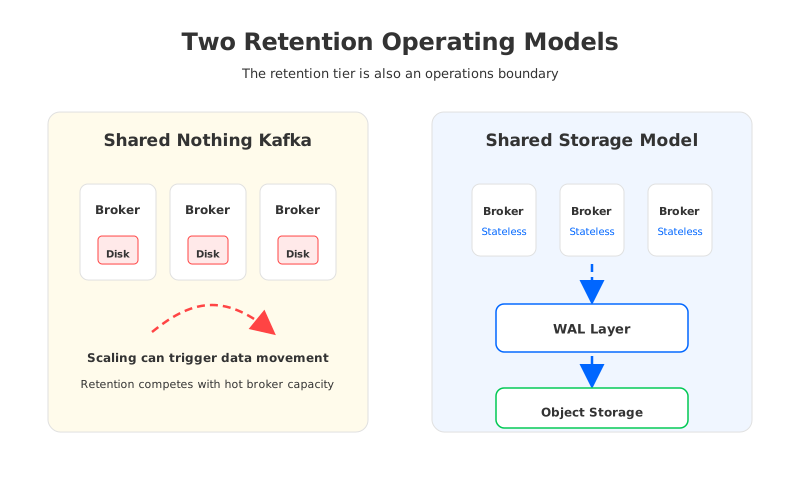
The more useful comparison is not "local disk versus object storage." It is "which component is allowed to be stateful?" In a shared-nothing Kafka cluster, the broker remains a stateful unit because it holds partition data locally. In a shared-storage design, the broker can become a stateless compute layer while durable data is stored through a shared storage service. That shift changes the operating model for retention because retained data no longer dictates broker identity in the same way.
4Evaluation checklist for FinOps and platform teams
A good hot/cold tier review starts with the current bill, but it should not end there. The team needs a shared checklist that connects cost, compatibility, operational behavior, governance, and migration risk. Otherwise FinOps optimizes storage, SRE optimizes recovery, security optimizes boundaries, and application teams optimize for minimal code change.
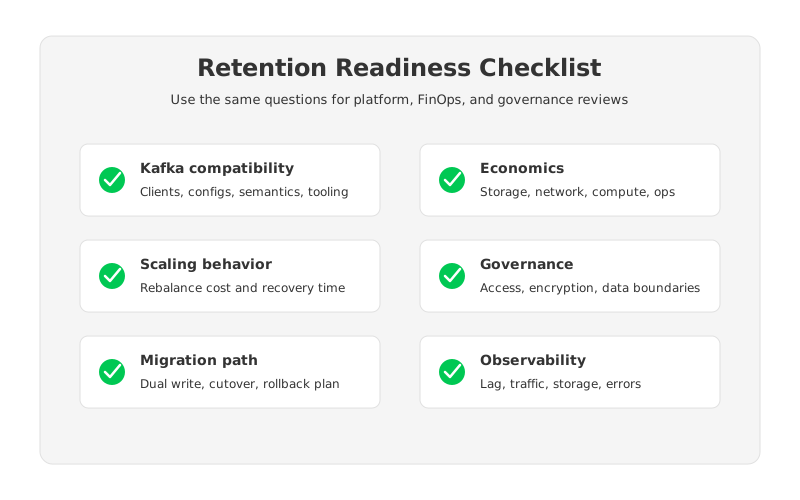
The checklist should force concrete answers:
- What data is truly hot? Define the active read window by topic or workload, not by habit. Payment, telemetry, and feature backfill streams can have different access curves even if they all use Kafka APIs.
- Which traffic crosses availability zones? Producer writes, follower replication, consumer fetches, reassignments, and recovery traffic may each behave differently. The cloud bill will not explain intent; the architecture has to.
- What breaks during a broker replacement? If the answer includes long partition movement or careful throttling, retention growth is already part of the recovery plan.
- How much Kafka compatibility is required? Client APIs, transactions, consumer groups, ACLs, monitoring tools, and operational scripts all matter. A platform can lower storage cost and still fail the migration if the compatibility surface is too narrow.
- Who controls the data boundary? BYOC, private networking, object storage buckets, encryption keys, and audit requirements can decide which architecture is acceptable before performance tuning begins.
These questions turn retention from a budget argument into an architecture review. They also prevent a common mistake: optimizing the cold tier while ignoring the hot path. A platform that makes cold storage inexpensive but leaves hot scaling brittle has moved the bottleneck, not removed it.
5When tiered storage is enough
Tiered storage is often the right answer when the existing Kafka deployment is stable, the main pressure comes from older segments, and the team is comfortable keeping brokers as the core operational unit. It can reduce local disk pressure while preserving familiar tooling and cluster behavior. For organizations that already have strong Kafka operations, this is an appealing path because it changes less at once.
The trade-off is that incremental changes inherit the original operating boundary. The broker still matters as the stateful owner of active data. Reassignment, hot partition skew, and broker lifecycle management remain central concerns. If the dominant cost is long-retained cold data, tiering can help. If the dominant cost is the coupling of storage, compute, and data movement, the review needs to go deeper.
This distinction matters during procurement. Two systems may both mention object storage, but one may use it as a colder extension of a broker-owned log while another places shared storage at the center of the architecture. Those designs lead to different answers when the team asks how fast it can scale, replace nodes, or isolate hot and cold reads.
6How AutoMQ changes the operating model
Once the evaluation framework is clear, AutoMQ fits into a specific category: a Kafka-compatible streaming platform that separates compute from storage and uses object storage as the durable foundation. Some retention problems are symptoms of a deeper coupling between broker identity and stored data.
AutoMQ's Shared Storage architecture changes that coupling. Brokers can be treated as stateless compute nodes, while S3Stream stores stream data on object storage and uses a WAL layer for low-latency persistence before data is compacted into object storage. In practical terms, the platform team can evaluate compute scaling and storage retention as separate planning dimensions instead of buying broker-local capacity for both.
This matters for hot and cold economics in several ways:
- Retention can align with object storage capacity rather than broker disk growth. That gives FinOps a cleaner way to model historical data without assuming every retained byte needs the same broker-local footprint.
- Broker lifecycle operations can avoid bulk data copying as the default path. If retained data is not anchored to a specific broker's local disk, scaling and replacement become less sensitive to the total retained footprint.
- Cross-zone traffic becomes an explicit design target. AutoMQ documentation describes inter-zone traffic optimization and client placement patterns, which are important when availability-zone data transfer is a material cost driver.
- Kafka compatibility remains part of the evaluation rather than an afterthought. Teams still need to verify client behavior, consumer groups, topic configuration, ACLs, monitoring, and migration steps against their own workload.
The caveat is worth stating plainly. Shared storage is not magic storage. Object storage availability, WAL configuration, cloud IAM, network paths, and observability still need production-grade review. The architectural advantage is that these concerns move into clearer layers instead of asking every broker to be a compute node, disk owner, replication participant, and long-retention warehouse.
7A practical decision matrix
The easiest way to compare options is to write down the dominant pressure before selecting the design. Retention-heavy platforms usually have a mix of pressures, but one or two tend to dominate.
| Dominant pressure | Traditional Kafka expansion | Kafka tiered storage | Shared-storage Kafka-compatible architecture |
|---|---|---|---|
| Hot throughput growth | Add brokers and rebalance partitions | Add brokers; remote tier helps older data | Scale compute separately from retained storage |
| Cold retention growth | Increase broker disk or broker count | Move older segments to remote storage | Store retained data in shared object storage |
| Node replacement risk | Plan around replica movement and throttling | Still manage hot local state carefully | Reduce dependence on broker-local retained data |
| Cross-zone cost pressure | Tune rack awareness and client placement | Tune placement plus remote tier behavior | Design for storage-backed durability and zone-aware traffic |
| Migration sensitivity | Minimal architecture change | Moderate change within Kafka operations | Requires compatibility and cutover validation |
The table is not a universal ranking. If the workload mainly needs a longer cold replay window, tiered storage may be enough. If it needs elastic compute, lower retained-data coupling, and cleaner recovery behavior, shared storage deserves a serious evaluation. If governance controls dominate, deployment boundaries may matter more than storage mechanics.
8Migration and governance risk
Retention architecture touches too many systems to be changed as a storage-only project. Producers may rely on acknowledgment behavior, consumers on lag patterns or backfill speed, and dashboards on broker disk, partition placement, and replication. A migration plan must make those assumptions visible before traffic moves.
A production readiness plan should include compatibility tests, a dual-run or mirrored-data period when feasible, cutover criteria, rollback criteria, and post-cutover traffic monitoring. It should also define who owns buckets, encryption, IAM policies, private endpoints, and audit logs. These details decide whether retained data stays inside the promised boundary.
For Kafka-compatible systems, the right migration question is not "does the benchmark look good?" Benchmarks are useful, but they do not prove that a team's clients, governance model, and recovery procedures will behave correctly. The stronger question is whether the team can replay its own operational incidents against the candidate architecture and get a better answer.
9Closing the economics loop
The original problem was not that Kafka retained too much data. Retention made hidden coupling visible: hot compute tied to cold storage, local broker state tied to recovery time, and data movement tied to cloud network economics. A good hot/cold tier strategy makes those couplings explicit, then removes the ones that no longer fit the workload.
If your team is evaluating Kafka-compatible retention with object storage, shared storage, or migration from broker-local capacity planning, review AutoMQ's architecture overview with the same checklist: AutoMQ architecture overview. The useful outcome is a platform where retention, recovery, governance, and cost can be reasoned about without pretending they are the same problem.
10References
- Apache Kafka documentation
- Apache Kafka tiered storage documentation
- AutoMQ architecture overview
- AutoMQ S3 storage architecture
- AutoMQ technical advantages overview
- AWS Amazon S3 pricing
11FAQ
11.1Is hot and cold tiering the same as Kafka tiered storage?
No. Hot and cold tiering is an economic and operational model for separating active data from historical data. Kafka tiered storage is one implementation path that moves older log segments to remote storage while preserving broker-local responsibilities for the active log.
11.2When should a team evaluate shared storage instead of adding broker disks?
Evaluate shared storage when retention growth forces broker overprovisioning, node replacement requires large data movement, cross-zone traffic is material, or compute scaling needs to happen independently from retained data growth.
11.3Does object storage remove the need for Kafka compatibility testing?
No. Object storage changes the economics of durable retention, but client behavior still needs validation. Test producers, consumers, transactions if used, consumer group behavior, ACLs, monitoring, backfill jobs, and rollback procedures before production cutover.
11.4How should FinOps teams model Kafka-compatible retention?
Model storage, compute, network movement, and operational recovery as separate cost drivers. A single storage-per-gigabyte comparison misses the effects of broker overprovisioning, partition movement, cross-zone traffic, and longer recovery windows.
11.5Where does AutoMQ fit in this decision?
AutoMQ fits when the team wants Kafka-compatible APIs with a shared-storage operating model. Its architecture separates broker compute from object-storage-backed durability, which can make retention and scaling easier to reason about for cloud-native deployments.


