
Table of Contents
Table of Contents
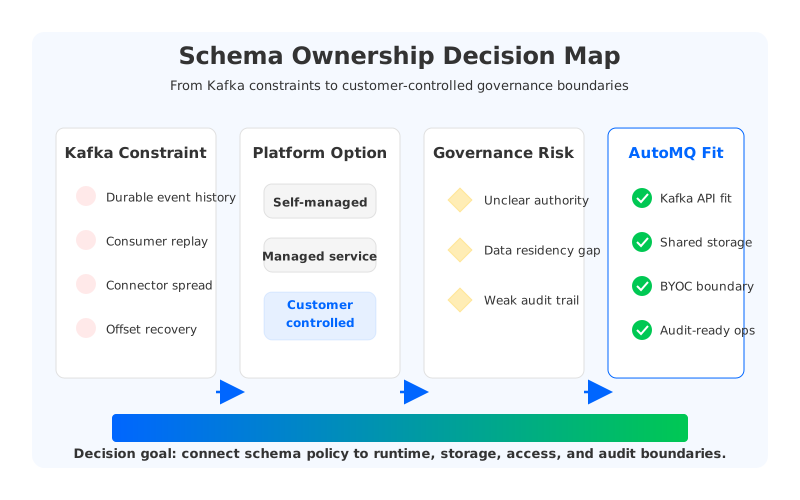
Teams search for schema ownership model kafka when schema governance has become an operating boundary problem. Naming rules, approval workflows, and producer ownership may already exist. The trouble starts when those rules must survive a real Kafka environment: multiple business domains, retained event history, consumer groups that lag or replay, connectors that move data into warehouses, and audit teams that ask where schema decisions are enforced.
The ownership question is not "who edits the schema file?" The harder question is who controls the infrastructure where schemas, data contracts, offsets, audit logs, network paths, and storage policies meet. In a regulated or multi-team platform, the answer must be encoded into deployment boundaries, access controls, migration procedures, and recovery drills.
That makes schema ownership a streaming platform design topic. A usable model has to say which team owns producer compatibility, which team approves breaking changes, which team operates the registry or contract service, and which team can prove that the resulting data stayed inside the intended account, Region, network, and retention boundary.
1Why Teams Search for schema ownership model kafka
Kafka makes schema ownership visible because events are durable, shared, and replayable. A REST API can reject a request at the edge and hide much of the implementation behind a service boundary. A Kafka topic becomes a long-lived contract. Once downstream systems depend on its fields, keys, headers, ordering assumptions, and retention window, the producer team cannot treat schema evolution as a private code change.
This is why the phrase "schema ownership model" often appears next to "data contracts." A schema describes the shape of a record. A data contract also describes compatibility rules, ownership, service-level expectations, retention assumptions, privacy classification, and allowed consumers. If either side is missing, governance falls back to meetings, tribal knowledge, and emergency rollbacks.
A production Kafka platform usually needs four ownership lanes:
- Domain ownership: the producing application team owns event meaning, versioning intent, and business semantics.
- Platform ownership: the Kafka platform team owns topic lifecycle, broker operations, ACLs, retention, migration, observability, and compatibility.
- Governance ownership: data governance or security teams own classification, audit evidence, approval policy, and the rules for personally identifiable or regulated data.
- Consumer ownership: consuming teams own read behavior, offset management, replay plans, and the impact of breaking changes on their applications.
Those lanes sound clean on paper. They collide in operations. A producer may want to delete a field while a consumer still replays old data. Governance may require stricter approval while the platform team protects release velocity. Security may require customer-controlled data residency while the streaming platform is managed through a control plane outside the data account. Schema ownership works only when the operating model resolves those collisions before an incident.
2The Production Constraint Behind the Problem
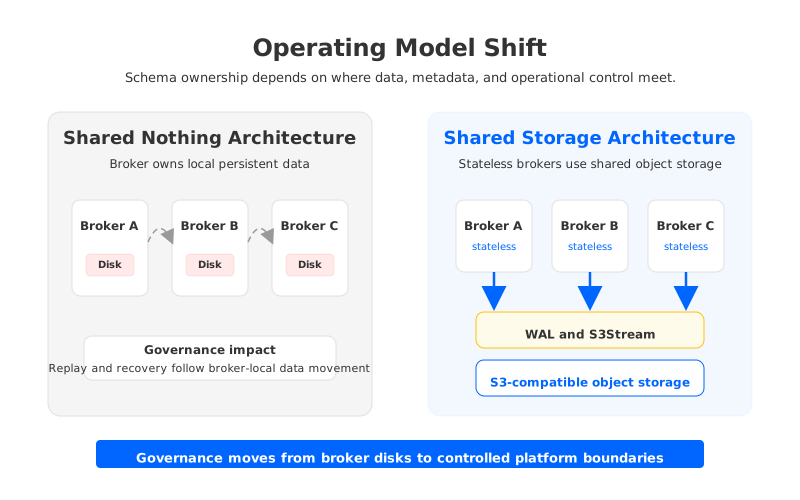
Traditional Kafka follows a Shared Nothing architecture: each broker owns local storage, and partition replicas are copied across brokers for durability. That design is familiar, but it makes storage placement, replication traffic, partition reassignment, and broker replacement part of the governance surface. When a schema change requires replay, backfill, connector rebuild, or topic migration, the ownership model inherits the constraints of broker-local data.
The coupling matters because schema governance is rarely isolated from recovery. Suppose a team introduces a compatible field, then discovers that a downstream job interprets it incorrectly. The platform must know whether old records remain available, which consumers committed which offsets, whether connectors propagated the bad records, and whether it can isolate or replay data without moving large volumes between brokers.
Apache Kafka documentation makes the surrounding mechanics explicit: consumer groups coordinate partition ownership and offsets, transactions provide atomic writes across partitions for supported clients, KRaft manages cluster metadata, and Kafka Connect runs source and sink integration workloads. These mechanisms are powerful, but they also show why schema ownership cannot live in a registry alone. The registry validates schemas; Kafka operations determine how schema decisions affect live data flow, retained history, and recovery.
This is where cloud architecture changes the discussion. A regulated team may need strict control over three layers at once:
- Data location: where record payloads, changelog topics, compacted topics, and connector outputs are stored.
- Control authority: who can create topics, alter compatibility settings, reset offsets, change ACLs, scale brokers, and approve migrations.
- Evidence trail: which logs, metrics, audit events, and deployment records prove that the policy was followed.
If any layer sits outside the customer's account or network boundary, the schema ownership model must explain that dependency. Some teams accept a fully managed external service. Others need the control plane, data plane, registry, object storage, encryption keys, and network routing to remain under customer-controlled deployment boundaries.
3Architecture Options and Trade-Offs
Most platform teams choose among three operating models. The first is self-managed Apache Kafka. It gives the customer direct infrastructure control and freedom to place Schema Registry, Connect, observability, and access controls wherever policy requires. The trade-off is operational load: broker-local storage, partition balancing, capacity planning, upgrades, and recovery remain the platform team's responsibility.
The second model is an external managed Kafka service. It can reduce operational burden and standardize administrative workflows. The trade-off is boundary clarity. If data, metadata, schema services, networking, or operational access cross into a vendor-controlled environment, governance teams need to review residency, encryption, auditability, incident response, and exit plans.
The third model is customer-controlled cloud-native Kafka-compatible deployment. The customer keeps deployment boundaries inside their own cloud account, VPC (Virtual Private Cloud), or private environment, while the platform architecture reduces broker-local storage operations. This model fits teams that want cloud elasticity without turning data governance into an external trust exercise.
| Evaluation area | Self-managed Kafka | External managed service | Customer-controlled cloud-native deployment |
|---|---|---|---|
| Schema authority | Flexible, but often manually integrated | Often standardized by provider workflows | Customer defines the registry, contracts, approvals, and access model |
| Data residency | Customer controlled | Depends on provider architecture and contract | Customer controlled in the chosen account, VPC, or data center |
| Operational burden | Highest | Lower for broker operations | Lower storage operations while retaining customer boundary control |
| Replay and migration risk | Depends on local storage capacity and data movement | Depends on provider tooling and access model | Depends on Kafka compatibility plus storage and migration architecture |
| Governance evidence | Built by the customer | Shared with provider evidence | Built in the customer environment with platform automation |
The table is not a ranking. If schema ownership is mostly a developer productivity issue, an external service may be the right trade-off. If the business must prove that event data, schema decisions, and operational authority remain in a controlled account, deployment boundaries become an architecture requirement.
4Evaluation Checklist for Platform Teams
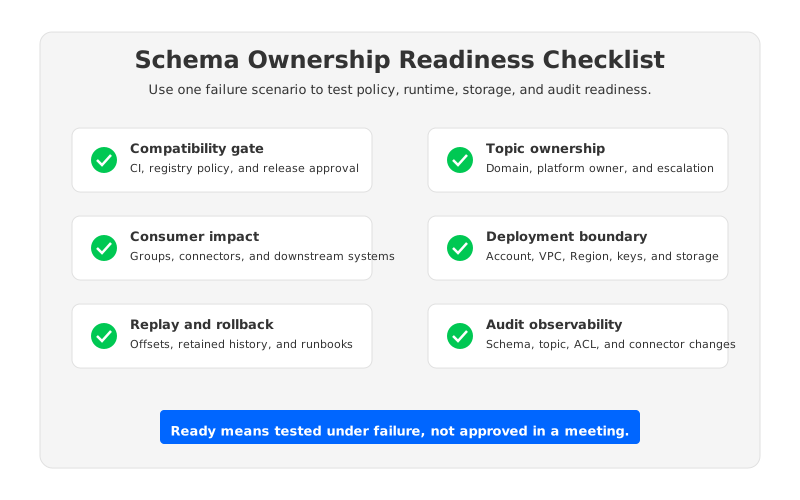
The simplest test is to follow one incompatible change through the system. Pick a realistic event, such as customer.updated or payment.authorized. Then ask what happens when a field is renamed, a key changes, or a privacy classification changes after consumers already depend on the topic. The answer should describe people, APIs, automation, and rollback paths, not a single approval meeting.
Use this checklist before choosing or changing the Kafka platform:
- Compatibility policy: Which schema formats and compatibility modes are allowed? Who can approve exceptions, and how are producer builds blocked when they violate the policy?
- Topic and contract ownership: Is every topic mapped to a producing domain, a responsible team, an escalation path, a retention class, and a data classification?
- Consumer impact: Can the platform identify consumer groups, connectors, and downstream systems affected by a contract change before it is deployed?
- Replay readiness: Does retained history support expected backfills, and can teams replay without destabilizing live workloads or moving large volumes of broker-local data?
- Access control: Are schema, topic, ACL, offset reset, and connector operations separated by role rather than granted through broad administrator access?
- Deployment boundary: Do record payloads, schema metadata, audit logs, encryption keys, and operational access stay inside the required customer-controlled boundary?
- Migration and rollback: Can the team migrate topics, consumers, and offsets while preserving contract semantics and keeping a tested rollback path?
The checklist exposes a common gap. Many teams have schema rules but not schema operations. They know which changes are allowed, but not who can prove that the change was enforced across producers, brokers, connectors, consumers, and retained history. That gap becomes expensive during audits and dangerous during incidents.
5How AutoMQ Changes the Operating Model
Once the evaluation framework is clear, AutoMQ enters the discussion as a Kafka-compatible, cloud-native streaming platform built around Shared Storage architecture. AutoMQ keeps Kafka protocol and API compatibility while moving the persistent storage layer away from broker-local disks and into S3-compatible object storage. Brokers become stateless for persistent data, while S3Stream, WAL (Write-Ahead Log), and object storage handle durability and recovery.
For schema ownership, the important change is not that a schema registry disappears. Teams still need schema validation, data contracts, ownership metadata, CI checks, and approval workflows. The change is that the streaming platform's operating boundary becomes easier to align with governance boundaries. In AutoMQ BYOC, control plane and data plane components run in the customer's cloud environment. In AutoMQ Software, they run in the customer's private environment. Security and governance teams can evaluate schema metadata, Kafka data, object storage, access controls, network paths, and observability inside that boundary.
Shared Storage architecture also changes recovery and scaling. In traditional Kafka, adding brokers or recovering failed brokers can require data movement because partitions are tied to broker-local disks. In AutoMQ, persistent data is stored in shared object storage, so broker replacement and partition reassignment focus on leadership, metadata, cache warmup, and traffic routing rather than copying the full retained log between machines. That matters when teams need to replay, backfill, isolate a bad producer, or scale capacity for a governance remediation job.
The operating model becomes more explicit:
- Domain teams still own event meaning and compatibility intent.
- Platform teams own Kafka-compatible runtime operations, topic policy, migration, observability, and storage configuration.
- Governance teams can review deployment boundaries, data residency, access control, audit evidence, and encryption in the customer's own environment.
- Application teams keep Kafka clients, offsets, consumer groups, connectors, and stream processing patterns that depend on Kafka semantics.
This is not a reason to weaken schema discipline. Customer-controlled deployment makes enforcement more concrete because the platform team can connect schema rules to cloud IAM, VPC routing, object storage policy, audit logs, monitoring, and runbooks. A data contract becomes more than a JSON, Avro, or Protobuf artifact. It becomes an enforceable boundary across code, Kafka topics, storage, and operations.
6A Practical Readiness Scorecard
Before treating a schema ownership model as production-ready, run one workshop with platform, governance, security, and application owners in the same room. Start with a failure scenario: a producer ships a schema change that passes syntax checks but violates downstream business semantics. Then trace how the organization detects it, stops it, rolls it back, replays affected records, and proves what happened.
Score each area from 1 to 5:
| Area | 1 means | 5 means |
|---|---|---|
| Ownership | Topic ownership is informal | Every topic has a domain owner, platform owner, data class, and escalation path |
| Compatibility | Checks happen after deployment | CI, registry policy, and release gates block unsafe changes before production |
| Consumer visibility | Consumers are discovered during incidents | Impacted consumers, connectors, and downstream systems are known before rollout |
| Deployment boundary | Data paths require case-by-case explanation | Data, metadata, storage, network, and audit boundaries are documented and tested |
| Recovery | Rollback depends on manual reconstruction | Offset, replay, connector, and migration runbooks are tested under load |
| Observability | Teams inspect logs manually | Schema changes, topic changes, ACL changes, offset actions, and connector changes are observable |
A low score does not mean the platform is wrong. It means the ownership model is not yet operational. Fixing it may require better CI, registry policy, catalog metadata, Kafka ACL design, connector governance, or cloud architecture. The point is to avoid discovering the gap after a breaking change has entered a retained event log.
Schema ownership in Kafka is durable because Kafka data is durable. The model has to survive old records, slow consumers, replay, migration, and audit. If your governance requirements depend on customer-controlled deployment boundaries, evaluate those boundaries with the same rigor you apply to schema compatibility rules. To explore how a Kafka-compatible Shared Storage architecture can fit that evaluation, start with the AutoMQ deployment path.
7FAQ
7.1Is schema ownership the same as Schema Registry ownership?
No. Schema Registry ownership is one part of the model. A production schema ownership model also covers topic ownership, compatibility policy, producer release gates, consumer impact analysis, access control, audit evidence, replay, and rollback.
7.2Should producer teams or platform teams own Kafka schemas?
Producer teams should own event meaning and versioning intent. Platform teams should own the enforcement mechanisms, runtime policy, Kafka operations, and migration paths. Governance teams should own classification and audit requirements. The model breaks when any one group is expected to own all of it alone.
7.3How does customer-controlled deployment affect data contracts?
It gives data contracts a clearer infrastructure boundary. Instead of describing only schema shape and compatibility, teams can tie contract enforcement to customer-owned storage, network isolation, IAM, encryption, audit logs, and operational runbooks.
7.4Does AutoMQ replace schema governance tools?
No. AutoMQ is a Kafka-compatible streaming platform, not a schema governance replacement. It changes the operating model underneath Kafka by using Shared Storage architecture and customer-controlled deployment options, while teams continue to use their chosen schema registry, catalog, CI checks, and approval workflows.
8References
- Apache Kafka documentation
- Apache Kafka design: consumers, transactions, replication, and log semantics
- Apache Kafka KRaft operations
- Apache Kafka Connect overview
- AutoMQ Kafka compatibility
- AutoMQ Shared Storage architecture
- AutoMQ S3Stream architecture
- AutoMQ WAL storage
- AutoMQ BYOC getting started
- AutoMQ security and access management


