
Table of Contents
Table of Contents
When platform teams search for secure cross region replication kafka, they are rarely looking for a generic replication diagram. The search usually starts after a production constraint becomes real: a regulator asks where event data resides, a security team questions whether replicated topics leave the approved network path, or a recovery test shows that offsets, schemas, and access policies do not move as cleanly as records do. Cross-region replication becomes a decision about who controls the data plane, who controls the storage account, and how much operational risk the team can accept during a failover.
That pressure is easy to underestimate because Kafka replication looks familiar on the surface. You can mirror topics. You can deploy a second cluster. You can script consumer group checks, schema exports, and cutover procedures. The harder question is whether those pieces still form a secure system when the primary region is unhealthy, the secondary region must accept writes, and the security team needs evidence that data residency, encryption, network isolation, and audit boundaries were preserved. A production design for secure cross-region replication Kafka should start with that question, not with a tool choice.
1Why teams search for secure cross region replication kafka
The word “secure” changes the architecture conversation. A basic replication plan asks whether records arrive in another region. A secure replication plan asks whether the operating boundary still matches the organization’s governance model after those records arrive. Kafka topics may carry payment events, customer activity, fraud signals, device telemetry, or AI feature streams. The payload is only part of the control surface; metadata, offsets, schemas, ACLs, network paths, encryption keys, and observability pipelines all matter.
The search often comes from teams that already run Kafka in production. They know about partitions, consumer groups, and lag. Their concern is how to keep Kafka-compatible streaming dependable across regions without creating a shadow platform that security cannot inspect. A DR cluster that receives records but loses schema compatibility is not ready. A replicated topic without a tested consumer position is not ready. A secondary region that requires broad permissions or unmanaged egress is not ready either.
The practical version of the problem has four questions:
- Can the target region run the same Kafka clients, serializers, connectors, and transactional workloads without application rewrites?
- Can the security team prove where data, keys, logs, and management actions reside?
- Can the platform team promote and roll back without corrupting offsets or accepting duplicate writes?
- Can the cost model survive steady-state replication, recovery drills, and burst catch-up traffic?
Those questions are uncomfortable because they cross team boundaries. Kafka operators own brokers and topic health. Security owns network paths, identity, and encryption policy. Data governance owns schema and contract rules. Application teams own producers and consumers.
2The production constraint behind the problem
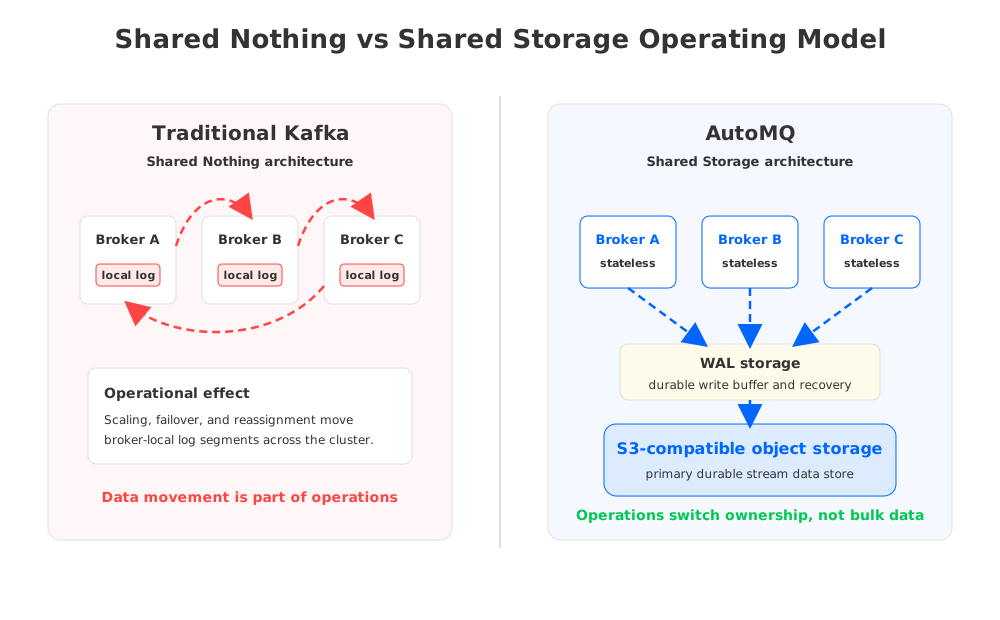
Traditional Kafka was built around a Shared Nothing architecture. Each broker owns local log segments, and partition replicas are copied between brokers for durability and availability. That model is coherent: the broker is both compute and persistent storage owner. It also means that any architecture change involving capacity, placement, or recovery has to respect where data physically sits.
In a single region, this shows up as partition reassignment, broker replacement, disk capacity planning, and cross-Availability Zone replica traffic. Across regions, the same pressure becomes larger. You are no longer moving broker state inside one operational domain. You are creating a second domain that is far enough away to survive regional failure but close enough in semantics to take over a Kafka workload. The farther apart those domains are, the more explicit your governance contract has to be.
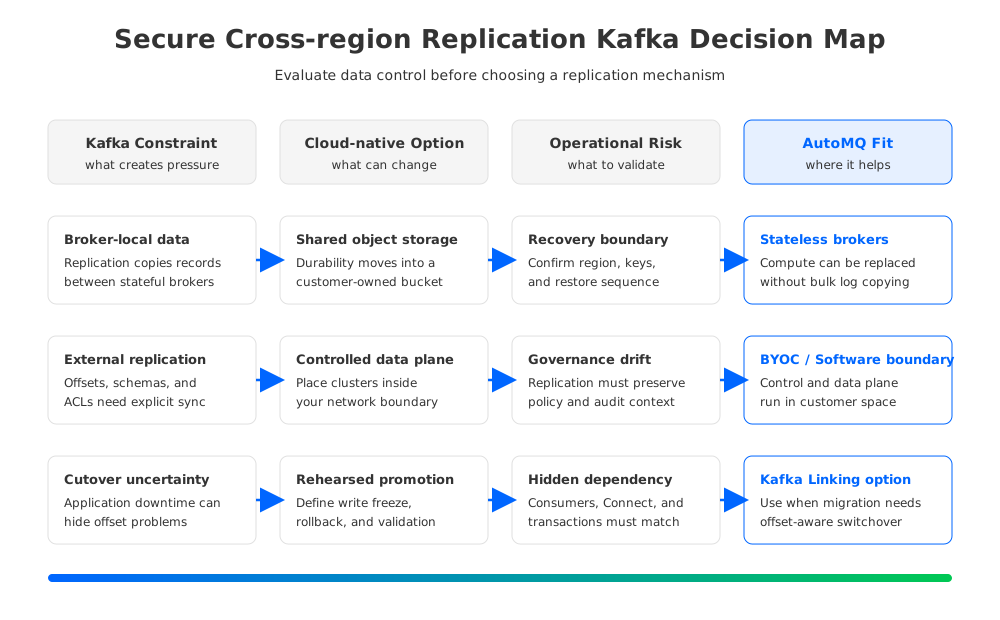
The production constraint is not that Kafka cannot replicate. Apache Kafka includes well-documented concepts for offsets, consumer groups, transactions, and cross-cluster mirroring through MirrorMaker2. The constraint is that replication is not the same thing as recovery. Recovery needs a promoted target that can serve real clients with known positions, compatible schemas, enforceable access policies, and a rollback path. If your design cannot answer those questions during a drill, it is a copy pipeline rather than a recovery architecture.
Tiered Storage can reduce pressure on local broker disks by moving older log segments to remote storage, and it is valuable for retention-heavy workloads. It does not remove the primary operational fact that the active Kafka broker still owns local hot data and participates in local replication. For secure cross-region replication, that distinction matters. A design that offloads historical data still needs to explain how active writes, leader placement, offsets, consumer progress, and promotion are controlled across regions.
3Architecture options and trade-offs
There are three common architecture paths. None is universally correct, and the wrong answer is usually the one selected before the team writes down its control requirements.
| Option | Where it fits | Main security question | Main operations risk |
|---|---|---|---|
| Active-passive mirroring | DR for selected topics and consumers | Can the mirror preserve the metadata needed for promotion? | Offset mismatch, schema drift, delayed catch-up |
| Active-active regional clusters | Local writes in multiple regions | Can data contracts and conflict rules be enforced consistently? | Duplicate writes, ordering ambiguity, complex rollback |
| Customer-controlled cloud-native Kafka | Regulated workloads that need Kafka compatibility and cloud-native operations | Can the data plane, storage, keys, and control actions remain inside customer boundaries? | Requires careful deployment, IAM, and migration planning |
Active-passive mirroring is often the most understandable design. Producers write to the primary region, records are copied to the secondary region, and the secondary waits for promotion. The appeal is clarity, but the hidden work is in the cutover. Consumer groups must resume from a known position. Producers must avoid writing to both regions by accident. Schema and data contract changes must be replicated or governed separately.
Active-active designs solve a different problem. They reduce regional dependency for applications that naturally write close to users or devices, but they move complexity into data semantics. Kafka gives ordered partitions, not a universal conflict-resolution system for multi-region writes. If two regions can accept writes to related keys, the application needs clear rules for ordering, deduplication, ownership, and replay. Security also becomes more complex because every region is both a source and a target.
Customer-controlled cloud-native Kafka changes the conversation by making deployment boundaries part of the platform decision. Instead of treating replication as a black box outside the customer’s cloud account or data center, the organization can evaluate whether the control plane, data plane, storage account, network path, and observability outputs remain within its governed environment. This does not remove replication design, but it gives security and platform teams a cleaner place to draw the line.
4Evaluation checklist for platform teams
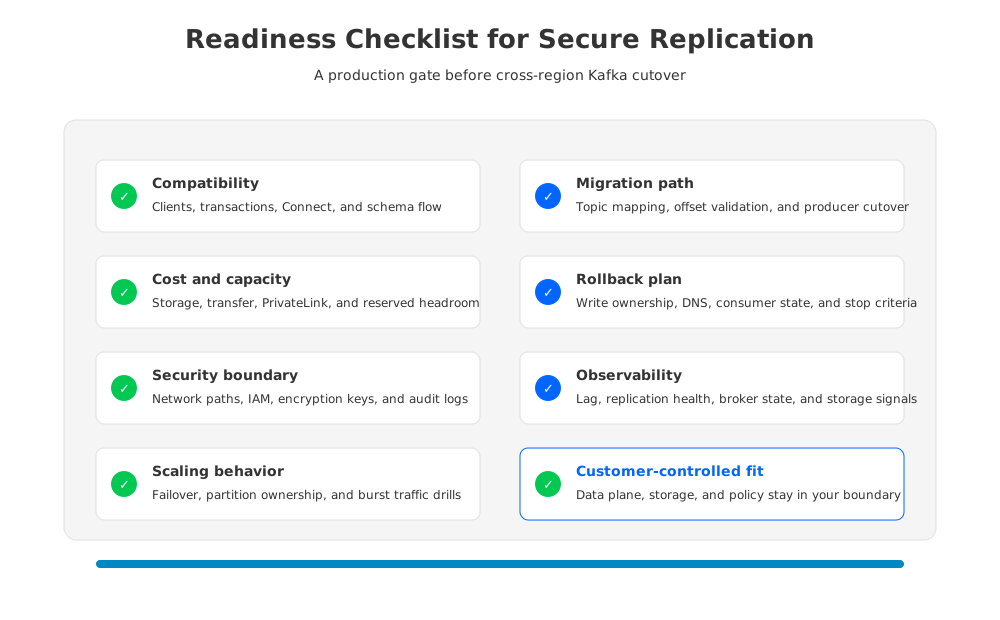
A good checklist is not a procurement form. It is a way to make hidden failure modes visible before the incident. The following gates are useful for any secure cross-region replication Kafka design.
- Compatibility gate. Verify client versions, serializers, Kafka Connect connectors, transactions, idempotent producers, consumer group behavior, and admin APIs. “Kafka-compatible” should cover your applications and tooling, not only produce and consume calls.
- Governance gate. Define how schemas, data contracts, ACLs, service accounts, encryption keys, audit logs, and retention policies move or remain pinned to each region.
- Network gate. Map every path used by producers, consumers, brokers, replication workers, object storage, PrivateLink or private endpoints, monitoring, and admin access.
- Cost gate. Separate steady-state replication, recovery drill, catch-up, cross-region transfer, and private connectivity costs. Use official cloud pricing pages before publishing a business case.
- Promotion gate. Rehearse the exact sequence for stopping writes, validating lag, promoting topics, switching clients, and reopening writes in the target region.
- Rollback gate. Decide when rollback is allowed, what data must be reconciled, and which side is authoritative after a partial promotion.
- Observability gate. Track replication lag, consumer lag, broker health, storage errors, control-plane actions, and application-level freshness in one recovery dashboard.
The checklist forces a useful separation: replication mechanics, platform operations, and governance evidence are different layers. A team can pass one layer and fail another, so secure replication should be tested as a system, not as a one-time topic copy.
5How AutoMQ changes the operating model
This is where AutoMQ enters the evaluation, not as a shortcut around DR design, but as a different operating model for Kafka-compatible streaming. AutoMQ keeps Kafka protocol compatibility while replacing Kafka’s broker-local storage layer with a Shared Storage architecture based on S3-compatible object storage, S3Stream, WAL storage, and stateless brokers. A broker is no longer the long-term owner of local persistent log data; it becomes compute that can be replaced, scaled, and rebalanced against shared durable storage.
For secure cross-region planning, that difference affects three decisions. First, the storage boundary becomes explicit. In AutoMQ BYOC, the control plane and data plane run in the customer’s cloud account and VPC, and Kafka records remain in customer-controlled storage. In AutoMQ Software, the same principle applies to a private data center or customer-operated environment. Security teams can evaluate buckets, IAM policies, encryption, network boundaries, and audit collection using their own control model.
Second, broker operations become less tied to bulk data movement. AutoMQ’s stateless brokers and Shared Storage architecture are designed so that scaling and reassignment are primarily ownership and metadata operations rather than broker-to-broker log copying. That does not make a cross-region promotion automatic, because region-level recovery still needs a controlled replication and cutover plan. It does reduce the amount of everyday operational work that depends on broker-local disks, which matters when platform teams are already managing replication, governance, and failover drills.
Third, migration and replication planning can use Kafka-aware paths. AutoMQ commercial editions provide Kafka Linking for migrations that require byte-to-byte message synchronization, offset consistency, and producer switchover support. That capability is not a substitute for readiness testing, but it addresses one hard part of Kafka migration: preserving the positions and write paths that stateful consumers and stream processors depend on. Records, offsets, schemas, and write ownership have to be handled together.
The result is a clearer responsibility model. Kafka-compatible APIs preserve the application contract. Shared Storage architecture changes broker operations. Customer-controlled deployment boundaries give security teams a concrete answer to data residency and network isolation questions. Together, those properties turn secure replication from tool assembly into an architecture decision that platform, security, and governance teams can review together.
6A readiness scorecard you can use
Before selecting a replication platform, score the design in a dry run. Give each category a value from 0 to 2: 0 means untested, 1 means tested manually, and 2 means tested with repeatable automation and evidence. A production-ready system should not rely on heroic manual steps during regional failure.
| Category | Score 0 | Score 1 | Score 2 |
|---|---|---|---|
| Client compatibility | Unknown client and connector behavior | Verified with selected apps | Verified across critical producers, consumers, connectors, and stream processors |
| Data governance | Topic copy only | Schema and ACL export tested | Contracts, access, encryption, retention, and audit evidence tested |
| Cutover | Informal runbook | Manual drill completed | Automated sequence with validation and stop criteria |
| Rollback | No defined authority | Manual authority decision | Predefined authority, reconciliation, and client routing rules |
| Observability | Broker metrics only | Replication and lag dashboards | End-to-end freshness, policy, storage, and control-action evidence |
| Cost control | No region-level model | Steady-state estimate | Steady-state, drill, catch-up, transfer, and connectivity estimate |
Scores are less important than the conversations they create. A low rollback score may reveal missing idempotency rules. A low governance score may reveal that schemas are copied but data contracts are not enforced in the target region. A low cost score may reveal that transfer or private connectivity costs were excluded. These gaps are fixable before an incident; they are expensive to discover during one.
For customer-controlled deployments, add one final question: if an auditor asks where the streaming data plane runs, where durable storage lives, who can administer it, and how a regional promotion was approved, can you answer from your own cloud or data-center evidence? If the answer is no, the architecture still has governance debt.
If you are evaluating Kafka-compatible streaming for regulated cross-region workloads, review AutoMQ’s deployment model and run a design session against your own recovery checklist. You can start from the AutoMQ team through this secure deployment CTA.
7FAQ
7.1Is MirrorMaker2 enough for secure cross-region Kafka replication?
MirrorMaker2 can be part of a secure replication design, especially for copying topics between Kafka clusters. The design still needs separate validation for offsets, schemas, ACLs, encryption, network paths, cutover, rollback, and observability. Topic replication alone is not the same as a recovery architecture.
7.2Does Shared Storage architecture remove the need for cross-region replication?
No. Shared Storage architecture changes the broker operating model and reduces dependence on broker-local persistent disks. Cross-region recovery still needs a region-level plan for data placement, promotion, client routing, and governance evidence.
7.3Why does customer-controlled deployment matter for security?
Customer-controlled deployment lets the organization evaluate the streaming platform inside its own cloud account, VPC, object storage, IAM, encryption, and audit model. That boundary is important for regulated teams that need evidence of data residency and operational control.
7.4What should teams test before promoting a secondary region?
Test producer write ownership, consumer group positions, schema compatibility, connector behavior, transactions if used, ACLs, encryption keys, monitoring, rollback criteria, and application-level freshness. The drill should produce evidence, not only a pass/fail note.
8References
- Apache Kafka documentation
- Apache Kafka MirrorMaker2 geo-replication documentation
- Apache Kafka Tiered Storage documentation
- AutoMQ architecture overview
- AutoMQ compatibility with Apache Kafka
- AutoMQ WAL storage documentation
- AutoMQ cross-AZ traffic documentation
- AutoMQ Kafka Linking documentation
- AWS S3 replication documentation
- AWS PrivateLink pricing


