
Table of Contents
Table of Contents
Teams search for sensitive data classification kafka when the streaming platform has stopped being an internal transport detail. A topic that once carried "events" begins to carry customer identifiers, device fingerprints, payment signals, support transcripts, or model feedback. Security teams ask where that data lives. Platform teams ask whether a broker resize, replay, migration, or support workflow creates another copy of data that now falls under review.
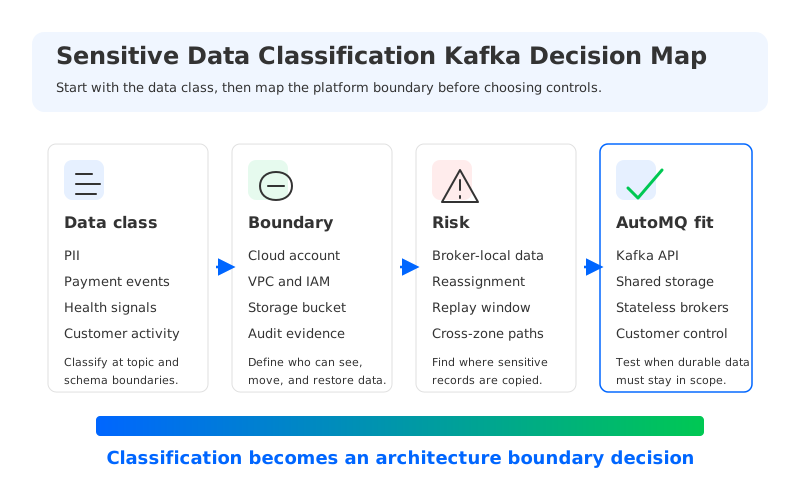
Kafka classification is not only a tagging exercise. A label such as "restricted" or "PII" matters, but it is incomplete until the team can explain how the data moves through producers, topics, partitions, brokers, storage, connectors, consumers, observability systems, and recovery tools. Classification becomes useful when it changes an operational decision: which topic can be replayed, which storage boundary owns durable records, which network path is allowed, and which team can approve a migration.
That is why customer-controlled deployments change the conversation. They do not remove the need for data contracts, schemas, access controls, encryption, or audits. They change the boundary under review. Instead of asking only whether a platform can process classified records, the better question is whether the platform lets you keep durable data, network paths, identity policies, and operational evidence inside the environment your security model already governs.
1Why teams search for sensitive data classification kafka
The search usually starts with a concrete trigger. A data protection review finds fields that were not part of the original topic design. A schema change adds a customer attribute to an event used by 12 downstream services. A machine learning pipeline starts consuming raw clickstream data with account-level identifiers. An audit team asks how long sensitive records remain available for replay and who can initiate that replay.
Kafka makes this question urgent because it is durable and replayable by design. Producers write records to topics. Consumers track offsets and can resume or replay from a known position. Consumer groups coordinate processing across partitions. Kafka Connect can move records into databases, warehouses, object storage, or search systems. These properties mean classification has to follow the record through time, not only through the first processing hop.
A practical classification model should answer four questions for each high-value stream:
- What is the highest data class carried by the topic? Do not classify a topic by its average record. Classify it by the most sensitive field that can appear in the value, key, headers, or derived schema.
- Where can the record be stored durably? Include broker storage, backup paths, remote storage, connector sinks, dead-letter topics, and operational exports.
- Who can move or replay it? Offset reset, reprocessing, migration, and connector restart procedures can expose more data than a normal steady-state read.
- What evidence proves the control worked? A policy without logs, schema history, access records, and recovery evidence is hard to defend in an incident review.
This is where teams find the gap between governance language and Kafka operations. The governance document says the field is restricted. The runbook says broker replacement may trigger partition movement. The connector team says the sink may retain a copy for retry. All three statements can be true, but they do not yet form an architecture.
2The production constraint behind the problem
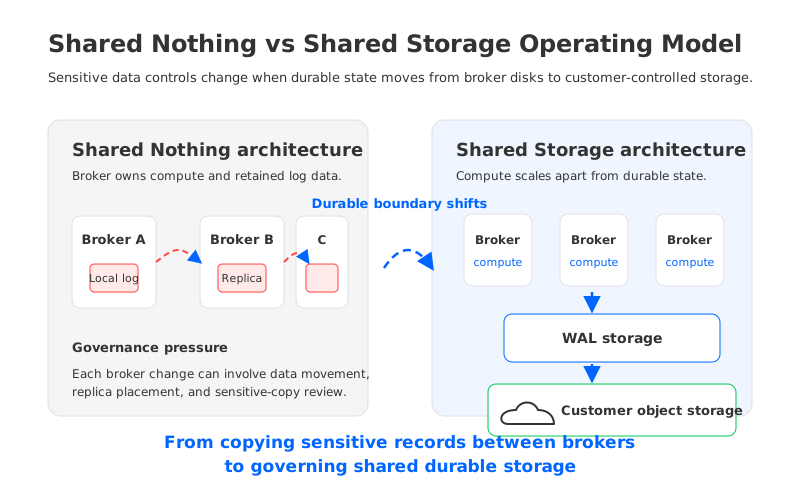
Traditional Kafka is built around a Shared Nothing architecture. Each broker manages local log storage, and partitions are placed across brokers with replication for availability. That model is powerful and well understood. It also means a broker is not only a compute node that accepts produce and fetch requests. It is a durable owner of retained records for the partitions assigned to it.
For ordinary event streams, that coupling is often a capacity issue. For classified streams, it becomes a governance issue. When the platform changes broker count, replaces nodes, moves partitions, expands retention, or runs a disaster recovery workflow, the team must understand whether sensitive records are copied, where replicas land, and how long intermediate states persist.
The pressure increases when platform teams try to solve growth with more local capacity. A longer retention window may require larger disks. A hot topic may require partition reassignment. An analytics workload added to the estate may require a replay from older offsets. A failed broker may require leadership movement and replica recovery. Each action is operationally normal, but each one touches the same classified data boundary that security teams are trying to make explicit.
This is not a reason to avoid Kafka. It is a reason to classify data at the level where Kafka actually operates: topic, partition, schema, offset, storage, connector, and replay path. A classification that cannot survive a broker failure drill or migration rehearsal is not ready for production.
3Architecture options and trade-offs
There are several ways to handle sensitive data classification in Kafka, and none of them should be treated as a universal answer. The right architecture depends on the sensitivity of the stream, the organization's operating model, and the cost of changing existing applications.
| Option | What it protects well | What still needs scrutiny |
|---|---|---|
| Topic-level classification and ACLs | Clear ownership, producer and consumer authorization, reviewable access scope | Derived topics, connector sinks, offset reset rights, and schema drift |
| Schema and data contracts | Field-level intent, compatibility checks, producer discipline | Runtime values, headers, emergency changes, and non-schema payloads |
| Encryption and key controls | Storage and transport confidentiality, separation of key ownership | Replay authorization, privileged operations, and observability exports |
| Fully managed streaming service | Reduced infrastructure burden and standardized operations | Exact data-plane boundary, support access, regional control, and vendor-side storage model |
| Self-managed Kafka | Maximum operational control and internal customization | Broker-local storage burden, patching, scaling, reassignment, and recovery complexity |
| Customer-controlled Kafka-compatible platform | Data plane, storage, network, and IAM can align with customer governance | Compatibility validation, migration planning, support model, and operational evidence |
The table is not a vendor checklist. It is a way to keep the review honest. If the main problem is uncontrolled producer behavior, a stronger schema and data contract program may produce the largest improvement. If the main problem is unauthorized consumers, ACLs and identity governance come first. If the main problem is that durable records leave the environment boundary your organization can audit, deployment model and storage architecture become first-order criteria.
Cost belongs in the same discussion, but not as a slogan. Sensitive streams often have long retention, replay-heavy analytics, and stricter recovery requirements. Those traits increase the cost of over-provisioned brokers, replicated local disks, and network movement. The useful question is whether the architecture reduces unnecessary data movement and idle capacity while preserving required controls.
4Evaluation checklist for platform teams
A production evaluation should start with one representative stream, not a generic platform scorecard. Pick a topic that carries data your security team cares about, has multiple consumers, uses schemas or contracts, and has a realistic replay or migration requirement. Then walk the record from producer to durable storage to downstream systems and back through recovery.
Use this checklist as the working review:
- Classify the topic by its highest-risk field. Include key, value, headers, derived topics, and dead-letter paths. If a field can appear during a backfill or special producer mode, include it.
- Map the durable storage boundary. Identify broker logs, remote storage, connector buffers, sink systems, and observability exports. Name the account, region, bucket, volume, or service where records can persist.
- Separate read access from operational power. A user who cannot consume a topic may still have permission to reset offsets, restart connectors, export logs, or trigger migration workflows.
- Test replay and deletion assumptions. Kafka's value comes from retention and replay, so policies around erasure, retention reduction, and downstream copy cleanup must be tested under real operating procedures.
- Validate compatibility before migration. Producers, consumers, Kafka Connect jobs, transactions, offset behavior, and monitoring tools should be tested against the target platform before any production cutover.
- Write the rollback path before approving the change. A classification review is incomplete when it only describes the target state. It must also describe what happens if the migration, schema change, or connector rollout fails.
This exercise exposes a useful distinction. Some problems are governance problems: missing owners, weak schema discipline, unclear data classes, or broad access. Other problems are architecture problems: durable data tied to broker-local disks, expensive reassignment, slow scaling, or recovery workflows that create unclear copies. Treating both as the same "Kafka security" issue leads to vague decisions.
5How AutoMQ changes the operating model
Once the review reaches architecture-level constraints, AutoMQ becomes relevant as a Kafka-compatible, cloud-native streaming platform built around Shared Storage architecture. A platform cannot classify data by itself. The point is that compute, durable storage, and customer-controlled deployment boundaries can be arranged in a way that is easier to reason about during a security review.
AutoMQ keeps the Kafka-facing contract familiar while changing the storage layer underneath. Its architecture uses stateless brokers for Kafka request handling and S3Stream for storage, with WAL storage used for write durability and recovery before data is organized in S3-compatible object storage. In that model, durable stream data is not treated as long-lived broker-local state in the same way it is in a traditional Shared Nothing architecture.
For sensitive data classification, that shift matters in three ways. First, the durable storage boundary can be mapped to customer-controlled object storage, IAM policies, encryption controls, and audit evidence. Second, broker scaling and replacement can be reviewed more like compute operations because the broker is less tightly coupled to retained log ownership. Third, customer-controlled deployment models such as AutoMQ BYOC and AutoMQ Software let teams evaluate control plane, data plane, network, storage, and support boundaries against their own requirements.
This does not replace Kafka governance. You still need topic naming rules, schema compatibility policies, producer accountability, ACLs, encryption, monitoring, and incident response. You still need to inspect Kafka Connect paths and downstream copies. You still need to test offsets, transactions, consumer group behavior, and client compatibility. A Shared Storage architecture changes the platform's operating model; it does not excuse weak governance.
The strongest fit is a workload where the team wants Kafka-compatible APIs and ecosystem behavior, but every classified-data review depends on broker-local storage movement, retained-data capacity planning, and unclear recovery copies. The weakest fit is a small, stable Kafka estate with short retention, limited sensitivity, and clean governance evidence. Architecture should solve the problem you actually have.
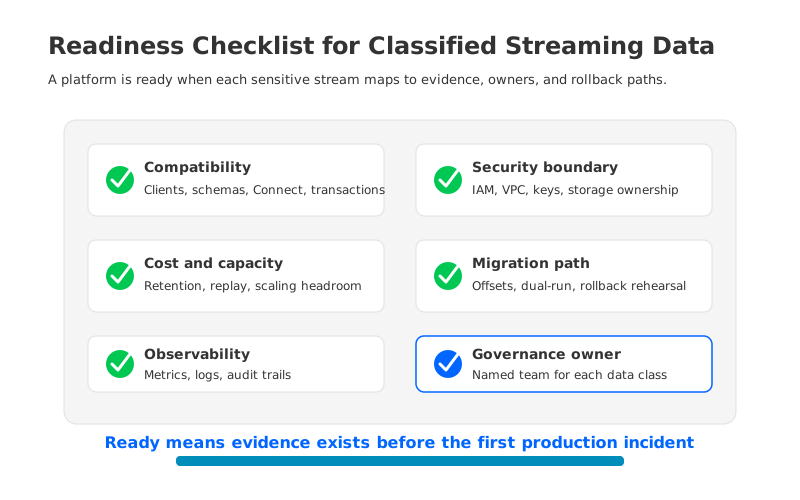
6A readiness scorecard for classified streams
Before approving a production platform for classified Kafka data, score it with evidence rather than opinions.
| Area | Ready evidence | Warning sign |
|---|---|---|
| Compatibility | Existing clients, Connect jobs, transactions, and monitoring pass a representative test | The evaluation stops at a hello-world produce and consume test |
| Data boundary | Durable storage, network paths, IAM scope, and support access are mapped | The team cannot say where retained records live during recovery |
| Governance | Each topic has a data class, owner, schema policy, and access review process | Classification exists in a spreadsheet but not in platform operations |
| Operations | Replay, offset reset, connector restart, broker replacement, and migration are rehearsed | The first full test will happen during production cutover |
| Observability | Metrics, logs, audit trails, and schema history prove the control path | Debug logs or exports may contain sensitive fields without review |
| Rollback | The team can return to a known state without expanding data exposure | Rollback means "call the platform team and improvise" |
The scorecard keeps the conversation grounded. If a stream lacks schema ownership, fix the contract. If no one can explain the durable data boundary, fix the platform review. If replay and migration are not tested, run the rehearsal before changing production.
7FAQ
7.1What is sensitive data classification in Kafka?
Sensitive data classification in Kafka is the practice of assigning data classes to topics, schemas, fields, storage paths, and operational workflows so teams can control how records are produced, consumed, retained, replayed, migrated, and audited.
7.2Should classification happen at the topic level or field level?
Both levels matter. Field-level classification identifies the actual sensitive values, while topic-level classification gives platform teams a workable unit for access control, retention policy, monitoring, and operational approval.
7.3Do data contracts solve sensitive data classification?
Data contracts help because they make schema intent explicit and reviewable. They do not cover every runtime value, header, connector copy, replay path, or operational export, so they should be paired with access control, storage-boundary review, and audit evidence.
7.4How does a customer-controlled deployment help?
A customer-controlled deployment can keep the data plane, durable storage, network routes, IAM policies, and operational evidence inside an environment governed by the customer's own controls. That makes the classification review more concrete because the team can map sensitive records to resources it owns and audits.
7.5Where does AutoMQ fit in the evaluation?
AutoMQ fits after the team has defined compatibility, governance, storage-boundary, migration, and recovery requirements. It is worth testing when Kafka-compatible behavior is required, but broker-local storage and data movement make classified-stream operations difficult to govern.
8Closing the loop
The original search was not really about a label. It was about control. A team looking for sensitive data classification kafka needs a way to prove where sensitive records live, who can move them, how replay works, and what happens when the platform changes under load. Start with one classified stream, run the scorecard, and make the architecture earn the label.
If your review points toward Kafka-compatible streaming with customer-controlled data, storage, and network boundaries, start a focused architecture evaluation through AutoMQ Cloud.


