
Table of Contents
Table of Contents
Kafka's original storage model made sense in the data center. A broker owned partitions, partitions lived on disks attached to that broker, and replication moved data between machines that were usually paid for as part of the same fleet. In the cloud, the same model behaves differently. Every replicated byte can become storage, network, recovery time, and operational risk. That is the pressure behind diskless Kafka: keep the Kafka API and the log abstraction, but stop treating broker-local disks as the center of the system.
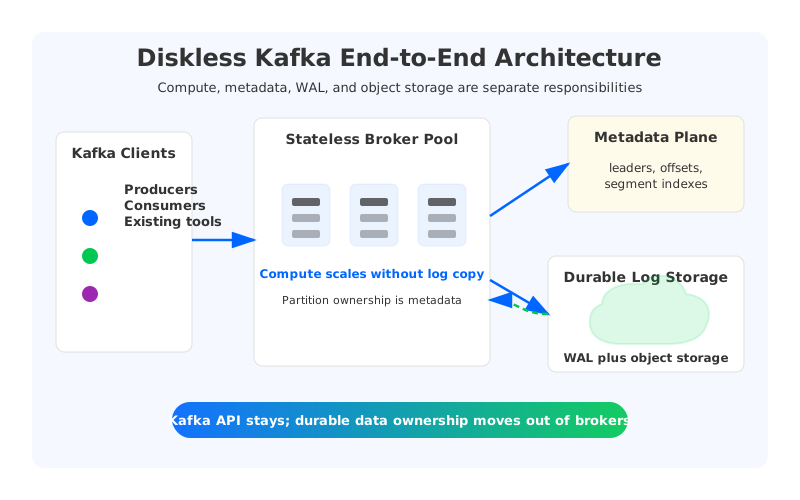
Diskless Kafka does not mean data becomes less durable. It means the durable log is no longer owned by a single broker's local filesystem. The broker becomes a serving and coordination layer, while a write-ahead log and object storage handle durability. AutoMQ follows this pattern with Kafka-compatible brokers, a pluggable WAL layer, and object storage as the long-term log store. The result is a system where compute can scale like a stateless service while data remains in shared durable storage.
1The old assumption: a broker is both compute and storage
Traditional Kafka combines several responsibilities in the broker. It accepts client requests, owns partition leadership, stores log segments locally, replicates data to follower brokers, serves reads, and participates in recovery. That bundling is simple to reason about at small scale, but it creates a hard coupling: when a broker changes, data has to move.
That coupling shows up in three places. Scaling requires partition reassignment and physical data movement. Failure recovery requires replicas to catch up from other brokers. Cost grows with local disks, replication factor, and cross-AZ traffic. None of these are bugs in Kafka. They are the natural result of a shared-nothing storage model running on cloud infrastructure where storage and network are separate billable resources.
Diskless Kafka breaks that coupling by moving the durable log away from the broker. The broker still speaks Kafka. Producers and consumers do not need to learn a new protocol. The difference is behind the API: the broker no longer needs to be the long-term owner of the bytes.
| Responsibility | Traditional Kafka | Diskless Kafka |
|---|---|---|
| Client protocol | Kafka API | Kafka API |
| Broker role | Compute plus local storage | Mostly compute and routing |
| Durable storage | Broker-attached disks | WAL plus object storage |
| Scaling unit | Broker with data | Broker compute |
| Partition reassignment | Moves log data | Moves ownership metadata |
The table is useful because it avoids a common misunderstanding. Diskless Kafka is not Kafka with tiered storage bolted on. Tiered storage often keeps the hot path on broker-local disk and moves older data to remote storage. Diskless Kafka changes the primary ownership model: the log is designed to live outside the broker from the start.
2The write path: why the WAL matters
The first question engineers ask is predictable: if the log lands in object storage, does every produce request wait on object storage latency? A production diskless design cannot work that way. Object storage is durable and cost-effective, but the write path still needs a low-latency commit point. That is the role of the WAL.
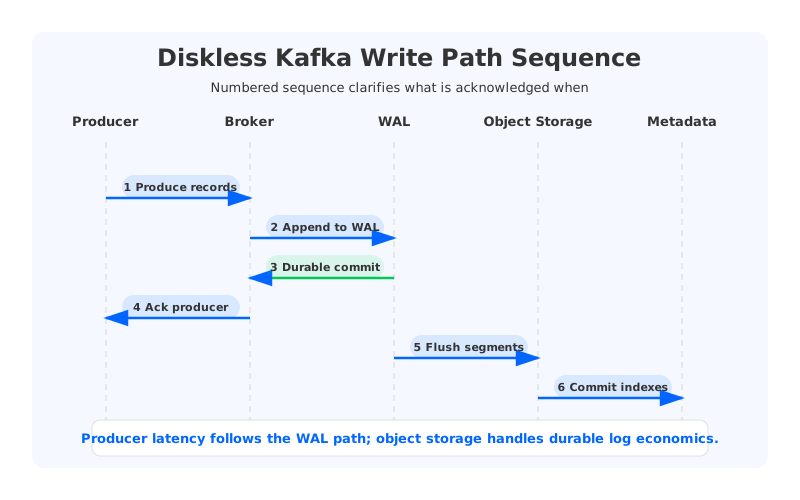
A simplified write path looks like this. The producer sends records to the partition leader. The broker appends those records to the WAL and can acknowledge once the configured durability condition is satisfied. The system then persists log segments and metadata so consumers can fetch data by offset. Object storage provides the long-term durable log, while the WAL absorbs the latency-sensitive part of the write path.
This architecture is why AutoMQ talks about a pluggable WAL layer rather than a single storage trick. Different environments need different latency and durability tradeoffs. Some deployments optimize for cloud object storage economics. Others use shared storage such as NFS-style WAL implementations for lower write latency. The important design point is that the WAL is explicit. It is not hidden as an implementation detail of a local disk broker.
A good diskless implementation has to answer several operational questions:
- What is the durability boundary for a producer acknowledgment?
- How are offsets, segment metadata, and object storage writes coordinated?
- What happens when a broker fails after the WAL append but before segment compaction or upload?
- How does the consumer read path avoid turning every fetch into a slow remote read?
- How are hot partitions redistributed without copying entire local logs?
Those questions are where diskless Kafka moves from a diagram to an engineering system. The architecture is attractive because it removes broker-local data ownership, but the implementation has to preserve the semantics Kafka users depend on: ordered offsets, committed records, predictable fetch behavior, and failure recovery.
3Stateless brokers change the scaling model
Once data is no longer tied to broker-local disks, broker scaling becomes a different operation. A new broker can join as compute capacity. It does not need to receive terabytes of partition data before it becomes useful. Partition ownership can shift through metadata, and the serving layer can rebalance traffic without waiting for a long physical copy.
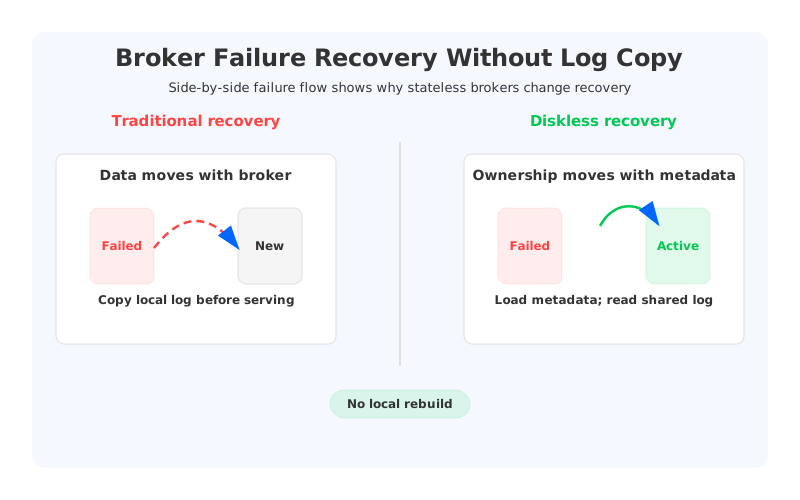
That distinction matters most when the system is under pressure. In traditional Kafka, adding brokers during a traffic spike may be the beginning of a long rebalance. In a diskless design, the cluster can add compute and move ownership much closer to the time scale of ordinary service scaling. The exact timing depends on workload, metadata operations, and storage backend, but the mechanism is fundamentally lighter because data movement is not the main unit of work.
Failure recovery follows the same logic. A replacement broker does not rebuild a local log before it can serve. It loads the relevant metadata, connects to the shared log, and resumes ownership according to the cluster's assignment. That does not make failures free; clients, leaders, and metadata still need to converge. It does remove the heaviest part of recovery: copying durable data from one broker's disks to another.
4What changes for readers and operators
Diskless Kafka is not a promise that every workload gets the lowest possible latency. Local NVMe systems can be excellent for ultra-low-latency paths. The stronger claim is about system-level economics and operations. If your workload is a typical cloud Kafka workload with high throughput, significant retention, multiple AZs, and uneven traffic, the cost of tying data to brokers often dominates the design.
For operators, the practical changes are concrete:
- Capacity planning shifts from broker-plus-disk bundles to separate compute and storage planning.
- Scaling becomes more about adding stateless compute than migrating log data.
- Long retention no longer forces every broker to carry local disk sized for historical data.
- Cross-AZ replication can be reduced because durability is handled through shared storage rather than broker-to-broker data copying.
- Recovery focuses on metadata and serving ownership instead of local log reconstruction.
AutoMQ's value is in making those changes while keeping the Kafka surface area familiar. Producers still use Kafka clients. Consumers still read topics and partitions. Existing ecosystem tools can remain part of the workflow. The change is underneath: the storage layer is redesigned for cloud infrastructure instead of treating cloud disks like rented data-center drives.
5The tradeoff to evaluate
A fair evaluation should not ask whether diskless Kafka is universally better. It should ask which part of your current Kafka system is limiting you. If your constraint is microsecond-level latency on dedicated hardware, a local-disk or memory-optimized design may be the right place to look. If your constraint is cloud cost, slow scaling, long recovery windows, or operational drag from stateful brokers, diskless Kafka deserves serious evaluation.
The decision also depends on how the implementation handles the hard parts: WAL durability, read amplification, metadata consistency, failure recovery, observability, and migration. A diagram with object storage is not enough. Production users should inspect the write path, ask what is acknowledged when, and test failure scenarios before trusting the architecture.
That is the useful way to read AutoMQ's diskless design. It is not trying to remove Kafka. It is trying to keep the Kafka API while replacing the part of Kafka that cloud infrastructure made expensive: broker-owned local storage. If the pain in your cluster comes from that coupling, diskless Kafka is not a cosmetic change. It is the architectural change that makes the rest of the system easier to operate.
6Questions to ask before adopting diskless Kafka
The right evaluation goes deeper than “does it use object storage?” Ask where the durability boundary sits, how the WAL is replicated or protected, and what happens when the storage backend becomes slow rather than completely unavailable. Slow storage is often harder to handle than failed storage because the system keeps running while tail latency grows. A mature implementation should expose metrics for WAL append latency, object storage flush lag, metadata operation latency, consumer fetch latency, and broker ownership changes. Without those signals, operators are flying blind.
The second set of questions is about workload shape. A high-throughput observability pipeline with long retention stresses storage and catch-up reads. A fraud decision stream stresses write latency and tail behavior. A CDC pipeline stresses ordering, compaction, and downstream fanout. Diskless Kafka can be a strong fit for all of these, but the storage backend, WAL choice, and operational thresholds may differ. That is why AutoMQ's pluggable WAL design matters: it lets the architecture adapt to latency and durability requirements without returning to broker-local disks as the source of truth.


