
Table of Contents
Table of Contents
Teams usually search for javascript kafka clients production after the first proof of concept becomes a platform problem. One application has a KafkaJS producer with a few retry settings. Another service wraps the client differently. A background worker commits offsets after processing, while a web-facing service commits earlier to reduce duplicate work. The platform team eventually has to answer a harder question: what behavior should every JavaScript service inherit before production?
The answer is not "pick a library and move on." JavaScript Kafka client standardization is a contract between application teams and the streaming platform. It defines producer retries, Consumer group behavior, offset commits, transactions when needed, credential rotation, and client telemetry. That contract matters even more during Kafka-compatible platform evaluations or migrations away from a broker-local operating model.
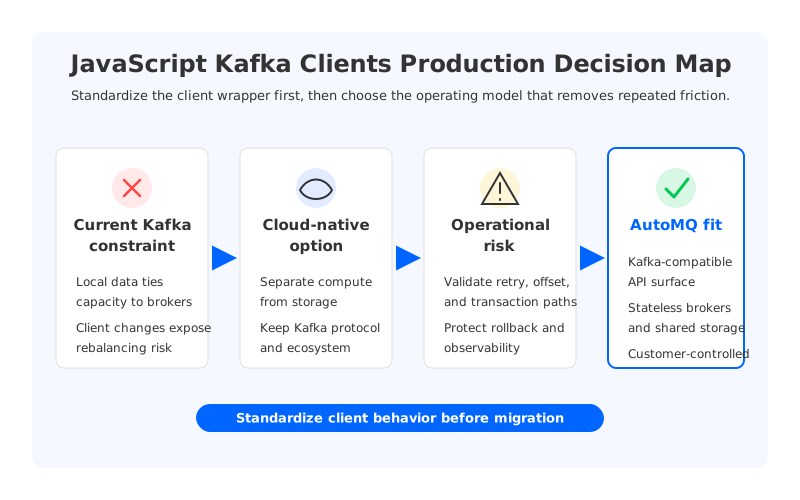
The most useful platform standard starts with client behavior, then follows the pressure back into the cluster architecture. If the client wrapper hides the wrong trade-offs, teams inherit fragile defaults. If the platform architecture makes every capacity change a storage movement project, even well-behaved clients can suffer during rebalancing, broker maintenance, or traffic spikes.
1Why Teams Search for javascript kafka clients production
JavaScript adoption changes Kafka operations. A small number of JVM services can often share a mature internal library, but JavaScript workloads spread across web backends, serverless jobs, enrichment workers, internal tools, and APIs. The platform team must support Kafka guarantees across teams that may not think about partitions, heartbeats, and offset commits every day.
That is why production readiness should be expressed as a short set of non-negotiable behaviors, not as a wiki page of optional tuning notes:
- Producer reliability: standardize
acks, retry policy, idempotence support where the chosen client and broker path allow it, message keys, timeout budgets, and error handling. A retry that protects an ingestion pipeline may be wrong for a user-facing API with a strict latency budget. - Consumer group discipline: define group IDs, heartbeat intervals, session timeouts, max processing time, partition assignment expectations, and offset commit policy. Apache Kafka documents Consumer groups and offsets as core coordination concepts, and JavaScript wrappers need to expose those concepts clearly rather than bury them.
- Serialization and schema ownership: choose how JSON, Avro, Protobuf, or custom formats are versioned, validated, and rolled back. Client standardization fails when the wire format becomes an application-by-application decision.
- Security and identity: make TLS, SASL, ACLs, secret rotation, and audit naming part of the generated client configuration. Production readiness includes knowing which service produced a record and which identity consumed it.
- Telemetry: emit client-side errors, retries, commit latency, rebalance events, consumer lag, and message size distributions in a format that SREs can correlate with broker metrics.
These application-facing rules quickly expose infrastructure-facing limits. A rebalance is not only a client event; it may signal broker pressure. A producer timeout may reflect leader movement, network changes, disk pressure, or migration. A useful standard gives application teams a stable surface and gives SREs enough signal to trace causes.
2The Production Constraint Behind the Problem
Traditional Kafka runs as a Shared Nothing architecture. Each broker owns local storage for the partitions assigned to it, and replication between leaders and followers provides durability. That design is a proven foundation for Kafka's protocol and ecosystem, but it also means the operational burden of the cluster leaks into client-facing behavior. When storage, leadership, and compute are tied to the broker, capacity changes tend to involve partition reassignment, replica movement, and careful throttling.
JavaScript client teams feel this indirectly. During broker maintenance, a producer may see metadata refreshes and retryable errors. During consumer group changes, a worker may pause while partitions are reassigned. During storage-heavy growth, platform teams may reserve more broker capacity than current traffic needs because storage and compute scale together.
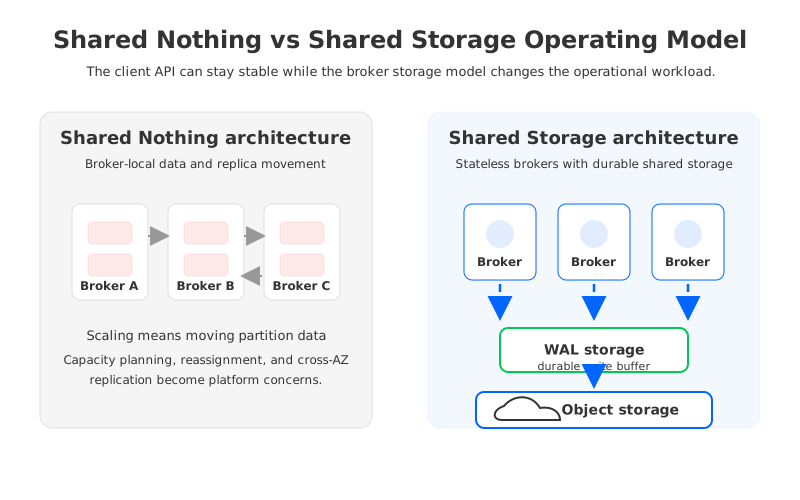
The client wrapper can reduce damage, but it cannot remove every architectural constraint. Better retry defaults do not make broker-local storage elastic. Cleaner offset handling does not make reassignment free. Platform teams should separate two categories of work: the JavaScript client standard every service follows, and the Kafka operating model that determines how often services are disturbed.
That distinction matters during platform evaluation. If the goal is to make JavaScript Kafka clients production-ready, a client library checklist is necessary but incomplete. The platform also needs predictable scaling, clear cost drivers, strong compatibility, observable failure modes, and migration mechanics that do not force every service team to rediscover Kafka behavior under pressure.
3Architecture Options and Trade-Offs
Most teams have three realistic options. They can keep their current Kafka deployment and harden the JavaScript client layer. They can move to a managed Kafka service while preserving the traditional broker-local model. Or they can evaluate a Kafka-compatible platform that changes the storage architecture while keeping the Kafka API surface.
The first option is often the right starting point. A platform-owned JavaScript package can wrap KafkaJS or another approved client, enforce common configuration, and ship opinionated observability. It can prevent avoidable mistakes such as inconsistent client IDs, missing retry telemetry, weak shutdown handling, or offset commits that do not match processing semantics. This is valuable even if the cluster architecture never changes.
The second option shifts some operational tasks to a service boundary, but it does not automatically remove the underlying coupling of broker compute and broker-local storage. Teams should still evaluate partition movement, storage growth, cross-AZ traffic, upgrade windows, quota behavior, and client compatibility. A managed service can reduce toil, but the application-visible behavior during rebalances, failover, and scaling still deserves testing.
The third option changes the evaluation question. If a Kafka-compatible platform uses Separation of compute and storage, brokers can become less stateful because durable data lives outside the broker-local disk path. This can reduce the amount of data movement tied to scaling and failure recovery. It also changes cost analysis: instead of treating broker disks as the durable storage boundary, the platform team evaluates object storage, WAL (Write-Ahead Log) storage, cache behavior, network paths, and control-plane automation.
| Decision area | What to standardize in JavaScript | What to test in the platform |
|---|---|---|
| Compatibility | Producer, Consumer, admin APIs, security settings, and error classes used by services | Kafka protocol behavior, client version support, transactions, offsets, and Consumer group behavior |
| Elasticity | Client shutdown, metadata refresh, retry budget, and backoff policy | Broker add/remove operations, partition reassignment behavior, and impact on client latency |
| Cost visibility | Message size, compression, produce rate, fetch rate, and client placement labels | Storage growth, cross-AZ traffic, retention, cache hit behavior, and object storage request patterns |
| Governance | Shared wrapper, approved configs, service identity, schema policy, and deployment templates | Console, Terraform, ACLs, audit logs, monitoring, and environment boundaries |
| Migration | Bootstrap configuration, dual-read tests, offset validation, and rollback path | Data copy semantics, cutover flow, consumer progress, and client restart requirements |
The table is deliberately neutral. It makes one point hard to ignore: a client standard and a platform standard are linked. The JavaScript wrapper defines service behavior at the edge; the streaming architecture defines how much operational turbulence reaches that edge.
4Evaluation Checklist for Platform Teams
A production standard should be scored before it is promoted to every service. The scoring does not need to be complicated. It needs to force the platform team to discuss the failure paths that usually appear after a rollout.
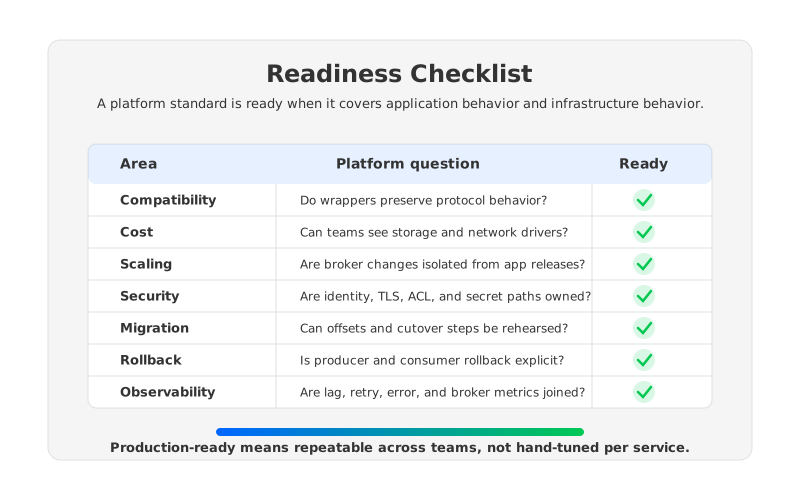
Use this checklist during design review:
- Compatibility: list the exact JavaScript client library, supported versions, Kafka features used by the organization, and features intentionally unsupported by the wrapper. Include Producer, Consumer, admin, authentication, and transaction paths if transactions are part of the workload.
- Failure behavior: rehearse broker restart, leader movement, network timeout, consumer rebalance, slow processing, poison record, and graceful shutdown. The wrapper should make the desired behavior the default, not a service-by-service convention.
- Cost drivers: label traffic by service, Topic, environment, and AZ where possible. Track compression ratio, message size, retention policy, and consumer fan-out because these values shape storage and network cost.
- Governance: provide a template for credentials, ACLs, schema ownership, Topic naming, client IDs, and operational dashboards. A standard that relies on tribal knowledge will drift.
- Migration readiness: prove how a service changes bootstrap endpoints, how offsets are validated, how producers avoid split-brain writes, and how rollback works if the target platform behaves differently under load.
- Observability: join client metrics with broker metrics. A retry spike without broker-side context creates debate instead of diagnosis.
The most revealing test is a controlled failure during a normal application release. If a service can deploy, stop, resume, and survive a rebalance without a custom runbook, the standard is useful. If the same test becomes a coordination meeting, the standard is incomplete.
5How AutoMQ Changes the Operating Model
After the client and platform evaluation framework is clear, the architecture question becomes easier to ask: what would change if Kafka-compatible brokers did not have to carry durable partition data on local disks? AutoMQ is a Kafka-compatible cloud-native streaming platform that answers that question with Shared Storage architecture, stateless brokers, S3Stream, and object-storage-backed durability.
In AutoMQ, the Kafka protocol and client ecosystem remain the application-facing contract. JavaScript services still connect through Kafka-compatible APIs, and platform teams can keep their wrapper strategy around producers, consumers, offsets, authentication, and telemetry. The deeper change is below that API surface. AutoMQ replaces Kafka's broker-local log storage path with S3Stream, where data is durably written through WAL storage and uploaded to S3-compatible object storage. Brokers focus on protocol handling, leadership, caching, and scheduling instead of acting as the long-term home of partition data.
That storage shift changes the operational model in several ways. Stateless brokers make broker replacement and scaling less dependent on moving large amounts of local partition data. Self-Balancing can focus on traffic and ownership rather than treating every placement change as a storage copy project. Self-healing can isolate unhealthy nodes and recover service more cleanly because durable data is not trapped on the failed broker. For JavaScript client teams, the goal is not to expose these internals; the goal is to reduce the number of infrastructure events that become application incidents.
The deployment boundary also matters. AutoMQ BYOC runs the control plane and data plane in the customer's cloud account and VPC, while AutoMQ Software targets customer-owned data center environments. For JavaScript client standardization, governance is not only code defaults; it is also credentials, storage location, Terraform workflows, Console operations, and monitoring boundaries.
AutoMQ's Kafka compatibility, Console, Terraform workflows, monitoring, Self-Balancing, Self-healing, Kafka Linking, Table Topic, and zero cross-AZ traffic capabilities are most useful when tied back to the platform contract. A JavaScript wrapper standardizes service-edge behavior, while AutoMQ reduces storage and scaling friction behind that edge.
6A Practical Standardization Plan
Start with an internal package that every Node.js service imports. Give it a small API: create producer, create consumer, create admin client, encode/decode records, register metrics, and shut down gracefully. Avoid exposing every client option at the application layer. Routine services should not choose retry, heartbeat, commit, and telemetry strategy from scratch.
Then create a production profile for each workload class. A request-path producer, an asynchronous ingestion worker, and a long-running batch consumer do not share the same latency budget or retry tolerance. Platform teams should define profiles such as "low-latency producer," "durable pipeline producer," "stateful consumer," and "stateless fan-out consumer." Each profile should include defaults, alerts, and test cases.
Next, run a platform evaluation with the same workloads. Do not test a streaming platform with a synthetic client that none of your teams use. Test the approved wrapper, real message sizes, realistic concurrency, deployment behavior, security configuration, and failure drills. Include a migration rehearsal because it exposes assumptions about bootstrap servers, offsets, Topic naming, and rollback.
Finally, publish the standard as a living contract. Name supported client versions, Kafka features allowed in production, observability fields every service must emit, and platform capabilities SREs can rely on during incidents. When the streaming architecture changes, update the contract first, then roll it through services with tests.
The original search was not really about JavaScript syntax. It was about making Kafka behavior repeatable across teams. If your platform team is evaluating a Kafka-compatible architecture that keeps the application contract stable while reducing broker-local operational work, review AutoMQ's deployment and migration options here: Talk to AutoMQ.
7FAQ
7.1Which JavaScript Kafka client should a platform team standardize on?
KafkaJS is a common pure JavaScript choice, while teams that need bindings closer to librdkafka may evaluate other clients. The platform decision should be based on supported Kafka features, operational behavior under failure, maintenance activity, security support, and whether the wrapper can hide unsafe defaults.
7.2Should every service use the same retry settings?
No. Every service should use the same retry framework, telemetry fields, and review process, but retry budgets should vary by workload class. A user-facing API, ingestion service, and background recovery worker usually need different timeout and retry policies.
7.3Does a Kafka-compatible platform remove the need for client standards?
No. Kafka compatibility preserves the protocol contract, but application behavior still needs governance. Client standards remain necessary for offset commits, schema handling, error handling, credentials, observability, and release safety.
7.4What should be tested before moving JavaScript clients to a different Kafka-compatible platform?
Test produce and consume paths, Consumer group rebalancing, offset continuity, transactions if used, security configuration, admin operations, failure behavior, deployment shutdown, and rollback. Use the same wrapper and workload profiles that production services use.


