
Table of Contents
Table of Contents
Searches for observability data retention kafka usually start after a platform team has already felt the pain. A logging topic filled faster than expected. A metrics stream kept growing after a label change. A trace pipeline needed replay during an incident, but the topic retained only a narrow window because broker disk was sized for average traffic. The question is not whether Kafka can carry observability data. It is whether the team has a retention standard that survives bursty telemetry, shared ownership, cost review, and recovery drills.
Observability retention is harder than ordinary event retention because data value changes with the incident. Most logs are not read again, until one outage makes a two-day replay window look like a production requirement. Metrics often need shorter raw retention but longer aggregate retention. Traces may be sampled aggressively until a bad deploy turns every missing span into an investigation gap. A good platform standard accepts that contradiction instead of pretending one retention number fits every telemetry stream.
The practical thesis is simple: standardize retention by recovery purpose, not by data type alone. Logs, metrics, and traces are useful categories, but they do not tell you how long raw data should stay in Kafka, how much replay capacity downstream teams need, or who pays when a tenant expands retention for a compliance review. Those decisions belong in an architecture and governance model, not in scattered topic overrides.
1Why teams search for observability data retention kafka
Kafka gives observability pipelines a strong set of primitives: durable append-only topics, offsets, consumer groups, replay, parallel processing, and ecosystem support through Kafka Connect and stream processors. That is why platform teams often place Kafka between emitters and destinations such as log indexes, metrics stores, tracing systems, object storage, and data lakes. The streaming layer becomes a buffer, a routing point, and an audit boundary.
The trouble starts when the pipeline is treated as a side workload. Observability traffic is often noisier than business traffic because it is coupled to deployment frequency, incident behavior, and instrumentation changes. A single service can multiply log volume through verbose output. One label added to a metrics stream can increase series count. A tracing policy change can alter event size and fan-out. Kafka absorbs the write path well, but retention turns those temporary choices into stored bytes.
Retention also creates a product boundary between teams. Application teams want enough raw telemetry to debug their systems. SREs want replay windows for triage. Security teams may require audit windows. FinOps teams want spend tied to actual need. Kafka operators translate all of that into partitions, broker storage, quotas, and topic configuration.
That is why the search is rarely a request for a single retention.ms value. It is a request for a repeatable operating model.
2The production constraint behind the problem
Apache Kafka retention is configured per topic by time and size, with settings such as retention.ms and retention.bytes documented in the official Kafka configuration reference. That mechanism is straightforward. The production constraint is not the setting itself; it is the storage architecture underneath it. In traditional Kafka, retained data lives primarily on broker-local storage, and durability comes from replica placement across brokers. More retained data means more broker storage. More replication means more internal data movement and more network traffic.
Consumer groups add another layer. Kafka tracks consumption progress through offsets, so a lagging consumer can resume from its committed position while the data remains retained. That is valuable for observability because downstream destinations fail, throttle, or need reindexing. It also means retention policy becomes a promise to consumers. If raw logs are retained for 24 hours, a search index that falls behind for 30 hours has lost its clean replay path.
Tiered Storage changes part of this equation by moving older log segments to remote storage while retaining Kafka semantics. It can be useful when the problem is long historical retention. But it does not make brokers stateless, and it does not remove the need to reason about hot data, local disk pressure, consumer catch-up, and operational recovery. Platform teams should evaluate it as one architecture option, not as a universal answer to observability retention.
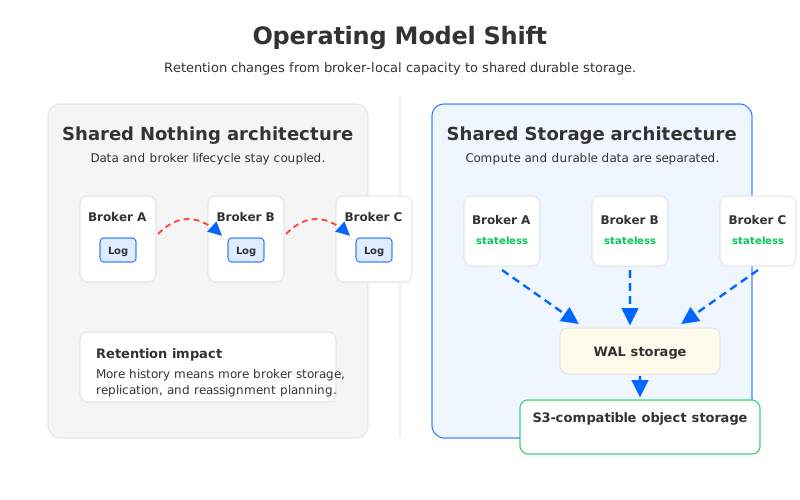
The constraint becomes visible during change. If a team increases retention from hours to days, the cluster may need more disk or different broker sizing. If the same team also needs to scale ingest capacity during a noisy incident, compute and storage decisions can collide. If a broker fails or a cluster expands, partition movement may compete with ingestion and catch-up reads. Observability data is supposed to help teams during incidents; the streaming layer should not become another source of uncertainty at the same moment.
3Architecture options and trade-offs
There are several defensible ways to design observability retention on Kafka-compatible streaming platforms. The right choice depends on replay needs, operational tolerance, and data governance boundaries.
| Option | What it is good for | Retention risk to test |
|---|---|---|
| Broker-local Kafka storage | Predictable hot retention, mature Kafka operations, known client behavior | Disk sizing, partition reassignment, and recovery can become tied to retained bytes |
| Kafka with Tiered Storage | Longer historical retention without keeping every byte on local disk | Hot/cold boundary, catch-up behavior, remote storage operations, and restore runbooks still need validation |
| Kafka-compatible shared storage | Decoupling broker compute from durable retained data | Object storage latency, WAL design, cache behavior, and compatibility coverage must be tested with real workloads |
| Downstream-only retention | Short Kafka retention with longer retention in logs, metrics, traces, or lake systems | Reprocessing becomes dependent on downstream systems, not the streaming layer |
This table is not a ranking. Broker-local Kafka remains reasonable when retention windows are short, traffic is predictable, and the team has operational headroom. Tiered Storage can fit teams that need deeper history without changing the overall Kafka operating model. Downstream-only retention can work when Kafka is a transient transport layer and replay is delegated elsewhere.
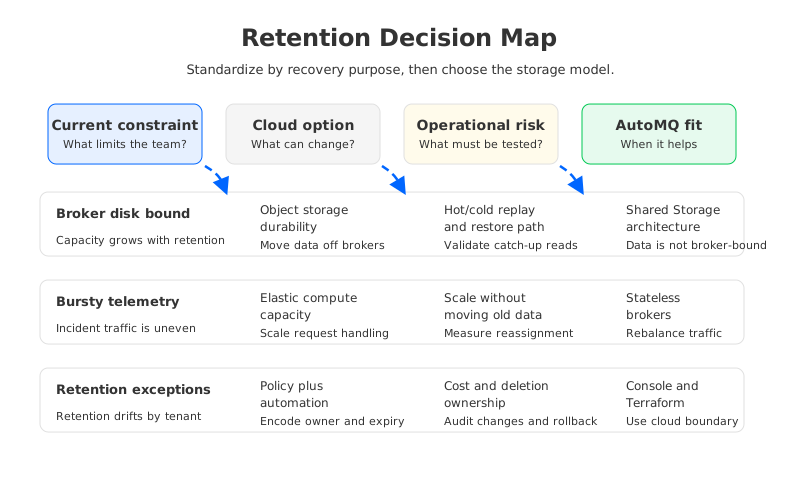
The shared-storage option becomes more interesting when observability teams need three things at the same time: Kafka compatibility, elastic ingest capacity, and retained data that is not tightly bound to broker-local disks. That combination matters for platform teams because observability retention is often adjusted by policy, while broker capacity is adjusted by load. Treating those as the same knob creates budget and reliability friction.
4Evaluation checklist for platform teams
Before choosing an architecture, write down the retention contract in terms that application owners and platform owners can both understand. Avoid starting with topic settings. Start with failure and replay scenarios, then map those scenarios to Kafka configuration and storage design.
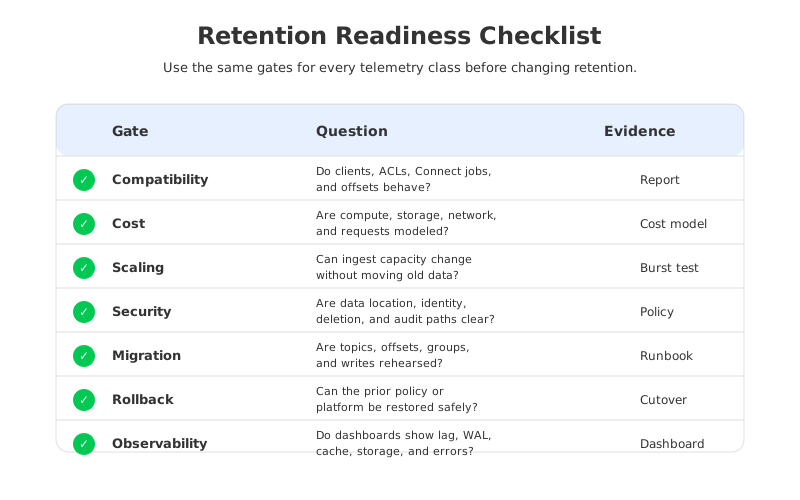
A useful checklist has seven gates:
- Compatibility. Confirm producers, consumers, admin scripts, Kafka Connect jobs, stream processors, authentication, ACLs, topic configuration, transactions, and Consumer group operations.
- Retention classes. Define raw hot retention, replay retention, audit retention, and downstream archive retention separately.
- Cost model. Separate compute, storage, network, object-store requests, private connectivity, backend cost, and engineering time.
- Scaling behavior. Test write-throughput bursts and retained-volume growth as separate events.
- Consumer recovery. Measure lag catch-up from realistic offsets, including downstream throttling and reindexing.
- Governance. Record who can raise retention, how long exceptions last, how data is deleted, and who owns the bill.
- Rollback. Keep a path back to the prior retention policy or platform during migration.
The most useful artifact is a matrix rather than a prose policy. For each telemetry class, record the owner, retention window, replay objective, write pattern, peak multiplier, consumer criticality, and deletion requirement. That matrix gives SRE, platform, security, and FinOps teams a shared language and prevents every team from asking for longer retention because trade-offs were never explicit.
5How AutoMQ changes the operating model
Once the evaluation framework is clear, AutoMQ becomes relevant as a Kafka-compatible shared-storage architecture rather than as a generic replacement pitch. AutoMQ keeps Kafka protocol and semantic compatibility while replacing broker-local log storage with S3Stream, a storage layer backed by WAL (Write-Ahead Log) storage and S3-compatible object storage. In this model, AutoMQ Brokers are stateless brokers, and durable data is stored in shared object storage instead of being bound to individual broker disks.
That architectural shift changes the retention conversation. A platform team still needs topic design, quotas, governance, and consumer recovery tests. What changes is the relationship between retained bytes and broker operations. Brokers focus on request handling, leadership, caching, and routing, while object storage holds durable stream data. Scaling compute for a burst no longer has to mean provisioning the same local disk shape, and replacing a broker no longer centers recovery on its local log.
AutoMQ's WAL design is important here because object storage alone is not a low-latency Kafka log. S3Stream writes data to WAL storage first, acknowledges the client after durable WAL write, and uploads data to object storage near real time. AutoMQ Open Source uses S3 WAL, which can fit throughput-oriented observability workloads where the lowest tail latency is not the main requirement. AutoMQ BYOC and AutoMQ Software can use additional WAL storage options for workloads that need different latency or durability trade-offs.
Self-Balancing and seconds-level partition reassignment also matter for observability retention. In a broker-local model, rebalancing can involve moving large amounts of partition data. In AutoMQ's Shared Storage architecture, most durable data already sits in object storage, so reassignment focuses more on ownership, metadata, and traffic distribution. That is useful when telemetry bursts are seasonal, incident-driven, or tenant-specific.
The control boundary matters as much as storage design. AutoMQ BYOC runs the control plane and data plane in the customer's cloud environment, so platform teams can align streaming with existing VPC, IAM, observability, and security controls. AutoMQ Console and Terraform support instance lifecycle, resource management, monitoring integrations, and migration workflows. For retention standardization, policy becomes an operational workflow rather than a collection of manual broker changes.
Migration still needs discipline. Kafka-compatible APIs reduce application change, but teams still need to test offsets, Consumer groups, connectors, authentication, and rollback. AutoMQ Kafka Linking is designed for byte-level copying, consumption progress synchronization, and controlled producer cutover. For observability topics, include realistic lag, replay, and retention tests, because the hard part is proving the operating model works on a bad day.
6A practical retention standard
The simplest workable standard has three layers. The first layer is topic defaults: short enough to control cost, long enough to cover normal downstream maintenance. The second layer is exception policy: longer retention allowed only with an owner, an expiry date, and a cost allocation path. The third layer is replay design: where raw data lives when Kafka retention expires, how consumers reprocess it, and how teams prove that path before an incident.
For example, a platform team might define raw log topics as short hot retention plus object-storage archive, high-value audit topics as longer Kafka replay retention, and metrics topics as short raw retention with longer aggregate retention downstream. The exact numbers depend on the organization, cloud region, and compliance requirements. The standard is not the number. The standard is the decision process that prevents every topic from becoming a special case.
That process should be reviewed whenever the observability estate changes. A tracing rollout, a security audit requirement, a move to another cloud account, or a consolidation of logging backends can all change the right answer. The retention matrix gives teams a place to update assumptions without rediscovering the same trade-offs during the next incident.
7FAQ
7.1Is Kafka a good place to retain observability data?
Kafka is useful when teams need durable buffering, replay, consumer isolation, and routing between emitters and destinations. It should not be the only long-term archive by default. Many teams combine Kafka replay retention with downstream storage for search, analytics, or compliance.
7.2How long should Kafka retain logs, metrics, and traces?
There is no universal value. Define retention by recovery purpose: hot replay, incident replay, audit retention, and archive retention outside Kafka. Then map each class to topic settings and cost ownership.
7.3Does Tiered Storage solve observability retention?
Tiered Storage can help with longer historical retention by moving older segments to remote storage. Teams still need to validate hot retention, catch-up reads, local disk pressure, recovery, and remote storage behavior.
7.4Where does AutoMQ fit?
AutoMQ fits when a team wants Kafka-compatible streaming while reducing the coupling between broker-local disks and retained data. Its Shared Storage architecture, stateless brokers, WAL storage, Self-Balancing, and customer-controlled deployment options can make retention standards easier to operate.
7.5What should a proof of concept include?
Test representative producers, consumers, authentication, ACLs, Kafka Connect jobs, stream processors, topic settings, lag recovery, cold replay, object storage behavior, broker replacement, scaling, monitoring, and rollback. Include failure scenarios, not only steady-state throughput.
8References
- Apache Kafka documentation
- Apache Kafka topic configuration reference
- Apache Kafka consumer design
- Apache Kafka KRaft documentation
- Apache Kafka Connect documentation
- AutoMQ Shared Storage architecture
- AutoMQ S3Stream overview
- AutoMQ WAL storage
- AutoMQ Kafka compatibility
- AutoMQ Self-Balancing
- AWS Amazon S3 pricing
If your team is turning ad hoc Kafka retention settings into a platform standard, the next useful step is to test the architecture with real observability traffic, not sample messages. Start with AutoMQ BYOC and validate retention, replay, scaling, and rollback inside your own cloud boundary.


