
Table of Contents
Table of Contents
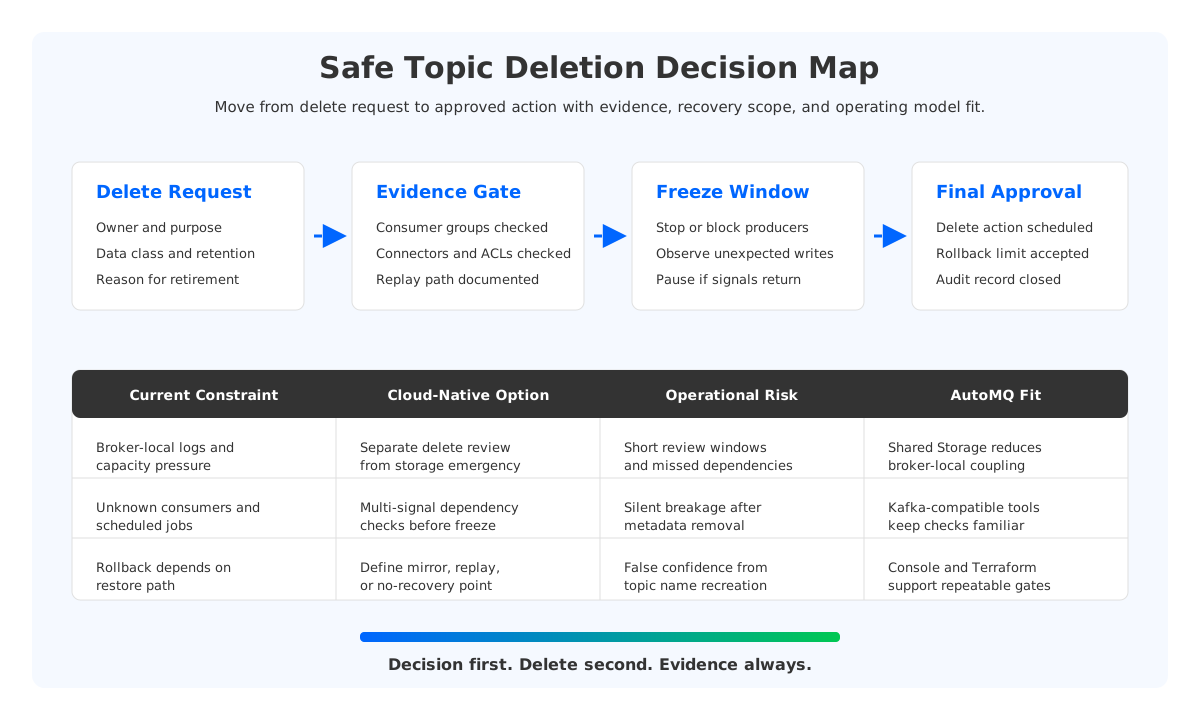
A safe topic deletion workflow kafka search rarely starts as a documentation exercise. It starts when a team finds an old topic with expensive retention, a stale service account, or a schema name nobody recognizes, and the question lands in a platform channel: can we delete this without breaking a consumer that wakes up once a week? Apache Kafka makes topic deletion available through its administrative tooling, but production teams know the command is the smallest part of the job.
The harder part is proving that a topic has no remaining business owner, no consumer group depending on old offsets, no connector using it as a checkpoint, no replay requirement in the incident runbook, and no downstream data contract that treats the topic as a recovery boundary. A deletion workflow therefore belongs in platform governance, not in an operator's terminal history. The workflow should make deletion boring, reviewable, reversible where possible, and explicit about the point where reversibility ends.
1Why teams search for safe topic deletion workflow kafka
Topic sprawl is a normal side effect of a successful Kafka estate. Application teams create topics for product launches, backfills, experiments, customer-specific streams, and migrations. Some live for years, some should have lived for a week, and some are abandoned after a failed rollout. The platform team inherits all of them, along with retention settings, ACLs, quotas, dashboards, alerts, and object ownership that may no longer match the people using the data.
Deletion looks attractive because it removes operational noise. It also creates a sharp failure mode. A topic can be recreated with the same name, but the original log, offsets, topic ID behavior, ACL assumptions, connector state, and audit trail may not come back in the same shape. Consumers that appear idle may be batch jobs. Topics with low traffic may hold reference data. A compacted topic may be the current state store for another service. The safe workflow must assume that low activity is not the same thing as low value.
That is why the first standard should be a decision record, not a shell command. The record should state who requested deletion, why the topic is no longer needed, which applications own it, what consumer groups and connectors were checked, which retention and replay obligations apply, and when the final delete action is allowed. If a team cannot name an owner, the workflow should escalate the topic into an ownership cleanup queue before deletion, rather than treating missing ownership as approval.
2The production constraint behind the problem
Kafka stores topic data as partition logs. In a traditional Shared Nothing architecture, those logs are local to brokers and protected through replication across leader and follower replicas. This design is proven and widely understood, but it couples administrative decisions to broker-local storage. A topic with many partitions and long retention is not only a name in metadata. It is storage on disks, replica placement, background IO, recovery time, and network movement when brokers are replaced or partitions are reassigned.
Topic deletion touches several parts of that model. The metadata change is coordinated by the cluster. The local log segments must be removed. Any remote or tiered data lifecycle must be understood. Consumer groups do not disappear because the topic is gone, and stored offsets can become misleading evidence during an incident if nobody records why the topic vanished. Kafka Connect deployments may also depend on internal topics, source offsets, or sink behavior that makes a topic look unused from ordinary application traffic alone.
The platform workflow should therefore separate four questions that teams often blend together:
- Can Kafka delete the topic? This is the administrative capability question. It depends on cluster configuration, permissions, and the operational state of the cluster.
- Should the business allow deletion? This is the ownership, retention, legal, and data contract question.
- Can applications tolerate deletion? This is the consumer group, connector, batch replay, and service dependency question.
- Can the platform recover if the decision was wrong? This is the backup, mirroring, snapshot, restore, and rollback question.
Teams get into trouble when they answer the first question and treat the other three as implied. A production workflow makes every answer explicit and keeps the evidence in the same system used for change approval.
3Architecture options and trade-offs
The deletion workflow should fit the storage model underneath the Kafka-compatible API. In broker-local Kafka, unused topics still occupy provisioned disk until cleanup completes. If a cluster is close to capacity, platform engineers may feel pressure to delete quickly because the alternative is adding brokers, moving partitions, or expanding disks. That pressure can shorten review windows and turn a governance task into a capacity emergency.
Tiered Storage changes part of the storage profile by moving older log segments to remote storage while brokers retain the active local log. It can reduce pressure from long-retention historical data, but it does not make brokers stateless. Platform teams still need to understand local hot data, remote object lifecycle, topic metadata, and restore behavior. For deletion governance, Tiered Storage is useful, but it does not remove the need for ownership review, dependency checks, and rollback planning.
Shared Storage architecture changes the operating model more directly. Persistent data is stored in shared object storage, while brokers focus on protocol handling, leadership, caching, and coordination. That does not make deletion casual. It changes which failure modes dominate. The workflow can pay less attention to broker-local data placement and more attention to metadata, object lifecycle, access control, audit evidence, and the application contract around replay.
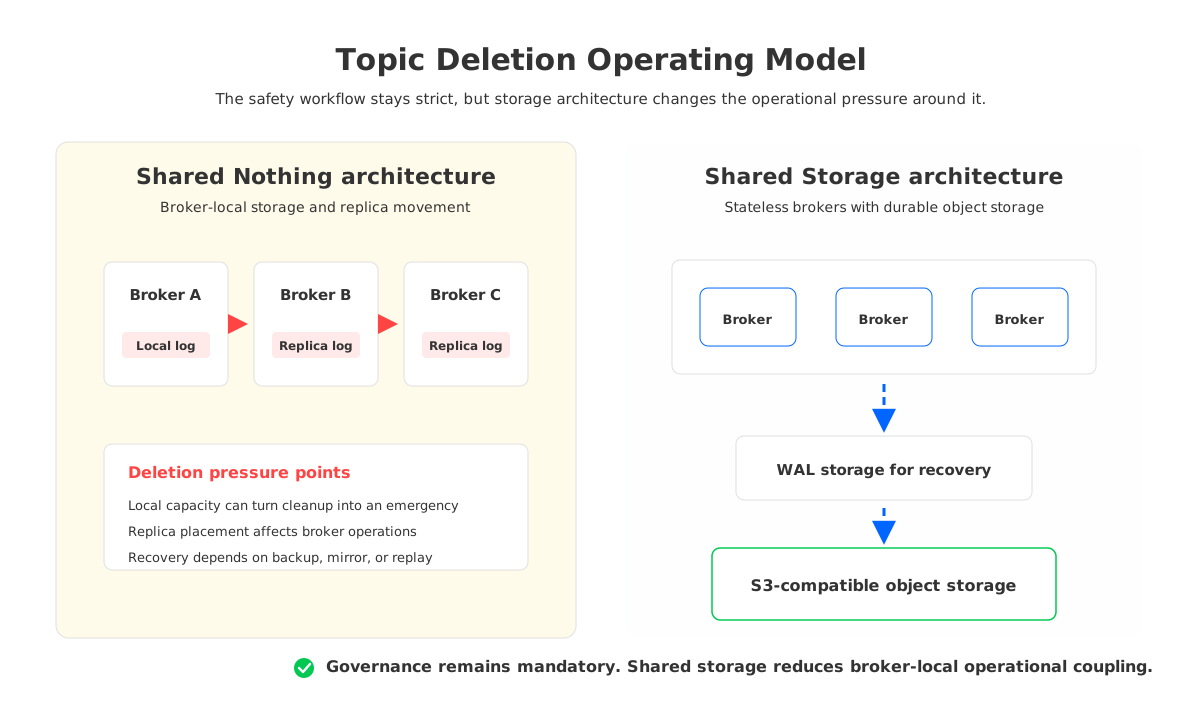
The useful comparison is not "old Kafka versus a product." It is the set of constraints a platform team must manage:
| Evaluation dimension | Broker-local Kafka | Tiered Storage | Shared Storage architecture |
|---|---|---|---|
| Storage pressure | Local disks drive urgency when retention grows. | Hot data remains local; older data moves remote. | Durable data lives in shared object storage. |
| Broker replacement | Data placement and reassignment remain operational concerns. | Local and remote state both need attention. | Brokers are designed to be replaceable compute. |
| Deletion review | Must include local log cleanup and dependency checks. | Must include local and remote lifecycle checks. | Must include metadata, object lifecycle, and dependency checks. |
| Rollback strategy | Usually depends on backup, mirror, or replay from another system. | Same, plus remote storage lifecycle details. | Same business rollback requirement, with less broker-local coupling. |
The table points to a practical rule: deletion safety comes from workflow discipline, while deletion speed and operational friction come from architecture. A mature platform standard should cover both.
4Evaluation checklist for platform teams
A good deletion standard is opinionated about gates. It should be hard to delete an important topic by accident and straightforward to remove a topic that has clearly expired. The checklist below is designed for platform teams that support many application teams and need a process that can be automated through an internal portal, Terraform workflow, GitOps repository, or ticketing system.
1. Classify the topic before reviewing traffic. Start with purpose, owner, data class, retention policy, and environment. A topic in production with personal data deserves a different approval path from a development topic with synthetic events. Classification also prevents the common mistake of using traffic volume as the first proxy for importance.
2. Prove dependency absence with more than one signal. Check consumer groups, ACLs, service configuration, connector tasks, schema registry usage, dashboards, and code search. A single "no active consumers" query is weak evidence because some consumers are scheduled, paused, or deployed only during incidents.
3. Freeze writes before deleting data. A safe workflow usually includes an announcement window, an ACL or application-level write freeze, and a short observation period. If producers still write after the freeze, the workflow should stop and return to owner resolution.
4. Preserve the right evidence. Keep the request, owner approval, dependency checks, final topic configuration, ACL state, retention settings, and deletion timestamp. This evidence helps during audits and avoids confusion when a team asks six months later why a topic is missing.
5. Define rollback honestly. Rollback may mean restoring from a mirror, replaying from an upstream system, recreating the topic name, or accepting that recovery is impossible after a defined point. The dangerous answer is "we can recreate it" without saying how data, offsets, and downstream state will be restored.
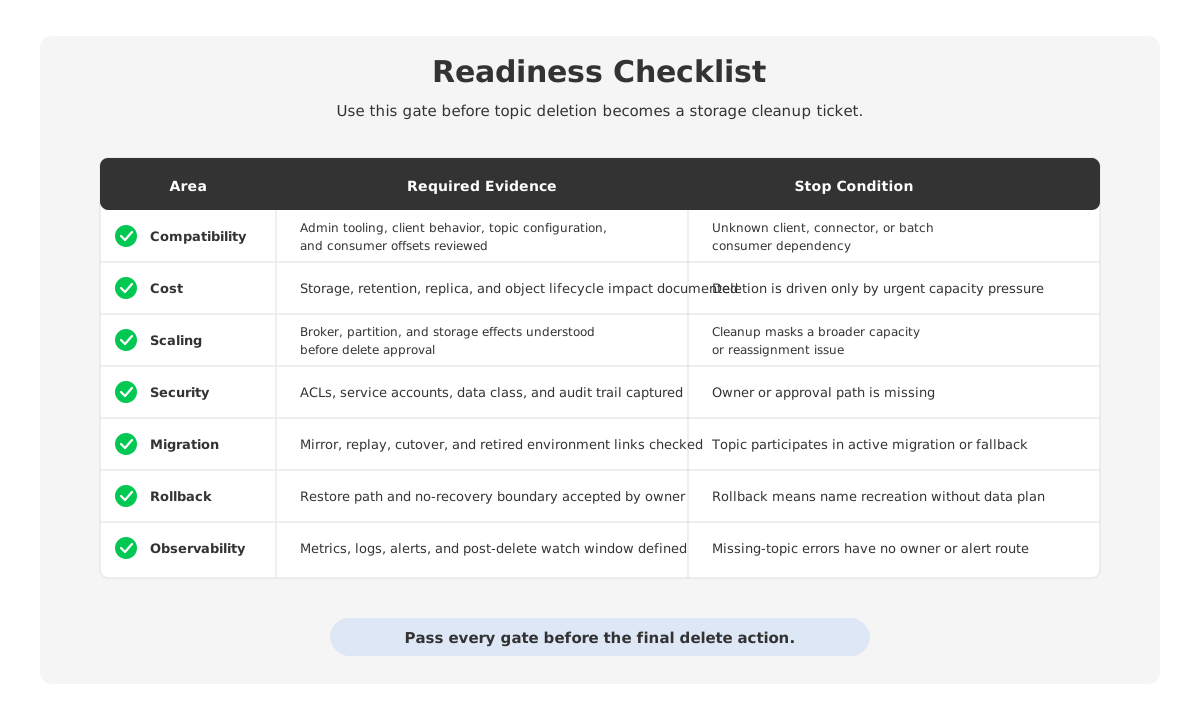
The checklist should be implemented as a workflow with states that application teams can see. Hidden platform-only workflows create distrust because developers cannot tell whether a topic is under review, frozen, deleted, or waiting for owner response. Visibility is part of safety.
5How AutoMQ changes the operating model
After the governance framework is in place, architecture determines how much operational drag surrounds each step. AutoMQ is a Kafka-compatible cloud-native streaming platform that keeps the Kafka API and protocol model while moving durable storage into Shared Storage architecture. AutoMQ Brokers are stateless brokers, and persistent data is stored through S3Stream on S3-compatible object storage with WAL (Write-Ahead Log) storage used for durable write buffering and recovery.
For topic deletion workflows, that architecture changes the platform team's attention budget. The deletion decision still needs ownership, dependency review, and audit evidence. What changes is the cluster operation around it. Since data is not permanently bound to broker-local disks, platform teams do not have to treat topic cleanup, broker replacement, and partition movement as the same operational knot. Self-Balancing and self-healing reduce the day-to-day friction of broker changes, while the Kafka-compatible API keeps existing client, consumer group, and admin tooling patterns familiar.
AutoMQ Console and Terraform support also matter because safe deletion is not only a storage concern. A platform team needs repeatable workflows, visible approvals, and consistent resource management. In AutoMQ BYOC, the control plane and data plane run in the customer's own cloud account or VPC boundary, which helps teams keep operational governance close to their security and compliance model. For private environments, AutoMQ Software follows the same principle within customer-controlled infrastructure.
The bigger shift is that topic lifecycle management can become a productized platform workflow rather than an emergency cleanup task. The platform team can standardize request intake, automated checks, freeze windows, final delete approval, monitoring validation, and post-delete review while the streaming layer handles compute elasticity and storage separation underneath. This is especially useful when topic deletion is part of a broader migration, cost cleanup, or environment consolidation program.
Teams evaluating AutoMQ should still run their own readiness test. Pick a representative topic family, map producers and consumers, apply the deletion workflow without deleting first, and measure how many checks can be automated. Then repeat the exercise for a non-critical topic in a staging or development environment. The result will show whether the blocker is architecture, ownership, tooling, or team boundaries.
6A standard workflow you can adopt
A production-grade safe topic deletion workflow kafka standard can be written as a short runbook. The platform team owns the process; application owners own the business decision; security and data governance own exceptions. That division prevents platform engineers from becoming accidental data stewards.
Use this sequence as a baseline:
- Request and classification. Capture topic name, environment, owner, data class, retention requirement, and reason for deletion.
- Dependency discovery. Query consumer groups and offsets, review producer permissions, inspect connector configuration, check schemas, and search service configuration.
- Owner approval. Require explicit approval from the owning application team and a fallback approval path for orphaned topics.
- Write freeze. Block or pause new writes, then observe metrics for unexpected producers, consumers, or connector errors.
- Recovery decision. Choose mirror restore, upstream replay, backup restore, or no recovery after the final approval point.
- Deletion and validation. Delete through the approved admin path, verify metadata and metrics, and record the change evidence.
- Post-delete watch. Keep dashboards and alerts active for a defined period so missing-topic errors are caught quickly.
This sequence should feel heavier than a one-off command because it protects more than the topic. It protects the trust between platform and application teams. Once the workflow is automated, the extra governance cost drops, and the team gains a reusable pattern for topic retirement, environment cleanup, and migration cutover.
If your current deletion workflow depends on tribal knowledge or emergency storage pressure, use the checklist above as a review template. If you are also evaluating a Kafka-compatible platform with Shared Storage architecture, test whether topic lifecycle work becomes less tied to broker-local capacity and partition movement. To see how AutoMQ approaches that operating model, start with the AutoMQ deployment path at go.automq.com/home.
7FAQ
7.1Is deleting a Kafka topic reversible?
Not by default. A topic name can be recreated, but the original records, offsets, topic configuration, ACL assumptions, and downstream state may not be restored. Treat recovery as a separate plan, not as a property of the delete command.
7.2How long should a write freeze last before topic deletion?
There is no universal duration. Use a window that covers the topic's known producer and consumer cadence. Batch topics and incident-only replay topics need longer observation than continuously active application streams.
7.3Should platform teams delete topics with no active consumers?
No. "No active consumers" is a weak signal by itself. Check owners, scheduled jobs, connectors, schema usage, ACLs, dashboards, and recovery runbooks before approving deletion.
7.4Does Shared Storage architecture remove the need for deletion governance?
No. Shared Storage architecture can reduce broker-local operational friction, but it does not decide whether the data is still needed. Governance, audit evidence, dependency checks, and recovery planning remain required.


