
Table of Contents
Table of Contents
Teams usually search for hot path cold path streaming kafka after the clean whiteboard version of the architecture has met the production version. The hot path wants fresh events, predictable producer latency, fast fan-out, and operational headroom during spikes. The cold path wants retention, replay, auditability, lakehouse handoff, and governance over data that may be read much later than it was written. Kafka can serve both, but the operational question is whether one cluster design should carry both paths with the same broker-local storage model.
That question matters because hot and cold are not only data-temperature labels. They represent different promises to different users. A fraud model, a Flink job, and an observability pipeline care about seconds and consumer lag. A backfill job, a compliance review, and an Iceberg ingestion pipeline care about recoverability, range reads, and how much historical data can remain accessible without turning every broker into a storage planning exercise. The thesis of this article is direct: once streaming becomes both the real-time transport layer and the replayable data foundation, hot path and cold path design becomes a storage architecture decision, not only a Kafka topic configuration decision.
1Why teams search for hot path cold path streaming kafka
The phrase shows up when platform teams are trying to turn a running Kafka estate into a repeatable design rule. They already understand topics, partitions, offsets, and Consumer groups. They are not asking what Kafka is. They are asking where to draw the line between fresh event processing and historical event reuse without creating two separate operational worlds.
In practice, the pressure comes from a few familiar patterns:
- Real-time applications need low-latency reads from the head of the log while analytics, audit, or replay jobs periodically scan older records.
- Retention requirements expand because downstream teams want to recompute state, rebuild tables, or debug incidents from the original event stream.
- Data platform teams want streaming data to feed lakehouse tables, but they do not want every long-retention topic to become a broker disk capacity project.
- SRE teams need scaling and failure recovery to behave predictably even when the cold path creates bursty catch-up reads.
This is why a purely application-level answer is incomplete. You can split topics, tune retention, isolate consumers, and use separate clusters for different workloads. Those are useful tools, and many teams should use them. The deeper constraint appears when the same physical broker model must satisfy low-latency ingestion, long retention, historical replay, and cloud cost control at the same time.
2The production constraint behind the problem
Traditional Kafka uses a Shared Nothing architecture: each broker owns local storage, and partitions are replicated across brokers for durability and availability. This design is coherent. It lets Kafka scale horizontally and keeps the log abstraction close to the broker that serves reads and writes. The constraint is that durable data ownership is tied to broker-local storage, so operational actions often become data movement actions.
Hot path pressure makes that coupling visible first. When producer traffic grows, the platform team may add brokers, rebalance partitions, or move leaders. But if partitions carry local logs, adding compute capacity does not only mean adding compute. It can also mean copying data, changing replica placement, and watching reassignment progress. The more data each partition retains, the heavier the operational action becomes.
Cold path pressure makes the same coupling more expensive to reason about. Longer retention increases the amount of data bound to local broker storage. Backfills and catch-up reads compete with fresh traffic for disk, cache, network, and broker resources. Tiered Storage can reduce the amount of old data kept on local disks, and it is a meaningful improvement for many Kafka deployments. But it does not fully remove the local primary storage model: the broker still has a hot local tier, and operational planning still revolves around how much data remains attached to broker instances.
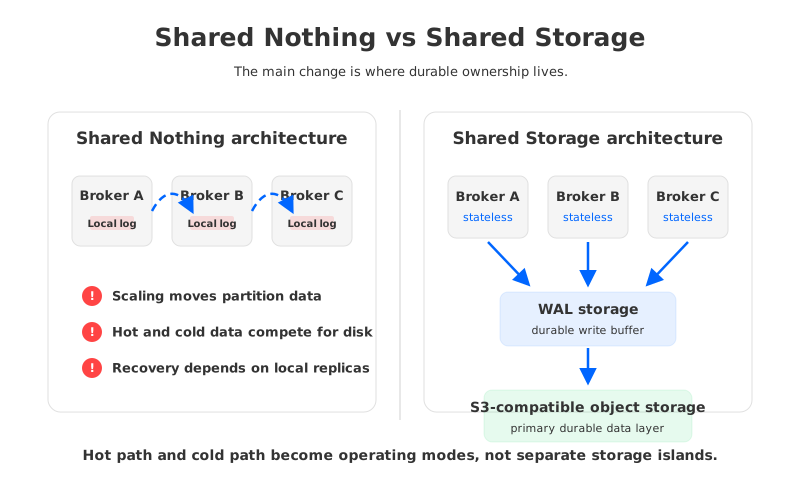
The hot/cold split therefore turns into a capacity and failure-domain problem. A platform team has to decide which workloads deserve isolated clusters, how much local disk to reserve, how to protect the hot path from replay jobs, and how to migrate data when the original partition layout no longer matches the workload. These are not signs of poor Kafka operations. They are consequences of using a broker-local storage model for workloads whose storage lifetime is growing faster than their compute demand.
3Architecture options and trade-offs
There are several reasonable ways to design hot path and cold path streaming in Kafka. The right answer depends on latency targets, retention requirements, team ownership, cloud boundaries, and migration tolerance. The mistake is treating every option as a small variation of the same design. Each one changes a different part of the operating model.
| Option | What it optimizes | Where it creates pressure |
|---|---|---|
| Separate Kafka clusters | Strong workload isolation and clear blast-radius boundaries. | More replication, more endpoints, more governance work, and harder cross-cluster consumer progress management. |
| Topic and consumer isolation | Lower operational change with existing Kafka deployments. | Hot and cold workloads still share broker-local storage and cluster-level capacity. |
| Tiered Storage | Better economics for older records and longer retention. | The hot local tier remains operationally important, especially for scaling, recovery, and cache behavior. |
| Stream-to-lake pipelines | Clear lakehouse handoff for analytics and table workloads. | The streaming layer still needs to retain enough data for replay, repair, and offset-safe recovery. |
| Shared Storage architecture | Durable data moves out of broker-local ownership. | Requires careful evaluation of compatibility, WAL storage, object storage, caching, and operational tooling. |
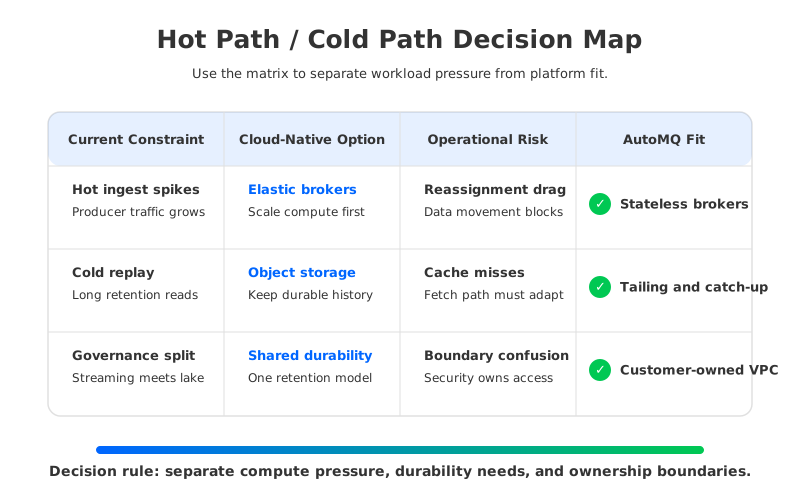
The key trade-off is not "hot path versus cold path." The real trade-off is whether the platform wants storage ownership to live with brokers or with a shared durable layer. If brokers own durable data, compute scaling and storage planning stay coupled. If a shared durable layer owns data, brokers can be treated more like replaceable compute nodes, but the platform must understand the write path, cache behavior, object storage semantics, and recovery model.
That is also where governance enters the conversation. Cold-path data often has longer retention, broader consumer access, and stronger audit requirements. In a broker-local model, governance is distributed across Kafka ACLs, cluster layout, storage policies, and downstream copies. In a shared-storage model, the team still needs Kafka-level access control, but it also gains a clearer place to reason about durable storage boundaries, object storage permissions, encryption, and customer-owned infrastructure.
4Evaluation checklist for platform teams
A useful evaluation starts before vendor selection. The platform team should write down what the hot path must protect, what the cold path must preserve, and what operational actions are acceptable during failure or growth. This turns an abstract platform debate into a testable set of constraints.
Use this checklist as a readiness review:
The checklist intentionally mixes application behavior and infrastructure behavior. Kafka platform changes fail when these two are reviewed separately. A design can look good for producers and still be painful for consumer replay. A design can reduce local storage and still be hard to govern if the data ownership boundary is unclear.
5How AutoMQ changes the operating model
After that neutral evaluation, AutoMQ becomes relevant as a Kafka-compatible streaming platform built around Shared Storage architecture. It keeps Kafka protocol and semantics compatibility as the user-facing contract, while replacing the broker-local storage layer with S3Stream, WAL storage, data caching, and S3-compatible object storage. The important shift is not a cosmetic storage backend change. It changes what a broker is responsible for during scaling, failure recovery, and hot/cold path contention.
In AutoMQ, brokers are stateless brokers for durable data ownership. A broker still handles Kafka requests, leadership, routing, caching, and execution, but persistent stream data is not treated as a local disk asset that must move with the broker. Writes first become durable through WAL (Write-Ahead Log) storage and are then uploaded into S3 storage as the primary durable data layer. Reads are separated into Tailing Read for fresh data and Catch-up Read for historical data, with data caching used to serve hot data and prefetched cold data efficiently.
This design matters for hot path operations because adding or replacing broker capacity no longer has the same relationship to retained partition data. The platform can reason about compute elasticity separately from durable history. It also matters for cold path operations because long retention and replay pressure move closer to the object-storage-backed layer, instead of forcing every broker to be sized as both a compute node and a historical data container.
There are still engineering choices to make. WAL storage type affects deployment shape and latency profile. AutoMQ Open Source uses S3 WAL, which is simple to deploy and suitable for workloads that can tolerate object-storage-oriented write latency. AutoMQ BYOC and AutoMQ Software can use additional WAL storage options for workloads that need lower write latency or different durability boundaries. The correct conclusion is not that every workload has the same hot path. The conclusion is that the storage architecture gives platform teams a more explicit control surface for matching workload expectations to deployment choices.
AutoMQ BYOC is also relevant for governance because the control plane and data plane run inside the customer's cloud account and VPC. Customer message data remains in customer-owned infrastructure, while AutoMQ Cloud is used as the environment management entry point rather than as a hosted data path. For teams evaluating hot and cold streaming paths in regulated environments, that boundary is often as important as the storage model itself.
6Migration readiness scorecard
The safest way to evaluate a shared-storage streaming architecture is not a big-bang rewrite. Start with a scorecard and choose a batch of topics where the hot path, cold path, and ownership boundary are clear. A good candidate is important enough to expose real operational behavior, but not so critical that the first test becomes a business continuity event.
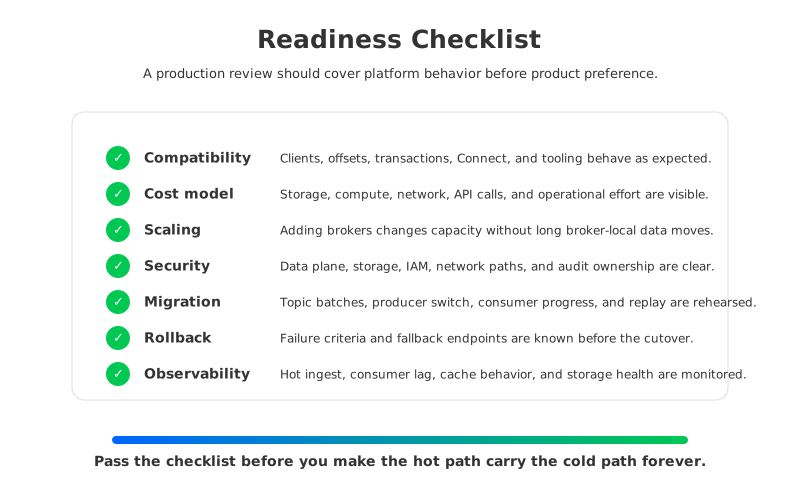
Score each area as green, yellow, or red before migration:
| Area | Green signal | Red signal |
|---|---|---|
| Compatibility | Required clients, offsets, transactions, Connect paths, and admin tooling are tested. | Teams assume Kafka API compatibility without testing the actual ecosystem. |
| Hot path | Producer latency, throughput, retries, and consumer lag SLOs are defined. | The success metric stops at "messages are flowing." |
| Cold path | Replay, retention, backfill, and table-writing expectations are documented. | Historical reads are tested only after the cutover. |
| Operations | Scaling, failure recovery, observability, and alert ownership are rehearsed. | Broker replacement and cache behavior are left to production discovery. |
| Rollback | Producer endpoints, consumer progress, and topic batches have a fallback plan. | The team can migrate forward but cannot explain how to stop. |
This scorecard is deliberately practical. It does not ask whether shared storage is fashionable. It asks whether the team can prove that the shared-storage operating model protects real-time ingestion while making historical data easier to retain, replay, and govern.
7FAQ
7.1Is hot path cold path streaming Kafka the same as Tiered Storage?
No. Tiered Storage is one architectural option for moving older Kafka data to remote storage while keeping a hot local tier. Hot path and cold path streaming is a broader design problem: it covers latency-sensitive ingestion, long retention, replay, governance, scaling, and migration behavior. Tiered Storage can be part of the answer, but it does not automatically separate compute ownership from durable data ownership.
7.2When should a team use separate Kafka clusters?
Separate clusters make sense when blast-radius isolation, organizational ownership, compliance boundaries, or workload extremes matter more than operational consolidation. The trade-off is that the team must manage more endpoints, replication paths, access policies, monitoring surfaces, and migration steps. Separate clusters solve isolation; they do not remove the need to reason about data movement and consumer progress.
7.3How does Shared Storage architecture help with cold reads?
Shared Storage architecture places durable history in S3-compatible object storage and uses cache-aware read paths for different access patterns. In AutoMQ terminology, Tailing Read serves fresh data, while Catch-up Read serves historical data by prefetching from S3 storage into data caching. This does not make every cold read identical to a hot read, but it gives the platform a storage model designed for both modes.
7.4Does Kafka compatibility remove migration risk?
No. Kafka compatibility reduces application change, but migration still has operational risk. Teams must test client versions, offsets, producer switch order, consumer progress, topic batching, observability, and rollback. Compatibility is the entry ticket; migration discipline is still required.
7.5Where should AutoMQ fit in a lakehouse architecture?
AutoMQ can act as the Kafka-compatible streaming foundation that feeds real-time applications and downstream table workloads. For teams using Apache Iceberg, AutoMQ Table Topic can reduce the amount of custom ETL required to land streaming data into table format. The architectural point is to keep streaming ingestion, replay, and table handoff aligned instead of building a separate storage exception for every cold-path requirement.
The original search problem comes back to one decision: do you want hot and cold paths to share the same broker-local storage constraint forever? If the answer is no, evaluate the storage architecture before you evaluate the feature checklist. To explore a Kafka-compatible Shared Storage architecture in your own cloud boundary, start with AutoMQ Cloud.


