
Table of Contents
Table of Contents
Teams rarely search for kraft controller operations kafka because they want a glossary entry. They search for it when a production cluster is about to change shape: ZooKeeper dependencies are being retired, controller quorum sizing is under review, brokers need to scale, or a failure drill exposed that the metadata layer and the storage layer are more entangled than the runbook admitted. KRaft makes the controller path explicit. It also makes a harder question visible: what work should a controller coordinate, and what work should the storage architecture avoid creating in the first place?
That distinction matters because Kafka operations are not only about who holds metadata leadership. The controller can elect leaders, manage partition placement, and coordinate cluster metadata, but it cannot make broker-local data weightless. When a cluster keeps durable partition data on broker-attached disks, many controller actions eventually turn into storage actions. A reassignment looks like metadata, then becomes network transfer, disk pressure, catch-up lag, and capacity math.
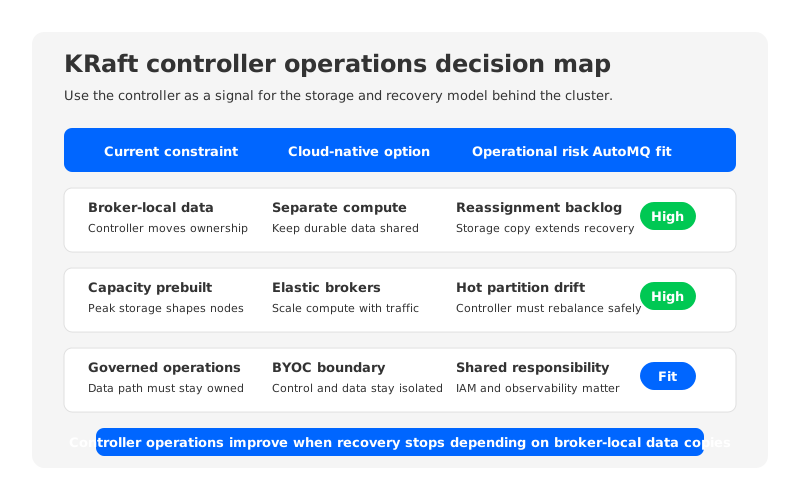
The practical thesis is simple: KRaft improves the metadata control plane of Kafka, while Shared Storage architecture changes the operating model around it. Platform teams evaluating Kafka-compatible streaming should judge both layers together. A clean controller quorum helps, but the largest operational gains appear when controller decisions are no longer coupled to large broker-local data movement.
1Why teams search for kraft controller operations kafka
KRaft replaces the external ZooKeeper dependency with Kafka's own metadata quorum. That shift simplifies the deployment surface, but it also moves more attention onto the controller role. Operators need to understand quorum voters, controller availability, metadata snapshots, broker registration, leader election, and how the cluster behaves when a controller or broker disappears. These are not theoretical topics; they decide whether an incident stays inside the platform team or leaks into producer and consumer error budgets.
The first trap is treating KRaft as a storage migration story. It is not. KRaft changes how Kafka stores and replicates cluster metadata. It does not, by itself, change where topic data is persisted, how many local replicas are needed, how much cross-Availability Zone traffic replication generates, or how long data movement takes during a rebalance. That is why a team can run a well-designed KRaft quorum and still struggle with slow broker replacement.
The second trap is treating controller operations as a checklist isolated from architecture. In production, the controller is the traffic director for a system whose physical constraints still matter. If the durable data lives on broker-local storage, controller decisions are bounded by disk throughput, replica catch-up, broker headroom, and the cost of moving bytes across zones. If durable data lives in shared object storage, controller decisions are closer to ownership and routing changes. The same KRaft concept sits on two different operating models.
2The production constraint behind the problem
Traditional Kafka uses Shared Nothing architecture. Each broker owns local storage, each partition replica sits on a broker, and durability depends on replication across brokers through ISR (In-Sync Replicas). This design made sense for Kafka's original operating environment. Local disks were fast, replication was explicit, and the broker was both compute node and storage node.
Cloud infrastructure changes the cost of that coupling. Compute can be elastic, but storage attached to compute is less elastic. Availability Zones isolate failure domains, but cross-zone replication can create a recurring network bill. Object storage offers durable, elastic capacity, but a broker-local log format cannot use it as the primary storage layer without changing the storage engine. KRaft cleans up controller metadata operations, yet the broker-local data model still decides the cost and time of many operational tasks.
The constraint shows up in ordinary work, not only major incidents:
- Broker replacement is not only process restart. A replacement broker must receive partition replicas before it carries the same durability role as the failed broker.
- Partition reassignment is not only a controller update. The cluster must copy data to the target replica and keep it caught up under live traffic.
- Capacity planning is not only CPU and network. Storage headroom, retention, replica factor, and zone placement all become part of the same calculation.
- Failure recovery is not only leader election. The remaining brokers must absorb traffic while the cluster restores replica health.
None of this means Shared Nothing architecture is broken. It is a proven design with a large ecosystem. The point is narrower and more useful: controller operations inherit the physical shape of the storage layer. A team that wants cloud-native elasticity should evaluate whether the storage layer lets the controller make small, reversible decisions, or forces it to orchestrate heavy data movement.
3Architecture options and trade-offs
There are three common ways teams try to reduce the operational pressure around Kafka controllers. The first is better runbook discipline: isolate controllers, size the metadata quorum carefully, monitor controller metrics, and keep broker changes controlled. This is necessary regardless of architecture. It reduces avoidable incidents, but it does not change the cost of broker-local data.
The second option is Tiered Storage. Apache Kafka Tiered Storage moves older log segments to remote storage while brokers retain recent data locally. This can improve retention economics and reduce the pressure of long local retention windows. It is not the same as a diskless or shared-primary-storage design. The broker still depends on local storage for the active log, and many operations still need to reason about broker-local state.
The third option is Shared Storage architecture. In this model, brokers handle Kafka protocol, partition leadership, request routing, caching, and scheduling, while durable data is stored in shared object storage through a storage layer designed for streaming workloads. The controller still matters, but broker replacement and partition movement do not require copying the full durable log from one broker's disk to another broker's disk.
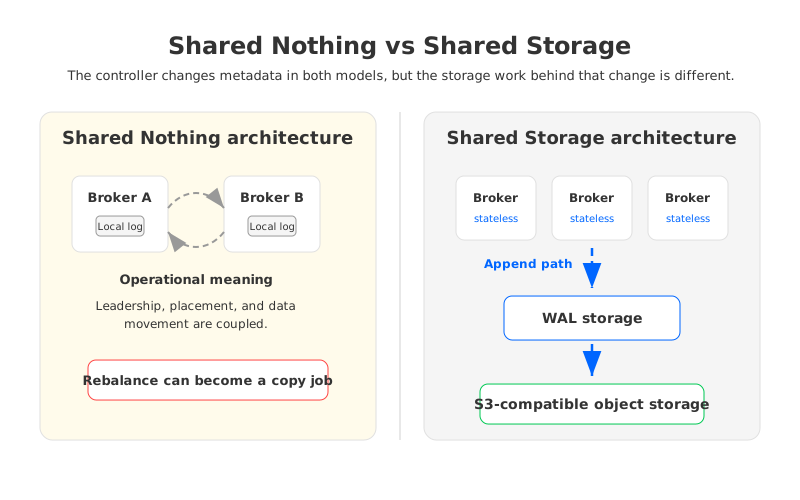
The choice is not only technical elegance. It changes the boundary between platform engineering, SRE, security, and application teams. A Shared Nothing cluster asks the platform team to manage durable data placement at broker granularity. A Shared Storage cluster asks the platform team to manage access to shared storage, write-ahead durability, cache behavior, and metadata correctness. The work does not disappear; it moves to a layer that can be automated and governed differently.
That is why the evaluation should be concrete:
| Decision area | Shared Nothing architecture | Shared Storage architecture |
|---|---|---|
| Broker replacement | Restore broker capacity and replica health | Replace compute and restore ownership/routing |
| Scaling | Add brokers, then move partition data | Add brokers and rebalance traffic with less data movement |
| Cost model | Compute, local storage, replication, and network interact | Compute, WAL storage, object storage, cache, and API usage interact |
| Controller risk | Metadata decisions can trigger long storage work | Metadata decisions are less coupled to durable log copies |
| Team boundary | Broker operations and storage placement are tightly linked | Compute operations and durable storage governance can be separated |
The table should not be read as a universal ranking. It is a prompt for design review. If your workload has small retention, stable traffic, and predictable cluster size, the operational gain from changing storage architecture may be modest. If your platform serves many tenants, has bursty traffic, runs across Availability Zones, or treats Kafka as shared infrastructure, the storage model becomes a first-order controller operations question.
4Evaluation checklist for platform teams
A useful KRaft operations checklist starts with the controller quorum, then immediately expands to the storage and migration model. The controller quorum must be available, observable, and isolated from avoidable broker churn. The data plane must also prove that controller actions can complete within the operational window the business expects.
Start with compatibility. A Kafka-compatible platform should preserve producer and consumer behavior, topic semantics, offsets, consumer groups, transactions where required, and the surrounding tools your teams already use. Compatibility is not a slogan in this review; it is a migration test plan. Run representative producers, consumers, admin tools, schema tooling, connectors, and failure cases before declaring the path clear.
Then test the cost model. For cloud deployments, separate the line items that traditional Kafka tends to blend together: compute, local or block storage, object storage, inter-zone data transfer, PrivateLink or private networking, observability, backup, and operational labor. Avoid broad claims unless you can map them to your own traffic shape. Controller operations become easier to defend when the financial model is explicit enough for FinOps and SRE to discuss the same diagram.
Security and governance should be reviewed with the same rigor. Who can change the controller quorum? Who can change broker count? Which identities can read or write object storage? Where do metrics and logs go? How are credentials rotated? Shared Storage architecture can improve operational separation, but only if access control, audit, and observability are designed as part of the platform.
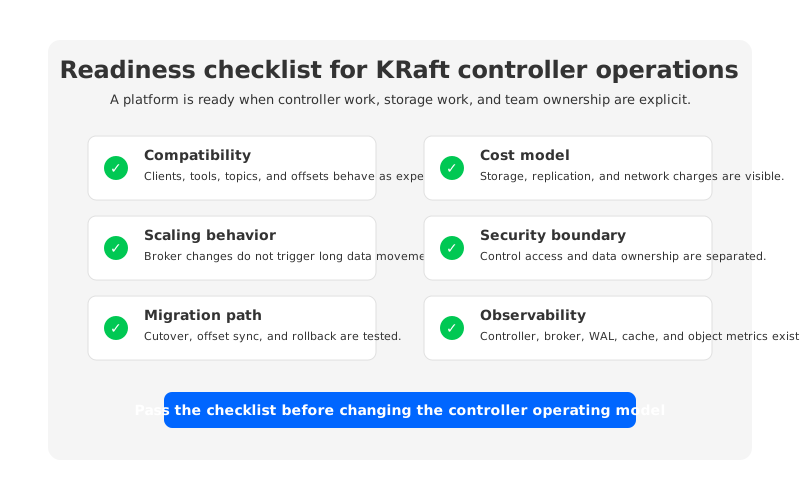
Finally, treat migration as an operations feature. A readiness review should include cutover, offset continuity, rollback, dual-write or replication strategy, monitoring thresholds, and ownership during the migration window. The strongest architecture paper still fails if the application team cannot answer one question: what happens if we need to reverse the cutover?
5How AutoMQ changes the operating model
Once the evaluation framework is clear, AutoMQ fits into a specific category: a Kafka-compatible cloud-native streaming platform built around Shared Storage architecture and stateless brokers. It keeps Kafka protocol and API compatibility as the user-facing contract, while replacing broker-local persistent logs with S3Stream, WAL (Write-Ahead Log) storage, data caching, and S3-compatible object storage.
The key operational change is that durable stream data is no longer owned by a specific broker's local disk. AutoMQ Brokers can focus on compute responsibilities such as request handling, partition leadership, caching, and scheduling. WAL storage provides the durable write path before data is uploaded and organized in object storage. Object storage becomes the main durable layer, while data caching handles hot and historical reads according to workload behavior.
For KRaft controller operations, that changes the failure and scaling conversation. Broker replacement is closer to replacing compute capacity than reconstructing a storage replica. Partition movement is closer to changing ownership and traffic placement than moving a full local log. Capacity planning separates compute peaks from durable retention more cleanly. These are architectural effects, not magic switches; operators still need quorum design, storage permissions, cache metrics, WAL health, and object storage observability.
AutoMQ BYOC also changes the governance boundary for cloud teams. In BYOC deployment, the control plane and data plane run in the customer's cloud account and VPC, and customer business data remains in the customer environment. For teams evaluating managed convenience against security ownership, that boundary is often as important as the storage engine. It lets platform teams discuss controller operations, IAM, network access, and data residency in the same review instead of treating them as separate procurement topics.
The honest trade-off is that Shared Storage architecture moves expertise. Teams spend less time planning broker-local data movement, but they must understand WAL choices, object storage configuration, cache behavior, and cloud permissions. That is a better trade for many cloud-native platform teams because the operational model lines up with the way they already manage compute, storage, and governance. It is still a trade, and it deserves a proof of concept with real workloads.
6FAQ
6.1Does KRaft remove the need to think about storage architecture?
No. KRaft changes Kafka metadata management and removes the external ZooKeeper dependency. It does not automatically change where topic data lives or how much data movement broker operations require.
6.2Is Tiered Storage the same as Shared Storage architecture?
No. Tiered Storage offloads older log segments to remote storage while the active log still depends on broker-local storage. Shared Storage architecture uses shared object storage as the primary durable layer through a storage engine designed for that model.
6.3What should a KRaft controller operations checklist include?
It should include controller quorum design, broker failure behavior, partition reassignment time, compatibility tests, storage and network cost analysis, security ownership, observability, migration cutover, and rollback validation.
6.4Where should AutoMQ enter the evaluation?
AutoMQ should enter after the team has defined requirements for compatibility, elasticity, cost visibility, governance, and migration. It is most relevant when broker-local data movement is a limiting factor in Kafka operations.
If your KRaft review keeps returning to broker-local storage, reassignment windows, or cross-zone operating cost, the next step is to test the storage model directly. Start with the AutoMQ GitHub project and run the same controller, broker, and migration checks against a Kafka-compatible Shared Storage architecture.


