
Table of Contents
Table of Contents
Searches for partition reassignment bottleneck kafka usually start after a cluster has become uncomfortable. A broker is running hot, a disk is close to full, a topic has grown faster than expected, or a maintenance window is approaching. Reassignment looks like a placement operation in the command line, but in broker-local Kafka it is also a storage migration, replication event, network event, and risk-management exercise.
Platform teams rarely reassign partitions for fun. They do it when production pressure has created a reason to change broker ownership: scale-out, scale-in, hardware replacement, uneven distribution, hot leaders, disk pressure, or recovery after failure. The useful question is not "How do we run the command?" Apache Kafka documents the mechanics. The harder question is "Why does a routine topology change compete with the workload it protects?"
The short answer is that traditional Kafka uses a Shared Nothing architecture. Each broker owns local storage for its partitions, and replication keeps followers in sync. This model is mature, but it couples compute capacity, durable data placement, recovery work, and network traffic. Shared Storage architecture changes what has to move when the cluster changes shape.
1Why Teams Search for partition reassignment bottleneck kafka
The search usually has a practical shape. A team has already reviewed broker CPU, disk utilization, under-replicated partitions, request latency, and consumer lag. Reassignment appears to be the path forward because the cluster needs a different distribution of leaders or replicas. Yet moving replicas can generate sustained disk reads, disk writes, inter-broker traffic, and follower catch-up while producers and consumers keep using the cluster.
Kafka's built-in reassignment workflow reflects that reality. Operators generate a plan, execute it, verify progress, and often apply throttles so reassignment traffic does not overwhelm production traffic. Throttling protects the workload, but it extends elapsed time. Removing throttles speeds up reassignment, but raises the chance that the cure becomes another source of latency and lag.
The pain becomes sharper in cloud environments. A broker may need more CPU long before it needs more disk, or more disk long before it needs more CPU. A topic may require longer retention without more serving load. A traffic spike may need temporary compute capacity, while the retained log should not become temporary. If the architecture ties those concerns to the same nodes, the team compensates with overprovisioning, slower change windows, or manual placement policy.
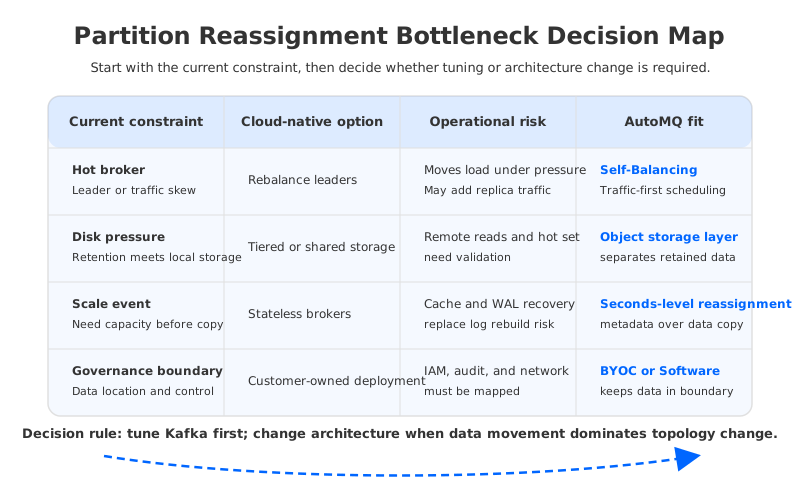
The search term is a symptom of a deeper operating model problem: can the Kafka platform adapt without turning every capacity change into a long data-copy project?
2The Production Constraint Behind the Problem
Partition reassignment has two meanings that operators often blur. At the metadata level, it changes which brokers host replicas and which broker should serve as leader. At the storage level, in a Shared Nothing architecture, target placement must be made real by copying log data and catching replicas up. The second part is where time and risk accumulate.
This is why reassignment duration does not scale only with partition count. It scales with retained bytes, network bandwidth, broker I/O headroom, throttles, controller coordination, and source and target broker health. A topic with a small active write rate but long retention can still be heavy to move.
Several operational patterns expose the same root constraint:
- Scale-out under pressure: Adding brokers creates fresh compute capacity, but the cluster may not benefit fully until partitions and leaders move. If moving them requires copying retained data, scale-out is not only an instance launch.
- Scale-in after a peak: Removing brokers requires draining ownership safely. With broker-local logs, that can mean moving data off nodes that the team wants to terminate.
- Hotspot correction: A skewed topic or leader distribution can require data movement even when total cluster capacity is sufficient.
- Failure recovery: Broker replacement and replica catch-up compete for the same disk and network resources that producers and consumers need.
- Retention growth: Longer retention increases the amount of data that may be involved in future reassignments, even when active throughput is unchanged.
This does not make traditional Kafka wrong. Shared Nothing architecture gives operators direct control over placement, disks, and replication. The constraint is that operational flexibility is paid for with data movement. In elastic cloud environments, that cost can become the reason a cluster is intentionally oversized.
3Architecture Options and Trade-offs
Before changing platforms, separate three ideas that are often mixed together: local storage, Tiered Storage, and Shared Storage architecture. Local storage keeps both hot and retained log data on broker-attached disks. Tiered Storage moves older log segments to remote storage while the broker still owns the active log and local replica model. Shared Storage architecture makes durable stream data a shared substrate, with brokers acting closer to stateless compute nodes.
The differences show up most clearly during reassignment:
| Architecture model | What changes during reassignment | What still needs attention |
|---|---|---|
| Shared Nothing architecture | Replica placement changes and log data may need to copy between brokers. | Throttles, disk headroom, network headroom, ISR health, leader balance, and maintenance timing. |
| Tiered Storage | Older data may be remote, but active local replicas and broker ownership still matter. | Local hot set sizing, remote read behavior, leader placement, and how much data remains broker-bound. |
| Shared Storage architecture | Durable data is not treated as the long-lived possession of one broker disk. Reassignment can focus more on ownership, metadata, cache, and traffic. | WAL design, object storage behavior, metadata consistency, cache warm-up, and compatibility with Kafka clients and tools. |
The table is not a universal ranking. A team with stable traffic, predictable retention, and mature Kafka operations may prefer the familiarity of broker-local storage. A team with long retention and rare scaling events may find Tiered Storage a useful optimization. A team whose main pain is elastic capacity, broker replacement, or repeated reassignment windows should evaluate whether durable data has to remain tied to broker-local disks at all.
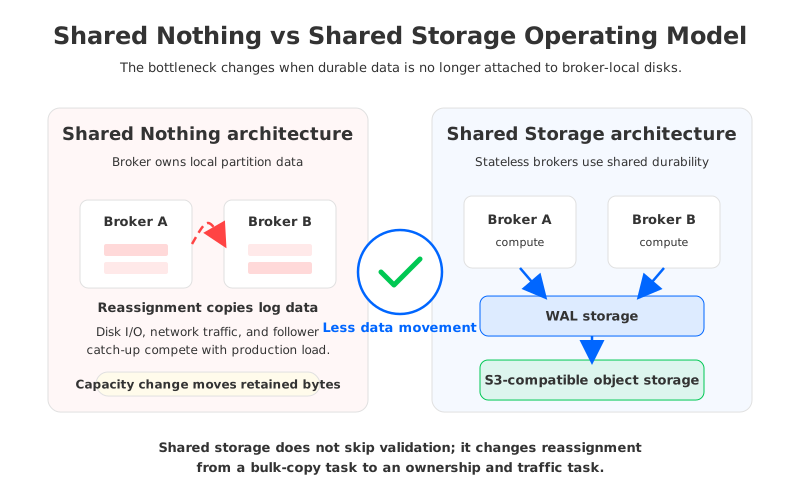
The important point is that Tiered Storage and Shared Storage architecture solve different problems. Tiered Storage can reduce local disk pressure for historical data, but it does not automatically make brokers stateless. Shared Storage architecture changes the source of truth for durable data. That is the architectural move that can make partition reassignment less dependent on retained-log copying.
4Evaluation Checklist for Platform Teams
A useful evaluation starts with the current bottleneck, not with a vendor category. If reassignment is slow because the team has no throttling policy, poor partition design, or weak observability, fix those first. If reassignment remains a recurring blocker because storage ownership is tied to broker lifecycle, then architecture becomes a legitimate decision point.
Use the following checklist to frame the discussion:
| Evaluation area | Question to ask | Why it matters |
|---|---|---|
| Compatibility | Can existing Kafka clients, topics, offsets, transactions, Kafka Connect jobs, and monitoring tools keep working? | A storage architecture change should not force an application rewrite. |
| Reassignment behavior | Does scaling or broker replacement require copying retained partition data? | This determines whether elasticity is bounded by data volume. |
| Cost model | Are compute, storage, and network costs separable, or does one resource force overprovisioning of another? | Broker-local storage often makes teams buy capacity in bundles. |
| Failure recovery | What happens when a broker disappears during high write throughput or consumer catch-up? | Recovery behavior matters more than the happy-path reassignment demo. |
| Governance | Where does data live, who controls the cloud account, and how are network paths, IAM, encryption, and audit handled? | Platform changes must fit security boundaries, not work around them. |
| Migration and rollback | Can the team mirror data, preserve offsets, validate consumers, and roll back if needed? | Architecture benefits are irrelevant if migration risk is uncontrolled. |
| Observability | Can the team see broker load, storage behavior, consumer lag, reassignment progress, cache behavior, and object storage errors? | Shared storage moves some bottlenecks; it does not make them invisible. |
This checklist also prevents a common mistake: treating "fast reassignment" as a standalone feature. The broader requirement is preserving Kafka semantics, data boundaries, operational signals, and a migration path that does not require a leap of faith.
5How AutoMQ Changes the Operating Model
Once the evaluation reaches the question of storage ownership, AutoMQ becomes a useful architecture reference. AutoMQ is a Kafka-compatible streaming platform built around Shared Storage architecture. It keeps the Kafka protocol and ecosystem surface while replacing broker-local persistent log storage with S3Stream, WAL storage, data caching, and S3-compatible object storage.
The practical effect is that AutoMQ Brokers are stateless brokers. They still process Kafka requests, hold partition leadership, serve reads, maintain cache, and participate in KRaft-based coordination. The difference is that durable stream data is not permanently owned by local disk. Fresh writes are persisted through WAL storage for durability and recovery, while longer-lived data is stored in shared object storage. When ownership changes, the system does not need to copy the entire retained log from one broker disk to another.
That changes partition reassignment in three ways. First, reassignment can become a metadata and ownership operation rather than a retained-data relocation project. Second, broker replacement becomes less dependent on rebuilding a local log directory before the node is useful. Third, scaling can focus on serving capacity and traffic distribution, while storage capacity follows the object storage layer.
There are still engineering details to validate. WAL type affects write latency and deployment requirements. Cache behavior affects hot reads and catch-up reads. Object storage permissions, bucket layout, network paths, and failure domains must match governance requirements. AutoMQ BYOC, AutoMQ Software, and AutoMQ Open Source also differ in deployment responsibility and available WAL options, so evaluation should be explicit about the target product shape.
This is where the architecture is more interesting than the marketing phrase. "Seconds-level partition reassignment" is possible because the system changes what reassignment has to do. If the retained log is already in shared storage, the platform can move leadership, metadata, and traffic without moving the full historical data set. The bottleneck does not vanish; it moves to the parts that should be easier to reason about during elasticity: metadata correctness, cache readiness, WAL recovery, and storage service health.
6Migration Readiness Scorecard
The safest next step is not a big-bang replacement. Treat partition reassignment pain as a signal to run a structured readiness assessment. Pick one production-like workload, copy its partition count, retention shape, write rate, read fan-out, and failure expectations, then compare realistic change events.
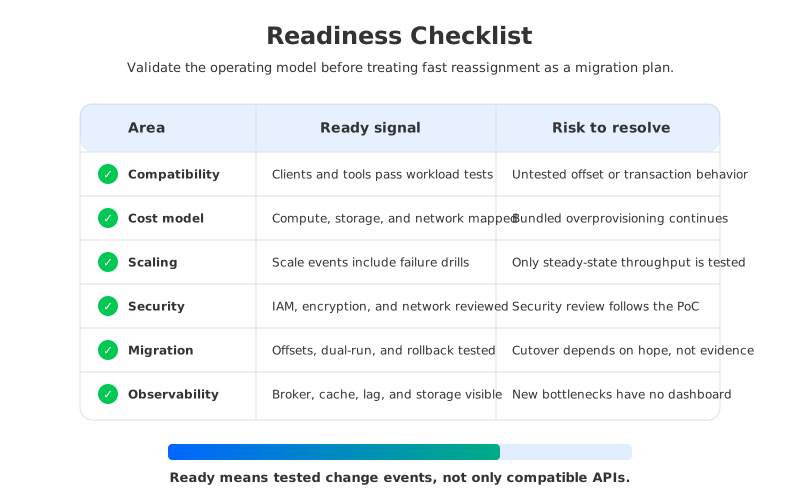
Score each area before committing to a migration:
| Area | Ready signal | Needs work signal |
|---|---|---|
| Workload profile | You know partition count, retained bytes, peak write rate, read fan-out, and consumer lag tolerance. | Reassignment decisions are based on broker averages and incident memory. |
| Change events | You can reproduce scale-out, scale-in, broker loss, and hotspot correction in a test environment. | The only evidence comes from production maintenance windows. |
| Compatibility | Client libraries, Kafka Connect jobs, ACLs, monitoring, and admin tooling are tested against the target platform. | The migration plan assumes Kafka compatibility without workload-specific validation. |
| Governance | Data location, IAM, encryption, network routing, and audit requirements are mapped to the deployment model. | Security review starts after the technical proof of concept. |
| Rollback | Offset handling, dual-running period, cutover criteria, and rollback ownership are documented. | Rollback means "restore from backup" without tested consumer behavior. |
The scorecard often reveals that the reassignment bottleneck is only one visible part of a larger platform boundary. Teams that understand that boundary make better architecture decisions. They can decide when tuning traditional Kafka is enough, when Tiered Storage addresses the pressure, and when a Shared Storage architecture is worth evaluating because the operating model itself has become the bottleneck.
7FAQ
7.1Is partition reassignment always a problem in Kafka?
No. Partition reassignment is a normal Kafka operation, and many teams run it successfully with good planning, throttling, observability, and maintenance discipline. It becomes a strategic problem when scale-out, recovery, or hotspot correction repeatedly requires long data movement that competes with production traffic.
7.2Is Tiered Storage the same as Shared Storage architecture?
No. Tiered Storage offloads older log segments to remote storage while brokers still manage local active log data. Shared Storage architecture makes shared storage the durable data layer, which changes what has to move when brokers are added, removed, or replaced.
7.3Does shared storage remove the need for partition planning?
No. Partition count, key distribution, leader placement, consumer parallelism, and read patterns still matter. Shared Storage architecture changes the cost of broker ownership changes; it does not fix poor topic design or missing observability.
7.4When should a team evaluate AutoMQ for this problem?
Evaluate AutoMQ when broker-local storage, retained-log movement, slow reassignment windows, cross-AZ replication traffic, or overprovisioned brokers are becoming recurring operational costs. The strongest signal is not one painful reassignment; it is a pattern where capacity changes require disproportionate data movement.
7.5What should be tested before migration?
Test client compatibility, producer latency, consumer lag, catch-up reads, broker replacement, scale-out, scale-in, offset continuity, Kafka Connect behavior, access control, monitoring, and rollback. A proof of concept should include failure and recovery paths, not only steady-state throughput.
8Closing Thought
The next time a team searches for partition reassignment bottleneck kafka, the first answer should not be a longer maintenance window. It should be a clearer diagnosis of what the cluster is being asked to move: metadata, leadership, traffic, cache, or retained bytes. If retained bytes dominate every topology change, the storage model has become part of the bottleneck.
To evaluate the Shared Storage approach in your own environment, start with the reassignment events that already create risk. Then test whether a Kafka-compatible platform with stateless brokers changes the amount of work behind those events. For a customer-controlled deployment path, explore AutoMQ BYOC and use your existing Kafka workload profile as the benchmark.


