
Table of Contents
Table of Contents
Teams searching for real time recommendation signals kafka usually already have a recommendation system in production. The problem is not whether Kafka can carry clickstream events. It is whether the streaming backbone can keep product views, cart changes, search terms, inventory updates, pricing rules, user feedback, and model features fresh enough for the next ranking decision without turning every traffic spike into an infrastructure incident.
Recommendation workloads expose a particular kind of pressure. The user path is interactive, but the signal graph behind it is wide: multiple producers, multiple consumers, enrichment jobs, feature stores, vector indexes, fraud systems, experimentation platforms, and audit pipelines all want a consistent view of the same stream. If the platform team shortens retention to protect disk, delays replay to avoid broker stress, or treats stale feature updates as an application issue, the ranking layer inherits infrastructure compromises it cannot see.
That is why the search should lead to an architecture question. A production recommendation signal platform needs Kafka semantics, but it also needs an operating model that can survive bursty writes, broad fan-out, long replay windows, data governance, and cloud cost review. Shared Storage architecture changes the discussion because it separates the Kafka-compatible contract from the broker-local storage assumptions that often dominate operations.
1Why teams search for real time recommendation signals kafka
Recommendation signals are not a neat stream with one consumer. A product detail view can influence a session ranker, a personalization profile, a fraud model, a campaign optimizer, and a warehouse table used for offline evaluation. Each consumer moves at its own pace. Some need low-latency reads near the head of the log. Others need replay after a feature definition changes or a model team rebuilds training sets.
Kafka is a natural fit because it provides durable topics, partitioned ordering, Consumer group fan-out, Offset-based replay, transactions for workloads that need atomic writes across partitions, and a broad ecosystem around Kafka Connect and stream processing. Those primitives let recommendation teams decouple event capture from downstream use. The ranking path can stay fast while feature builders, evaluation jobs, and audit systems consume the same facts independently.
The production question begins where the happy path ends. Search traffic can jump during campaigns. Inventory updates can surge during flash sales. A model rollout can trigger backfills and replay while live events continue to arrive. Recommendation freshness is therefore not a single broker latency number; it is a service-level objective across producers, brokers, processors, consumers, feature stores, and online serving systems.
2The production constraint behind the problem
The first constraint is freshness under mixed load. Recommendation systems often combine hot behavioral events with slower-changing reference data such as catalog, price, inventory, location, user segment, entitlement, and policy state. A stream can look healthy at the broker layer while the online feature store reads delayed context, so platform teams need to measure the path from source event to the system that the ranker actually queries.
The second constraint is replay. Recommendation teams rebuild state often: feature definitions change, embeddings are regenerated, ranking labels are reinterpreted, and privacy rules evolve. Kafka Offsets make replay understandable, but replay still consumes storage, network, broker, processor, and downstream capacity. A platform that supports live traffic but makes rebuilds operationally risky will push data scientists and ML engineers toward side channels, which then weakens governance.
The third constraint is data control. Recommendation signals often contain personal behavior, location hints, commercial intent, pricing context, and experiment assignments. Security teams need to know where the data lives, who can read it, how retention is enforced, how deletion or masking rules flow through downstream systems, and whether cross-region movement is intentional. Real time does not reduce governance requirements; it removes the buffer where teams used to catch mistakes.
These constraints create a more precise target than "fast Kafka." A production backbone for recommendation signals should answer four questions in plain language: how fresh the online context must be, how far back teams can replay, how quickly the platform recovers when capacity changes, and which data boundary governs the stream.
3Architecture options and trade-offs
Traditional Kafka uses a Shared Nothing architecture. Each Broker owns local storage, and durability is built around replicated partition logs across Brokers. This model is mature and widely understood, but it couples compute, storage, and recovery. When partitions move, data movement becomes part of the operation. When retention grows, local storage sizing becomes part of the platform contract. When the cluster spans Availability Zones, replication and client placement shape both cost and failure behavior.
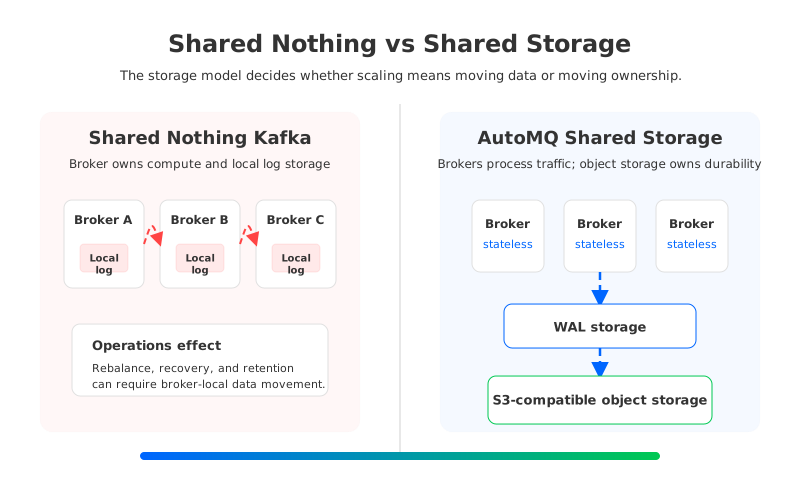
Tiered Storage addresses part of the storage pressure by moving older log segments to remote storage while keeping recent data on broker-local storage. It is useful when historical retention is the main problem. It does not make the hot path stateless, and it does not remove the need to reason about Broker ownership, local disk behavior, leadership, and recovery for active data.
Fully managed streaming services change a different part of the problem. They can reduce infrastructure ownership for teams that prefer a service abstraction, but the evaluation does not end at feature checklists. Recommendation workloads still need data residency review, network path review, cost visibility, client compatibility, operational observability, and a credible exit path if application teams need to move later.
Kafka-compatible Shared Storage architecture is the third path to evaluate. The goal is not to discard Kafka semantics; the goal is to preserve the Kafka API and ecosystem while changing where durable stream data lives. If persistent data is no longer bound to broker-local disks, scaling and recovery can focus more on traffic ownership, metadata, cache, and consumer behavior instead of treating local log movement as the center of every operation.
| Architecture option | Where it fits | Risk to validate |
|---|---|---|
| Traditional Kafka on broker-local storage | Teams with stable capacity planning and mature Kafka operations | Reassignment, retention growth, disk pressure, and cross-zone replication work |
| Kafka with Tiered Storage | Workloads where long historical retention is the main pressure | Active data remains tied to broker-local behavior |
| Fully managed streaming service | Teams that prioritize service abstraction over infrastructure control | Data boundary, portability, network path, and cost transparency |
| Kafka-compatible Shared Storage architecture | Teams that need Kafka semantics with more elastic cloud operations | Compatibility, write path, governance, migration, and rollback evidence |
This matrix is deliberately neutral. The right answer depends on workload shape, team skill, compliance boundary, and migration tolerance. The important move is to evaluate the storage model as an operating model, not as an implementation detail.
4Evaluation checklist for platform teams
Start with the recommendation decision, then work backward. A homepage ranker, search ranker, feed ranker, ad selector, and next-best-action engine do not all have the same freshness budget. Some decisions tolerate slightly stale catalog metadata. Others lose value quickly when the last click, cart add, or inventory update is missing. The platform should make those differences visible instead of hiding them behind a generic real-time label.
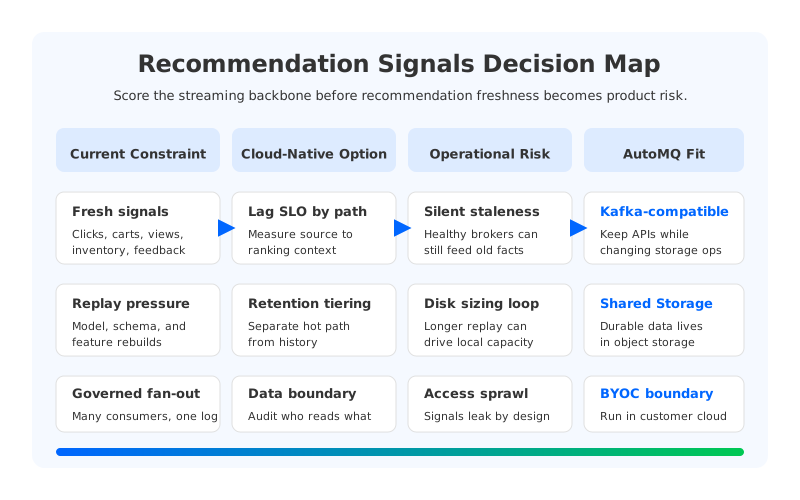
Use these questions before choosing a Kafka-compatible platform:
- Compatibility: Can existing producers, consumers, transactional workloads, serializers, schema tools, connectors, and monitoring systems continue to work without application rewrites?
- Freshness: Where is end-to-end lag measured: broker append, stream processor output, feature store write, or ranking service read?
- Replay: Which downstream states must be rebuilt after model, schema, feature, privacy, or experiment changes?
- Elasticity: Can bursty traffic be absorbed without partition reassignment or data movement becoming the critical path?
- Governance: Can teams prove data location, access control, retention, masking, and audit paths for sensitive recommendation signals?
- Cost: Are compute, storage, network, object storage requests, replay jobs, and operations included in the same cost model?
- Migration: Can the team move one signal family at a time while preserving offsets, rollback, and observability?
The checklist prevents a common mistake: benchmarking the easy part of the system. A throughput test can show that records move quickly, but it will not prove that the ranker reads fresh features during a catalog import. A storage cost estimate can look attractive, but it will not prove that replay is safe after a feature bug. A serious proof of concept should include uneven event sizes, broad fan-out, replay, connector behavior, failure drills, and the data governance path.
5How AutoMQ changes the operating model
Once the evaluation framework is explicit, AutoMQ becomes relevant as a Kafka-compatible streaming platform built on Shared Storage architecture. It preserves Kafka protocol compatibility while using S3Stream to move durable stream data into S3-compatible object storage. AutoMQ Brokers are designed as stateless brokers, so persistent data is not treated as broker-local ownership in the traditional Kafka sense.
That change matters for recommendation infrastructure because elastic demand is the norm, not an exception. Brokers still process Kafka requests, handle leadership, cache hot data, and coordinate through KRaft-based metadata. WAL (Write-Ahead Log) storage provides the durable write path, and S3 storage is the primary storage layer for stream data. The important operational shift is that adding, replacing, or rebalancing Brokers no longer has to revolve around copying large local logs as the source of truth.
For recommendation teams, this can change how platform SLOs are written. Instead of treating scale-out as a storage movement event, the team can evaluate whether traffic ownership, cache warmup, consumer lag, and downstream writes return to target behavior. Instead of sizing local disks around every replay window, the team can align long retention with object storage and then test catch-up read behavior under realistic consumers. The architecture does not remove workload validation; it changes which parts of validation are likely to dominate.
The cloud boundary is also part of the operating model. AutoMQ BYOC runs the control plane and data plane in the customer's cloud account or VPC, which helps teams keep recommendation events within customer-controlled infrastructure. That matters when signal streams include behavioral data, personalization attributes, experiment assignments, or regulated user context. A Kafka-compatible API helps application teams move; a clear data boundary helps security and compliance teams approve the move.
Migration should still be treated as an engineering project, not a switch flip. Teams should validate client behavior, offset handling, schema evolution, consumer lag, connector paths, observability, rollback, and failure recovery with one contained signal family before expanding. If a current Kafka estate already works well, the argument for Shared Storage architecture is strongest when broker-local data movement, retention growth, cross-zone traffic, or bursty scaling are recurring operational constraints.
6A readiness scorecard for recommendation signals
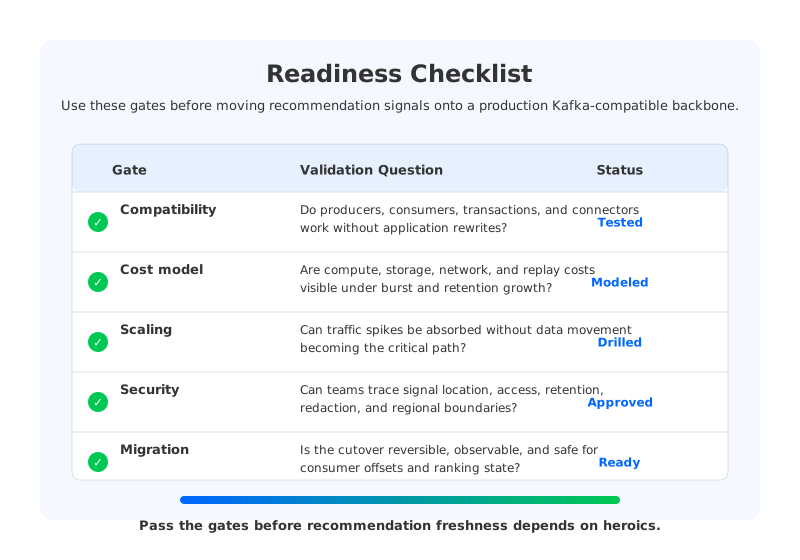
A useful scorecard turns architecture claims into evidence. Pick one signal family that matters to ranking quality but has a bounded blast radius: product view events, cart updates, inventory deltas, search query events, feedback labels, or experiment assignment changes. Keep the existing path available during validation so rollback is a practiced operation rather than a diagram.
| Domain | Evidence to collect | Pass condition |
|---|---|---|
| Freshness | Source-to-feature-store lag and ranking read freshness | The path stays inside the decision budget during bursts |
| Replay | Rebuild time for one online or offline feature state | Replay is documented, repeatable, and observable |
| Recovery | Broker, consumer, connector, and processor failure drills | Recovery steps do not require manual data repair |
| Governance | Topic access, retention, masking, audit, and region controls | Security can trace data location and consumption paths |
| Cost | Compute, storage, network, object storage, and operations | The cost envelope supports the promised SLO |
| Migration | Cutover, offset validation, rollback, and dual-run evidence | One signal family can move without ranking blind spots |
The scorecard keeps the conversation grounded. It is easy to argue about streaming platforms in the abstract; it is harder to ignore a failed replay drill, an unclear data boundary, or a cost model that excludes cross-zone traffic and rebuild jobs. The right platform is the one that keeps the recommendation contract visible when traffic, models, and data rules change.
Return to the original search: real time recommendation signals kafka. The useful answer is not "use Kafka" or "replace Kafka." The useful answer is to make freshness, replay, governance, scaling, and migration measurable, then choose the storage model that lets your team keep those promises. If broker-local storage is becoming the bottleneck behind that promise, evaluate a contained workload with AutoMQ in your own cloud environment.
7FAQ
7.1What does real time recommendation signals kafka mean in production?
It means using Kafka or a Kafka-compatible streaming platform as the durable event backbone for signals that affect recommendation decisions. The stream may carry clicks, views, carts, searches, inventory updates, price changes, feedback labels, experiments, and model evaluation events.
7.2Is Kafka enough for real-time recommendation signals?
Kafka provides a strong event-log foundation: ordered partitions, Consumer groups, Offsets, replay, transactions, and ecosystem integrations. The full system still needs stream processing, schema governance, feature serving, online stores, model evaluation, privacy controls, and observability.
7.3When should teams evaluate Shared Storage architecture?
Evaluate Shared Storage architecture when broker-local storage starts shaping platform decisions: retention is shortened, replay is delayed, rebalance windows are painful, cross-zone traffic is hard to control, or bursty recommendation traffic requires too much manual capacity planning.
7.4Does Shared Storage architecture remove the need for performance testing?
No. Teams should test producer latency, consumer lag, replay throughput, cache behavior, connector behavior, failure recovery, and rollback under their own workload. The architecture changes the operating model; it does not replace workload-specific validation.
7.5How should a team start a migration?
Start with one bounded signal family and run it beside the existing path. Validate client compatibility, offset behavior, ranking freshness, governance controls, observability, and rollback before moving more recommendation workloads.
8References
- Apache Kafka documentation
- Apache Kafka Consumer Design
- Apache Kafka Transactions and Semantics
- Apache Kafka Connect
- Apache Kafka KRaft
- Apache Kafka Tiered Storage
- AutoMQ Kafka Compatibility
- AutoMQ Architecture Overview
- AutoMQ S3Stream Shared Streaming Storage
- AutoMQ BYOC Environment Overview
- AutoMQ Kafka Linking Migration Overview
- AutoMQ zero cross-AZ traffic overview
- AutoMQ Continuous Self-Balancing
- AutoMQ Table Topic Overview
- AWS Data Transfer pricing


