
Table of Contents
Table of Contents
Teams usually search for stream table duality operations kafka after the theory has stopped being the hard part. They know that a stream can represent changes and that a table can represent the latest materialized state. The pressure comes from running that model in production: Kafka topics have retention, consumer groups have offsets, processors have checkpoints, lake tables have schemas, and platform teams have to keep all of it recoverable.
That is why the operating question matters more than the definition. Stream-table duality sounds elegant on a whiteboard because one event log can feed operational applications, Flink jobs, Kafka Streams applications, Kafka Connect pipelines, and table-format sinks. In production, the same pattern creates a compound responsibility: preserve Kafka semantics while giving analytical and governance teams a trustworthy table boundary. The useful thesis is direct: stream-table duality becomes easier to operate when durable stream data is not trapped on broker-local disks.
1Why Teams Search for Stream Table Duality Operations Kafka
The search intent is rarely academic. A data platform team may be asked to feed Apache Iceberg tables from Kafka without losing replayability. A real-time application team may want the latest customer, order, device, or risk state while still retaining the full change history. An SRE group may be asked whether a backfill, schema rollback, or broker failure will disturb live consumers. These teams do not need another explanation that streams and tables are related; they need a way to keep the relationship stable.
Kafka already gives the operational vocabulary for the stream side. Topics are split into partitions, records have offsets, consumer groups divide partition ownership, and transactions can coordinate writes across partitions. Kafka Connect moves data between Kafka and external systems. KRaft removes ZooKeeper from Kafka metadata management, and Tiered Storage moves older log segments to remote storage. Each piece helps, but none removes the need to decide where durable state lives and how it is recovered.
The table side adds different expectations. A table sink must handle schema evolution, compaction, file layout, catalog ownership, access control, lineage, and query freshness. If the stream is the system of record for changes, the table is often the system of access for analytics, AI features, auditing, and reconciliation. The risk appears when streaming engineers think in offsets and lag while lakehouse engineers think in snapshots and table commits. The platform underneath has to give both groups a shared failure model.
2The Production Constraint Behind the Problem
Traditional Kafka uses a Shared Nothing architecture: each broker owns local log storage, and durability is achieved through replicated partition copies across brokers. This design is battle-tested, and it made sense for data center-era clusters where local disks and rack-aware placement were the natural primitives. In the cloud, the same model turns many stream-table operations into storage operations. A broker is not only compute capacity for client requests; it is also a durable owner of retained bytes.
That coupling is manageable at small scale, but stream-table workloads amplify it. Long retention is common because replay feeds table rebuilds, late-arriving corrections, regulatory investigations, and AI feature reprocessing. High fan-out is common because the same topic may feed online services, Flink jobs, Connect sinks, monitoring systems, and a table writer. Frequent rebalancing is common because processor load and table sink throughput do not stay neatly aligned with the original partition plan. Every retained byte tied to broker-local storage makes these changes heavier.
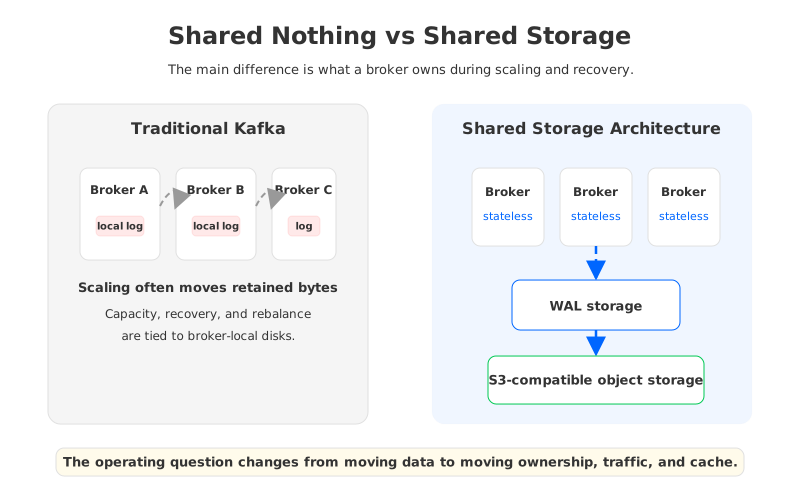
Tiered Storage helps a real problem by moving older log segments to remote storage while keeping the active log local. That can reduce pressure from historical retention. It does not make brokers stateless, because the hot path, leadership, and local storage boundary still matter. For teams operating stream-table duality, this distinction is not a vocabulary detail. A backfill that reads older data, a table rebuild that touches a wide retention window, and a broker replacement during live ingestion all behave differently depending on whether storage is an archive tier or the primary durable substrate.
The production constraint is therefore not "Kafka cannot feed tables." It can. The constraint is that the cost, recovery, and migration model inherits the storage model of the streaming substrate. If durable data is broker-local, platform teams must plan around disk capacity, replica placement, inter-zone replication, partition reassignment, and rebuild time. If durable data is in shared storage, they still need to validate write latency, cache behavior, metadata consistency, and object storage operations, but the unit of operation shifts away from moving retained log data between brokers.
3Architecture Options and Trade-offs
There are three broad ways to approach stream-table duality operations on Kafka-compatible infrastructure. The first is to keep a traditional Kafka cluster and build the table path with Kafka Connect, Flink, Spark Structured Streaming, or a custom writer. This keeps the application contract familiar and gives teams maximum control, but the platform still carries broker-local storage operations. It is often a good fit when workload growth is predictable, retention is modest, and the organization already has strong Kafka operations maturity.
The second path is to use Kafka with Tiered Storage. This can improve retention economics and make historical reads less dependent on broker disk capacity. It is especially relevant when the main pain is long retention rather than elastic capacity. The trade-off is that tiering introduces another boundary to observe: local hot data, remote segments, cache behavior, and fetch performance during catch-up reads. It reduces one class of pressure without fully changing the broker state model.
The third path is a Kafka-compatible shared-storage architecture. In this model, brokers preserve the Kafka protocol boundary for clients and ecosystem tools, while durable log data is placed in shared storage. A write-ahead log absorbs the low-latency write path, and object storage becomes the primary durable repository. This changes the operating model most sharply: brokers are closer to replaceable compute nodes, and scaling or recovery can focus more on ownership, metadata, traffic, and cache than on copying retained bytes.
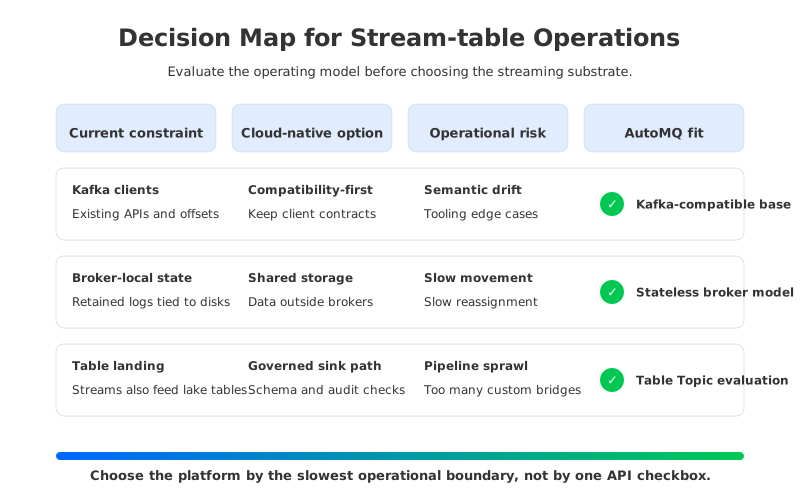
The right architecture is the one that matches the slowest operational boundary in your environment. If application compatibility is the hardest constraint, preserve Kafka clients and test edge APIs before debating storage internals. If table freshness is the hardest constraint, benchmark end-to-end sink behavior, not only broker append throughput. If cloud cost is the hardest constraint, model retained bytes, cross-zone traffic, request patterns, and replay fan-out together. A platform that looks efficient for steady writes can still be expensive during table rebuilds or catch-up reads.
| Evaluation area | What to test | Why it matters for stream-table duality |
|---|---|---|
| Kafka compatibility | Producer behavior, consumer groups, offsets, transactions, Connect, security, and admin operations | The stream side should not force application rewrites before the table design is even validated. |
| Retention and replay | Backfills, table rebuilds, cold reads, and catch-up consumers | Table recovery often depends on replaying retained streams under production load. |
| Scaling and recovery | Broker replacement, partition reassignment, cache warm-up, and failure drills | The platform must recover without turning every incident into a data movement project. |
| Cost model | Compute, storage, inter-zone traffic, object requests, and migration overhead | Stream-table workloads combine steady ingestion with bursty replay and fan-out. |
| Governance | Schema ownership, access control, audit evidence, table commits, and data residency | The table boundary must be trusted by analytics, compliance, and platform teams. |
This framework keeps the evaluation neutral. Traditional Kafka, managed Kafka services, Tiered Storage, and shared-storage Kafka-compatible platforms can all be valid depending on workload shape and team constraints. The mistake is choosing from a feature list while ignoring the operating sequence that will run during an incident, migration, or table rebuild.
4Evaluation Checklist for Platform Teams
A useful checklist starts with contracts, not products. Write down the Kafka behavior your applications depend on: client versions, authentication, authorization, idempotent producers, transactions, consumer group behavior, Connect connectors, schema handling, and operational tooling. Then map the table path: which topics feed which tables, what freshness is required, how corrections are represented, who owns schema changes, and how a broken table commit is rolled back.
From there, test the uncomfortable paths. A steady-state demo does not tell you whether stream-table duality is operable. Pause a table writer and let lag build. Rebuild a table from a retained topic. Replace a broker during a catch-up read. Change a schema and verify that both stream consumers and table readers behave as expected. Run the same test while a consumer group rebalance is happening. These drills expose whether the platform has a coherent failure model or only a happy-path integration.
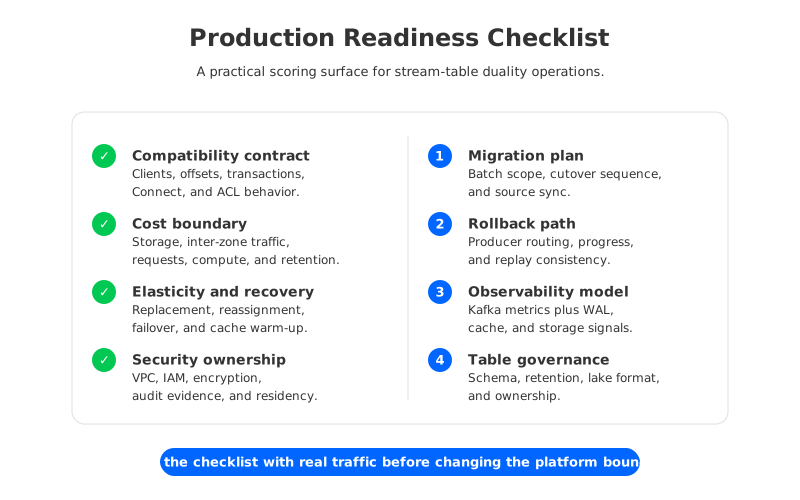
The readiness scorecard should produce a decision, not a pile of notes:
- Proceed with current Kafka architecture when broker-local storage is not the bottleneck, the team has mature operations, and table rebuilds fit within known maintenance windows.
- Adopt Tiered Storage when long retention is the dominant pain and the team can validate remote fetch behavior, cache sizing, and historical replay under real workloads.
- Evaluate shared storage when scaling, broker replacement, retained-data movement, or cross-zone replication dominates the operating burden.
- Delay the platform change when compatibility, rollback, schema governance, or observability cannot be tested with production-like traffic.
5How AutoMQ Changes the Operating Model
Once the evaluation reaches the storage boundary, AutoMQ fits a specific architectural category: a Kafka-compatible cloud-native streaming platform built around Shared Storage architecture. AutoMQ keeps Kafka protocol and ecosystem compatibility while replacing broker-local durable log storage with S3Stream, WAL storage, and S3-compatible object storage. The important point is not that object storage exists somewhere in the system. The important point is that durable stream data is no longer permanently owned by a broker disk.
This changes stream-table operations in three practical ways. First, capacity planning can separate broker compute from retained data. Brokers still need enough CPU, memory, network, and cache to serve the workload, but they do not need to be sized as the permanent home for all retained log history. Second, recovery and reassignment can focus on metadata, leadership, WAL recovery, and cache behavior rather than copying the full retained log from one broker-local disk layout to another. Third, governance teams can reason about a clearer durable storage foundation when long retention, replay, and table-building workloads grow.
AutoMQ also matters because stream-table duality often leads to migration questions. Kafka Linking is designed for migration scenarios that need topic synchronization and consumer-group progress continuity. Table Topic is relevant when teams want data written to AutoMQ topics to be stored directly in Apache Iceberg table format. These capabilities do not remove the need for validation. They change what can be validated: instead of proving that every table pipeline must be custom-built and every retained byte must stay tied to brokers, teams can test a Kafka-compatible shared-storage foundation with their own clients, schemas, tables, and recovery drills.
The deployment boundary is part of the architecture decision. AutoMQ BYOC runs in the customer's cloud account and VPC, while AutoMQ Software is designed for customer-controlled private environments. For stream-table duality operations, governance also depends on where the data plane runs, which cloud resources hold durable data, how network paths are controlled, and how audit evidence is collected.
Shared storage is not a shortcut around engineering judgment. WAL choice, object storage behavior, cache sizing, topic design, connector throughput, table commit semantics, and observability still need real tests. The difference is that the hardest operational question changes. Instead of asking how many broker disks must be provisioned and copied as the stream-table estate grows, teams can ask how much compute is needed for current traffic, how much durable storage is needed for retention, and how quickly ownership can move when the system changes shape.
6FAQ
6.1What does stream-table duality mean in Kafka operations?
It means the same event history can be treated as a stream of changes and as the basis for materialized table state. In Kafka operations, the hard part is preserving offsets, ordering assumptions, replayability, schema rules, and recovery behavior while downstream systems build tables from those streams.
6.2Is Tiered Storage the same as shared storage?
No. Tiered Storage usually keeps the active Kafka log on broker-local storage and moves older segments to remote storage. Shared Storage architecture makes shared storage the primary durable location for stream data, with brokers operating more like compute nodes over that durable foundation.
6.3When should a team evaluate AutoMQ for stream-table duality?
Evaluate AutoMQ when Kafka compatibility is required but broker-local storage has become the operating bottleneck. Typical signals include long retention, frequent backfills, slow broker replacement, heavy replay, cross-zone replication cost, or a need to run the data plane inside a customer-controlled cloud or private environment.
6.4Does shared storage remove the need for Kafka expertise?
No. Teams still need to understand topics, partitions, offsets, consumer groups, transactions, retention, schemas, and observability. Shared storage changes the infrastructure operating model; it does not remove the application semantics that make Kafka useful.
6.5What should be tested before migration?
Test client compatibility, security, producer retry behavior, consumer-group progress, connector behavior, table sink correctness, rollback, failure recovery, cold reads, cache warm-up, and observability. The test should include real traffic patterns, not only a synthetic append benchmark.
7Closing the Loop
The original search for stream table duality operations kafka usually starts with a modeling question, but the production answer lives in the storage and recovery model. If retained streams are the foundation for operational state, analytics tables, and future replay, the platform has to make those streams durable without making every operational change a broker-disk event.
For teams evaluating that boundary, start with a workload-specific checklist and then test the architecture under failure. To explore the AutoMQ implementation path, review the AutoMQ architecture documentation or try the project from GitHub.


