
Table of Contents
Table of Contents
Teams rarely search for streaming anomaly detection kafka because they need a definition of Apache Kafka. They search because an alerting path, fraud model, operations console, or AI decision loop is starting to depend on data that cannot wait for the next batch job. The streaming layer has become part of the decision path, and the painful question is no longer "Can Kafka move events?" It is whether the Kafka estate can keep anomaly signals fresh while traffic spikes, retention grows, models replay history, and SREs still have to sleep.
That pressure changes the infrastructure conversation. Anomaly detection workloads do not behave like a single steady ingestion pipe. They mix hot event streams, reference data updates, feature computation, model scoring, dead-letter analysis, and replay after model changes. A quiet day may need predictable low-lag consumption. A bad day may need burst capacity, fast catch-up reads, and a clean rollback path after a model or rule turns noisy. The architecture has to absorb both days without turning every incident into a storage migration.
The useful thesis is simple: for production anomaly detection, Kafka compatibility is necessary but not enough. The storage model underneath Kafka determines how expensive, elastic, and recoverable the system becomes when the workload stops being tidy.
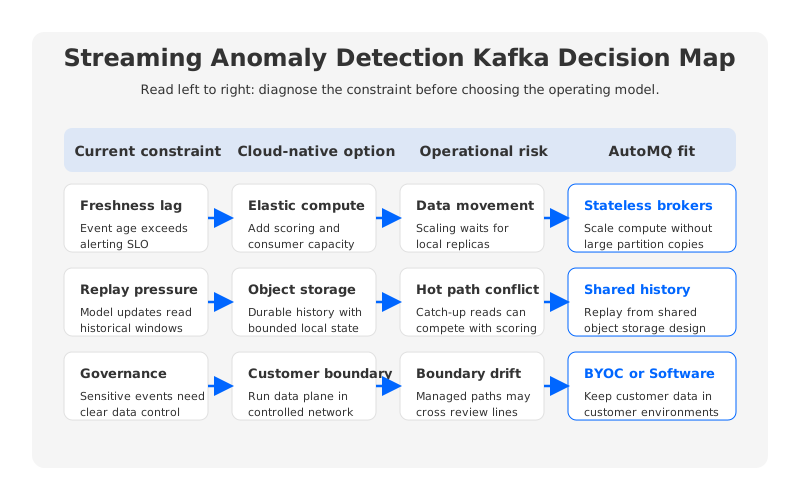
1Why teams search for streaming anomaly detection kafka
An anomaly detection pipeline usually starts with a clean diagram. Producers write business events into Kafka topics. A stream processor builds windows, aggregates, or features. A scoring service emits suspicious activity, equipment alerts, or operational incidents. Downstream systems fan out the result to dashboards, case management tools, AI agents, or automated controls. The diagram is reasonable, and it often works during the first production launch.
The trouble appears when the pipeline becomes important. Once the stream feeds an action path, the team has to reason about event age, consumer lag, offset commits, replay behavior, and partial failure. A consumer group that falls behind is not only a metric problem. It means the detector is making decisions from older evidence. A replay that reads a week of history is not only a batch backfill. It competes with fresh scoring traffic and exposes whether broker storage was sized for the real workload.
Platform teams usually discover four constraints at the same time:
Kafka gives teams a strong application contract for records, topics, partitions, offsets, and consumer groups. Apache Kafka documentation also covers transactions, Kafka Connect, KRaft metadata management, and Tiered Storage for long-term retention patterns. Those are important building blocks. The infrastructure question is what happens when the storage and scaling behavior behind those building blocks becomes the bottleneck.
2The production constraint behind the problem
Traditional Kafka is a Shared Nothing architecture. Each broker owns local storage for its partitions, and replication keeps copies across brokers for durability and availability. This model is familiar, mature, and still a good fit for many workloads. It also ties capacity planning to broker-local disk, broker network, replica placement, and partition reassignment. When the anomaly workload grows, the cluster often has to move data before it can fully use added capacity.
That coupling matters because anomaly detection creates uneven pressure. A fraud topic may spike during a campaign. A telemetry topic may receive a burst when devices reconnect. A security detector may need to replay historical events after a rule update. In a broker-local storage model, these events stress several dimensions at once: disk headroom, network throughput, replication traffic, consumer fetch capacity, and rebalancing time.
Tiered Storage helps with one part of that picture by offloading older log segments to remote storage while keeping the active log on local broker storage. It can reduce the cost of long retention and make historical data less dependent on local disks. It does not make brokers stateless. Hot data, leader placement, local storage pressure, and partition movement still remain operational concerns. For anomaly detection, this distinction is more than terminology. A workload that needs both fresh scoring and frequent replay can still be limited by the local hot path.
The capacity trap is hard to spot because the first symptom often looks like an application problem. The detector falls behind, the stream processor checkpoint takes longer, or case creation arrives late. Behind that symptom, the platform may be protecting disk space, throttling fetches, moving replicas, or waiting for a new broker to receive enough partition data to help. The application team sees stale signals. The platform team sees a cluster doing exactly what its architecture requires.
3Architecture options and trade-offs
Before choosing a platform, separate the anomaly detection requirements from the product shortlist. A useful evaluation starts with the shape of the data path: how events enter, how stateful processing reads them, how results are written, how history is replayed, and how operators recover from a bad deployment. Only then should you compare self-managed Kafka, a managed Kafka service, a Kafka-compatible cloud platform, or a shared-storage architecture.
The trade-off is not "old Kafka versus new platform." It is where you want the hard parts to live.
| Architecture choice | What it preserves | What to test under anomaly workloads |
|---|---|---|
| Self-managed Kafka | Maximum operational control and familiar Kafka behavior | Broker disk growth, replica movement, cross-AZ replication, upgrade burden, and replay impact |
| Managed Kafka service | Kafka semantics with less cluster administration | Pricing dimensions, networking boundaries, scaling delay, connector model, and support for governance requirements |
| Kafka plus Tiered Storage | Kafka local hot path with remote historical retention | Hot log sizing, fetch behavior during replay, remote storage cost, and recovery from broker failures |
| Kafka-compatible shared storage | Kafka application surface with durable data separated from brokers | Compatibility coverage, WAL behavior, object storage operations, p99 latency, and migration path |
This table is deliberately neutral. There are legitimate reasons to keep broker-local storage, especially for very latency-sensitive hot paths where the team has tuned hardware, replication, and operations around a narrow SLO. There are also legitimate reasons to move toward shared storage when the dominant pain is elasticity, retention, rebalancing, or cloud network cost. Anomaly detection is often in the second group because freshness is only useful when the platform can also catch up, replay, and recover.
4Evaluation checklist for platform teams
A production checklist should force each candidate through the same failure modes. Start with compatibility, because an anomaly platform usually has more dependencies than the first architecture diagram shows. Producers, consumers, stream processors, Kafka Connect jobs, schema tooling, admin scripts, ACLs, observability dashboards, and offset management workflows all touch the streaming layer. A platform that handles produce and consume correctly can still surprise you if a connector, transaction pattern, or consumer group workflow behaves differently.
Then test the operating model, not only the steady-state benchmark. Anomaly detection systems fail in bursts and corrections. A benchmark that measures a clean write path is useful, but it does not answer what happens when a detector has to replay historical data while fresh events keep arriving. It also does not answer whether the team can add capacity without waiting for large partition copies or whether a failed broker turns into a data movement event.
Use a readiness scorecard like this before committing to a migration:
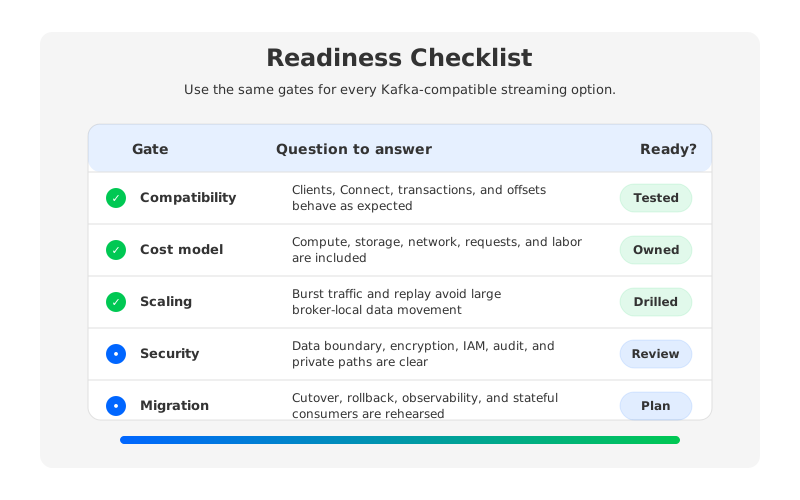
The most important rows are usually the ones teams postpone. Security needs to cover data residency, private networking, encryption, access control, audit trails, and who operates the control plane. Cost needs to include compute, storage, object requests, cross-Availability Zone (AZ) traffic, private connectivity, replay traffic, and operational labor. Rollback needs a written plan for producers, consumers, offsets, and stateful processors. If any of those are left as "we will handle it during cutover," the migration plan is not ready.
5How AutoMQ changes the operating model
Once the neutral evaluation points to storage coupling as the constraint, AutoMQ becomes relevant as a Kafka-compatible, cloud-native streaming platform built around Shared Storage architecture. It keeps the Kafka protocol and ecosystem surface while changing the storage layer underneath. AutoMQ Brokers are stateless brokers, and durable data is stored through S3Stream on S3-compatible object storage rather than being anchored to broker-local disks.
That shift changes the operational unit. In a broker-local model, adding brokers often means waiting for partitions and replicas to move before the cluster fully benefits. In AutoMQ, the persistent log is already in shared storage, so broker replacement and partition ownership changes are closer to metadata and traffic scheduling problems. The WAL (Write-Ahead Log) layer absorbs the write path before data is uploaded to object storage, while object storage becomes the durable backing store. The exact latency profile depends on the WAL type and cloud environment, so teams should test their own p99 requirements instead of assuming all shared-storage systems behave the same.
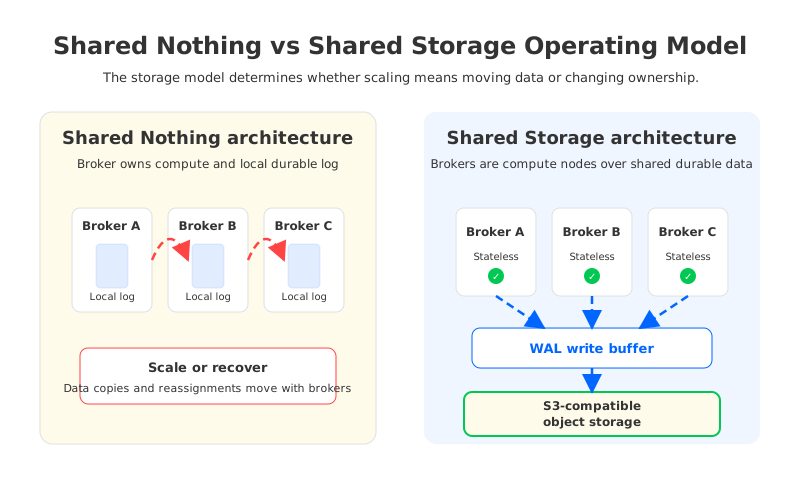
For streaming anomaly detection, the practical effect is not a slogan about storage. It is a different incident playbook. If traffic spikes, the platform team can focus on compute capacity and consumer throughput rather than tying every scaling move to local disk migration. If a model change requires replay, historical reads are part of the shared storage design rather than an exception that fights local hot storage. If a broker fails, recovery is less about rebuilding local durable state and more about bringing compute back and reconnecting it to the stored stream.
AutoMQ BYOC also matters for teams that cannot send operational data through a vendor-hosted data plane. In BYOC (Bring Your Own Cloud), the control plane and data plane run in the customer's cloud account and Virtual Private Cloud (VPC), keeping customer data within the customer's boundary. AutoMQ Software serves private data center deployments with the same broad architectural direction. For regulated anomaly detection workloads, this boundary can be as important as storage cost because the pipeline may carry user behavior, payments, machine telemetry, or security events.
The migration story is part of the same operating model. AutoMQ documentation describes Kafka Linking for AutoMQ commercial editions, including byte-to-byte synchronization and offset-consistent migration paths. That matters because anomaly detection consumers are often stateful. A sloppy offset cutover can create duplicate alerts, missed cases, or confusing model evaluations. The migration test should prove that producers, consumers, stream processors, offsets, and rollback behavior are acceptable before the production switch.
AutoMQ is not a reason to skip workload testing. It is a reason to test a different hypothesis: can the team keep Kafka application compatibility while moving durable state into shared object storage and making brokers easier to replace, scale, and rebalance? If the anomaly detection workload is dominated by bursty traffic, replay, retention, multi-AZ cost, and strict data boundaries, that hypothesis deserves a serious proof of concept.
6A practical decision path
Start with the operational symptom that triggered the search. If the problem is only stream processing code, broker architecture may not be the first fix. Tune consumer parallelism, state backend sizing, partition keys, window definitions, and offset commits before moving the platform. If the same team keeps hitting broker disk growth, partition reassignment windows, retention cost, cross-AZ traffic, and slow capacity changes, the storage model is probably part of the problem.
A good platform review ends with a written decision, not a favorite architecture diagram. Record the freshness SLO, replay requirement, retention policy, expected burst profile, governance boundary, migration plan, and rollback trigger. Then run the same workload against the shortlisted options. Measure p99 produce latency, consumer lag recovery, event age, replay throughput, broker replacement behavior, object storage request profile, and operational steps required during failure drills.
For teams building a real time AI data pipeline or event driven AI architecture, the streaming layer is no longer background plumbing. It is the system that decides whether the detector sees the event while it is still actionable. If your current Kafka estate is reliable but increasingly hard to scale, rebalance, or govern for anomaly detection, evaluate AutoMQ with your own topics, clients, retention, and failure drills: start an AutoMQ BYOC evaluation. The right answer is the one whose trade-offs still hold when the detector is under pressure.
7FAQ
7.1Is Kafka a good fit for streaming anomaly detection?
Kafka is a strong fit when the workload needs ordered event streams, fan-out, offset-based recovery, consumer groups, and integration with stream processors or connectors. The harder question is whether the chosen Kafka deployment model can meet freshness, replay, retention, and governance requirements without excessive operational friction.
7.2Does shared storage remove the need to design partitions carefully?
No. Partitioning still determines ordering, parallelism, consumer assignment, and hot-key behavior. Shared storage changes how durable data is placed and how brokers operate, but application-level partition keys still need to match the anomaly detection domain.
7.3Is Tiered Storage the same as Shared Storage architecture?
No. Tiered Storage offloads older Kafka log segments to remote storage while the active log remains tied to broker-local storage. Shared Storage architecture makes shared object storage the durable backing store and makes brokers less dependent on local persistent data.
7.4What should teams validate before migrating an anomaly detection pipeline?
Validate client compatibility, stream processor behavior, connector tasks, offset handling, security boundaries, p99 latency, replay throughput, consumer lag recovery, observability, rollback, and operating procedures during broker or Availability Zone failure drills.
7.5Where does AutoMQ fit?
AutoMQ fits when a team wants Kafka-compatible streaming with stateless brokers, Shared Storage architecture, object-storage-backed durability, and customer-controlled deployment boundaries through AutoMQ BYOC or AutoMQ Software.
8References
- Apache Kafka 4.3 documentation
- Apache Kafka client compatibility documentation
- AutoMQ overview
- AutoMQ architecture difference with Apache Kafka
- AutoMQ difference with Tiered Storage
- AutoMQ Kafka Linking overview
- AutoMQ Table Topic overview
- AutoMQ zero inter-zone traffic overview
- Amazon S3 user guide
- Amazon S3 pricing


