
Table of Contents
Table of Contents
Teams searching for streaming embeddings pipeline kafka are rarely asking whether Kafka can move events. They are asking how to keep embeddings fresh when documents, product records, support tickets, behavioral events, policies, and model versions all change at different speeds. The pipeline has to capture the source change, enrich it, call an embedding service, write to a vector index or feature store, and preserve enough history to replay when the model or schema changes.
That workload exposes a gap between a prototype and a platform. In a prototype, a consumer reads a topic, calls an embedding model, and upserts a vector. In production, the same path needs rate limiting, retries, idempotency, deletion handling, offset tracking, auditability, and a backfill plan that does not starve live ingestion. The question is no longer "Can we stream into an embeddings service?" It is "Can this infrastructure keep the embeddings contract true while traffic, models, and governance rules move?"
The storage model underneath Kafka-compatible streaming matters because embeddings pipelines are replay-heavy by design. A model upgrade can require re-embedding millions of records. A metadata policy change can require rebuilding index payloads. A deletion or correction flow can require tombstones and downstream proof. If broker-local storage and partition movement dominate every large replay or capacity change, the AI platform inherits operational limits from a layer that most model teams never see.
1Why teams search for streaming embeddings pipeline kafka
Embeddings pipelines sit between source systems and retrieval or decision systems. The input may be a database change event, a document upload, a clickstream event, a case note, a catalog update, or a tool execution log. Before the record becomes useful, it is often filtered, chunked, enriched, embedded, versioned, and written to a downstream system. Kafka fits naturally in that middle layer because it gives teams durable topics, ordered partitions, Consumer groups, Offsets, Kafka Connect integrations, and a replayable log.
The appeal is not only low latency. A streaming embeddings pipeline needs a record of what changed and where every downstream worker stopped. Consumer groups let multiple embedding workers share load while separate consumers feed audit, evaluation, warehouse, or monitoring systems. Offsets give operators a way to resume or replay without guessing. Transactions and idempotent producer behavior matter when a workflow writes derived events and wants stronger guarantees around duplicates or partial updates.
2The production constraint behind the problem
The first constraint is freshness under uneven demand. Source systems produce small edits, large imports, deletion events, and bursty behavioral signals. Embedding capacity is rarely identical to ingestion capacity because model inference may depend on GPU pools, third-party rate limits, or batch windows used to improve throughput. Kafka can buffer the mismatch, but the platform still has to define how much lag is acceptable for each downstream use case.
The second constraint is replay. Embeddings are derived data, not source truth. When an embedding model changes, the same source record can produce a different vector. When chunking rules change, one document may become a different set of vector rows. When metadata rules change, access control or ranking filters may need to be rebuilt. A Kafka-compatible log gives teams a replay handle, but the cost and operational risk of replay depend heavily on the storage architecture behind that log.
The third constraint is governance. Embeddings can encode sensitive input data even when raw text is not stored in the vector database. Platform teams need to track source identity, embedding version, retention policy, deletion state, access boundary, and audit path. That is hard to retrofit if the pipeline is built as a chain of ad hoc workers. It is easier when the stream is treated as the durable control surface for source changes and derived-state rebuilds.
These constraints create a more precise requirement than "real time AI data pipeline." A production streaming embeddings pipeline needs Kafka semantics, measurable freshness, replayable history, elastic capacity, and a data boundary that security teams can review. The evaluation should start there, before any vendor or service is placed on a shortlist.
3Architecture options and trade-offs
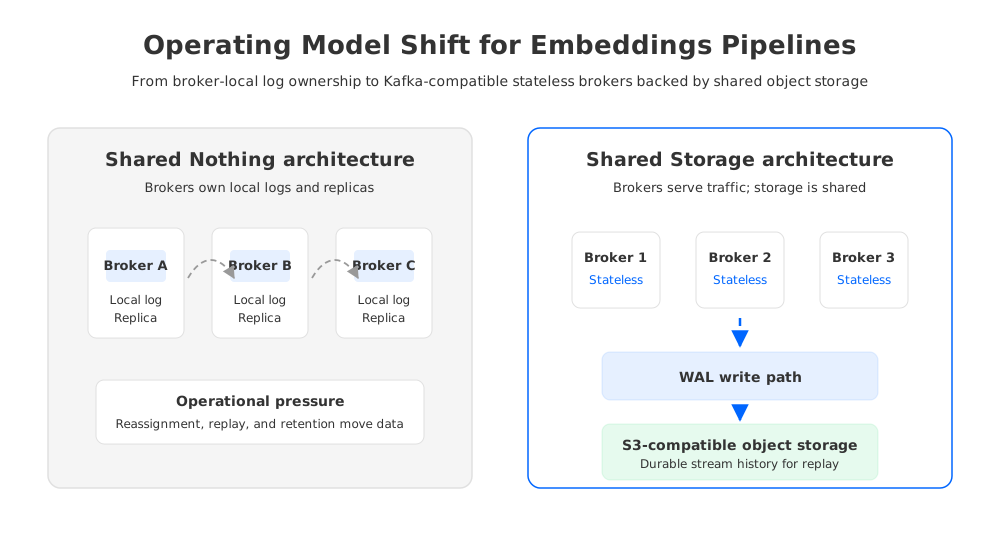
Traditional Kafka uses a Shared Nothing architecture. Each Broker owns local log storage, and durability relies on replicated partition data across Brokers. This design is proven, but it couples compute, storage, and data movement. When retention grows, broker-local disk planning grows with it. When brokers are added or removed, partition reassignment can become a data movement operation. When the cluster spans Availability Zones, replication and client placement become part of both the failure model and the cost model.
Tiered Storage changes part of that picture by moving older log segments to remote storage while active data remains tied to broker-local behavior. For embeddings pipelines, that can help with long retention, especially when replays usually start from older records. It does not fully separate active broker compute from storage ownership, so platform teams still need to test hot-path behavior, leader movement, local storage pressure, and recovery.
Fully managed streaming services change the ownership boundary instead of the storage model alone. They can reduce infrastructure work for teams that want a service abstraction, but the evaluation still has to cover data residency, client behavior, network paths, cost visibility, observability, and exit planning. Embeddings pipelines often process sensitive or regulated context, so the operating boundary is not a procurement detail.
Kafka-compatible Shared Storage architecture takes a different route. The application contract remains Kafka-compatible, but durable stream data is placed on shared object storage and Brokers focus on protocol handling, leadership, caching, and traffic service. The point is not to make storage invisible. The point is to stop treating broker-local disks as the source of truth for every replay, scale-out, and recovery decision.
| Architecture option | Where it fits | Risk to validate |
|---|---|---|
| Traditional Kafka on broker-local storage | Predictable ingestion, short retention, mature Kafka operations | Reassignment windows, disk pressure, replay cost, and cross-zone replication |
| Kafka with Tiered Storage | Long historical retention with familiar Kafka operations | Active data remains tied to broker-local behavior |
| Fully managed streaming service | Teams prioritizing service abstraction and vendor-operated control | Data boundary, portability, network path, and cost transparency |
| Kafka-compatible Shared Storage architecture | Replay-heavy AI pipelines that need Kafka semantics and elastic cloud operations | Compatibility, write path, governance, migration, and rollback evidence |
The evaluation should keep one distinction clear: Tiered Storage is not the same as Diskless architecture. Tiered Storage offloads older data to another layer while Brokers still own the hot local log. Diskless architecture uses Shared Storage architecture so persistent stream data is not bound to broker-local disks in the same way. For embeddings teams that expect repeated re-embedding, backfills, and capacity swings, that distinction becomes operational, not academic.
4Evaluation checklist for platform teams
Start from the retrieval or decision path and work backward. A support assistant may need policy updates within minutes. A product recommendation system may need behavior signals within seconds. A fraud workflow may need deletion and correction events to win over speed. The platform should let each stream declare its freshness and replay expectations instead of hiding every workload behind one "real-time" label.
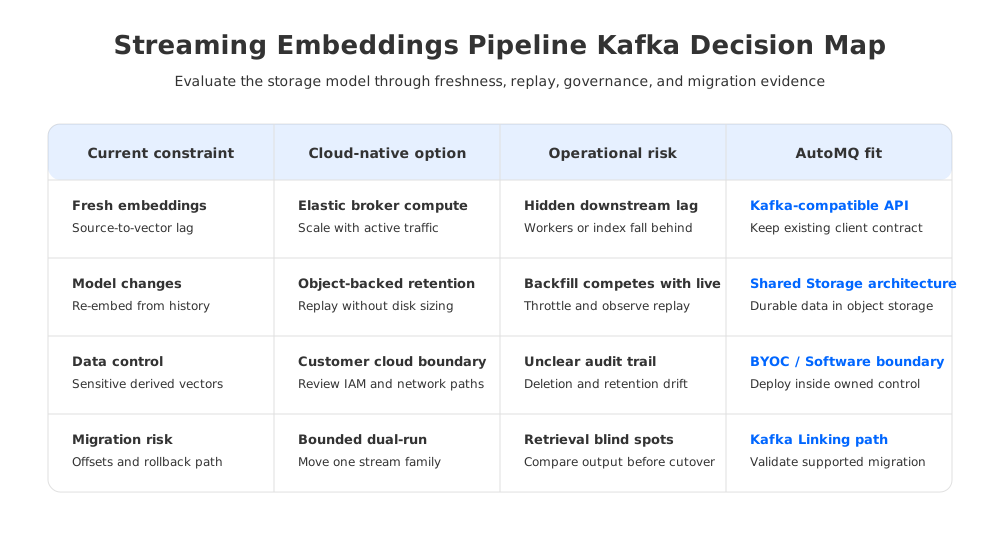
Use this checklist before choosing a Kafka-compatible streaming platform:
This checklist prevents a common platform mistake: benchmarking the easiest stage. A producer throughput test does not prove that a vector index receives current embeddings during a backfill. A storage estimate does not prove that re-embedding is safe during live traffic. A serious proof of concept should include deletion, retries, uneven record sizes, broad fan-out, failure drills, replay, and the full observability path.
5How AutoMQ changes the operating model
Once the neutral evaluation framework is clear, AutoMQ becomes relevant as a Kafka-compatible cloud-native streaming platform built on Shared Storage architecture. It preserves Kafka protocol compatibility while using S3Stream to move durable stream data into S3-compatible object storage. AutoMQ Brokers are stateless brokers, and persistent data is not treated as broker-local ownership in the traditional Kafka sense.
That difference matters for embeddings pipelines because their hard moments are rarely steady ingestion. They are imports, replay, re-embedding, model migrations, and recovery from partial downstream failure. AutoMQ Brokers still handle Kafka requests, leadership, caching, and KRaft-based coordination. WAL (Write-Ahead Log) storage provides the durable write path before data is organized in S3 storage. The operational shift is that scaling and recovery can focus more on traffic ownership, metadata, cache behavior, and downstream lag instead of copying large local logs as the source of truth.
The data boundary is also part of the design. AutoMQ BYOC runs the control plane and data plane in the customer's cloud account or VPC, which is important when embedding inputs include customer documents, user behavior, support content, product data, or regulated context. For private environments, AutoMQ Software provides a deployment model for customer-operated infrastructure. In both cases, teams should validate the exact storage, IAM, network, encryption, and audit configuration that applies to their environment.
AutoMQ features should be evaluated as evidence, not slogans. Kafka compatibility matters because producers, consumers, tools, and Connect-based integrations can keep the Kafka contract. Self-Balancing matters when broker traffic changes and the platform needs to redistribute load without making data movement the main event. Kafka Linking can help supported migration paths where offset consistency and staged cutover are required. Table Topic is relevant when a team wants some stream data to land directly in Apache Iceberg tables for analytical or governance workflows, while the embedding path continues to serve online retrieval.
The architecture does not remove workload validation. Teams still need to test producer latency, consumer lag, embedding throughput, cache behavior, catch-up reads, connector behavior, failure recovery, and rollback under their own workload. Shared Storage architecture changes which parts of the system dominate the test. For replay-heavy embeddings pipelines, that is the point.
6Readiness scorecard for streaming embeddings
A useful scorecard turns architecture discussion into evidence. Pick one stream family with a real business consumer and a bounded blast radius: support article updates, product catalog text, policy documents, user profile changes, tool execution summaries, or case notes. Run it beside the existing path long enough to compare freshness, retrieval quality, failure behavior, and operator effort.
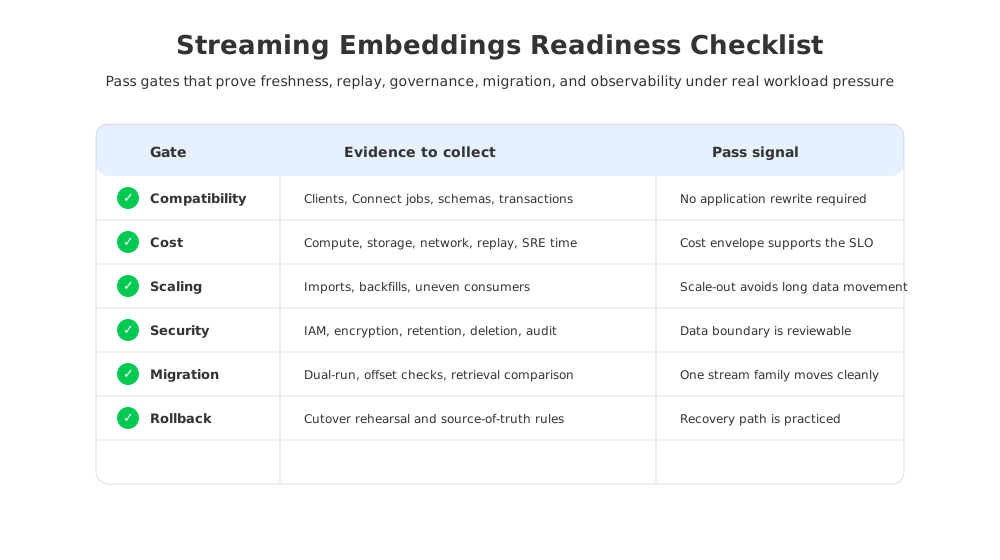
| Domain | Evidence to collect | Pass condition |
|---|---|---|
| Freshness | Source-to-vector lag across normal traffic and bursts | The path stays inside the decision budget for the target use case |
| Replay | Re-embedding time for one model or chunking change | Replay is repeatable, throttled, and observable |
| Correctness | Idempotent upserts, tombstones, versioning, and retry behavior | The index does not accumulate stale or duplicate vectors |
| Recovery | Broker, worker, connector, model API, and index failure drills | Recovery does not require manual data repair |
| Governance | Access tags, retention, deletion, audit, and region controls | Security can trace data location and derived-state handling |
| Migration | Dual-run, offset validation, retrieval comparison, and rollback | One stream family can move without retrieval blind spots |
The scorecard keeps the team honest. Embeddings infrastructure can look clean in a diagram while hiding the exact failure modes that hurt production: a stale vector after a deletion, an unbounded backfill queue, a re-embedding job that starves live updates, or a data boundary that security cannot approve. The right platform is the one that keeps those risks visible when the workload changes.
Return to the original search: streaming embeddings pipeline kafka. The useful answer is not "use Kafka" or "replace Kafka." The useful answer is to make freshness, replay, governance, scaling, and migration measurable, then choose the storage model that lets the platform keep those promises. If broker-local storage is becoming the bottleneck behind embeddings freshness and replay, evaluate a contained workload with AutoMQ in your own cloud environment.
7FAQ
7.1What is a streaming embeddings pipeline with Kafka?
It is a pipeline that uses Kafka or a Kafka-compatible streaming platform to capture source changes, coordinate embedding workers, track offsets, replay history, and feed downstream vector indexes, feature stores, or retrieval systems. The stream becomes the durable record of what changed and what can be rebuilt.
7.2Is Kafka required for embeddings pipelines?
No. Teams can use other queues or streaming systems. Kafka is common because many organizations already use Kafka-compatible clients, topics, partitions, Offsets, Consumer groups, Kafka Connect, and monitoring tools. The value is strongest when the pipeline needs replay, multiple downstream consumers, and operational visibility.
7.3When should teams evaluate Shared Storage architecture?
Evaluate Shared Storage architecture when embeddings workloads need long replay windows, frequent re-embedding, bursty imports, strict governance, or elastic broker capacity. It is especially relevant when broker-local storage planning starts shaping retention, replay, or scaling decisions.
7.4Does AutoMQ replace the embedding model or vector database?
No. AutoMQ is the Kafka-compatible streaming layer. Embedding models still generate vectors, and vector databases still serve similarity search. AutoMQ changes the durable event backbone and broker operating model that feed those systems.
7.5What should SREs monitor?
Monitor source-to-vector freshness, Kafka consumer lag, embedding queue depth, model API latency or GPU utilization, retry rates, tombstone processing, vector upsert success, replay throughput, broker health, and downstream retrieval freshness. The most useful signal follows a record across the full path, not one queue in isolation.
8References
- Apache Kafka documentation
- Apache Kafka consumer design
- Apache Kafka transactions and semantics
- Apache Kafka Connect
- Apache Kafka KRaft
- Apache Kafka Tiered Storage
- AutoMQ Kafka compatibility
- AutoMQ Shared Storage architecture
- AutoMQ S3Stream shared streaming storage
- AutoMQ WAL storage
- AutoMQ BYOC overview
- AutoMQ Kafka Linking migration overview
- AutoMQ zero cross-AZ traffic overview
- AutoMQ Continuous Self-Balancing
- AutoMQ Table Topic overview
- AWS data transfer pricing


