
Table of Contents
Table of Contents
Teams do not search for table format interoperability kafka because they want another diagram of Apache Iceberg, Kafka Connect, and stream processing boxes. They search because a production boundary has started to hurt. Kafka is already the system of record for real-time events, the lakehouse is becoming the system of record for analytics, and platform teams are being asked to make the two behave like one reliable data substrate.
That pressure is operational before it is architectural. A Flink job may own checkpoints and offsets, a Kafka cluster may own retention and consumer group state, an Iceberg catalog may own snapshots and schema evolution, and an SRE team still owns the pager when a broker fills disk during a backfill. The hard question is not "Can records land in a table format?" Most teams can make that happen. The harder question is whether the path remains reversible, observable, cost-aware, and secure after it becomes part of the production write path.
1Why teams search for table format interoperability kafka
The search usually starts with a reasonable business request. Analytics teams want fresher lakehouse tables. Data engineering teams want fewer extract, transform, load jobs. Real-time application teams want Kafka to remain the integration layer because producers and consumers already depend on Kafka clients, Consumer group behavior, and operational tooling. Nobody wants to rebuild every producer because one downstream team needs Apache Iceberg tables.
The first implementation often looks straightforward. Use Kafka Connect, a stream processing job, or a managed ingestion feature to write records into a table format. Register schemas, map topics to tables, and define a catalog. That path can work, and for many workloads it is the right starting point. Kafka Connect is part of the Apache Kafka ecosystem for moving data between Kafka and external systems, and table formats such as Apache Iceberg are designed to give analytical engines a consistent view of files, metadata, and snapshots.
The trouble begins when this path becomes a shared platform contract. A table writer is no longer a side pipeline if product dashboards, compliance exports, machine learning features, and incident investigations depend on it. At that point, the team must answer questions that do not fit inside a connector configuration file:
- Which component is the source of truth when Kafka offsets and table snapshots disagree?
- How much replay can the system tolerate when a table writer falls behind?
- Does a schema change fail fast, quarantine records, or create another table version?
- Can the platform roll back a cutover without forcing producers to dual-write?
- Who pays for retention, cross-Availability Zone traffic, object storage operations, and backfill compute?
This is why "interoperability" is a slightly misleading word. It sounds like a compatibility checkbox. In production, it is a contract between streaming semantics, table semantics, and cloud operations.
2The production constraint behind the problem
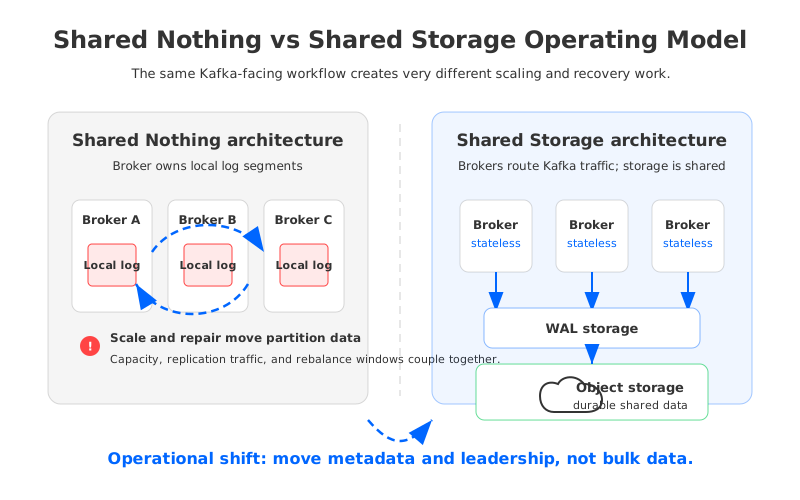
Traditional Kafka is built on a Shared Nothing architecture. Each Broker owns local storage for the partitions it leads or follows, and Kafka durability comes from replication across brokers. This design has served the Kafka ecosystem well because it gives the system a clear local log abstraction: append records, assign offsets, replicate to followers, and let Consumers read ordered partitions.
Three effects show up repeatedly:
None of this means Kafka cannot feed table formats. It means the storage model determines how painful the steady-state operations become. A connector can bridge APIs, but it cannot remove the underlying coupling between broker-local data, replication, rebalance windows, retention, and cloud network paths.
3Architecture options and trade-offs
There are several legitimate ways to connect Kafka streams with table formats. The right choice depends on how much control the team needs over Kafka semantics, table layout, operational boundaries, and migration risk.
| Option | Where it fits | Main trade-off |
|---|---|---|
| Kafka Connect sink to table storage | Teams already standardizing on connectors and external workers | Clear separation of concerns, but another runtime owns failure handling, scaling, and connector-specific state |
| Stream processor writing tables | Teams that need transformation, enrichment, or event-time logic before table materialization | Flexible, but checkpoints, offsets, and table commits must be governed together |
| Platform-native topic-to-table path | Teams that want table output as part of the streaming platform contract | Lower pipeline surface area, but the platform must expose clear catalog, schema, and rollback behavior |
| Dual-write from applications | Narrow cases where applications already own both stream and table writes | Simple on paper, but hard to make atomic and difficult to roll back safely |
The evaluation should start with semantics. Kafka offsets are not the same thing as table snapshots. Kafka transactions are not the same thing as catalog commits. A Consumer group offset tells you how far a consumer has read in a partition; a table snapshot tells analytical engines which set of data files and metadata are visible. A reliable interoperability design explains how these states relate during normal writes, failures, retries, and recovery.
The next layer is cost. Avoid abstract claims such as "object storage is lower cost" or "networking is expensive" without a workload model. A useful estimate includes produced data, retained data, replication behavior, read fan-out, backfill frequency, object storage requests, inter-zone traffic, PrivateLink or endpoint charges where relevant, and the compute needed to transform or compact table files. The answer will vary by cloud and region, but the shape of the calculation matters more than a single headline number.
Governance is the third layer. A table path that bypasses schema enforcement can create a lakehouse cleanup problem. A table path that is too strict can turn minor schema drift into a production outage. The platform needs a policy for schema compatibility, dead-letter handling, catalog permissions, audit trails, and retention alignment between Kafka topics and table snapshots.
The final layer is migration. Teams rarely get to redesign everything at once. The safer path is to run the candidate table workflow beside the existing Kafka workload, verify offsets and table visibility, test rollback, and promote traffic only when the operational evidence is boring. Boring is good here. It means the system has stopped surprising you.
4Evaluation checklist for platform teams
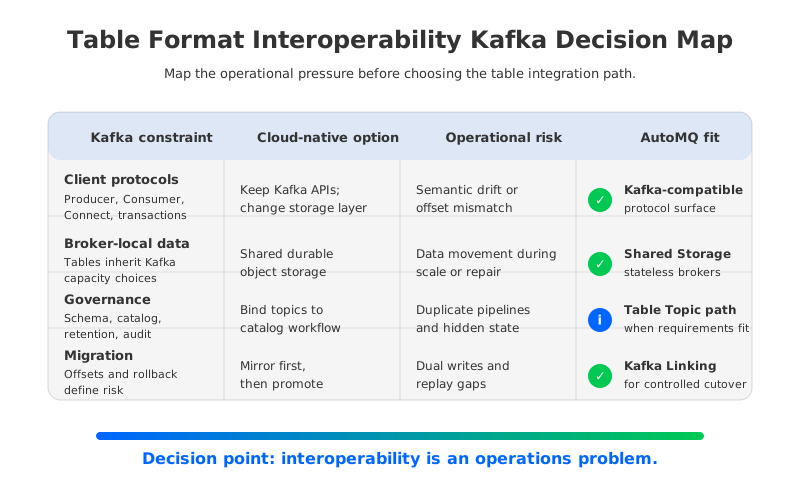
The decision map below is a practical way to review a proposed architecture before it becomes a production dependency. It deliberately mixes application semantics with infrastructure operations because table format interoperability crosses both teams.
Start with compatibility. Producers and Consumers should keep using Kafka APIs unless there is a clear reason to change the application contract. Check client versions, authentication, authorization, serialization, idempotent Producer usage, transactions, Consumer group behavior, and any Kafka Connect assumptions. If the proposed platform claims Kafka compatibility, validate the specific API surface your applications use instead of accepting a generic statement.
Then inspect the failure path. A good design tells you what happens when the table catalog is unavailable, object storage throttles requests, a writer commits data but fails before updating its checkpoint, or a Consumer group needs to replay a historical window. The answer should include retry behavior, duplicate handling, lag metrics, and the exact operator action required to recover.
Cost belongs in the same review, not in a separate procurement spreadsheet. The table path can change storage duration, object size, compaction frequency, cloud API calls, and network routes. For AWS deployments, for example, teams should review the official Amazon S3 pricing, data transfer pricing, and PrivateLink documentation where those services are part of the design. The same principle applies on every cloud: use the provider's current pricing pages and your own traffic assumptions.
Security and governance should be reviewed before the first production topic is mapped to a table. The checklist should cover VPC boundaries, IAM roles, catalog permissions, encryption, audit logs, schema ownership, and who can promote or roll back a table workflow. This is especially important when platform teams provide Kafka as a shared service to many application teams.
5How AutoMQ changes the operating model
Once the evaluation framework is clear, the architecture question becomes sharper: can the streaming platform preserve Kafka-facing semantics while reducing the storage and scaling work that makes table interoperability hard to operate? AutoMQ is a Kafka-compatible cloud-native streaming platform built around that premise. It keeps the Kafka protocol and client ecosystem while replacing broker-local persistent storage with a Shared Storage architecture backed by object storage.
The key change is that AutoMQ Brokers are stateless for persistent data. Writes go through a WAL (Write-Ahead Log) layer for durability and recovery, and long-term stream data is stored in S3-compatible object storage. Because persistent data is not tied to a broker's local disk, scaling and broker replacement no longer require the same bulk data movement pattern that operators associate with broker-local Kafka storage.
This does not make table interoperability automatic. It changes the operating model around it. A table writer, Table Topic workflow, or migration path still needs schema policy, catalog integration, monitoring, and rollback. But the platform no longer has to treat every capacity change as a storage relocation event. That difference matters when table workloads create uneven replay, long retention, or bursty analytical ingestion.
AutoMQ's Table Topic capability is relevant when a team wants streaming data to land in Apache Iceberg tables without maintaining a separate extract, transform, load pipeline for every topic. The architectural value is not only that data reaches a table. It is that the table path can be managed closer to the Kafka-compatible platform boundary, where topics, schema constraints, scaling, and observability already belong. For teams that prefer explicit external processing, Kafka Connect and Flink remain valid options; the point is to choose the boundary intentionally.
Migration is another place where storage architecture affects risk. Moving from a broker-local Kafka cluster to a shared-storage platform is safer when offsets, Consumer groups, and producer cutover are handled as first-class migration objects. AutoMQ commercial editions provide Kafka Linking for controlled migration workflows, including byte-to-byte topic synchronization and Consumer group progress synchronization. That is useful for table interoperability because downstream table writers often depend on stable offsets and replay behavior during a cutover.
The deployment boundary also matters. AutoMQ BYOC runs the control plane and data plane in the customer's cloud account, while AutoMQ Software targets customer-managed private environments. For teams dealing with regulated data, lakehouse catalogs, and private networking, this boundary is often as important as the storage engine. Interoperability is easier to adopt when data ownership, network routes, and operational access are explicit from the beginning.
6A practical readiness scorecard
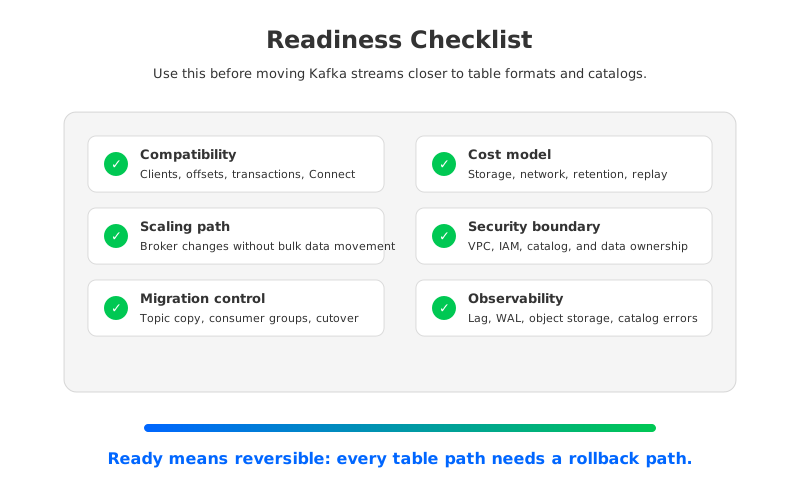
Before choosing a platform-native table path, connector-based ingestion, or stream processor, score the design against seven questions. A weak answer does not mean the architecture is wrong. It means the team has found the next design review topic.
- Kafka semantics: Can you identify the exact Producer, Consumer, transaction, offset, and Consumer group behaviors that must remain unchanged?
- Table semantics: Can you explain how Kafka offsets map to table snapshots, commits, schema evolution, and late data handling?
- Storage model: Does the platform require broker-local data movement during scale-out, scale-in, repair, or migration?
- Cost model: Have you estimated storage, compute, object operations, inter-zone traffic, endpoint charges, retention, and backfill scenarios using current cloud pricing?
- Security model: Are VPC boundaries, IAM permissions, catalog access, encryption, and audit requirements documented before production use?
- Rollback model: Can you return producers and consumers to the previous path without data loss, duplicate processing surprises, or manual offset reconstruction?
- Observability model: Do dashboards show Kafka lag, writer lag, table commit health, object storage errors, WAL health, and catalog failures in one operational view?
The best scorecard result is not "all green" on the first pass. The best result is a short list of risks the team can test. Run a replay drill. Break catalog access in a staging environment. Scale brokers during a table backfill. Promote and roll back a mirrored topic. The architecture that survives these drills is the one you can trust with production interoperability.
7FAQ
7.1Is table format interoperability the same as Kafka Connect?
No. Kafka Connect is one implementation path for moving data between Kafka and external systems. Table format interoperability is broader: it includes how Kafka offsets, schema, transactions, retention, replay, table snapshots, and catalog governance work together.
7.2Does Shared Storage architecture replace Apache Iceberg?
No. Shared Storage architecture changes how the Kafka-compatible streaming platform stores and moves stream data. Apache Iceberg remains a table format with its own metadata and snapshot model. The two solve different layers of the architecture.
7.3When should a team use a stream processor instead of a platform-native table path?
Use a stream processor when the table output depends on joins, enrichment, event-time windows, complex deduplication, or business transformations. A platform-native path is more attractive when the goal is direct topic-to-table materialization with minimal pipeline surface area.
7.4What should SRE teams monitor?
Monitor Kafka consumer lag, table writer lag, failed commits, schema errors, object storage request failures, WAL health, catalog availability, replay throughput, and cutover status. The important point is to monitor the stream and table sides together.
7.5How does AutoMQ fit into a table interoperability strategy?
AutoMQ fits when teams want a Kafka-compatible platform with Shared Storage architecture, stateless brokers, object-storage-backed durability, and customer-controlled deployment boundaries. It can reduce the operational coupling between retention, scaling, broker repair, and table-oriented workloads.
Table format interoperability starts as a search query, but it ends as an operating model. If your team is evaluating a Kafka-compatible shared storage foundation for real-time streams and lakehouse tables, try AutoMQ BYOC through the AutoMQ Cloud Console and test the scorecard against your own topics, catalogs, and rollback requirements.


