
Table of Contents
Table of Contents
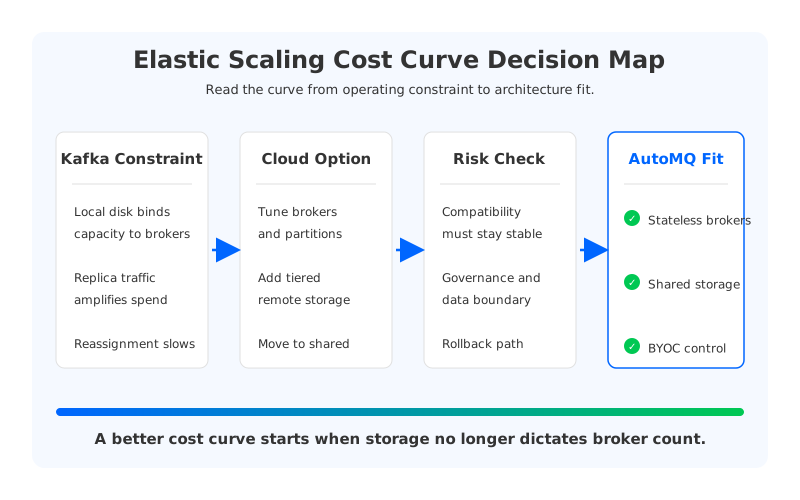
Someone searching for elastic scaling cost curve kafka is usually past the first wave of Kafka adoption. The cluster works, applications depend on it, and the hard question is why every attempt to scale more precisely still leaves the team paying for brokers, disks, network paths, and operational headroom that are not always doing useful work.
That is the shape of the Kafka scaling curve: capacity is not purchased one clean unit at a time. A burst in producer traffic may require more broker CPU, but the broker also brings local storage, replica placement, partition leadership, rebalance risk, and recovery obligations. Finance sees a cost curve. SRE sees an operating model. The better question is which parts of that curve come from workload growth and which come from architecture coupling.
1Why teams search for elastic scaling cost curve kafka
Elastic scaling sounds like capacity planning, but in production Kafka it becomes a boundary problem. The platform owner wants compute to follow traffic. The storage owner wants predictable retention cost. Application teams want stable offsets, Consumer group behavior, transactions, and clients. Security wants to know where data travels, and procurement wants to know why a low-traffic week still carries a high infrastructure bill.
Those questions collide because Kafka is not a stateless HTTP tier. A broker is also part of the storage layout, replication topology, failure domain, and operational workflow. Topics are partitioned across brokers for parallelism; replicas keep data available during failures; connectors and stream processing jobs assume Kafka protocol semantics stay stable. Scaling a broker pool therefore changes more than CPU capacity.
Cost reviews tend to expose this coupling in three places:
- Peak-to-average waste. Teams size for peak ingest, catch-up reads, maintenance, and failure recovery. When traffic falls, broker count and storage placement may not fall with it.
- Retention-driven compute spend. Long retention increases local disk requirements, and local disk requirements can keep broker instances large even when compute demand is moderate.
- Operational risk premiums. Reassignment, rebalance, and recovery windows often force teams to keep extra headroom because the cost of being under-provisioned is an incident.
The phrase "cost curve" separates one-time cleanup from structural economics. Compression, partition cleanup, quotas, and retention hygiene are worth doing, but they do not necessarily change the slope when more data, longer retention, and burstier traffic arrive together.
2The production constraint behind the problem
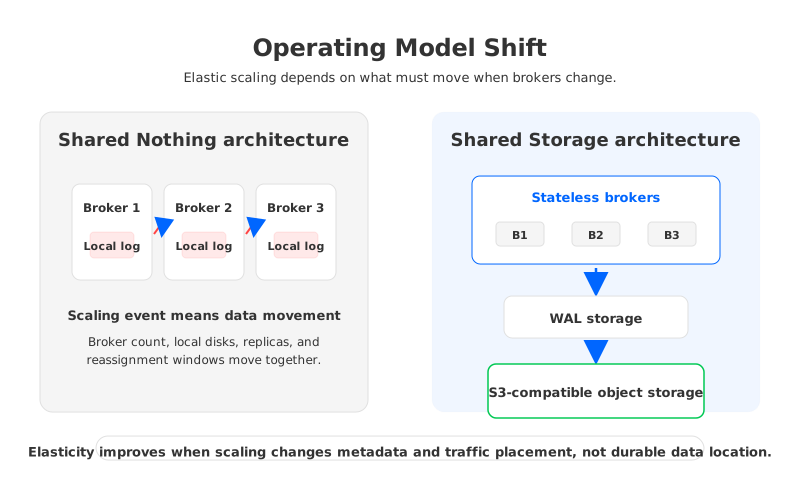
Traditional Kafka follows a Shared Nothing architecture. Each broker owns local storage, and partitions are placed across brokers with leader/follower replication. Kafka's introduction describes topic partitions distributed across brokers and replicated for fault tolerance, with a common production setting of a replication factor of 3. The design is coherent: it gives Kafka durable storage, parallelism, and high availability through broker-local responsibility.
The cloud changes the cost surface around that design. Compute is elastic, but local durable storage is attached to compute nodes or provisioned per broker. Network traffic can be metered when data moves across Availability Zones. Operational work is also real: engineers plan broker additions, partition reassignments, disk expansion, traffic balancing, and incident recovery.
This is where the curve bends upward. A team may only need more write throughput for a few hours, but adding brokers can trigger placement work. It may only need more retention for audit replay, but that retention can pin larger disks to brokers. It may only need multi-AZ durability, but broker-to-broker replication can turn availability design into network spend.
Tiered Storage improves one part of the equation by moving older log segments to remote storage. Apache Kafka documents Tiered Storage as an operational capability, and for many clusters it reduces pressure on broker-local disks for historical data. It is not the same as making brokers stateless: hot data, leadership, reassignment mechanics, and recovery planning still matter because the primary write path remains tied to brokers.
3Architecture options and trade-offs
Before choosing a platform, separate tuning from architecture. Tuning helps when cost comes from poor configuration or stale assumptions. Architecture change is worth evaluating when the same symptoms return after obvious fixes.
| Option | What it can improve | What it may not change | Best fit |
|---|---|---|---|
| Broker right-sizing | Reduces obvious over-provisioning and idle compute. | Storage, replication, and reassignment remain tied to brokers. | Stable workloads with predictable growth. |
| Retention cleanup | Removes abandoned data and shortens local storage pressure. | Long-retention use cases still need a durable storage plan. | Clusters with unclear topic ownership. |
| Tiered Storage | Moves older data to remote storage and reduces local hot-set requirements. | Brokers still carry primary write-path responsibility. | Workloads where historical replay is the main storage driver. |
| Managed service | Shifts some operational labor to a provider. | Pricing, data boundary, and elasticity model depend on the provider. | Teams prioritizing operational outsourcing. |
| Shared Storage architecture | Decouples durable data from broker-local disks. | Requires validation of latency, compatibility, migration, and governance. | Teams whose cost curve is driven by coupled compute and storage. |
The right answer depends on which cost driver dominates. A regulated bank may value predictable change windows. A SaaS company with spiky tenants may care more about rapid broker elasticity. A data platform team with heavy replay may care more about retention economics than peak ingest.
Do not treat "Kafka cost" as one number. Separate broker compute, durable storage, network movement, and operations. Compute grows with request handling and throughput. Storage grows with retained bytes and replication design. Network grows with client placement, inter-AZ paths, replication, and reads. Operations grow with the manual steps required to change any of them.
4Evaluation checklist for platform teams
A production evaluation should start from the behaviors the business cannot afford to break. Kafka is valuable because its ecosystem is broad: producers, consumers, Admin API workflows, Kafka Connect, stream processing jobs, observability tools, and security policies surround the broker layer. If cost work breaks those assumptions, spreadsheet savings become migration risk.
Use these questions before committing to a different scaling model:
- Compatibility: Which Kafka client versions, producer guarantees, Consumer group behaviors, transactions, ACLs, and connector patterns are in use?
- Cost attribution: Can you separate compute, storage, network, and operations in your current bill and on-call history?
- Elasticity trigger: Are you scaling for CPU, disk, partitions, throughput, retention, reads, or failure headroom?
- Governance: Where does message data live, who controls IAM, and which network path carries produce and consume traffic?
- Migration safety: Can you dual-run, validate offsets, cut over by topic or business domain, and roll back without rewriting applications?
- Observability: Can you observe lag, rebalance behavior, broker saturation, storage path latency, cache effectiveness, and cross-AZ traffic?
The checklist reveals whether the problem is cleanup or architecture. If the weakest answers are "we do not know which topics are owned" or "no one has reviewed retention," fix governance first. If the weakest answers are "we cannot scale down because data is pinned to brokers" or "adding brokers starts a long reassignment process," architecture is part of the cost problem.
5How AutoMQ changes the operating model
Once the evaluation points to compute-storage coupling, a different architecture becomes relevant. AutoMQ is a Kafka-compatible, cloud-native streaming platform that keeps Kafka protocol and ecosystem compatibility while replacing broker-local log storage with a Shared Storage architecture. The product argument comes after the evaluation because Shared Storage architecture is useful when the operating model is the constraint.
In AutoMQ, stateless brokers handle Kafka protocol work, partition leadership, caching, and traffic placement, while durable data is stored through S3Stream on WAL storage and S3-compatible object storage. AutoMQ documentation describes S3Stream as a stream storage library rather than a distributed storage service. Data is written durably to WAL storage and then uploaded to S3 storage, while caching supports both Tailing Read and Catch-up Read patterns.
That changes the scaling curve in four practical ways:
- Compute and storage scale independently. Broker count can follow request load more closely because durable data is no longer pinned to broker-local disks.
- Partition movement becomes lighter. Reassignment is closer to changing ownership, metadata, and traffic placement than copying large volumes of durable data.
- Retention has a different cost basis. Long-lived data sits in object storage as the primary durable layer, while brokers focus on serving active traffic.
- Network economics can improve in multi-AZ deployments. AutoMQ documents an S3-based design for eliminating inter-zone data transfer paths by reducing broker-to-broker replica traffic and routing clients to same-AZ access paths.
Platform teams still need to validate latency, object storage behavior, WAL type, cache hit rates, client placement, and failure modes. AutoMQ Open Source relies on S3-compatible storage for WAL storage, while AutoMQ commercial editions can support additional WAL storage options for different latency and durability requirements. A proof of concept should test the WAL configuration you would actually run.
AutoMQ BYOC also changes governance. In BYOC deployment, the control plane and data plane run in the customer's cloud account or VPC, and customer message data remains in customer-controlled infrastructure. That keeps cost visibility and data boundary review close to the cloud account that owns the workload.
6A practical decision matrix
Map the cost driver to the control you need. If the driver is abandoned topics, enforce ownership and retention cleanup. If it is inefficient broker sizing, right-size. If it is long historical replay, evaluate Tiered Storage and object-storage-backed designs. If it is repeated over-provisioning caused by broker-local data movement, evaluate Shared Storage architecture.
| Dominant symptom | Likely root cause | First action | When to consider Shared Storage architecture |
|---|---|---|---|
| Brokers stay large after peak traffic | Compute and storage are scaled as one unit | Measure CPU, disk, and partition pressure separately | When disk or reassignment risk prevents scale-down |
| Long retention inflates broker footprint | Durable data is tied to local broker storage | Classify topics by replay and retention need | When retention growth dominates compute need |
| Multi-AZ bill grows faster than ingest | Replication and client placement move data across zones | Audit client racks, replica placement, and traffic paths | When broker replication is the structural driver |
| Scaling requires long maintenance windows | Reassignment moves too much local data | Reduce partition churn and automate balancing | When data movement is the limiting step |
| Procurement cannot compare options | Cost categories are mixed together | Build a bill model by compute, storage, network, and operations | When architecture changes the categories themselves |
This matrix prevents a common mistake: buying elasticity from the wrong layer. Compute autoscaling helps when compute is the bottleneck, but it does not solve storage-bound broker sizing by itself. Storage tiering helps with historical data, but it does not necessarily make brokers stateless. Managed operations help team bandwidth, but they do not automatically change the data path.
7Migration readiness scorecard
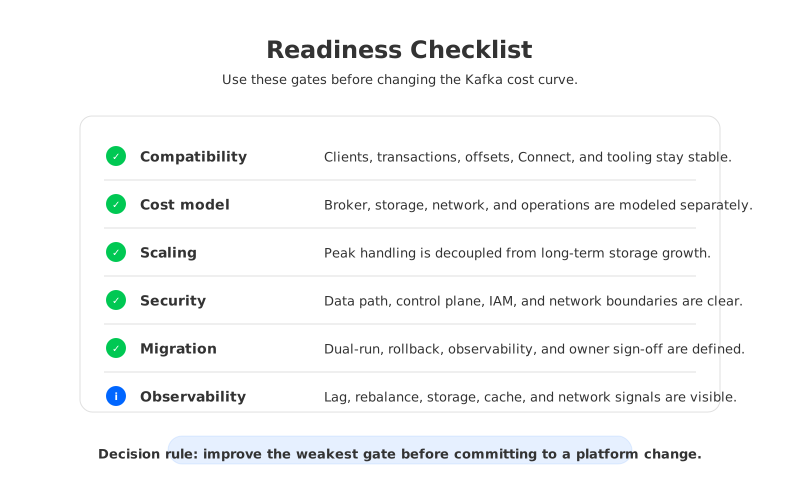
The readiness scorecard should be short enough for a platform review and strict enough to block a risky migration. Score each category from 1 to 5: 1 means unknown or unowned; 5 means tested under production-like conditions.
| Category | What a 5 looks like |
|---|---|
| Compatibility | Client versions, APIs, transactions, offsets, connectors, and tools have been tested against the target platform. |
| Cost model | Current and target models separate compute, storage, network, and operations with clear assumptions. |
| Scaling behavior | Scale-out and scale-in triggers are tied to observed workload signals, not static broker count. |
| Security boundary | Data path, management path, IAM roles, encryption, and network access are reviewed. |
| Migration plan | Dual-run, topic batches, offset validation, producer cutover, consumer cutover, and rollback are documented. |
| Observability | Lag, throughput, broker load, storage path behavior, cache behavior, and cross-AZ traffic are visible. |
Do not average the score too quickly. A platform with a 5 in cost and a 1 in rollback is not ready. The weakest category is the real decision gate.
For teams that already know compute-storage coupling is the constraint, the next step is to test the architecture against a representative workload. Use the same retention profile, client mix, connector behavior, and AZ layout that created the original cost curve. To evaluate AutoMQ in that context, use the AutoMQ BYOC entry point to discuss a workload-specific proof of concept.
8FAQ
8.1Is elastic scaling mainly a broker autoscaling problem?
Not always. Broker autoscaling helps when compute is the binding constraint. In Kafka, broker count can also be constrained by local storage, replication, partition placement, and reassignment risk.
8.2Does Tiered Storage solve the same problem as Shared Storage architecture?
No. Tiered Storage moves older data to remote storage while the primary broker write path still depends on broker-local responsibilities. Shared Storage architecture moves durable storage out of broker-local disks.
8.3What should FinOps teams ask before approving a Kafka platform change?
Ask for a cost model that separates broker compute, durable storage, network transfer, and operations. Then ask which category changes under the target architecture.
8.4What should SRE teams validate first?
Validate compatibility, failure recovery, observability, and rollback. Cost efficiency is not useful if the team cannot see lag, storage behavior, broker saturation, or migration progress.
8.5Where does AutoMQ fit?
AutoMQ fits when teams want Kafka-compatible behavior but need Shared Storage architecture, stateless brokers, independent compute/storage scaling, and customer-controlled deployment boundaries through AutoMQ BYOC or AutoMQ Software.
9References
- Apache Kafka 4.3 Introduction
- Apache Kafka 4.3 KRaft operations
- Apache Kafka 4.3 Tiered Storage
- Apache Kafka 4.3 Kafka Connect overview
- AutoMQ architecture overview
- AutoMQ S3Stream overview
- AutoMQ compatibility with Apache Kafka
- AutoMQ eliminate inter-zone traffics overview
- AWS Global Network FAQs: data transfer charges
- AWS Data Exports: understanding data transfer charges


