
Table of Contents
Table of Contents
Someone searching for high throughput write economics kafka is rarely asking whether Kafka can handle writes. They already know it can. The harder question is why every additional wave of producer throughput brings more brokers, storage, replication traffic, and operational conditions that finance cannot read from a unit-price sheet.
Write throughput looks like an application metric, but in production it becomes an architecture bill. Producers write to partitions, brokers own local storage, replicas follow across failure domains, and SREs keep headroom for failures and catch-up reads. A write-heavy workload pays for more than accepted bytes. It pays for the operating model that keeps those bytes durable.
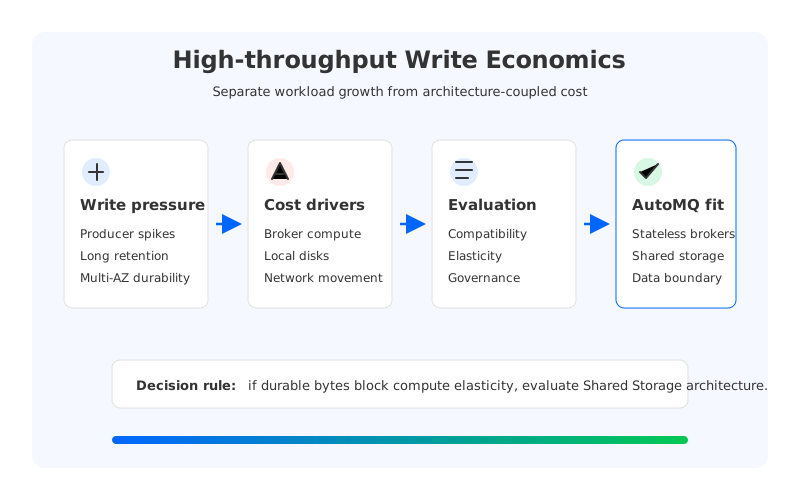
The useful frame is not "Kafka is expensive." It is this: which costs grow because the business writes more data, and which costs grow because the broker is compute node, storage owner, replication participant, and recovery unit at the same time?
1Why teams search for high throughput write economics kafka
High-throughput write economics becomes visible when Kafka moves from shared infrastructure to a material line item. Early adoption is supported by reliability, ecosystem fit, and developer velocity. Later, platform teams must explain why a product launch, telemetry pipeline, or AI feature changed broker spend before anyone extended retention or added consumers.
The pressure comes from multiple stakeholders. FinOps wants compute, storage, network, and labor separated. Platform owners want enough capacity to protect producers. SREs want fewer long reassignments and emergency disk expansions. Security teams want to know where message data lives and which paths carry it. These questions are connected because Kafka's write path is not stateless.
Write-heavy clusters usually expose four cost patterns:
- Peak write capacity becomes baseline infrastructure. Teams size for peak traffic plus failure and recovery, while quiet hours carry much of the same footprint.
- Local storage shapes broker sizing. Retained bytes and write amplification can force larger instances or volumes even when CPU is not the bottleneck.
- Replication turns durability into traffic. Multi-AZ deployments can add broker-to-broker and client-path movement that producer throughput does not show.
- Operations add a risk premium. Reassignment, rebalance, and recovery workflows make teams keep more headroom than a clean capacity spreadsheet suggests.
Those patterns are not mistakes by themselves. Kafka was designed as a durable distributed log, and broker-local responsibility is part of that design. The economic issue appears when cloud elasticity is expected from an architecture that still couples compute, storage, and data movement.
2The production constraint behind the problem
Traditional Kafka follows a Shared Nothing architecture: each broker manages local storage, and partitions are distributed and replicated across brokers for fault tolerance. Apache Kafka documentation describes partitions replicated across brokers, with one broker acting as leader for reads and writes. That model gives operators clear ownership, but it also means a write updates a broker-owned log and a replica workflow.
Cloud infrastructure changes the cost surface. Compute instances can be added and removed, but durable local storage stays attached to the broker or its failure domain. Network traffic can be metered when data crosses Availability Zones. Operational work also matters: adding brokers, moving partitions, recovering nodes, balancing leaders, and protecting consumer lag during change windows.
The mismatch is familiar. More ingest capacity becomes more brokers, storage, replica placement, monitoring, and migration caution. Longer retention extends local storage or adds tiering, then requires catch-up read validation. Tighter availability increases redundancy and network-path scrutiny.
Tiered Storage helps by moving older log segments to remote storage. Apache Kafka's Tiered Storage documentation frames it as a way to reduce the burden of historical data on broker disks. That helps replay-heavy or long-retention workloads, but it does not make brokers stateless. The active write path, leadership, local hot set, reassignment mechanics, and recovery model still matter.
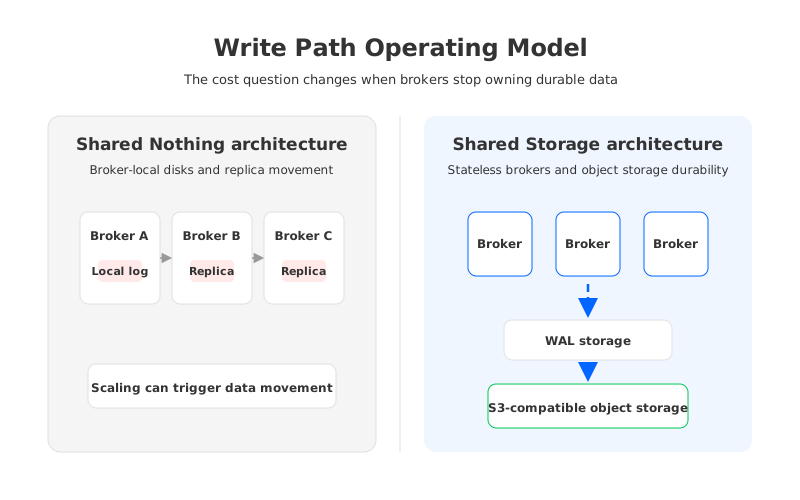
This distinction matters for write economics. If the cost problem is mostly abandoned topics or retention sprawl, governance and Tiered Storage may be enough. If durable bytes prevent compute from scaling independently, the architecture itself is part of the bill.
3Architecture options and trade-offs
Start by separating cleanup, outsourcing, and architecture change. Each option attacks a different driver.
| Option | What it improves | What remains constrained | When it fits |
|---|---|---|---|
| Topic and retention cleanup | Removes stale data and clarifies ownership. | Write-path architecture does not change. | Clusters with poor governance. |
| Broker right-sizing | Reduces obvious over-provisioning. | Broker count may still be bounded by storage, replicas, or recovery headroom. | Stable workloads. |
| Tiered Storage | Moves older segments to remote storage. | Brokers still own the active write path. | Long-retention or replay-heavy workloads. |
| Managed Kafka service | Reduces some operational workload. | Pricing, elasticity, and data boundaries depend on provider design. | Teams prioritizing outsourcing. |
| Shared Storage architecture | Decouples durable data from broker-local disks. | Requires validation of latency, compatibility, governance, and migration. | Write-heavy workloads where storage ownership blocks elasticity. |
The table prevents a common shortcut: treating all Kafka cost work as right-sizing. Right-sizing helps when waste comes from stale capacity assumptions, but not when storage cannot move independently from compute. Managed services can shift operational responsibility, but they do not automatically change whether writes require broker-local replicas.
A practical evaluation should classify costs into four buckets. Compute is broker capacity for requests, leadership, protocol work, compression, and cache behavior. Storage is the durable footprint for retention and recovery. Network is movement across clients, brokers, zones, and remote storage. Operations is the work needed to change capacity without breaking producer guarantees or consumer progress.
When those buckets are mixed together, debates become circular. Finance asks for a lower bill. Engineering answers with risk. Procurement compares headline unit prices. SREs point to avoided incidents. The conversation improves when everyone can see which cost comes from workload demand and which comes from coupling.
4Evaluation checklist for platform teams
Kafka is valuable because its ecosystem is broad. Producers, consumers, Admin API workflows, Kafka Connect, stream processing jobs, schema tooling, ACLs, observability, and runbooks assume Kafka semantics remain stable. A lower-cost write path is not attractive if it breaks clients or turns migration into a rewrite.
Use this checklist before changing the platform layer:
- Compatibility: Which Kafka client versions, producer guarantees, transactions, Consumer group behaviors, ACLs, and connector patterns are in production?
- Cost attribution: Can the current bill be split into broker compute, durable storage, network movement, and operational effort?
- Elasticity trigger: Is the cluster scaling for CPU, write throughput, partitions, retained bytes, catch-up reads, or failure headroom?
- Governance boundary: Where does message data live, who controls IAM, and which network paths carry client traffic?
- Failure recovery: What happens when a broker, disk, Availability Zone, or object storage path has a fault?
- Migration safety: Can the team dual-run, validate offsets, cut over by topic or domain, and roll back without changing application code?
The answers reveal whether the next move is cleanup or architecture review. If topic ownership is unknown, fix governance first. If retention policy is inconsistent, clean it up before blaming architecture. But if broker-local data movement prevents scale-down, or multi-AZ replication dominates write-heavy economics, a Shared Storage architecture deserves serious evaluation.
5How AutoMQ changes the operating model
Once the evaluation points to compute-storage coupling, AutoMQ becomes relevant as an architecture answer rather than a generic cost pitch. AutoMQ is a Kafka-compatible, cloud-native streaming platform that keeps Kafka protocol compatibility while replacing broker-local log storage with a Shared Storage architecture.
The core design change is straightforward. AutoMQ Brokers handle Kafka protocol work, partition leadership, caching, and scheduling, while durable data is stored through S3Stream on WAL storage and S3-compatible object storage. WAL storage provides the durable write buffer, and S3 storage becomes the primary durable layer.
That changes high-throughput write economics in several ways:
- Compute and storage scale independently. Broker capacity can follow request handling and leadership needs because durable data is not pinned to broker-local disks.
- Partition movement becomes metadata and ownership work. Reassignment no longer has to be dominated by copying large volumes of local log data between brokers.
- Retention changes cost basis. Long-lived data can live in object storage as the primary durable layer instead of forcing broker disks to grow with retained bytes.
- Multi-AZ traffic can be reduced structurally. AutoMQ documents Zero cross-AZ traffic for deployments that use its shared-storage design and same-AZ routing pattern.
Engineering validation still matters. AutoMQ Open Source uses S3 WAL, while AutoMQ commercial editions can support additional WAL storage options such as Regional EBS WAL or NFS WAL. Platform teams should test the configuration they intend to operate, including latency, cache behavior, catch-up reads, failure recovery, observability, and object storage limits.
Governance is also part of the decision. In AutoMQ BYOC, the control plane and data plane run in the customer's cloud account or VPC, and customer message data remains in customer-controlled infrastructure. The same account can own the bill, storage, network policy, and operational evidence.
6A decision matrix for high-throughput write economics
The decision is easier when symptoms are mapped to root causes. A platform team should move when the same constraint returns after normal cleanup and tuning.
| Dominant symptom | Likely root cause | First action | When Shared Storage architecture fits |
|---|---|---|---|
| Broker fleet stays large after traffic falls | Storage and failure headroom are tied to brokers | Split CPU, disk, partitions, and throughput metrics | When durable data prevents compute scale-down |
| Write-heavy topics inflate network cost | Replica placement or client paths move data across zones | Audit rack awareness, client placement, and traffic paths | When replication traffic is structural |
| Long retention forces larger broker disks | Retained bytes are bound to local storage | Classify topics by replay and retention need | When retention growth dominates compute need |
| Scaling requires long change windows | Partition reassignment moves too much local data | Reduce partition churn and automate balancing | When data movement is the bottleneck |
| Procurement cannot compare options | Cost categories are blended | Build a compute/storage/network/operations model | When architecture changes the categories themselves |
The matrix also protects against over-buying. Poor retention hygiene calls for governance first. Predictable growth may need right-sizing. Shared Storage architecture is strongest when high writes require durable capacity, durable capacity pins brokers, and pinned brokers slow elasticity.
7Migration readiness scorecard
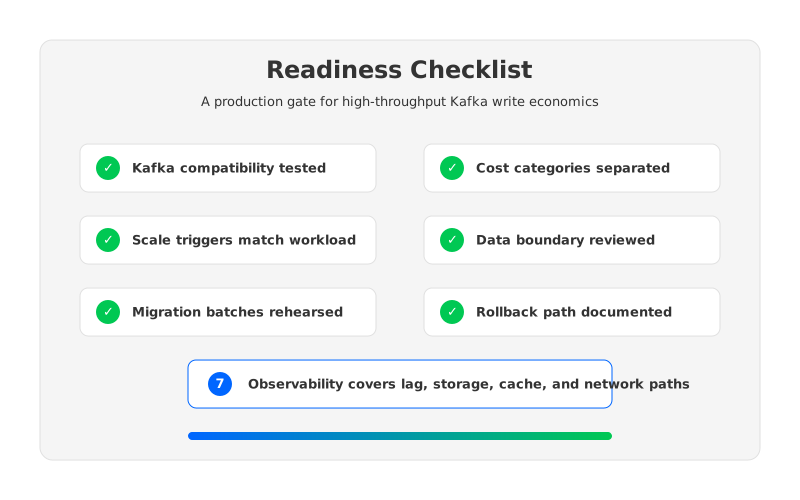
Migration readiness should be strict because Kafka sits between many systems. Score each category from 1 to 5, where 1 means unknown and 5 means tested under production-like conditions. Do not average away a weak score.
| Category | What a 5 looks like |
|---|---|
| Compatibility | Client APIs, versions, transactions, offsets, connectors, and admin tools have been tested. |
| Cost model | Current and target models separate compute, storage, network, and operations with named assumptions. |
| Scaling behavior | Scale-out and scale-in triggers are tied to observed workload signals, not static broker count. |
| Security boundary | Data path, management path, IAM roles, encryption, and network access are reviewed. |
| Migration plan | Topic batches, dual-run, offset validation, producer cutover, consumer cutover, and rollback are documented. |
| Observability | Lag, write throughput, broker load, storage path behavior, cache behavior, and cross-AZ traffic are visible. |
The scorecard gives FinOps a cost model, SRE a rollback gate, security a boundary review, and platform engineering a compatibility test plan. It also keeps AutoMQ or any alternative from being evaluated as a slogan. The workload decides whether the architecture matters.
8FAQ
8.1Is high-throughput Kafka write economics mainly about broker CPU?
Not usually. Broker CPU is one part of the model, but write-heavy Kafka workloads also pull in local storage, replication, network paths, retention, failure headroom, and operational change windows.
8.2Does Tiered Storage solve the same problem as Shared Storage architecture?
No. Tiered Storage moves older log segments to remote storage, reducing local disk pressure for historical data. Shared Storage architecture changes where durable data lives, making brokers less dependent on local persistent storage.
8.3What should FinOps teams ask first?
Ask for a cost model that separates compute, storage, network, and operations. Then ask which categories change under the proposed architecture and which categories are only being moved to a different line item.
8.4What should SRE teams validate first?
Validate compatibility, observability, failure recovery, and rollback. A cost-efficient write path is not useful if the team cannot see lag, storage latency, broker saturation, or cutover progress.
8.5Where does AutoMQ fit?
AutoMQ fits when teams want Kafka-compatible behavior but need Shared Storage architecture, stateless brokers, independent compute/storage scaling, Zero cross-AZ traffic, and customer-controlled deployment boundaries through AutoMQ BYOC or AutoMQ Software.
9Turning the search into a platform decision
The search for high throughput write economics kafka starts with a bill, but it should end with an architecture model. If your cost curve is stale topics, fix ownership. If it is oversized brokers, right-size them. If it is historical replay, evaluate Tiered Storage. If high writes keep forcing broker-local storage, replica traffic, and long reassignment windows, test whether Shared Storage architecture changes the operating model.
For teams that already see compute-storage coupling, the next step is a workload-specific proof of concept. Use the same producer profile, retention policy, client placement, Availability Zone layout, and rollback requirements that make the current cluster expensive. To evaluate AutoMQ against that workload, start with the AutoMQ BYOC entry point.
10References
- Apache Kafka documentation
- Apache Kafka operations: KRaft
- Apache Kafka operations: Tiered Storage
- Apache Kafka Connect overview
- AutoMQ architecture overview
- AutoMQ S3Stream overview
- AutoMQ compatibility with Apache Kafka
- AutoMQ eliminate inter-zone traffic overview
- AWS Global Network FAQs: data transfer charges
- AWS Cost and Usage Report: data transfer charges


