
Table of Contents
Table of Contents
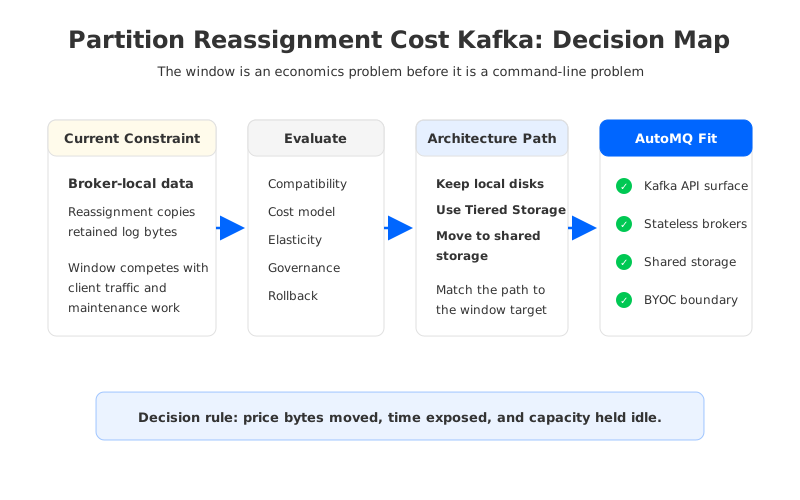
Searches for partition reassignment cost kafka usually start after a team has already felt the problem. A cluster needs more brokers, a storage-heavy node needs to be drained, a hotspot partition keeps burning one broker, or a cloud bill shows data transfer during a maintenance window that nobody had modeled. The command is operational, but the question is economic: how many retained bytes must move, how long will the system sit in a constrained state, and what extra capacity must be held idle?
Apache Kafka treats partitions as the unit of placement, leadership, ordering, and parallelism. That model makes traffic distribution explicit. It also means that when a broker-local deployment changes placement, the work touches storage, network, replication, client impact, and human scheduling at the same time. A reassignment window is where the platform pays for past retention decisions, current traffic, and future safety margin all at once.
The practical thesis is simple: the cost of Kafka partition reassignment is shaped less by the reassignment command than by the storage architecture underneath it. Shared Nothing architecture prices the window around copied data. Shared Storage architecture prices the window around ownership, metadata, a small write-ahead path, and the controls that prove the handoff is safe.
1Why Teams Search for partition reassignment cost kafka
The search phrase sounds narrow, but it usually hides a platform review. FinOps wants to know why a capacity change produced network charges. SREs want to know why adding brokers did not relieve pressure fast enough. Platform owners want to know whether storage-heavy Kafka clusters can scale on the same schedule as compute-heavy workloads. Procurement may frame the question as managed service cost, but the engineering team knows the bill is tied to the operating model.
Traditional Kafka makes several things share the same clock. Retention determines how much data lives on broker storage. Replication determines how many copies must remain healthy. Reassignment determines which broker should own a partition replica after the operation. Client traffic keeps flowing, so the operation consumes the same network and disk surface that production depends on. Slowing the operation protects clients but lengthens the window; speeding it up adds background pressure.
A useful cost model separates four surfaces instead of asking for one blended number:
- Bytes moved: the retained log data that must be copied, rebuilt, or caught up to make the new placement safe.
- Time exposed: the period where the cluster is in a maintenance state, capacity is uneven, or recovery choices are constrained.
- Capacity buffer: extra brokers, disks, network headroom, and operational staffing kept ready because the window is not predictable.
- Cloud bill surface: intra-region data transfer, storage I/O, provisioned disk, object storage requests, private connectivity, and observability volume.
This framing matters because two platforms can both say they support Kafka partition reassignment while producing very different economics. The API behavior may look similar from a client, but the maintenance window can be governed by completely different physical work.
2The Production Constraint Behind the Problem
In Apache Kafka, consumer groups, offsets, transactions, and Kafka Connect integrations depend on stable Kafka semantics, not on a specific cloud storage device. That is why the first requirement for any alternative architecture is compatibility. A lower reassignment cost is not useful if it breaks clients, changes offset behavior, weakens ordering guarantees, or forces teams to rewrite operational tooling.
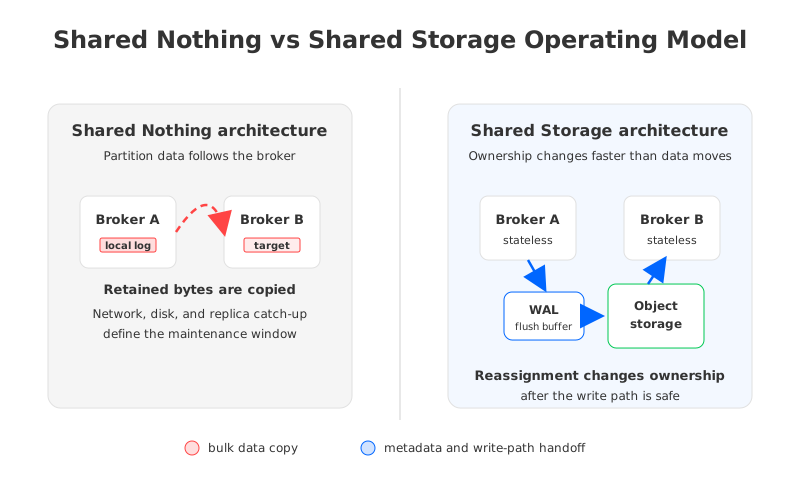
Once compatibility is protected, the hard constraint is broker-local ownership. In a Shared Nothing architecture, each broker manages its own local log storage. Replication through leader and follower replicas gives durability and availability, but it also couples durable bytes to broker placement. When partitions are reassigned, the platform has to make the target replica safe by moving or rebuilding data before it can remove the old placement. That operation is bounded by disk throughput, network throughput, throttling, follower catch-up, and the amount of retained data behind the partition.
This is why retention policy quietly changes reassignment economics. A topic that retains only a small active window is easier to move than a topic keeping long replay history on broker disks. A cluster that stores local data for audit, backfill, feature computation, or incident replay turns scaling into storage logistics. The team may be adding brokers for CPU or network, but the reassignment pays for retained bytes.
Cloud deployment adds another layer. AWS documentation distinguishes data transfer within a Region and states that traffic across Availability Zones can be charged in each direction, while traffic between supported resources in the same Availability Zone can be free. The exact bill depends on service, Region, and architecture. Identify which parts of the reassignment path create cross-zone or cross-service traffic, then test the bill shape under your own placement rules.
3Architecture Options and Trade-Offs
There are several reasonable ways to reduce the pain. The right answer depends on whether the team is trying to reduce retained storage cost, shorten scale-out windows, simplify recovery, preserve self-managed control, or move to a managed operating model.
| Option | What changes | What remains hard | When it fits |
|---|---|---|---|
| Tune broker-local Kafka | Reassignment throttles, partition placement, disk sizing, and operational runbooks | Durable data still lives on brokers, so large retained logs still move during placement changes | Teams with stable traffic, known maintenance windows, and mature Kafka operations |
| Use Apache Kafka Tiered Storage | Older completed segments can be offloaded to remote storage while local storage keeps the active path | The active log path and broker ownership model remain stateful | Teams whose main issue is long retention on broker disks |
| Adopt a managed Kafka service | Day-to-day operations shift to the provider | Cost model, network exposure, quotas, and migration constraints depend on the service | Teams prioritizing operational outsourcing over infrastructure control |
| Evaluate shared storage | Durable data moves out of broker-local ownership; brokers become compute, cache, and leadership nodes | The platform must prove write durability, fencing, cache behavior, and metadata correctness | Teams whose main issue is scale, recovery, and reassignment windows |
Apache Kafka Tiered Storage addresses a real problem: local disks are a poor place to keep every historical byte forever. Moving older data to remote storage can reduce local storage pressure and improve retention economics. But tiering is not the same thing as making brokers stateless. The active path, local log ownership, leader behavior, and reassignment mechanics still matter, especially for data that is not yet safely offloaded or for operations that involve active traffic.
Managed services can reduce staffing load and standardize many operational tasks. The trade-off is that the cost model becomes a contract with the provider's abstraction. You still need to ask how data transfer is metered, how scaling is scheduled, how quotas behave, how private networking is priced, and how migration or rollback works. Outsourcing operations moves architecture economics into a different bill and control boundary.
Shared storage changes the question more directly. Instead of asking how fast retained logs can be copied from broker A to broker B, it asks whether retained data should be broker-owned in the first place. That shift raises engineering questions: durable acknowledgment, stale-writer fencing, metadata coordination, hot-read performance, and object storage behavior hidden from Kafka clients.
4Evaluation Checklist for Platform Teams
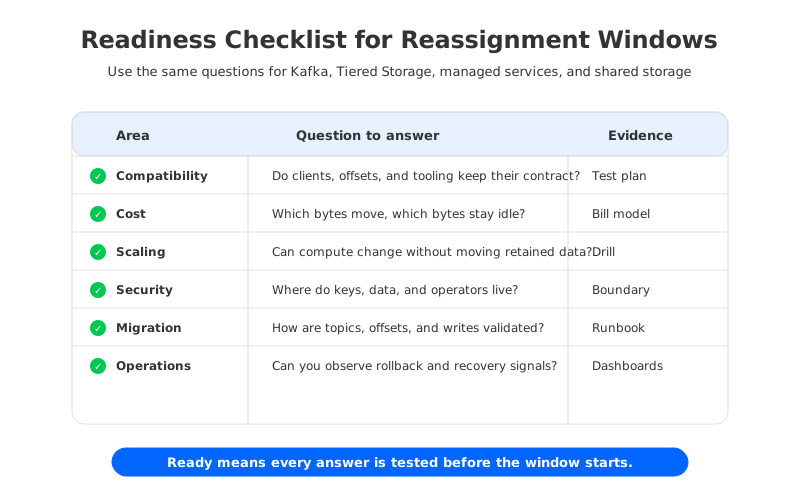
The strongest evaluation starts with a window rehearsal. Pick one topic class that represents real pain: high write throughput, long retention, multi-AZ placement, or a high-value consumer group. Then model the operation as if it were happening during a capacity event, not a quiet lab exercise. The goal is to learn what the platform does under pressure.
Use this checklist before selecting the path:
- Compatibility: Verify producer, consumer, admin, transaction, Kafka Connect, Schema Registry, monitoring, and ACL behavior against the client versions you actually run.
- Cost: Split storage, compute, network, request, observability, and support costs. Reassignment cost should be visible as bytes, time, and buffer, not buried in a monthly average.
- Elasticity: Test scale-out and scale-in separately. Scale-out asks how fast new capacity helps. Scale-in asks what happens to the data and leadership that leave.
- Security and governance: Confirm where data, metadata, keys, logs, metrics, operators, and control-plane actions reside.
- Migration and rollback: Prove topic sync, offset handling, dual-write or cutover strategy, validation, and rollback before declaring the window acceptable.
- Observability: Track leader movement, partition lag, broker I/O, object storage errors, client latency, reassignment progress, and billing indicators during the test.
The checklist also prevents a common mistake: measuring only the happy path. A reassignment window exposes the ownership model. If the test does not include throttling, a slow broker, a consumer lag spike, or a rollback decision, it has not tested the economic risk behind the search query.
5How AutoMQ Changes the Operating Model
After the neutral evaluation, AutoMQ belongs in the shared-storage category. AutoMQ is a Kafka-compatible streaming platform that keeps the Kafka protocol surface while replacing broker-local persistent log storage with S3Stream, WAL (Write-Ahead Log) storage, data caching, and S3-compatible object storage. The important point is that durable stream data is no longer permanently owned by one broker's local disk.
That changes partition reassignment from bulk data logistics into controlled ownership handoff. AutoMQ Brokers process Kafka requests, own leadership at runtime, cache data, and coordinate with the Controller, but persistent stream data is stored in shared storage. During reassignment, the system does not copy the full retained log between broker disks. It makes the write path safe, coordinates metadata, and moves traffic ownership.
AutoMQ documentation describes the architecture as Shared Storage architecture built around S3Stream, WAL storage, S3 storage, and data caching. WAL storage protects acknowledgment and recovery, while object storage acts as the main durable layer. In AutoMQ Open Source, S3 WAL is the supported WAL option. AutoMQ commercial editions can use other WAL storage types depending on deployment requirements, such as Regional EBS WAL or NFS WAL. That distinction matters because latency, availability domain, and storage operations differ by WAL type.
The economic effect shows up in three places. First, reassignment windows become less dependent on retained log size because retained data is already in shared storage. Second, compute and storage can be scaled more independently, so a compute-heavy capacity event does not automatically require moving retained bytes. Third, in S3-based multi-AZ designs, AutoMQ's zero cross-AZ traffic model can reduce the replication-style inter-zone traffic that traditional broker-to-broker replication creates. That claim still needs workload validation, but the mechanism is architectural rather than cosmetic.
AutoMQ BYOC and AutoMQ Software also matter for governance. In AutoMQ BYOC, the control plane and data plane run in the customer's cloud account or VPC, and customer business data remains in the customer environment. In AutoMQ Software, the same boundaries apply to private data center deployment. That is relevant for teams that want shared-storage economics without moving every workload into a fully hosted external service.
The right test is direct: take the same topic profile used in your Kafka reassignment rehearsal and run it through an AutoMQ proof of concept. Measure client compatibility, reassignment behavior, handoff latency, object storage behavior, observability, and cloud billing signals. If the old window was priced by copied retained bytes, the new window should be priced by ownership handoff safety.
6FAQ
6.1What is the biggest hidden cost in Kafka partition reassignment?
The hidden cost is usually the combination of retained bytes and time exposed. Large retained logs extend the operation, while throttling, network pressure, follower catch-up, and human supervision keep capacity tied up during the window.
6.2Does Apache Kafka Tiered Storage remove reassignment cost?
It can reduce local storage pressure for older completed segments, which helps some retention-heavy workloads. It does not fully remove broker statefulness or make reassignment equivalent to a metadata-only operation.
6.3Is shared storage always the right answer?
No. Shared storage is worth evaluating when broker-local data ownership is the root problem: slow scaling, expensive recovery, difficult scale-in, or long reassignment windows. Teams with stable clusters and predictable maintenance may get enough value from tuning broker-local Kafka.
6.4How should I model partition reassignment cost kafka for a business case?
Build a small model with five inputs: retained bytes per moved partition, expected background traffic, reassignment throttle, cloud network pricing for the path involved, and staffing or risk cost for the maintenance window. Then compare that model with a rehearsal rather than relying only on estimates.
6.5Where does AutoMQ fit in the decision?
AutoMQ fits when the team wants Kafka compatibility, shared storage, stateless brokers, independent compute and storage scaling, and customer-controlled deployment boundaries. It should be evaluated with the same client tests, failure drills, and billing checks used for any Kafka-compatible platform.
The search that began with partition reassignment cost is asking whether your Kafka operating model charges you every time ownership changes. If the answer is yes, test a platform where retained data is not broker-local state. Start with the same reassignment runbook and compare it against AutoMQ's shared-storage model: try AutoMQ or talk to the team.
7References
- Apache Kafka documentation: Operations and partition reassignment
- Apache Kafka documentation: Tiered Storage
- Apache Kafka documentation: Consumers and consumer groups
- Apache Kafka documentation: KRaft
- AutoMQ documentation: Architecture overview
- AutoMQ documentation: Partition Reassignment in Seconds
- AutoMQ documentation: Eliminate cross-AZ traffic
- AWS documentation: Amazon EC2 On-Demand Pricing, data transfer within the same AWS Region


