
Table of Contents
Table of Contents
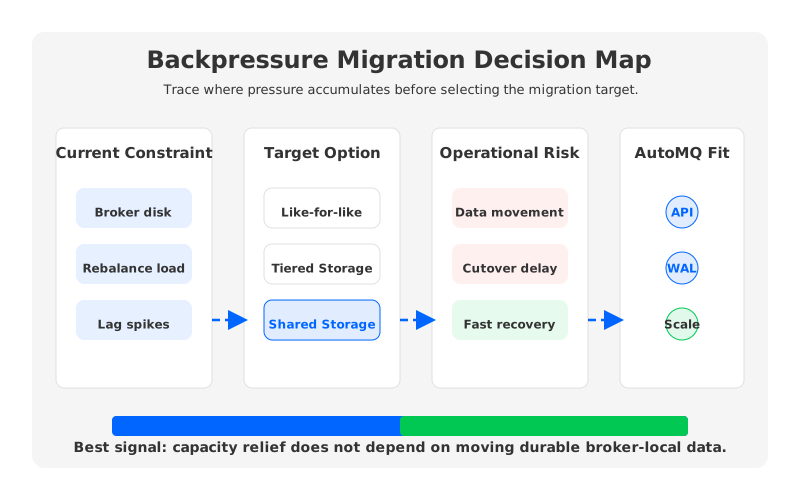
Teams usually search for backpressure migration kafka after the migration plan has stopped looking like a clean sequence of tickets. The target cluster exists, replication is running, dashboards are open, and then a normal production event happens: a consumer group slows down, a producer retry storm starts, a broker hits disk pressure, or a catch-up workload competes with live traffic. The question is no longer "can we copy records?" It is "what happens to pressure while two Kafka environments are connected?"
That distinction matters because backpressure is not a single metric. In Kafka, pressure can appear as producer latency, request queue growth, broker I/O saturation, replication lag, consumer lag, fetch throttling, or offset movement that no longer matches the team's cutover assumptions. During migration, the same workload can stress the source cluster, the replication path, the target cluster, and the applications that are being moved in stages. A safe plan treats backpressure as a system behavior, not as a lag number to watch at the end.
The core thesis is simple: a migration target with broker-local durable storage inherits many source-cluster pressure points, while a Kafka-compatible target with stateless brokers changes where pressure accumulates and how teams relieve it. Compatibility testing, capacity planning, observability, and rollback still matter, but the operating model behind them changes.
1Why teams search for backpressure migration kafka
A Kafka migration creates a temporary but demanding topology. The platform team runs the source system, the target system, and the bridge between them. Producers may still write to the source while records are copied to the target; consumers may be tested against the target while production consumers still commit offsets on the source. Some teams migrate by topic, others by application tier, and some keep a rollback window open until downstream processors prove stable.
This overlap is necessary, but it adds a second path for pressure to travel. A slow sink consumer can increase lag on the target. A replication task that catches up from an old offset can increase read load on the source. A producer cutover can reveal target-side quota, authentication, DNS, or broker capacity issues. If the team reacts by adding brokers to a Shared Nothing architecture, the work may trigger partition reassignment and local data movement at the exact moment when the migration needs predictability.
Backpressure during migration is often misclassified as an application issue. Sometimes it is. A slow consumer will remain slow after any platform move. But migration-specific pressure often comes from the infrastructure shape around the workload:
- The source cluster must serve live producers, live consumers, and migration reads at the same time.
- The target cluster must absorb replicated writes, validation reads, and early production traffic before the migration is complete.
- The bridge must preserve ordering and offset expectations while handling retries, throttling, and network faults.
- The rollback plan must stay valid even when one side is ahead, behind, or temporarily unhealthy.
Those are platform constraints. Application teams can tune consumers, but they cannot make broker-local storage easier to rebalance during a stressed migration. That is where architecture enters the discussion.
2The production constraint behind the problem
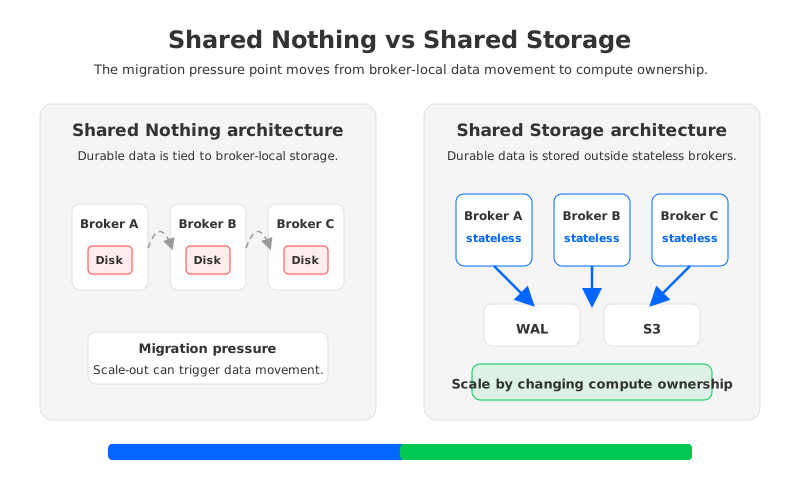
Traditional Kafka uses a Shared Nothing architecture. Each broker owns local log segments for the partitions it hosts, and reliability comes from replication across brokers. This model has served production systems well for years because it keeps the log close to the broker and gives operators explicit control over replication, retention, and placement. The trade-off is that storage ownership is tied to broker ownership.
That coupling shows up during migration in four ways. Capacity is lumpy: adding brokers is not the same as adding usable capacity unless partitions and leaders move. Rebalancing can compete with migration traffic because reassignment reads and writes data while the bridge is already active. Disk pressure becomes a cutover risk when retained data, replay, and catch-up reads arrive together. Failure recovery is also heavier because replacing a broker means restoring or reconstructing local state through replication and reassignment.
Apache Kafka's own concepts make this visible. Consumer groups coordinate partition ownership, offsets define progress, transactions and idempotent producers rely on broker-side semantics, and Kafka Connect tasks add their own retry and offset behavior. A migration plan that keeps Kafka-facing compatibility must respect those contracts. It cannot treat the broker as a generic queue endpoint.
The hardest incidents happen when several contracts are stressed at once. Imagine an ordered analytics topic, a stream job tracking offsets, a sink connector, and a bridge copying records into a target cluster. If the connector slows, lag grows. If the bridge retries, source reads increase. If the target broker is full, produce latency rises. If the team adds brokers and triggers reassignment, the target spends resources moving data instead of absorbing the migration.
3Architecture options and trade-offs
There is no universal answer to Kafka migration pressure. The right target depends on why the team is migrating. A procurement-driven move may fit a like-for-like managed Kafka target. A compatibility-driven move must preserve protocol behavior and offset semantics. A move driven by scaling, broker replacement, retention, or recovery requires a harder look at storage architecture.
The neutral evaluation starts with the pressure boundary. Ask where the system stores durable data, what work happens when capacity changes, and how the platform recovers when a broker disappears. Then ask whether those behaviors are acceptable during the migration window, not only after the final cutover.
| Evaluation area | What to test during migration | Why it affects backpressure |
|---|---|---|
| Client compatibility | Producers, consumers, transactions, offset commits, Kafka Connect, and admin tooling | A compatible API reduces application churn, but compatibility must include behavior under retry and throttling. |
| Capacity elasticity | Add and remove broker capacity while replication and validation reads are active | If scaling requires heavy data movement, capacity relief can arrive too late. |
| Storage model | Local broker disks, Tiered Storage, or Shared Storage architecture | The storage model decides whether retention and reassignment compete with migration traffic. |
| Offset and rollback design | Consumer group progress, cutover order, and the point where rollback stops being safe | Backpressure can make one side lag behind, so rollback must be defined by observed state. |
| Network and security | VPC routing, authentication, ACLs, private connectivity, and cross-zone paths | A migration bridge can expose network limits that steady-state Kafka never hit. |
| Observability | Source lag, target lag, bridge throughput, broker queues, storage latency, and client errors | Lag alone is late evidence. Operators need pressure signals before clients time out. |
This framework separates data copying from operating-model change. A replication tool can move records; a migration target changes what happens when traffic spikes, a broker fails, retention expands, or a workload replays old data. Platform teams should evaluate both.
4Evaluation checklist for platform teams
The checklist below assumes the target speaks Kafka APIs well enough to run production clients, then asks whether the migration can survive normal production pressure.
-
Define the backpressure budget before the bridge starts. Pick limits for source read load, target produce latency, replication lag, consumer lag, and error rates. Base them on workload SLOs and source-cluster measurements.
-
Classify topics by pressure behavior. High-write topics, long-retention topics, compacted topics, transactional workloads, and connector-heavy topics fail differently. Moving them in one wave hides which pressure source caused the incident.
-
Reserve migration headroom explicitly. If the bridge consumes target capacity, size for live traffic plus replication and validation. AutoMQ's migration prerequisites recommend reserving additional capacity during Kafka Linking migrations because the migration path consumes cluster resources.
-
Test scale-out while the migration is under load. A target that scales only when idle is not enough. Add broker or compute capacity while records are being copied and consumers validate the target.
-
Prove offset behavior with real consumers. Use representative consumers, not only synthetic readers, and verify how they resume after pausing, switching, and rolling back.
-
Make rollback a state machine, not a meeting decision. Define the last safe rollback point for each topic or application. Once producers write to the target or consumers commit target-only progress, the rollback plan changes.
Migration failures are rarely caused by one missing command. They usually come from an unmodeled pressure path: replay becomes a storage problem, validation becomes a quota problem, or scale-out becomes a data movement problem.
5How AutoMQ changes the operating model
After the neutral evaluation, AutoMQ becomes relevant as a Kafka-compatible streaming platform built around Shared Storage architecture and stateless brokers. AutoMQ keeps the Kafka protocol surface while moving durable stream data away from broker-local disks and into S3-compatible object storage through S3Stream and WAL storage. The key migration point is that durable partition data is no longer owned by a specific broker's local disk.
That changes the response to backpressure. If target-side compute is saturated, added broker capacity can become useful without receiving a full local copy of historical partition data first. If a broker fails, recovery is less about rebuilding local storage and more about reassigning ownership and serving data from Shared Storage architecture and cache. If retention grows during validation, the durable data layer is object storage rather than broker-local volumes pre-sized for the worst week of migration.
AutoMQ Kafka Linking connects this operating model to cutover. Its public documentation describes byte-to-byte replication, synchronized consumer progress, and a producer proxy path for non-stop migration. For a backpressure-focused plan, those details preserve the migration state model while the target cluster's stateless broker model changes capacity and recovery mechanics underneath.
Governance also belongs in the evaluation. In AutoMQ BYOC, the control plane and data plane run in the customer's cloud environment, and customer message data stays within that boundary. That does not replace security review, but it gives platform, security, and compliance teams a clearer boundary to assess.
The architecture still needs workload testing. WAL type, cache behavior, object storage configuration, network paths, topic settings, and client versions all affect production behavior. Stateless brokers are not a reason to skip migration discipline; they make scaling, broker replacement, reassignment, and recovery less dependent on moving durable data between brokers.
6A readiness scorecard for the final review
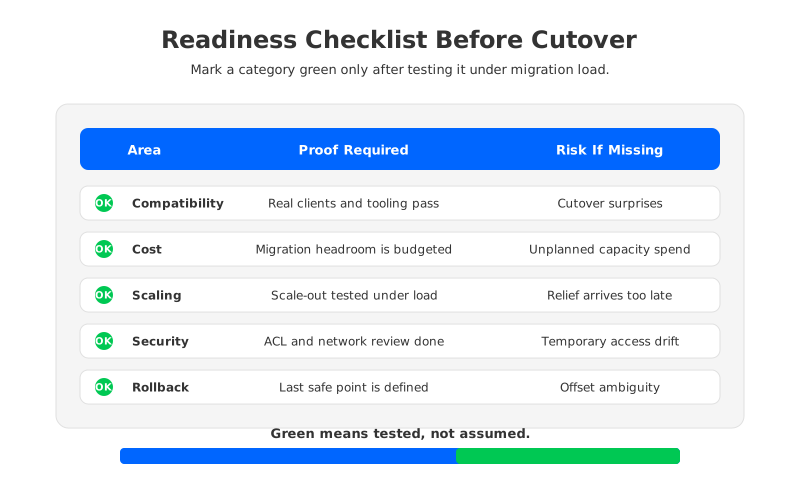
Before cutover, score each area green, yellow, or red. Green means tested under migration load. Yellow means understood but dependent on a manual runbook or narrow margin. Red means assumed.
| Area | Green signal | Red signal |
|---|---|---|
| Compatibility | Real clients pass produce, consume, offset, transaction, and connector tests. | Only synthetic clients were tested. |
| Backpressure | Source, bridge, target, and consumer lag limits are defined and alerting works. | The team watches only end-to-end lag. |
| Scaling | Capacity can be added during replication without heavy disruption. | Scale-out requires large data movement during the migration window. |
| Rollback | Each wave has a documented last safe rollback point. | Rollback depends on manually reconstructing offsets after pressure appears. |
| Security | Network, ACL, authentication, and data boundary reviews are complete. | Temporary bridge permissions are broader than the steady-state design. |
| Operations | Broker failure, slow storage, and client retry scenarios have been rehearsed. | The runbook covers only the happy path. |
The scorecard keeps the conversation grounded. A migration is ready when the team understands how pressure moves through the system and has tested the actions that relieve it. Stateless brokers can make those actions faster and less storage-bound, but backpressure still has to be a first-class design constraint.
If your Kafka migration is blocked by broker-local storage, slow reassignment, or unclear rollback boundaries, evaluate the target architecture before you expand the project plan. AutoMQ's Kafka-compatible Shared Storage architecture is designed for that class of problem, and you can explore the BYOC path here: start with AutoMQ.
7FAQ
7.1What does backpressure mean in a Kafka migration?
Backpressure is the system's response when one part of the pipeline cannot keep up. During migration, it can appear in producers, brokers, replication tasks, consumers, connectors, storage, or network paths. Treat it as a cross-system condition, not only as consumer lag.
7.2Do stateless brokers eliminate Kafka migration risk?
No. Stateless brokers change the storage and recovery model, but teams still need compatibility testing, capacity planning, observability, security review, and rollback design. The benefit is that scaling and broker replacement are less tied to moving durable partition data between brokers.
7.3Is Tiered Storage the same as Shared Storage architecture?
No. Tiered Storage can move older data to object storage while brokers still rely on local storage for active log segments. Shared Storage architecture uses object storage as the durable data layer behind stateless brokers, which changes scaling and recovery behavior more directly.
7.4What should be tested before moving producers?
Test real producer configs, idempotence, transactions if used, ACLs, retries, DNS, bootstrap behavior, quotas, and target-side produce latency under migration load. Also define the rollback point before producers write directly to the target.
7.5Where does AutoMQ fit in a Kafka migration checklist?
AutoMQ fits after the team has defined compatibility, pressure, rollback, and governance requirements. It is most relevant when the migration goal is not only to move records but also to change the broker storage and operating model underneath Kafka-compatible workloads.


