
Table of Contents
Table of Contents
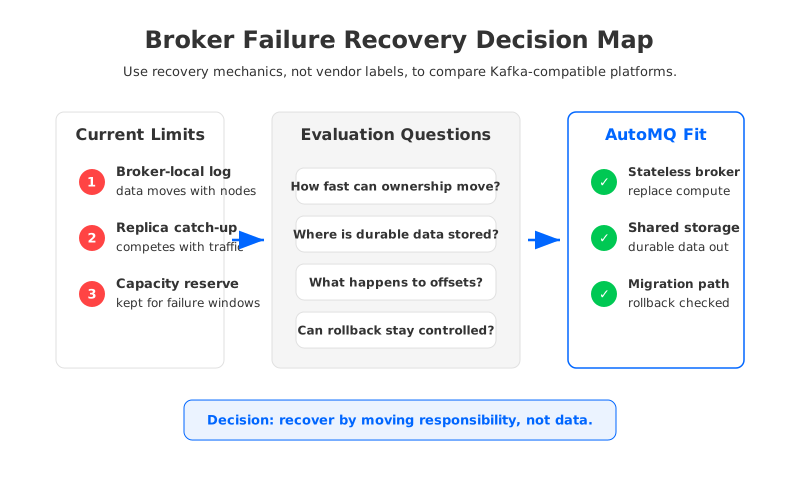
Searches for broker failure recovery kafka usually start after a bad operational moment. A broker failed, leader elections happened, lag moved in the wrong direction, and a team had to decide whether the cluster was recovering or entering a longer rebuild cycle. The hard part is understanding what work the system must finish before the platform is safe again.
Kafka operators already know the normal vocabulary: leaders, followers, in-sync replicas, offsets, consumer groups, retention, and reassignment. What is harder to see during an incident is the architectural coupling behind those terms. In a traditional Apache Kafka deployment, a broker is not only a request-processing node. It is also a storage owner. When that broker fails, the recovery path must account for leadership, replica health, local log state, network traffic, capacity headroom, and client behavior at the same time.
That is why broker failure recovery is an architecture question, not only an alerting question. Better runbooks help, but they cannot erase the work created by broker-local storage. If durable data is tied to a machine or disk, recovery is partly a data placement problem. If durable data lives outside the broker, recovery becomes more about moving responsibility, warming cache, preserving metadata correctness, and validating client semantics.
1Why teams search for broker failure recovery kafka
The search term is narrow, but the production pressure behind it is broad. Platform teams are rarely asking, "What is a broker?" They are asking whether a failed broker will create a customer-visible incident, whether consumer lag will recover inside the SLO window, whether producers will see retries or timeouts, and whether the team can replace capacity without triggering a second wave of data movement.
The same concern appears during migration planning. A team evaluating a Kafka-compatible platform wants to know whether the architecture changes recovery mechanics or only the management interface. Managed operations can improve patching, monitoring, and support escalation, but the storage model still determines what happens when a broker disappears.
For a production review, the useful question is specific: after a broker failure, what must be rebuilt, moved, or revalidated before the cluster is healthy? A reliable answer usually covers four areas:
- Metadata and leadership. Which partitions need new leaders, and how quickly can clients discover the updated metadata?
- Durable log state. Is the authoritative log already available to another compute node, or does it need to be copied, replicated, or rebuilt?
- Client progress. Do producers, consumers, transactions, and consumer group offsets keep their expected Kafka behavior?
- Operational capacity. Does recovery consume the same network, disk, and CPU headroom needed to serve live traffic?
Those questions are more useful than a generic promise of high availability. They force the team to separate "the service stayed reachable" from "the system recovered without creating a hidden backlog."
2The production constraint behind the problem
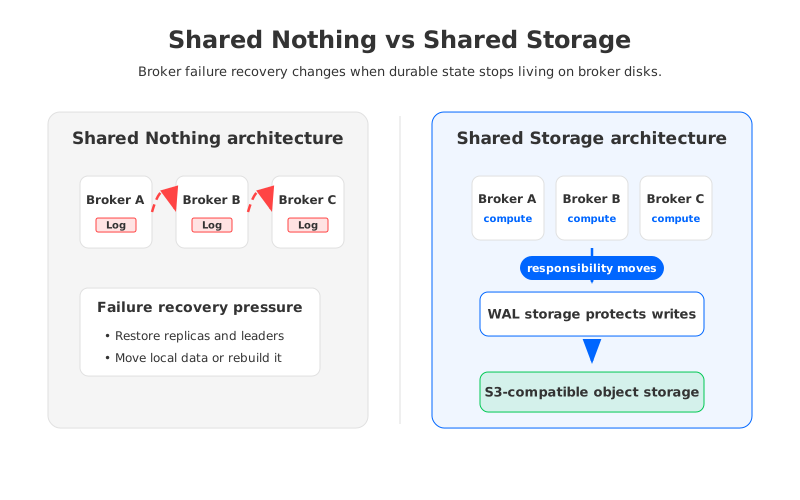
Traditional Kafka follows a Shared Nothing architecture. Each broker manages local log storage, and replicas are placed across brokers so the cluster can survive node or disk failure. This model is mature and well understood, and it remains a strong fit for many stable workloads. Its trade-off is that availability is achieved by coordinating multiple copies of broker-owned data.
That trade-off becomes visible during failure recovery. When a broker fails, the cluster must elect leaders for affected partitions and continue serving client traffic. If replicas are healthy and caught up, the first recovery step can be quick. The deeper work starts when the team replaces the failed broker, restores the desired replication layout, or handles partitions that need catch-up. Recovery traffic can compete with production reads and writes, and the team often keeps spare capacity because the worst day is not the average day.
Cloud infrastructure changes the economics of that pattern. Cross-Availability Zone traffic, block storage sizing, and over-provisioned compute appear as recurring line items and operational constraints. AWS documents data transfer pricing separately from compute and storage, which is why multi-AZ traffic patterns deserve explicit modeling. The exact bill depends on region, topology, and workload, so model your own traffic instead of copying another cluster's benchmark.
Tiered Storage can reduce pressure from long retention by moving older log segments to remote storage. It does not make brokers stateless. The active write path, recent data, leader behavior, and recovery of the hot set still involve broker-local responsibilities. That distinction matters because many failure incidents are about hot partitions and current traffic, not only archived segments.
3Architecture options and trade-offs
A practical evaluation should compare operating models rather than product names. The first option is to keep traditional Kafka and improve discipline around capacity, placement, replication, quotas, and incident response. This is often right when workloads are stable, the team has strong Kafka expertise, and broker replacement time is already inside the business recovery target. The trade-off is continued engineering around broker-local storage.
The second option is managed Kafka with a familiar Shared Nothing architecture underneath. This can reduce provisioning, upgrade, and maintenance burden. It may not change the failure mechanics that matter most to a platform SRE: local storage still influences reassignment, replica catch-up, and capacity reserve. Managed service boundaries also need review because incident visibility, support, networking, and data residency shape recovery.
The third option is a Kafka-compatible Shared Storage architecture. In this model, brokers remain responsible for Kafka-facing compute: request handling, partition leadership, routing, caching, and coordination. Durable stream data is placed in shared storage rather than being treated as long-lived local broker state. Broker failure recovery changes because the replacement broker does not need to become the new owner of a large local log estate before it can take useful work.
This is not a free pass. Shared storage designs must prove their write path, metadata consistency, cache behavior, object storage access pattern, and migration story. A stateless broker still has connections, queues, leadership assignments, metrics, caches, and in-flight work. The narrower claim is that the broker is not the long-term owner of irreplaceable durable log data.
| Evaluation area | Traditional broker-local Kafka | Shared storage with stateless brokers |
|---|---|---|
| Broker replacement | Replace capacity, then restore placement and replica balance. | Replace compute, then move ownership and warm runtime state. |
| Recovery bottleneck | Local disk, replica catch-up, and network headroom can dominate. | WAL, metadata, cache, and shared storage access pattern dominate. |
| Cost visibility | Compute, block storage, and cross-AZ traffic are tightly coupled. | Compute, WAL storage, object storage, and request patterns can be modeled separately. |
| Migration risk | Low application change if staying on Kafka, but storage model remains. | Requires compatibility validation, offset planning, and rollback design. |
| Team boundary | Kafka operators own most recovery mechanics. | Platform, cloud, and security teams share the architecture review. |
The table is intentionally neutral. Stateless brokers are attractive when the root problem is broker-local data ownership. They are less decisive when the main issue is application schema quality, badly tuned clients, insufficient observability, or an unclear ownership model for topics and consumer groups.
4Evaluation checklist for platform teams
Before choosing a platform, build a failure recovery checklist that SREs, application owners, security, and FinOps can all read. It should be short enough for design review and concrete enough to become a test plan.
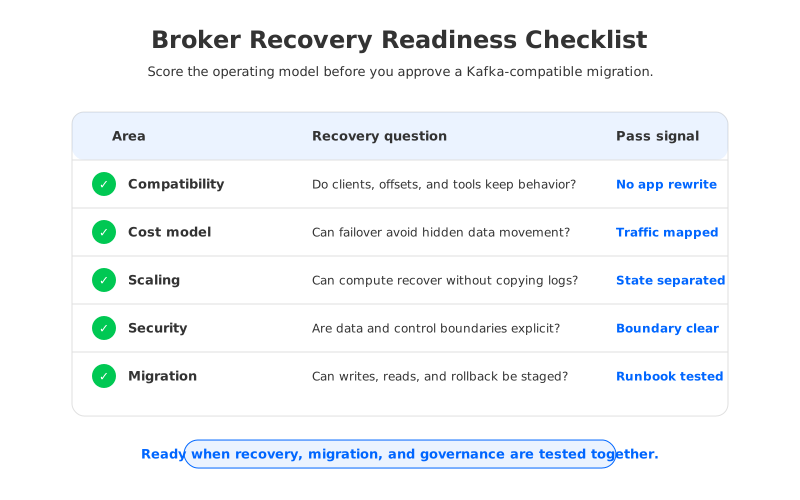
Start with compatibility. Apache Kafka's documentation defines behavior across producers, consumers, consumer groups, transactions, KRaft metadata, and client configuration. A Kafka-compatible target should preserve the behavior your applications rely on, not merely accept the same bootstrap address. Test representative producers, consumers, transactions if you use them, offset commits, rebalances, admin tooling, monitoring, and connector paths.
Then model recovery cost. Do not stop at broker count. Map what happens to write traffic, read traffic, replication or shared-storage traffic, WAL storage, object storage requests, private networking, and cross-AZ transfer during a failure. A platform can look cost-effective during steady state and still surprise you during recovery if catch-up traffic or remote reads are not modeled.
The migration checklist should also include rollback. Migration plans often over-focus on data sync, client cutover, and post-migration validation. Broker failure recovery planning needs the reverse path too. If a target cluster has an issue during cutover, can producers return to the source path, consumers resume from consistent offsets, and partial topic promotion be handled by the runbook?
Use a scorecard with three outcomes instead of a binary pass/fail:
- Ready for production test. Compatibility, recovery, observability, security boundaries, and rollback have been tested with realistic traffic.
- Ready for limited workload. The architecture fits, but only a subset of topics, clients, or failure cases has been validated.
- Not ready. The team cannot explain the recovery path, or the migration design has no controlled rollback.
This scoring avoids a common trap. A platform can pass a quick functional test and still fail the operational review because the team has not tested the exact failure mode that motivated the project.
5How AutoMQ changes the operating model
Once the neutral framework is clear, AutoMQ becomes relevant as a Kafka-compatible, cloud-native streaming platform built around Shared Storage architecture. AutoMQ keeps Kafka protocol and ecosystem compatibility while changing the storage layer underneath: AutoMQ Brokers handle Kafka-facing compute, while S3Stream places durable stream data in WAL storage and S3-compatible object storage.
That changes the recovery model in a specific way. Broker replacement and partition reassignment are less dominated by copying retained partition data between broker-local disks. The cluster still coordinates metadata, leadership, cache warm-up, and workload placement, but durable data is not treated as a local asset that must move with the failed broker. Operationally, the failed compute node is closer to a replaceable worker than a storage owner.
WAL storage is the important bridge in that design. Writes become durable through the WAL path before data is organized in object storage for longer-term retention. Different WAL types have different deployment and latency trade-offs, so production review should name the WAL type rather than treating "shared storage" as one generic implementation. This is also where cloud and security teams should review bucket policies, network paths, encryption, observability, and failure domains.
AutoMQ's deployment boundaries matter for regulated or infrastructure-conscious teams. AutoMQ BYOC runs the control plane and data plane in the customer's cloud account and VPC, while AutoMQ Software is designed for private environments. The team can map where brokers, WAL storage, object storage, metrics, logs, and management components live.
Migration is part of the recovery story, not a separate project. AutoMQ Kafka Linking is designed to help migrate Kafka workloads while preserving topic data and consumer progress semantics. For a broker recovery evaluation, the key point is whether the migration plan controls writes, reads, offsets, and rollback under the same discipline used for a failure runbook.
6A production-ready broker recovery scorecard
Use the following scorecard before approving a migration or architecture change. It is deliberately practical; every item should map to a test, dashboard, or runbook section.
| Readiness item | Evidence to collect | Why it matters |
|---|---|---|
| Client compatibility | Test producers, consumers, admin tools, and connectors against real versions. | Recovery is not successful if applications need emergency code changes. |
| Offset behavior | Validate consumer group progress before, during, and after cutover. | Lag recovery and rollback depend on consistent progress tracking. |
| Failure drill | Kill or isolate a broker under representative traffic. | Architecture claims need incident-shaped evidence. |
| Capacity headroom | Measure live traffic plus recovery traffic. | Recovery work should not starve production workloads. |
| Storage path | Document WAL type, object storage policy, and access pattern. | Durable data placement defines the real recovery boundary. |
| Observability | Alert on leadership, lag, WAL, cache, storage, and client errors. | The team needs to distinguish recovery from hidden degradation. |
| Rollback | Rehearse source fallback, client routing, and data consistency checks. | A migration without rollback is an availability risk. |
The scorecard gives teams a cleaner comparison. Instead of asking whether a vendor has "fast recovery," ask what the platform must do after a broker fails. If the answer still depends on copying a large local log estate, the recovery model remains broker-local. If the answer depends on moving compute responsibility while durable data remains available through shared storage, the operating model has changed.
7FAQ
7.1Does stateless mean an AutoMQ Broker has no state at all?
No. Stateless brokers still maintain runtime state such as connections, request queues, metadata views, cache, metrics, and leadership assignments. In this context, stateless means the broker is not the long-term owner of durable Kafka log data on local disk.
7.2Is Tiered Storage the same as stateless broker architecture?
No. Tiered Storage can move older segments to remote storage, but the active write path and recent data can still be broker-local. Stateless broker architecture changes where durable stream data lives for the operating model as a whole.
7.3What should a Kafka migration checklist include for recovery?
Include client compatibility, offset behavior, producer cutover, consumer group progress, rollback routing, failure drills, observability, WAL or storage configuration, and security boundaries. The migration is not production-ready until the team has tested both cutover and recovery paths.
7.4When should a team evaluate AutoMQ?
Evaluate AutoMQ when Kafka broker recovery, scaling, retention, or cloud cost is constrained by broker-local storage, and when the team still needs Kafka-compatible APIs and ecosystem behavior. It is most relevant after the team has defined compatibility, recovery, governance, and rollback requirements.
If your team is evaluating Kafka-compatible recovery architecture, test AutoMQ with your own broker failure drills, client versions, and rollback requirements: start an AutoMQ BYOC evaluation.


