
Table of Contents
Table of Contents
Someone searching for leader election risk kafka is rarely asking an academic question. A broker failed during a peak hour, a partition leader moved at the wrong moment, a consumer group fell behind, or a migration plan exposed an uncomfortable dependency on where Kafka data lives. The visible symptom is leader election. The production risk is broader: can the platform move ownership of partitions without turning storage recovery, client retry behavior, network paths, and rollback into one tangled incident?
Apache Kafka has a strong reliability model when replication, acknowledgments, in-sync replicas (ISR), metadata quorum, and clients are configured with care. The risk appears when a team treats leader election as a narrow controller event, even though it can collide with broker-local logs, replica catch-up, under-provisioned surviving brokers, cross-Availability Zone (AZ) traffic, and application owners who need to know where consumers resume.
The useful question is not "can Kafka elect another leader?" It is "what else must be true for that election to be uneventful?" That is where architecture begins to matter.
1Why teams search for leader election risk kafka
The search often starts after a routine event feels bigger than it should: a broker restart exceeds its window, a leader imbalance pushes hot partitions onto too few brokers, an AZ impairment moves traffic into an untested path, or a migration dry run leaves application owners unsure whether offsets and rollback behavior are safe.
Leader election is the part of the failure that everyone can name, but it can distract from the operating model around it. Kafka clients do not care that the controller made a valid decision if the new leader lacks capacity, consumers repeatedly rebalance, or a downstream processor resumes from a point the team cannot explain.
For platform teams, the pressure usually comes from three directions:
- Reliability reviews: SREs need evidence that broker loss, AZ impairment, and maintenance do not break producer and consumer service-level objectives.
- Migration planning: Architects need to know whether a Kafka-compatible platform can preserve client behavior, offsets, security boundaries, and rollback options.
- Cost and capacity audits: FinOps and platform owners need to understand whether storage, replica traffic, and standby capacity are structural costs or tunable settings.
These pressures are connected. If partition leadership is tied to broker-local durable state, recovery planning is also tied to local disk, replica placement, and retained bytes. If brokers are stateless compute units backed by shared storage, the same leader movement has a different failure shape.
2The production constraint behind the problem
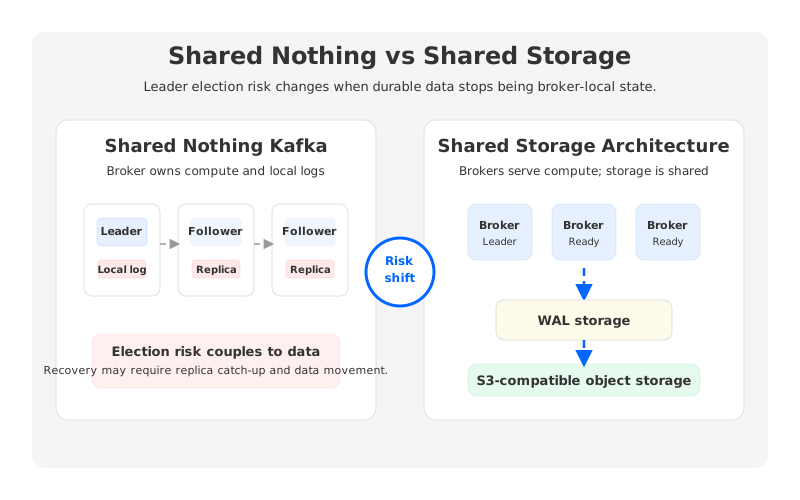
Traditional Kafka follows a Shared Nothing architecture. Each broker owns local or attached storage for its partition replicas. A partition leader handles reads and writes, while followers replicate from that leader and remain eligible for failover when they stay in sync. This design is well understood, battle-tested, and operationally familiar, but it deliberately binds compute placement to durable log placement.
That binding is the core constraint behind leader election risk. When a broker fails, the cluster is reacting to the loss of a process that owned local replicas, page cache, disk queues, network flows, and partition leadership. The controller may elect new leaders quickly, but the surrounding system still has to absorb load, rebuild missing replica state, and keep clients moving through metadata changes.
Several production details decide whether the event stays quiet:
- ISR health: If followers are not caught up, leader election choices narrow and unclean election policies become a data-safety discussion.
- Capacity headroom: Surviving brokers must handle the partitions, connections, reads, and writes that moved away from the failed broker or zone.
- Client configuration: Retry budgets, metadata refresh behavior, idempotence, acknowledgments, and consumer rebalance settings shape application-visible impact.
- Storage recovery: Broker restart, log recovery, replica catch-up, and long-retention topics can stretch the tail of the incident.
- Network locality: Multi-AZ deployments may shift traffic across zones. Cloud providers publish different pricing and networking rules, so the correct answer depends on the selected region and path.
Runbooks help the team execute, but they cannot change the amount of state attached to each broker. If retained data and active leadership are tied to broker-local disks, leader election risk includes data movement, disk pressure, and placement skew.
3Architecture options and trade-offs
The first option is to keep the existing Shared Nothing design and raise the operational bar. This can be sound when growth is predictable, retention is bounded, topic count is controlled, and the team has mature tooling for reassignment, rack awareness, capacity planning, and client validation. The trade-off is that broker-local durable state remains part of every scaling, recovery, and maintenance decision.
The second option is Tiered Storage. Apache Kafka Tiered Storage moves older log segments to remote storage while keeping the active write path on broker-local storage. It can help with long retention and catch-up reads, but it does not make brokers stateless. Leader election still depends on active local replicas, broker capacity, metadata behavior, and the near-tail serving path.
The third option is a Kafka-compatible Shared Storage architecture. Durable stream data lives in shared object storage, while brokers keep Kafka protocol handling, partition leadership, caching, and request processing. The design goal is to decouple compute from durable storage so broker replacement and partition reassignment depend less on copying retained logs between disks.
The comparison should stay neutral until the workload is clear:
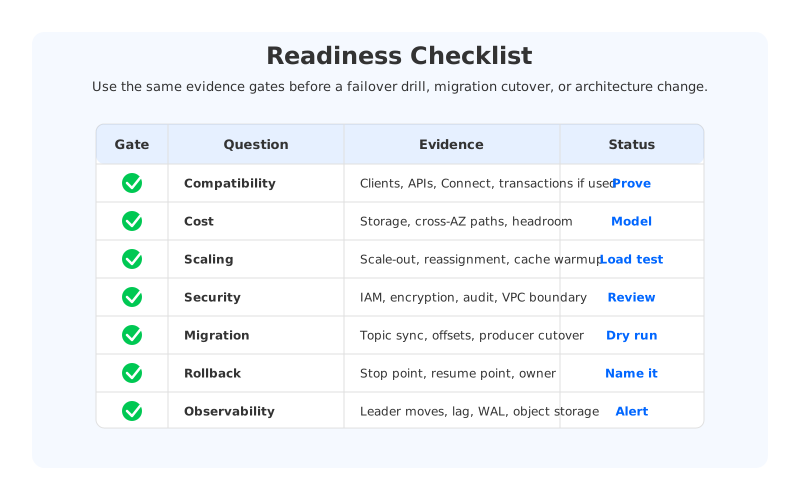
| Evaluation area | What to validate | Why it affects leader election risk |
|---|---|---|
| Compatibility | Producers, consumers, admin clients, Kafka Connect, transactions if used, and monitoring tools | A leader change is safe only if the estate behaves correctly after metadata changes |
| Storage model | Local logs, remote tiers, WAL path, object storage durability, and cache behavior | Storage placement decides whether recovery is data-heavy or metadata-heavy |
| Elasticity | Scale-out, scale-in, partition reassignment, and cache warmup under load | A surviving cluster still fails if it lacks capacity after election |
| Governance | IAM, encryption, VPC boundaries, audit logs, and ownership of cloud resources | Recovery must fit the organization's control and compliance model |
| Migration | Topic sync, offset consistency, producer cutover, and fallback path | Migration risk becomes reliability risk when cutover overlaps with failures |
| Observability | Leader movement, under-replicated partitions, lag, request latency, WAL health, and storage errors | Teams need to distinguish expected churn from actual data-plane risk |
The point is to avoid a false binary. Traditional Kafka may be adequate with disciplined operations. Tiered Storage may be enough when retention is the main issue. Shared Storage architecture deserves evaluation when recurring pain comes from broker-local durable state.
4Evaluation checklist for platform teams
Start with the application contract, not the broker. Test producers for retries, idempotence where used, acknowledgments, timeout budgets, and metadata refresh behavior. Test consumers for group rebalancing, offset commits, replay tolerance, and lag recovery. If Kafka Connect, Flink, Spark, or custom processors sit in the path, validate their recovery separately.
Then test the metadata and placement layer. KRaft-based Kafka deployments depend on a metadata quorum, so leader election testing should include controller health, quorum placement, and behavior when a controller or broker role is impaired. Treat metadata health as part of the reliability model, not as a detail below the runbook.
Storage should be tested before the failure drill. Replace a broker under load, reassign partitions with long-retention topics, and run catch-up consumers from older offsets. The slow part tells the team whether the bottleneck is data movement, cache warmup, disk recovery, client behavior, downstream processing, or architecture.
Cost belongs in the same checklist. If leader election or AZ impairment moves traffic across zones, model that path with the cloud provider's pricing documentation for the selected region. A failover plan that passes technically but consumes all reserved headroom has shifted risk into the next incident.
Finally, make rollback explicit. Name the stop point, roll-forward point, consumer resume point, and owner for each decision. During migration, offset consistency is the difference between "we know where every consumer resumes" and "we hope duplicate processing is acceptable."
5How AutoMQ changes the operating model
After that neutral evaluation, AutoMQ is easier to place. AutoMQ is a Kafka-compatible streaming platform that keeps Kafka protocol and ecosystem compatibility while replacing broker-local log storage with a Shared Storage architecture built around S3Stream, WAL storage, and S3-compatible object storage. Brokers still serve Kafka clients and own partition leadership, but durable stream data is no longer broker-local state.
That changes the leader election conversation in four practical ways.
First, broker replacement is less tied to retained data. In a Shared Nothing cluster, replacing a broker can imply local log recovery, replica catch-up, or partition data movement. In AutoMQ's model, durable data is in shared storage, while WAL storage protects the hot write path and object storage holds the primary stream data. Recovery still validates metadata, cache, WAL, and object storage health, but it is not centered on rebuilding local retained logs.
Second, partition reassignment becomes lighter. AutoMQ documents seconds-level partition reassignment because reassignment is primarily about ownership and traffic movement rather than copying partition data between broker disks. The hard part shifts from moving retained bytes to validating control decisions, client behavior, and capacity.
Third, migration readiness can include offset-aware cutover. AutoMQ commercial editions provide Kafka Linking for migration scenarios, including byte-to-byte topic synchronization and consumer progress synchronization. A good migration plan should prove where producers write, where consumers resume, how rollback works, and whether offsets remain consistent for dependent applications.
Fourth, deployment boundaries stay part of the architecture decision. AutoMQ BYOC runs the control plane and data plane in the customer's cloud account and VPC. AutoMQ Software targets private environments. For governed workloads, the recovery path must fit network controls, IAM review, encryption policy, audit expectations, and operational ownership.
None of this makes testing optional. Stateless brokers reduce one class of coupling, but they introduce a different validation checklist: WAL type, object storage behavior, cache warmup, metadata health, observability, and deployment operations.
6Decision matrix for migration and reliability owners
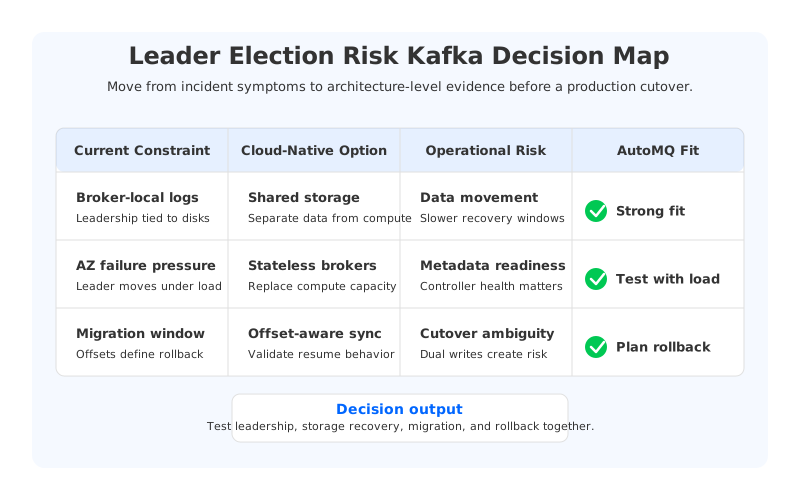
Use this scorecard before changing platforms or running a major failure drill. A "yes" tells you where the current risk comes from.
| Question | If the answer is yes | Architecture implication |
|---|---|---|
| Do leader elections become incidents because surviving brokers lack headroom? | Capacity, placement, and cache behavior need stronger testing | Improve operations or evaluate elastic broker capacity |
| Do reassignments take too long because retained data is tied to broker disks? | Storage ownership is part of the failure mode | Evaluate Shared Storage architecture |
| Is cross-AZ traffic a major cost or latency concern during failover? | Locality and replication paths need evidence | Model network paths and consider storage designs that reduce replica traffic |
| Does migration risk center on offsets and rollback? | Cutover mechanics are reliability mechanics | Test offset-aware migration tooling and consumer resume behavior |
| Does governance require customer-controlled deployment boundaries? | Managed service convenience is not the sole criterion | Evaluate BYOC or customer-operated deployment models |
The highest-risk Kafka workloads are the ones where the team cannot explain what happens after leadership moves: which clients retry, which consumers resume, which data path serves reads, which cost path activates, and which owner can stop the change. Stateless brokers do not remove that explanation. They make a different explanation possible.
If broker-local storage may be the root of your leader election risk, start with one workload class: a hot topic group, a long-retention topic group, or a migration candidate with strict offset requirements. Build the scorecard, run the failure and cutover tests, and compare the operating model against a Kafka-compatible Shared Storage architecture. To explore that path in a customer-controlled environment, start with AutoMQ BYOC.
7FAQ
7.1What is leader election risk in Kafka?
Leader election risk is the application and operational impact that appears when partition leadership moves after broker failure, maintenance, overload, or metadata changes. The election itself is a Kafka mechanism. The risk comes from surrounding factors such as ISR health, client retries, broker capacity, storage recovery, consumer lag, and rollback ambiguity.
7.2Do stateless brokers eliminate Kafka leader election risk?
No. Stateless brokers change the risk profile by reducing the amount of durable data tied to each broker. Teams still need to test metadata health, WAL behavior, object storage access, cache warmup, client behavior, capacity, and observability.
7.3Is Tiered Storage the same as Shared Storage architecture?
No. Tiered Storage moves older log segments to remote storage while keeping the active write path and broker operation tied to local storage. Shared Storage architecture moves durable stream data into shared storage so brokers can operate more like replaceable compute units.
7.4What should be tested before a Kafka migration cutover?
Test client compatibility, topic configuration, producer cutover, consumer group progress, offset consistency, security controls, monitoring, failure behavior, and rollback. For strict processing pipelines, consumer resume behavior is often the gate that decides whether cutover is safe.
7.5When should AutoMQ be evaluated?
AutoMQ is most relevant when the recurring pain is structural: slow reassignment, heavy broker replacement, cloud cost pressure from replica traffic, elastic capacity needs, or migration plans that require Kafka compatibility with offset-aware cutover.
8References
- Apache Kafka documentation: Replication, KRaft, consumer configuration, and Tiered Storage
- AutoMQ documentation: Kafka compatibility, architecture overview, stateless broker, and partition reassignment
- AutoMQ migration documentation: Kafka Linking overview and migration prerequisites
- Cloud network pricing references: AWS data transfer, Google Cloud network pricing, and Azure bandwidth pricing


