
Table of Contents
Table of Contents
A high Confluent bill is rarely caused by one bad setting. It is usually the visible edge of a workload shape: write rate, read fanout, retention, partition count, network path, peak-to-average ratio, and the commercial model wrapped around all of it. The first reaction should not be a platform migration. The first reaction should be measurement.
Confluent Cloud is built around Kafka-compatible managed infrastructure, and its documentation describes billing dimensions such as ingress and egress, storage, partitions, Cluster Linking, connectors, ksqlDB, Flink, and support. The optimization question is not "which line item looks large?" It is "which workload behavior is creating that line item, and can we change it without changing application semantics?" Cost tuning becomes risky when it weakens durability, shortens retention that downstream systems rely on, or moves clients across networks without understanding latency and data-transfer effects.
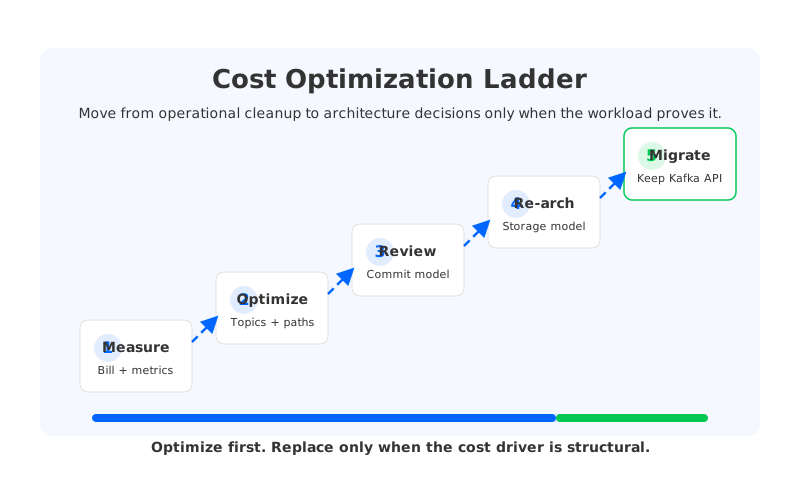
The safest path is a ladder. Measure the workload, remove waste inside the current Confluent environment, review the commercial model, then ask whether the remaining cost is structural. Only after that does a Kafka-compatible replacement become a serious engineering option rather than a procurement reflex.
1Start with your Kafka workload profile
A useful workload profile is more specific than "we run Kafka at scale." Confluent's cluster type documentation points teams toward ingress, egress, storage before replication, partitions before replication, client connections, connection attempts, and request volume when planning capacity. Those are also the right dimensions for cost analysis because they map operational behavior to billable or capacity-constraining behavior.
Build the profile from metrics and invoices together. Metrics show how the system behaves; invoices show which behavior is expensive under the current plan. If those two views are separated, cost work becomes guesswork. A storage line item may be caused by retention that no consumer reads. An egress line item may be caused by analytical consumers outside the cloud or region. Capacity pressure may come from a short daily spike that forces peak sizing.
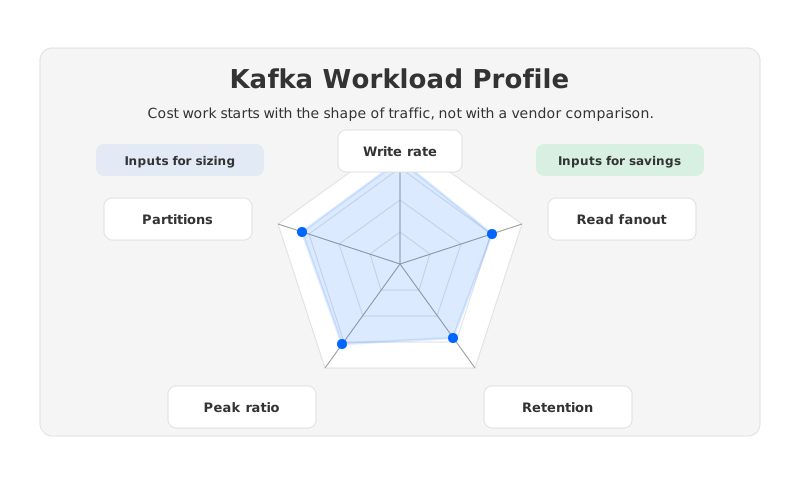
The profile should answer five questions before anyone proposes a platform change:
- What is the sustained and peak write throughput by topic family? Topic grouping prevents one high-volume pipeline from hiding under an average.
- How many independent consumer paths read the same data, and where do those consumers run? Read fanout can make egress and broker load grow faster than producer traffic.
- Which topics carry contractual, operational, or analytical retention requirements? Unowned retention is different from retention tied to recovery or replay.
- How many partitions are needed for parallelism, and how many came from old defaults or automatic topic creation? Partition count affects manageability, limits, metadata, and capacity guidance.
- What is the peak-to-average ratio? A bursty workload has a different cost problem from a workload with constant heavy throughput.
This step should produce a ranked list, not a spreadsheet museum: cost driver, workload, owner, and change risk. Once the profile is clear, optimization can be surgical.
2Quick wins inside Confluent Cloud
The best Confluent cost optimization work starts with cleanup that also improves operability. If a change lowers the bill but makes the system harder to reason about, it will probably be reversed during the next incident. Good changes remove unused data, straighten network paths, and normalize bill review.
| Optimization area | What to inspect | Compatibility risk |
|---|---|---|
| Retention | retention.ms, retention.bytes, compacted topics, replay requirements | Medium |
| Topic hygiene | Dead topics, duplicate pipelines, accidental partitions, automatic topic creation | Low to medium |
| Networking | Public internet, private networking, cloud/region placement, consumer location | Medium |
| Environments | Dev/test clusters, idle connectors, orphaned links | Low |
| Commercial model | Pay-as-you-go, annual commitment, marketplace path | Low |
Retention is usually the first place to look because it is visible, adjustable, and dangerous when handled casually. Apache Kafka exposes topic-level retention through configurations such as retention.ms and retention.bytes, and Confluent Cloud documents how cluster-level defaults such as log retention can be changed for new topics on applicable clusters. Lower retention only when the owning team confirms replay, recovery, and downstream backfill needs. Unused retention is waste; retention used for analytics or recovery is a dependency.
Topic hygiene is the companion to retention. Look for topics with no active producers, no active consumers, unexpected partition counts, or old experiments. The goal is ownership, not aggressive deletion. Once ownership exists, cleanup becomes a normal lifecycle process: deprecate, monitor, shorten retention, then delete.
Networking deserves the same discipline. Confluent Cloud supports public internet connectivity and private networking options depending on cloud provider and cluster type. Kafka traffic is rarely one-way: producers write, consumers read, replication or linking may move data, and analytical systems can sit in a different region, VPC, or cloud. If high-volume consumers live outside the network boundary, the Kafka bill may reflect an old topology decision.
Non-production environments are less glamorous, but often easier to fix. Development clusters, test connectors, old ksqlDB applications, and temporary Cluster Links can keep producing recurring charges after their project ends. A monthly review that asks "who owns this and when does it expire?" can remove spend without touching production paths.
Commercial review comes after technical cleanup. Confluent documents pay-as-you-go and annual commitment billing models, marketplace paths, and a Costs API for retrieving cost data. Those tools are useful only when the workload baseline is honest. Committing to a wasteful shape makes waste more predictable.
3Networking and data transfer paths
Kafka cost optimization often underestimates networking because application teams think in topics while cloud invoices think in bytes crossing boundaries. A producer may be close to the cluster, while consumers live in another VPC, another region, or another cloud. A data platform may read the same topic multiple times for search, analytics, and monitoring.
Start by drawing the path of the largest topics. Mark where producers run, where the cluster runs, where major consumer groups run, and whether traffic uses public endpoints, peering, Private Link-style connectivity, transit gateways, or cross-region links. Then compare that topology with billing dimensions for ingress, egress, and network services.
A safe networking review looks for three patterns. Move high-volume consumers closer to the cluster when the application architecture allows it. Avoid duplicate downstream reads when one derived stream or materialized sink would serve multiple teams. Check whether private networking was selected for security, latency, data-transfer control, or habit.
Do not optimize networking by making the path less reliable or less secure. Public connectivity may look simpler, but it can be the wrong answer for regulated workloads. A better cost conversation asks whether the data needs to move, whether it needs to move in raw form, and whether repeated reads could share a downstream representation.
4When optimization stops being enough
After cleanup, the remaining bill may still be high for a more fundamental reason: the workload is asking Kafka to behave like a cloud-native storage service while the Kafka operating model still couples brokers, partitions, replication, and storage pressure. Managed services can hide operational toil, but they cannot make every architectural trade-off disappear. With large retention windows, heavy read fanout, and bursty throughput, economics are shaped by the storage and scaling model.
This is where teams need to separate optimization from substitution. Optimization changes how you use the current platform. Substitution changes the architecture that provides Kafka-compatible behavior. Consider it when storage grows with business history, brokers are sized for peaks, partition movement creates friction, or network topology keeps forcing expensive data paths.
The key question becomes: can the platform keep Kafka compatibility while changing the parts of the architecture that drive cost? A replacement that breaks producers, consumers, offsets, ACLs, or tooling is not a cost optimization project; it is an application migration. A credible alternative must preserve the Kafka contract and change the storage and scaling model underneath it.
5What a Kafka-compatible replacement must preserve
Kafka compatibility is not a slogan. For platform teams, it is a list of behaviors that keep application teams from rewriting code. Producers should continue to use Kafka clients and familiar configuration patterns. Consumers should keep group coordination, offsets, fetch behavior, and delivery expectations. Operators should keep admin workflows around topics, ACLs, quotas, metrics, and troubleshooting. Security controls should map cleanly to existing authentication, authorization, encryption, and audit patterns.
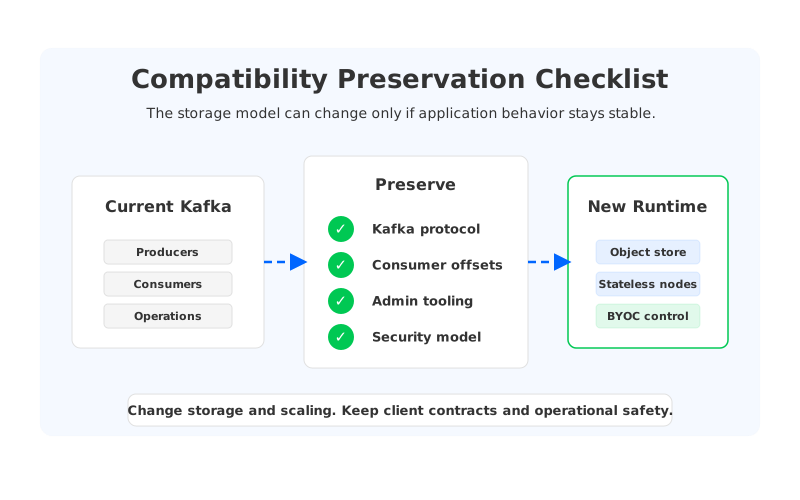
The preservation checklist should be explicit:
- Client protocol compatibility: existing Kafka clients should connect without replacing the application's messaging abstraction.
- Topic and partition semantics: ordering, partition assignment, and operational controls should stay understandable.
- Consumer group behavior: offsets, lag, rebalances, and reset workflows should not become a new mental model.
- Security and governance: authentication, ACLs, network isolation, encryption, and audit paths must satisfy existing controls.
- Migration safety: the team needs rollback, parallel validation, data checks, and a way to test consumer progress before cutover.
This is also where "Kafka-compatible" alternatives differ sharply. Some systems are protocol-compatible for common producer and consumer paths but diverge in admin APIs, ecosystem integration, or edge-case behavior. Others preserve more Kafka behavior but require a different deployment model. The right evaluation tests your actual producers, consumers, connectors, observability, and incident workflows.
6How AutoMQ approaches Kafka cost reduction
AutoMQ belongs in the conversation after the workload profile shows that cleanup is not enough. It is a Kafka-compatible streaming platform that changes the storage and scaling model rather than asking application teams to abandon Kafka. AutoMQ uses object storage as the durable storage foundation and makes brokers stateless by separating compute from persistent data.
That distinction matters because many Kafka cost problems come from coupling. In a traditional Kafka architecture, brokers carry both serving responsibility and local data responsibility. Scaling, recovery, partition reassignment, and storage growth are tied to broker-local state. AutoMQ's shared-storage architecture moves persistent log storage to object storage while keeping Kafka protocol and semantics compatible for clients. Its documentation describes native Apache Kafka compatibility, shared S3-based storage, stateless brokers, fast partition reassignment, and scale-out or scale-in behavior.
The cost argument should be kept precise. Object storage can reduce long-term storage pressure because durable data is no longer primarily bound to broker-local disks. Stateless brokers can reduce the operational cost of elasticity because adding or removing compute does not require moving large local log segments in the same way a broker-local architecture does. BYOC changes the control model: teams run the data plane in their own cloud account or environment, improving data control, network placement, and infrastructure transparency.
None of that removes the need for a migration plan. A responsible AutoMQ evaluation still starts with a compatibility matrix, a representative workload test, a network design, and a cutover strategy. The point is not that every Confluent workload should move. The point is that once optimization stops at structural limits, the next rational option is not "accept the bill forever." It is to evaluate whether object storage and stateless brokers can preserve the Kafka contract while changing the cost curve underneath.
For teams exploring that path, start with the same artifacts created for Confluent optimization: workload profile, topic inventory, retention requirements, consumer fanout map, network topology, and bill breakdown. Those documents ground the replacement evaluation in workload facts.
7What not to optimize
Cost work should have guardrails. Do not lower replication or durability assumptions to make a bill look better. Do not shorten retention for topics used in recovery, compliance, delayed processing, or analytical backfills without owner approval. Do not collapse environments in a way that mixes production and experiments. Do not move high-volume consumers across a lower-cost network path without testing latency, security, and failure behavior.
The most expensive Kafka incident is often the one caused by a cost-saving change that nobody can unwind. A mature platform team treats cost as an SLO-adjacent concern: visible, reviewed, owned, and balanced against reliability. The optimization ladder keeps that balance and creates a clean decision point for architecture-level alternatives.
If your Confluent bill is still dominated by storage growth, heavy fanout, peak sizing, or data movement after cleanup, evaluate AutoMQ with your real workload profile rather than a generic benchmark. Compare Kafka behavior, storage architecture, elasticity, BYOC fit, and migration safety using your own topics and clients.
8References
- Confluent Cloud billing overview
- Confluent Cloud Kafka cluster types
- Confluent Cloud cluster configuration settings
- Confluent Cloud networking overview
- Apache Kafka topic configuration: retention.ms
- Apache Kafka topic configuration: retention.bytes
- AutoMQ architecture overview
- AutoMQ native compatibility with Apache Kafka
- AutoMQ stateless broker
- AutoMQ BYOC environment overview
9FAQ
9.1What is the first step to reduce Confluent cost?
Start with a workload profile that connects metrics to billable dimensions. Measure ingress, egress, storage, partition count, client connections, request rate, retention, and peak-to-average ratio before changing settings or evaluating alternatives.
9.2Can I reduce cost by lowering Kafka retention?
Sometimes, but only after confirming topic ownership and replay requirements. Retention controls such as retention.ms and retention.bytes can reduce stored data, but they can also break recovery, backfills, delayed consumers, and compliance workflows when changed without context.
9.3When should a team consider a Kafka-compatible Confluent replacement?
Consider replacement after internal optimization has removed obvious waste and the remaining cost is structural. Common signals include long retention windows, heavy read fanout, bursty workloads that force peak sizing, and operational friction caused by broker-local storage or partition movement.
9.4What does Kafka compatibility need to include?
It should cover producer and consumer behavior, topic and partition semantics, consumer groups and offsets, admin tooling, security controls, observability, and migration safety. A replacement that requires broad application rewrites is not a low-risk cost optimization path.
9.5How does AutoMQ reduce Kafka infrastructure cost?
AutoMQ keeps Kafka compatibility while using object storage for durable stream storage and stateless brokers for compute. That architecture is designed to reduce broker-local storage pressure, make elasticity less dependent on data movement, and support BYOC deployments where teams keep the data plane in their own cloud environment.


