
Table of Contents
Table of Contents
Replacing Confluent Cloud is rarely about disliking Kafka. Most teams searching for a Confluent Cloud replacement want the opposite: keep the Kafka clients, topics, consumer groups, connectors, and operating model that already work, while changing the commercial or infrastructure boundary around them. The hard part is making that move without turning a platform decision into an application rewrite.
That distinction matters. A Kafka-compatible alternative can accept producer and consumer traffic, but production migration still has to preserve behavior around offsets, ACLs, schema dependencies, private networking, connector placement, monitoring, rollback, and incident ownership. If any of those handoffs are treated as an afterthought, the replacement project can fail even when the target platform speaks the Kafka protocol.
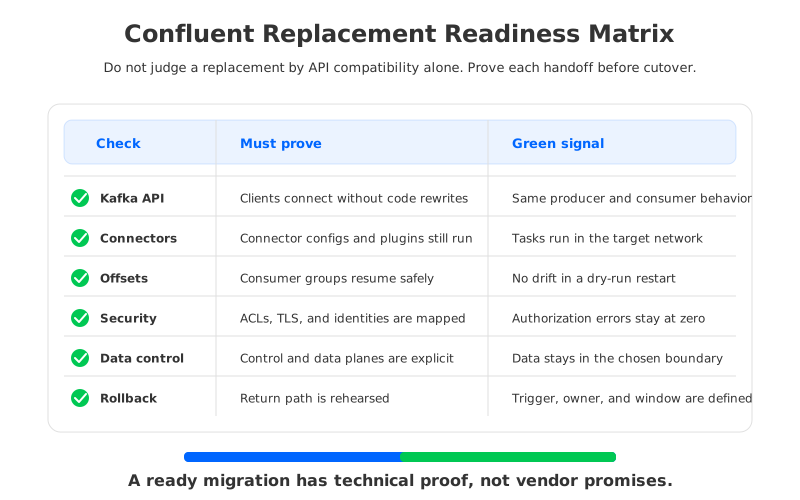
The practical question is not "what is the cheapest Confluent alternative?" It is "which replacement lets us keep the Kafka application contract while improving the parts of Confluent Cloud that pushed us to leave?"
1Why Teams Start Looking for a Confluent Cloud Replacement
Confluent Cloud solves a real problem. It gives teams a managed Kafka-compatible platform with multiple cluster types, private networking options, connectors, governance features, and a broad streaming ecosystem. Confluent's own documentation lists cluster types such as Basic, Standard, Enterprise, Dedicated, and Freight, each aimed at different performance and networking requirements. For many teams, that managed platform is easier to adopt than building a Kafka operations practice from scratch.
The search for a replacement usually begins when the managed-service tradeoff changes. A team may hit a renewal conversation where the bill no longer matches the workload shape. A security review may ask where the data plane, control plane, metadata, and operational access actually live. A platform group may want the same Kafka interface across AWS, Azure, GCP, or private environments. Or a business may want a clearer exit strategy after IBM announced on December 8, 2025 that it had entered a definitive agreement to acquire Confluent for an enterprise value of $11 billion.
None of those reasons automatically make Confluent Cloud the wrong choice. They do mean the decision has moved past "we need managed Kafka." At replacement time, the team has to price control, portability, migration risk, and operational responsibility as first-class requirements.
2What Must Stay Compatible During the Migration
Kafka compatibility starts with producers and consumers, but it does not end there. A simple service that writes JSON messages to one topic may move with a bootstrap-server change and a rolling restart. A real platform estate usually has more surface area:
- Producers with idempotence, batching, compression, retries, custom partitioners, or transactional assumptions.
- Consumers with committed offsets, lag SLOs, rebalance behavior, and stateful downstream systems.
- Kafka Connect workers, Debezium jobs, sink connectors, dead-letter queues, and transforms.
- Schema Registry usage, topic naming conventions, ACLs, quotas, TLS settings, and service identities.
- Monitoring, alerting, client metrics, audit logs, chargeback tags, and incident runbooks.
This is why a replacement project should inventory behavior, not only resources. Topic count and retained bytes tell you how much data must move. Client behavior tells you how much production risk exists at cutover. Connectors and schemas tell you how many surrounding workflows have to survive the move.
Confluent provides migration and data-sharing mechanisms such as Cluster Linking for certain Confluent Cloud cluster types and networking configurations. Apache Kafka operators often use MirrorMaker 2 for replication between Kafka clusters. AutoMQ Open Source documents MirrorMaker 2 as a migration path, while AutoMQ commercial editions provide Kafka Linking for byte-to-byte synchronization with offset consistency and zero-downtime migration under the supported conditions. The right tool depends on source platform, target platform, networking, offset requirements, and rollback expectations.
3The Replacement Criteria That Actually Matter
A useful Confluent Cloud replacement scorecard should be stricter than a feature checklist. The target must prove five things before production traffic moves.
| Criterion | What to verify | Why it matters |
|---|---|---|
| Kafka behavior | Client versions, consumer groups, transactions if used, compaction, ACLs | Protocol compatibility problems appear during migration, not during vendor demos |
| Data movement | Topic replication, ordering assumptions, offset strategy, lag validation | A cutover is only safe when consumers can resume predictably |
| Deployment boundary | SaaS, BYOC, self-managed, control plane, data plane, metadata | "Data control" depends on where the platform actually runs |
| Cost model | Compute, storage, network, managed fees, migration overlap | The migration period often runs two platforms at once |
| Rollback | Trigger, owner, time window, source cluster state, client reversal | A migration without rollback is a bet, not a plan |
The deployment boundary deserves special attention. Confluent Cloud networking documentation covers private connectivity patterns such as Private Link, VPC peering, VNet peering, and related constraints. Private connectivity can reduce public exposure, but it is not the same thing as running the streaming platform inside the customer's own account or VPC. If the replacement requirement is data-plane ownership, metadata control, or use of committed cloud spend, the team should distinguish private networking from Bring Your Own Cloud.
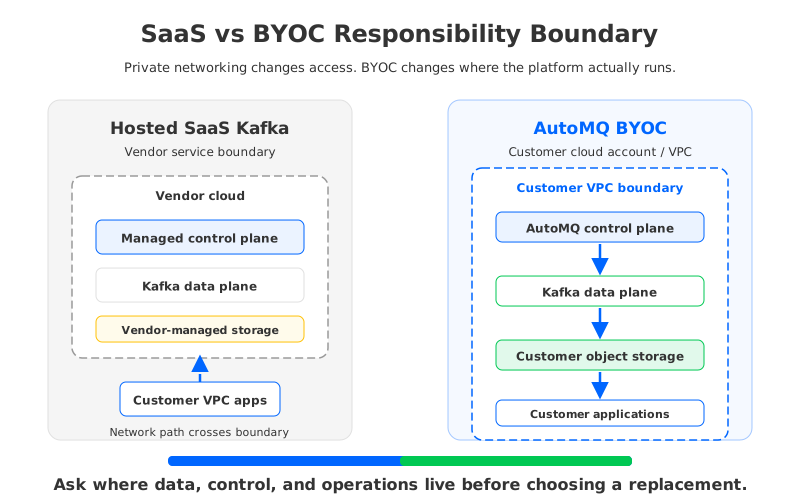
BYOC also changes the operating conversation. It can improve data control and cost transparency, but it may move more responsibility into the customer's environment. The point is not that BYOC is always better than SaaS. The point is that the responsibility boundary should be explicit before the architecture is chosen.
4Where AutoMQ Fits as a Kafka-Compatible Replacement
AutoMQ is relevant when the replacement requirement is not "leave Kafka" but "keep Kafka while changing the storage and ownership model." AutoMQ is designed as a Kafka-compatible streaming platform: it keeps the Kafka protocol and ecosystem surface while replacing the storage layer with a cloud-native shared-storage architecture. Its documentation describes compatibility across Kafka clients, connectors, proxies, and ecosystem components, with the storage layer redesigned around S3Stream and object storage.
That architecture changes the replacement discussion in two ways. First, existing Kafka applications can be evaluated against a familiar contract: producers, consumers, Kafka Connect, and client tooling remain central to the migration test plan. Second, the durable log is no longer tied to broker-local disks in the same way traditional Kafka deployments are. AutoMQ's stateless broker documentation explains how separating storage and compute makes brokers easier to scale, replace, and operate because persistent data is offloaded to shared storage.
For a team leaving Confluent Cloud, the practical AutoMQ evaluation should focus on four questions:
- Do current Kafka clients, connectors, ACLs, and operational tools behave correctly against the target AutoMQ version?
- Does the BYOC or deployment model satisfy the organization's data-residency, networking, IAM, and audit requirements?
- Does the storage architecture change the cost drivers that originally made Confluent Cloud painful, such as retained data, over-provisioned capacity, or migration overlap?
- Does the migration tool preserve offsets and provide a rollback path under the team's actual workload conditions?
Those questions keep the article out of vendor-slogan territory. AutoMQ is not a magic bootstrap-server swap for every Confluent Cloud estate. It is a strong candidate when Kafka compatibility, customer-controlled deployment, and cloud-native storage economics are the reasons the team is looking beyond SaaS managed Kafka.
5A Practical Cutover Path
A safe Confluent Cloud replacement should be staged as a sequence of gates. The source cluster should remain healthy until the target has survived enough real traffic to prove that the migration is reversible.
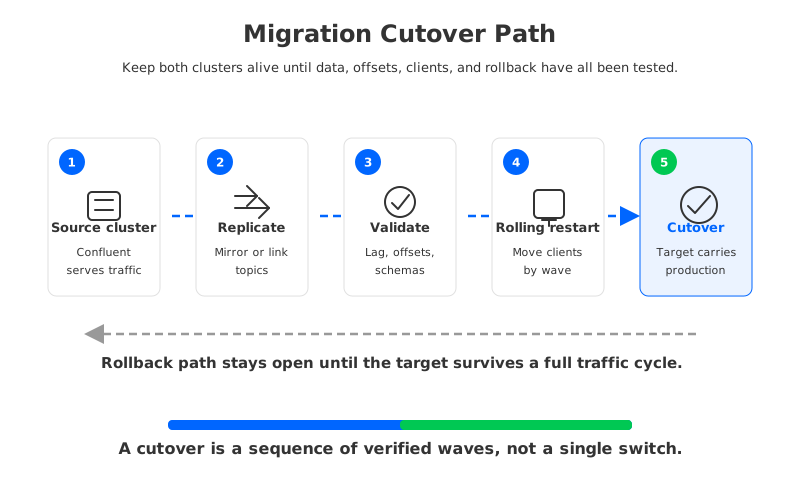
Start with an inventory. Export topic configuration, ACLs, quotas, schemas, connector definitions, client versions, authentication paths, monitoring dashboards, and consumer-group ownership. This step is unglamorous, but it catches the dependencies that break migrations later.
Build the target environment next. For BYOC Kafka, this includes cloud account, VPC or VNet design, DNS, private connectivity, object storage, IAM roles, observability, and maintenance access. Do not replicate data into an environment whose security and operating boundary has not been approved.
Then replicate topics and validate lag. The validation should include at least three checks: record flow, consumer offset behavior, and application-level correctness. A consumer that starts at the right offset but fails on schema, auth, or downstream dependency is still a failed migration.
Only after validation should clients move in waves. Start with non-critical consumers, then critical consumers, then selected producers, then larger traffic slices. Each wave should have a rollback trigger and an owner. A rollback plan written after the first failed wave is already late.
6Replacement Checklist Before You Move Production
Before changing production bootstrap servers, the team should be able to answer these questions without guessing:
- Which applications use Confluent-specific features or managed connectors?
- Which topics require compaction, transactions, strict ordering, or long retention?
- Which consumer groups must preserve offsets exactly, and which can replay safely?
- Which network paths change when the target platform moves into BYOC or another cloud boundary?
- Which metrics prove the target is healthy before cutover?
- Who can authorize rollback, and how long will the source cluster stay writable?
- What is the temporary cost of running Confluent Cloud and the target platform in parallel?
The best replacement projects are not dramatic. They look almost boring: inventory, replicate, validate, move clients in waves, monitor, and keep rollback open until the new platform has lived through normal and peak traffic. That discipline is what lets a team replace Confluent Cloud without rewriting the Kafka applications that made the platform valuable in the first place.
7FAQ
7.1Can you replace Confluent Cloud without changing Kafka application code?
Often, yes, if the target is Kafka-compatible and the applications use standard Kafka client behavior. You still need to test client versions, security configuration, offset behavior, connector dependencies, and any platform-specific features before assuming the move is code-free.
7.2Is BYOC the same as private networking?
No. Private networking controls how applications reach a service. BYOC describes where the service components run and who owns the underlying cloud resources. A Kafka platform can use private networking while still running in a vendor-managed environment.
7.3Should every Confluent Cloud user move to AutoMQ?
No. Confluent Cloud remains a reasonable fit for teams that value a broad managed streaming platform and prefer SaaS operations. AutoMQ is most relevant when the replacement driver is Kafka compatibility plus stronger data control, storage-compute separation, and a different cloud cost model.
7.4What should be tested first in a Confluent replacement proof of concept?
Start with the riskiest production behavior: a representative producer, a stateful consumer group, one connector pipeline, ACL/TLS configuration, and a rollback rehearsal. A PoC that only writes and reads a test topic proves very little about production migration.


