
Table of Contents
Table of Contents
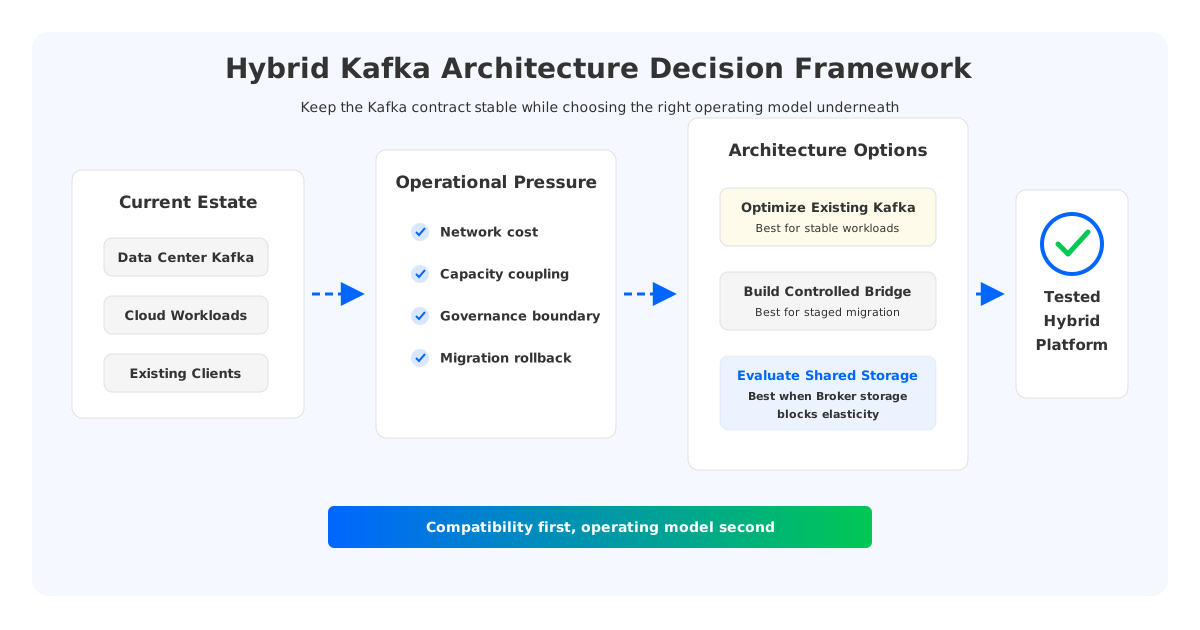
Teams usually start searching for hybrid Kafka architecture after one of two things happens. Either the data center Kafka estate can no longer keep up with cloud-first application teams, or the cloud Kafka estate has grown faster than governance, networking, and cost controls can follow. The technical question sounds straightforward: how do we connect cloud and data center streaming without breaking producers, consumers, offsets, security policy, or budgets? The harder question is architectural: which Kafka assumptions still help, and which assumptions now make the platform harder to operate?
Kafka is often treated as a portable abstraction because the client protocol, Topic model, Consumer group behavior, and Offset semantics travel well across environments. That portability is real, but it does not make every deployment architecture equivalent. A cluster that works cleanly inside one data center can become expensive and slow to operate when data must move across Availability Zones, cloud regions, VPC boundaries, and private network links. Hybrid architecture is where the Kafka API is only the visible layer; underneath it sit decisions about storage locality, replication paths, identity boundaries, failover, and migration.
The useful question is not whether cloud or data center is better. A production platform team usually needs both for a while. What must remain compatible for applications, and what must become more elastic for the platform?
1Why Hybrid Kafka Architecture Matters
A hybrid Kafka architecture is rarely built for elegance. It is built because real organizations have uneven constraints. Payment systems, regulated datasets, and latency-sensitive services may still run in private data centers, while AI feature pipelines, analytics platforms, lakehouse ingestion, and digital applications run in the cloud. Kafka becomes the bridge because it is already the shared event interface.
That bridge carries operational promises, not just records. Producers expect stable bootstrap endpoints and familiar acknowledgments. Consumers expect group membership, offset commits, and predictable rebalancing. Security teams expect encryption, identity, ACLs, certificate rotation, and auditability. Finance teams expect the network bill to match the diagram.
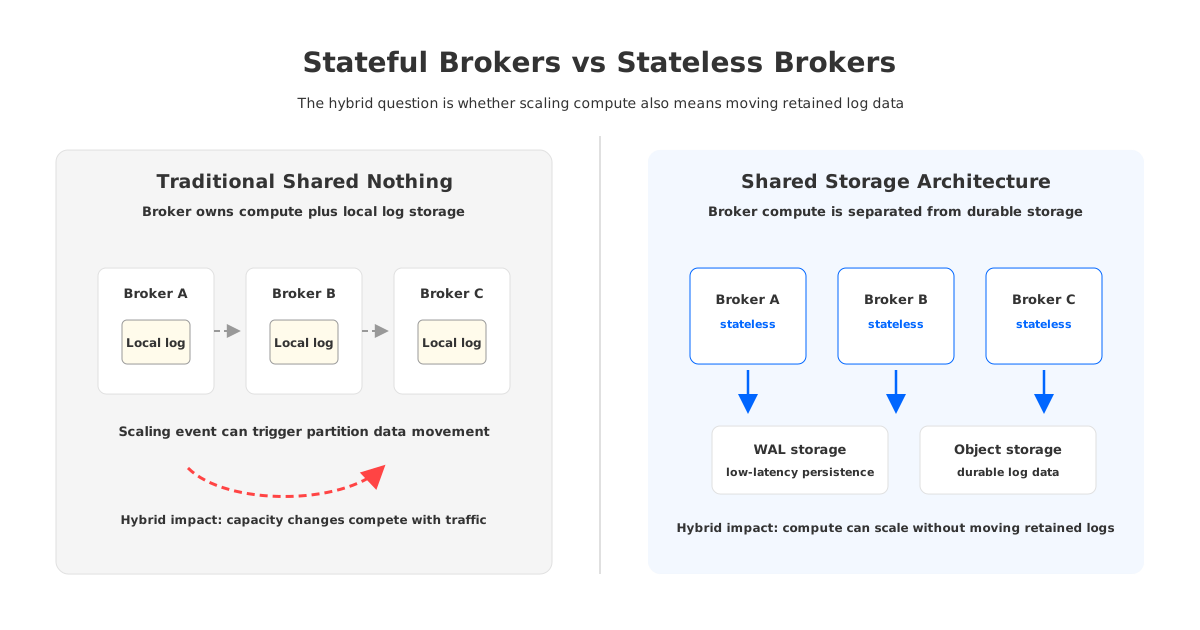
The first hidden cost is duplicated movement. In a traditional Kafka deployment, data is written to a leader Broker, replicated to follower Brokers, retained on broker-local storage, and often copied again for disaster recovery, analytics, or cloud migration. Across cloud zones or private connectivity, every additional copy becomes a networking, storage, and governance decision.
The second hidden cost is capacity coupling. If the Broker owns both compute and persistent storage, scaling the cluster is not only a CPU and memory operation. It is also a data placement operation. Reassigning partitions can move large volumes of data between Brokers, and that movement competes with foreground traffic. In a hybrid environment, the platform team has to ask whether it is scaling Kafka capacity or scheduling a data migration every time it changes the cluster shape.
2The Production Constraints Behind the Search
Hybrid Kafka planning often starts with connectivity diagrams, but connectivity is the shallowest layer. A VPN, Direct Connect circuit, private endpoint, or interconnect can move packets; it does not decide which side owns the log, how far a Consumer may lag, or how rollback works when a migration window goes sideways. Production readiness depends on constraints that reinforce one another.
| Constraint | Architecture question | Failure mode if ignored |
|---|---|---|
| Compatibility | Can existing Kafka clients, schemas, offsets, and security settings keep working? | Application teams must rewrite clients during infrastructure migration. |
| Data ownership | Which environment is the source of truth for each Topic? | Dual writes, inconsistent offsets, or unclear recovery ownership. |
| Network cost | Which data paths cross zones, regions, or private links? | Replication and consumer traffic create an unpredictable bill. |
| Elasticity | Can compute scale without moving retained log data? | Scaling events become slow, risky partition movement projects. |
| Governance | Are identity, encryption, retention, and audit policies enforced consistently? | Hybrid becomes a compliance exception instead of a platform pattern. |
| Rollback | Can producers and consumers return to the previous cluster without losing position? | Cutover risk blocks migration or forces long downtime windows. |
The table is deliberately not vendor-specific. Every serious Kafka-compatible streaming option has to answer these questions. The answer may be to keep the current cluster, replicate selected Topics into the cloud, or move the data plane into a customer-controlled cloud account. The point is to evaluate the operating model, not only the service label.
This is also where "managed Kafka" can be a misleading phrase. Managed operations are valuable, but hybrid architecture requires clarity about control boundaries. Who owns the VPC? Who manages encryption keys? Where does the data plane run? A service can reduce operational load and still be a poor fit if it moves the wrong boundary for the organization.
3Three Architecture Patterns Teams Usually Compare
The first pattern is data center primary, cloud consumer. Kafka remains in the data center, while cloud services consume selected Topics through private connectivity or replication. This pattern is conservative when systems of record must stay in private infrastructure. Its weakness is cloud dependence on data center egress, replication lag, and original cluster limits.
The second pattern is cloud primary, data center bridge. The cloud Kafka-compatible platform becomes the main event backbone, and data center applications connect through private links, edge gateways, or migration tooling. This pattern fits cloud-first estates and AI/data workloads that need elastic capacity near cloud storage and compute. Its weakness is political as much as technical: security, connectivity, and rollback must feel as controlled as the legacy environment.
The third pattern is domain-split hybrid. Some domains keep local Kafka clusters; others use cloud-native Kafka-compatible infrastructure. Data moves between domains through explicit replication, linking, or event contracts. This avoids a single big-bang migration, but it can drift into platform sprawl if Topic ownership, schema governance, and observability are weak.
The deciding factor is not where the Brokers sit on a diagram. It is where the durable log lives, how many times data must be copied, and whether scaling compute changes storage placement. That is why the storage model matters so much in hybrid Kafka architecture.
4Why Traditional Shared Nothing Kafka Becomes Harder In Hybrid
Apache Kafka's traditional Shared Nothing architecture is elegant inside its original assumptions. Each Broker owns local log segments for the partitions assigned to it. Replication across Brokers provides durability. Clients use the Kafka protocol to find partition leaders, Producers write records, Consumers commit Offsets, and the cluster coordinates group membership and metadata. The model is mature and widely understood.
The trade-off appears when infrastructure becomes more distributed than the cluster design. Broker-local storage makes partitions physically attached to specific nodes, so expansion, shrinkage, replacement, and hot-partition rebalancing often move data. Tiered Storage can reduce local disk pressure for long retention, but it does not make Brokers fully stateless because the hot write path and recent data still depend on local Broker storage.
In a hybrid environment, that distinction is not academic. Suppose a platform team needs cloud capacity for a bursty analytics workload while keeping regulated Producers in the data center. If Kafka storage remains tightly coupled to Brokers, the team must plan network routing, partition placement, replica movement, hot data locality, and cross-boundary reads. The API may stay stable while the operations team absorbs the complexity underneath.
This is why many hybrid Kafka designs eventually separate application compatibility from infrastructure design. The Kafka API is the contract for producers and consumers. The storage and control model is the contract for the platform team.
5Evaluation Checklist For Platform Teams
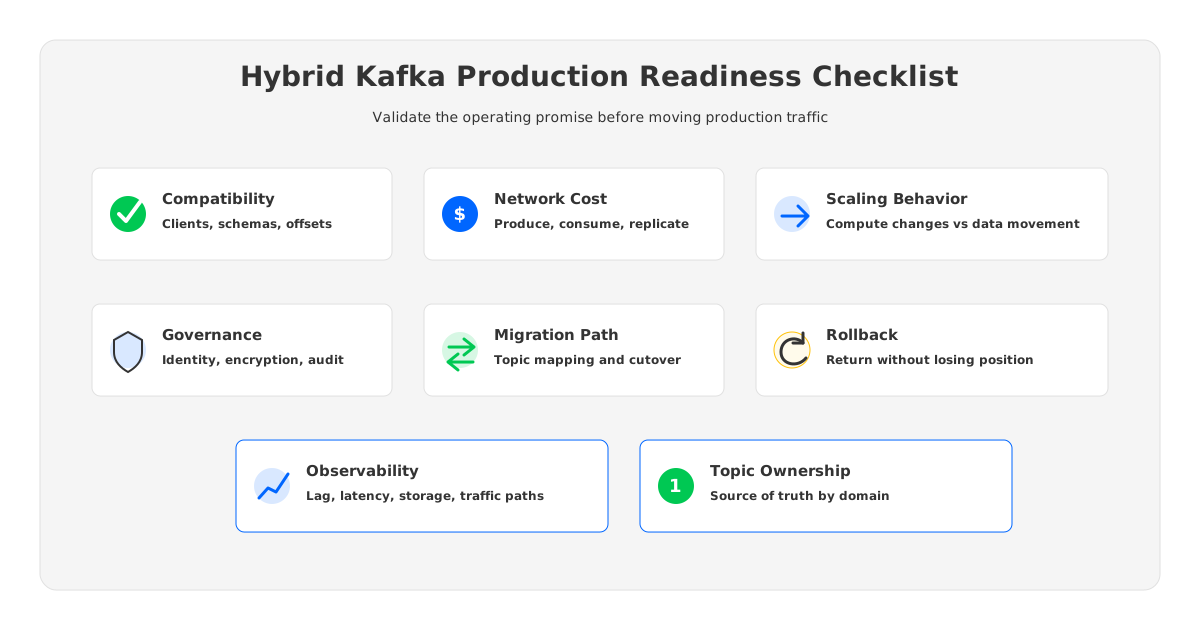
Before selecting a pattern, write down the operating promise in testable language. A hybrid architecture that cannot be tested is a preference, not a production plan.
| Readiness area | What to verify before production |
|---|---|
| Client compatibility | Existing producer, consumer, admin, and connector clients can run without application rewrites. |
| Offset continuity | Consumer groups can resume from known positions after migration, failover, or rollback. |
| Security boundary | TLS, SASL, ACLs, IAM integration, private DNS, and certificate ownership match enterprise policy. |
| Network paths | Produce, consume, replication, and monitoring traffic paths are documented and cost-reviewed. |
| Retention model | Hot and historical data retention are designed around latency and recovery needs, not only disk capacity. |
| Scaling behavior | Adding or removing compute capacity does not create unacceptable data movement or rebalance risk. |
| Observability | Lag, throughput, request latency, storage usage, and cross-zone or cross-boundary traffic are visible. |
| Migration rollback | Cutover can be reversed without losing data, duplicating writes, or resetting consumers blindly. |
The checklist also exposes a common anti-pattern: treating replication as the entire hybrid strategy. Replication is a mechanism. It can support migration, disaster recovery, cloud ingestion, or domain isolation, but it does not decide ownership. If two clusters accept writes for the same business stream without a clear conflict model, the architecture has created a distributed consistency problem and called it streaming.
For many teams, the cleanest intermediate step is to classify Topics by ownership and movement tolerance. Systems-of-record Topics may stay close to regulated applications. Derived analytics Topics may move cloud-side. High-volume operational telemetry may be redesigned around cloud storage and elastic compute. Once Topic classes are explicit, hybrid design becomes bounded choices instead of one giant migration.
6Where AutoMQ Changes The Operating Model
After that neutral evaluation, AutoMQ becomes relevant because it changes the part of Kafka that hurts most in hybrid operations: the coupling between Broker compute and durable storage. AutoMQ is a Kafka-compatible, cloud-native streaming platform built around Shared Storage architecture, moving the storage layer to shared object storage through S3Stream and a WAL layer.
That architecture does not make every hybrid problem disappear. You still need network design, identity controls, migration planning, and governance. What changes is the scaling and recovery model. If Brokers are stateless, adding or replacing compute capacity no longer has to imply moving retained partition data from one local disk to another. In cloud environments, that can reduce the operational drag that traditional Broker-local storage brings into elastic workloads.
The deployment boundary matters as much as the storage model. AutoMQ BYOC runs the control plane and data plane inside the customer's cloud environment, while AutoMQ Software addresses private data center deployment. The right choice depends on whether the hybrid target is cloud-owned infrastructure, private infrastructure, or a staged path between the two.
AutoMQ Kafka Linking is also relevant for migration planning because hybrid transitions often fail at cutover rather than at steady state. A useful migration tool must preserve Topic mapping, data position, Producer routing, and Consumer group progress well enough that application teams can move without rewriting their mental model. That is the practical difference between "we copied the data" and "the business can switch traffic."
The architectural takeaway is not that every hybrid Kafka estate should become AutoMQ. Shared Storage architecture gives platform teams another design point: keep Kafka compatibility at the client layer while changing the storage and elasticity model underneath. For workloads where broker-local storage is the bottleneck, that design point is worth evaluating alongside managed Kafka services, self-managed Kafka, and replication-first hybrid patterns.
7Decision Table: Optimize, Bridge, Or Re-Platform
Hybrid architecture decisions become clearer when teams separate short-term stabilization from long-term platform direction.
| Situation | Better first move | Why |
|---|---|---|
| One data center cluster serves stable workloads with limited cloud demand | Optimize current Kafka and harden network/security controls | A re-platforming project may add risk without enough payoff. |
| Cloud analytics needs selected streams from regulated systems | Build a controlled bridge with explicit Topic ownership | Replication or linking can serve downstream use cases without moving all producers. |
| Kafka storage and partition movement block elasticity | Evaluate Kafka-compatible Shared Storage architecture | The bottleneck is the operating model, not the Kafka API. |
| Multiple teams run disconnected Kafka clusters with weak governance | Standardize contracts, observability, and ownership before migration | A platform change will not fix unclear domain boundaries. |
| A cloud-first platform needs customer-controlled infrastructure | Evaluate BYOC-style deployment and private networking | The team can gain cloud elasticity without moving the data plane outside its account. |
The decision table is intentionally plain. Hybrid Kafka architecture is a place where sophistication can become a trap. Simpler architecture with explicit Topic classes, tested rollback, and observable network paths usually ages better.
If your team is evaluating whether broker-local storage is still the right foundation for cloud and hybrid Kafka workloads, test the storage model directly. Run a workload that exercises retention, scale-out, failover, consumer lag recovery, and private network paths. Compare throughput and latency with the work created by each scaling event. AutoMQ Open Source and commercial editions can be explored from the AutoMQ GitHub project when Shared Storage architecture is part of that evaluation.
The architecture question was how to bridge cloud and data center streaming. Avoid making the bridge carry every assumption. Keep the Kafka contract where it helps teams move safely. Reconsider storage, scaling, and control where assumptions make hybrid operations heavier.
8References
- Apache Kafka Documentation
- Apache Kafka Operations: Tiered Storage
- AWS Direct Connect Documentation
- AWS PrivateLink Documentation
- AWS EC2 On-Demand Pricing: Data Transfer
- AutoMQ Architecture Overview
- AutoMQ S3Stream Shared Streaming Storage
- AutoMQ Compatibility With Apache Kafka
- AutoMQ Kafka Linking Migration Overview
9FAQ
9.1What is hybrid Kafka architecture?
Hybrid Kafka architecture connects Kafka-compatible workloads across cloud and data center environments. It needs clear ownership for Topics, compatible clients, offset continuity, security controls, network cost visibility, and rollback paths.
9.2Is hybrid Kafka the same as multi-region Kafka?
No. Multi-region Kafka focuses on availability, disaster recovery, or locality. Hybrid Kafka bridges infrastructure domains, such as data center and cloud. The patterns can overlap, but hybrid adds stronger control-boundary and migration concerns.
9.3Does Tiered Storage make Kafka Brokers stateless?
No. Tiered Storage can move older log segments to remote storage and reduce local disk pressure, but the Broker still owns the active write path and hot local data. Stateless Brokers require deeper compute and storage separation.
9.4When should a team keep existing Kafka instead of re-platforming?
Keeping existing Kafka is reasonable when workloads are stable, cloud demand is limited, governance is strong, and near-term issues can be solved with better monitoring, security, and network controls. Re-platforming becomes compelling when broker-local storage, slow partition movement, or capacity coupling blocks business needs.
9.5How does AutoMQ fit into hybrid Kafka planning?
AutoMQ fits as a Kafka-compatible Shared Storage architecture option. It is most relevant when the team wants Kafka client compatibility while changing Broker storage and scaling. AutoMQ BYOC is cloud-oriented, while AutoMQ Software is designed for private data centers.


