
Table of Contents
Table of Contents
When platform teams search for identity management kafka boundaries, the real question is rarely "How do I create another Kafka ACL?" The pressure usually appears after Kafka has become a shared production service. Application teams want to create topics without opening tickets. Security teams want every producer, consumer, connector, and administrator mapped to an accountable identity. FinOps wants the cost of that freedom to remain visible. SREs want incident response to stay possible when dozens of teams can change streaming resources on their own.
That is the hard part of self-service streaming: identity is the boundary between developer velocity and production blast radius. Kafka already provides security building blocks such as authentication, authorization, encryption, quotas, and audit-friendly client identity patterns. Those controls matter, but they do not answer the architecture question by themselves. A self-service platform also needs clear ownership over network placement, storage durability, scaling, retention, migration, rollback, and operational access.
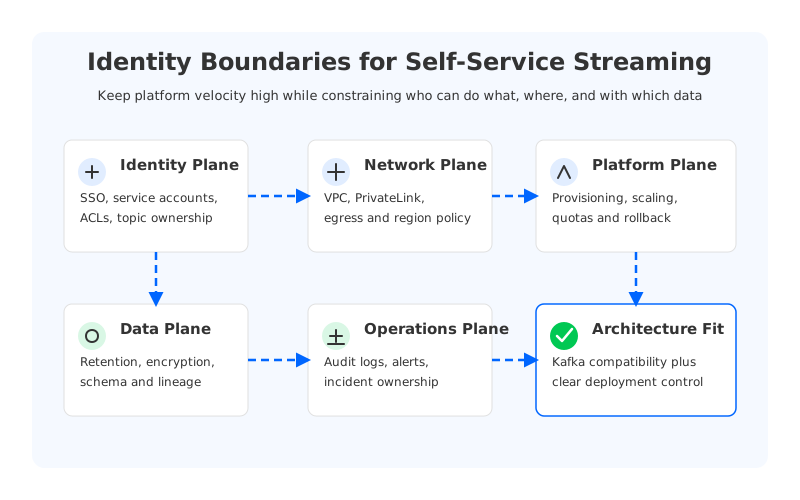
The boundary problem becomes visible when one team asks for a small change and several platform domains get pulled into the same approval path. A topic may require an ACL, a schema policy, a retention decision, a quota, a data classification label, and a cost allocation tag. A connector may require credentials to an upstream system, network access to a private subnet, offset storage, secret rotation, and incident ownership. If these concerns live in different tools with different owners, self-service becomes a faster way to create ambiguity.
1Why Teams Search for identity management kafka boundaries
Kafka is often adopted by teams that already understand distributed systems. The first production cluster may be governed by a small platform group, and that group can keep policy in runbooks, Git repositories, or internal scripts. The model works while the application count is small and the platform team has enough context to review every change. It starts to break when Kafka becomes a company-wide substrate for event-driven applications, analytics pipelines, AI feature flows, and operational integration.
At that point, every identity decision has two meanings. It grants access to Kafka resources, and it assigns responsibility for the consequences of that access. A service account that can write to a high-value topic is also a source of data quality risk. An administrator role that can change retention is also a cost and compliance risk. A connector identity that can read from a database and publish to Kafka is also a data movement boundary. Treating these as isolated ACL entries misses the operating model underneath.
The practical boundary should answer who can create, read, write, alter, delete, or describe each streaming resource; which network paths those identities may use; where durable data lives; how quotas and retention map to cost ownership; who receives audit evidence; and what rollback path applies when a self-service change affects production traffic.
These questions are deliberately broader than "Kafka identity management." They are the reason identity management kafka boundaries is an architecture topic, not an access-control checklist.
2The Production Constraint Behind the Problem
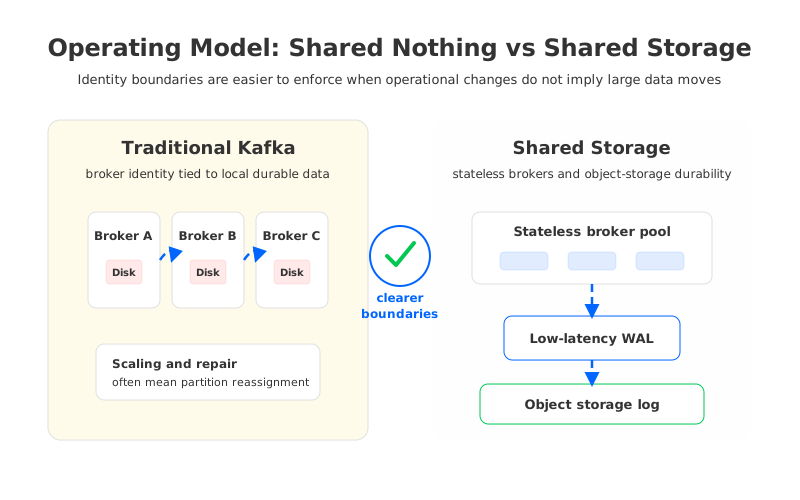
Traditional Kafka is a shared-nothing system: brokers own local storage, partitions are assigned to brokers, and replication creates durable copies across the broker set. That design has served Kafka well, especially where machines and disks are the natural unit of failure and capacity planning. In cloud production, the same model can make identity boundaries harder to express because operational authority and data placement are tightly coupled.
Consider a platform team that wants to delegate topic creation to application teams. The identity policy may be clear: a service owner can create topics under a namespace and grant producer or consumer access to approved identities. The storage and operations policy is less clean. High retention consumes disk, many partitions change broker load, and fast growth can trigger partition reassignment, broker expansion, or cross-zone replication traffic. The person who clicked "create" may not own the operational side effects.
The mismatch grows during lifecycle events. Replacing a broker, expanding a cluster, or rebalancing partitions can require data movement. Identity boundaries that look precise in a control plane become fuzzy because the platform team must step back in to protect availability. Self-service is allowed for the happy path and revoked for the moments that matter most.
Kafka Connect has a similar pattern. Connectors are often where identity boundaries meet the rest of the enterprise. A source connector may use credentials for a database, write records to Kafka, store offsets, and expose metrics. A sink connector may deliver regulated data into a downstream system. The connector identity, Kafka ACLs, secret store, network access, and owner escalation path must match. If any one layer is delegated without the others, the platform creates hidden privilege.
3Architecture Options and Trade-offs
A mature streaming platform usually lands on one of three operating models. The right answer depends on the organization, but each model has a different relationship between identity, cost, and operational control.
| Model | Identity Boundary | Operational Trade-off | Good Fit |
|---|---|---|---|
| Centralized platform team | Platform team approves most changes | Strong consistency, slower delivery | Regulated environments with low topic churn |
| Scripted self-service on traditional Kafka | Teams request changes through templates or GitOps | Faster requests, but data movement remains platform-owned | Organizations with strong SRE capacity |
| Cloud-native Kafka-compatible platform | Teams get bounded self-service while compute and durable storage are decoupled | More architecture change upfront, cleaner scaling and recovery boundaries | Multi-team streaming platforms with growth pressure |
The table matters because identity controls should match the failure mode of the platform. If brokers are stateful and local storage is the constraint, the platform team will keep operational authority even when it delegates topic-level changes. If durable storage is decoupled from broker identity, the control boundary can move closer to the application owner without handing them unsafe infrastructure power.
Cost governance belongs in the identity discussion. Kafka permissions decide who can use a resource; cloud architecture decides how expensive that usage becomes. A platform that lets teams create topics but hides storage growth, partition count, replication traffic, and connector egress is not self-service. It is delayed billing surprise.
The architecture evaluation should stay neutral and concrete:
- Compatibility: Can existing Kafka clients, security mechanisms, operational tools, and migration workflows continue to work?
- Control boundaries: Can identity, network, data, and operations ownership be described without exceptions for routine scaling?
- Elasticity: Can the platform add or remove compute capacity without making data movement the main event?
- Cost visibility: Can owners see how retention, partitions, traffic patterns, and connector behavior affect spend?
- Recovery: Can the team restore service and roll back bad changes without violating normal boundaries?
Teams that skip this evaluation often mistake a permission system for a platform model. The first one tells Kafka whether a request is allowed. The second one tells the organization who owns the outcome.
4Evaluation Checklist for Platform Teams
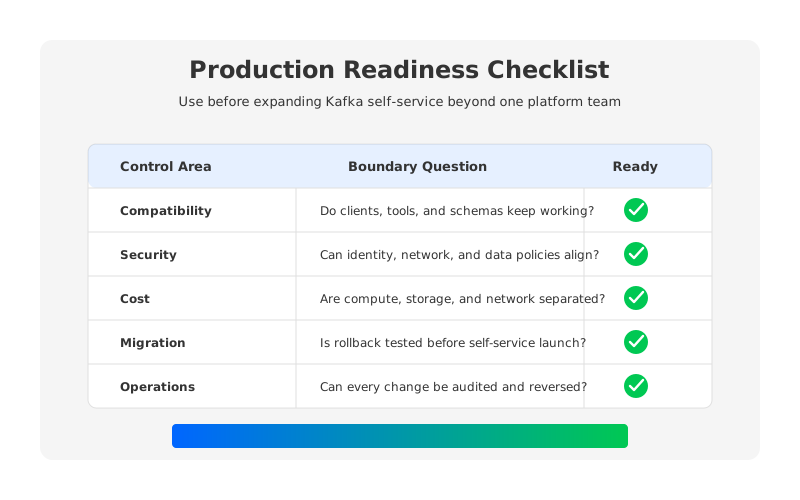
Before expanding self-service, platform owners should design the boundary as a contract readable by security, SRE, application teams, and finance. If it only makes sense to Kafka administrators, it is not ready for broad delegation.
Start with resource ownership. Every topic should have an owning team, business context, retention policy, and data classification. Every service account should have an owner, rotation path, contact channel, and limited scope. Every connector should declare source and destination systems, credential handling, offset storage, network paths, and failure escalation. These are the difference between an incident that routes to the right team and an incident that turns into a platform-wide search.
Then separate user-facing controls from infrastructure controls. Application teams may safely own topic naming within a namespace, producer and consumer identities, schema evolution under review rules, and workload-level quotas. Platform teams should usually retain authority over broker-level configuration, cluster upgrade cadence, encryption defaults, network boundaries, privileged admin roles, and emergency intervention. The exact split varies, but the split must be explicit.
A production checklist should include:
- Namespace and topic ownership rules, including who can create, alter, and delete resources.
- Authentication and authorization patterns for people, services, connectors, and automation.
- Network boundaries such as private connectivity, approved CIDR ranges, and region constraints.
- Data governance controls for retention, encryption, schema compatibility, and sensitive fields.
- Quotas and cost allocation that connect platform usage to team ownership.
- Observability requirements for audit logs, client identity, lag, connector status, and broker health.
- Migration and rollback tests before self-service is enabled for critical workloads.
The strongest checklist is not the longest one. It is the one that removes judgment calls during an incident. When a producer floods a topic, the platform should know which identity wrote the records, which quota applied, which team owns the topic, which dashboard shows the impact, and which rollback action is allowed.
5How AutoMQ Changes the Operating Model
After the neutral framework is clear, AutoMQ becomes relevant as an architectural option rather than a slogan. AutoMQ is a Kafka-compatible, cloud-native streaming system that keeps the Kafka protocol and client ecosystem while moving durable log storage away from broker-local disks and onto shared object storage. Brokers become closer to stateless compute, while the storage layer provides the durable foundation for the log.
That shift matters because it changes what platform teams protect during routine operations. In a broker-local model, scaling and repair are intertwined with partition data placement. In a shared storage model, broker replacement and compute scaling can be handled with less dependence on moving durable log data between broker disks. The platform team can define self-service boundaries around resources and identities while keeping infrastructure operations more predictable.
AutoMQ also fits governance discussions because deployment ownership can be aligned with customer control. AutoMQ Cloud supports a BYOC model where resources are deployed in the customer's cloud account and VPC, and AutoMQ Software is available for organizations that need private deployment boundaries. That does not remove the need for Kafka authentication, ACLs, network policy, or audit design. It gives platform teams an architecture where identity management, cloud account ownership, and data placement can be discussed in the same control model.
For security and compliance architects, the useful question is not "Does this platform have roles?" Every serious platform has roles. The better question is whether those roles map cleanly onto the actual infrastructure boundary. If a team owns a workload but the platform team must constantly intervene in storage rebalancing, the identity boundary is incomplete. If a team owns a workload, the network path is private, the durable data location is known, and compute changes are operationally isolated, the boundary is easier to defend.
For FinOps, the same architecture creates a clearer conversation. Compute, storage, and network behavior can be reasoned about separately. Retention becomes a storage decision, partitioning becomes a compute and metadata decision, and connector traffic becomes a network and governance decision. Identity is the label that connects those decisions to accountable owners.
6A Practical Boundary Model
A usable model has three layers. The first is Kafka-level identity: users, service accounts, ACLs, quotas, client IDs, and connector principals. The second is cloud and network identity: VPCs, PrivateLink or equivalent private connectivity, IAM roles, object storage permissions, encryption keys, and region placement. The third is organizational identity: team ownership, approval paths, incident routing, cost centers, and review evidence.
Weak self-service platforms collapse those layers into one admin role. Strong platforms keep them separate but connected. A service account can write only to approved topics, the topic belongs to a known team, the network path is private by policy, and the durable storage boundary is documented. The platform team can intervene without becoming the permanent owner of every application-level change.
This approach also makes migration less risky. When moving from an existing Kafka deployment to a Kafka-compatible target, the platform team can compare boundaries instead of feature lists. Which client identities move? Which ACLs and quotas must be preserved? Which connector credentials need rotation? Which workloads need rollback tests before cutover? Compatibility helps, but the migration succeeds when boundary evidence survives the move.
Self-service should not mean every team receives every lever. It should mean each team receives the levers that match its responsibility. Application teams should not need broker-level privileges to ship events, SREs should not become application owners to restore service, and security teams should not review every routine topic change to maintain policy. A well-designed boundary gives each group less manual work and more confidence.
7CTA
If your Kafka platform is ready for self-service but your identity, storage, and operations boundaries still blur together, evaluate the architecture before adding another approval workflow. AutoMQ gives teams a Kafka-compatible path to shared-storage streaming with customer-controlled deployment options, making it easier to align platform operations with real ownership boundaries. You can start from the product path here: Get started with AutoMQ.
8References
- Apache Kafka Documentation: Security
- Apache Kafka Documentation: Multi-tenancy
- Apache Kafka Documentation: Kafka Connect Security
- AWS PrivateLink documentation
- AutoMQ Documentation: Compatibility with Apache Kafka
- AutoMQ Documentation: Architecture Overview
- AutoMQ Documentation: What Is AutoMQ Cloud
9FAQ
9.1What are identity management boundaries in Kafka?
Identity management boundaries define which people, services, connectors, and automation can perform specific actions on streaming resources, and how those permissions map to network, data, cost, and operational ownership. In production Kafka, the boundary should cover more than ACLs because access decisions create storage, retention, traffic, and incident-response consequences.
9.2Are Kafka ACLs enough for self-service streaming?
Kafka ACLs are necessary, but they are not enough by themselves. A self-service platform also needs namespace rules, quotas, connector credential handling, audit logs, data classification, network constraints, cost allocation, and rollback procedures. ACLs answer whether a request is authorized; the platform boundary answers who owns the outcome.
9.3How does shared storage affect identity boundaries?
Shared storage decouples durable log data from broker-local disks. That can reduce the operational coupling between broker identity, scaling, and data placement. For platform teams, this means workload owners can receive more bounded self-service while infrastructure teams keep clearer control over deployment, storage, and recovery operations.
9.4Where should AutoMQ appear in a Kafka boundary evaluation?
AutoMQ should be evaluated after the team defines its neutral requirements: Kafka compatibility, private deployment boundaries, scaling behavior, cost visibility, governance, migration risk, and rollback. It is relevant when a team wants Kafka-compatible APIs with a cloud-native shared storage architecture and customer-controlled deployment options.


