
Table of Contents
Table of Contents
A team usually searches for incident replay playbook kafka after something has already gone wrong. A release polluted downstream state. A payment workflow accepted duplicate events. A model pipeline consumed a bad feature stream for hours before anyone noticed. The immediate question sounds procedural: which offsets do we rewind, which consumers do we pause, and who approves the replay? The deeper question is architectural: can the streaming platform replay durable event history without turning the recovery into a second incident?
Kafka is attractive because it already has the primitives incident response teams need: ordered partitions, Consumer group offsets, retention, connectors, and stream processors. Those primitives are powerful, but they do not automatically create a safe replay operation. A production replay stresses storage, network, governance, and team boundaries at the same time.
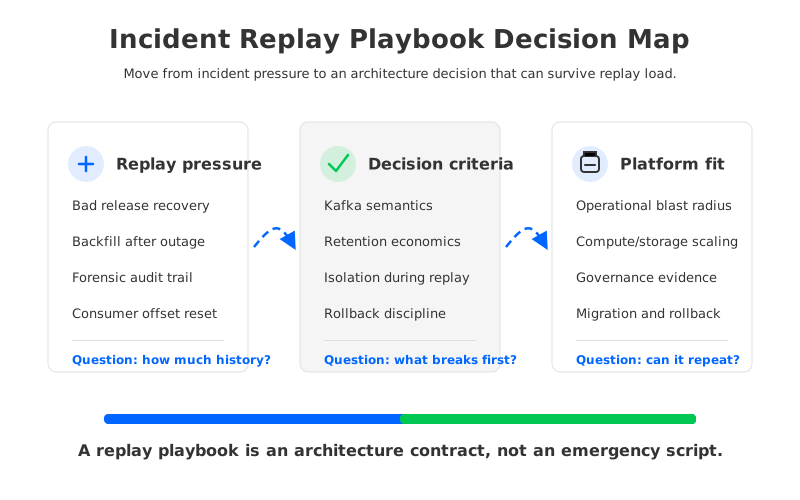
The useful playbook is not a wiki page with a few kafka-consumer-groups commands. It is a contract between application owners, platform engineers, SREs, security reviewers, and data consumers. It says which history is authoritative, how far the team can rewind, how replay traffic is isolated, and what evidence proves the system returned to a correct state.
1Why Teams Search for incident replay playbook kafka
Incident replay begins with a symptom, not a diagram. A downstream database has the wrong balances. A search index missed a deployment window. A fraud model needs to be re-scored from raw events. A CDC sink wrote malformed records. In each case, Kafka becomes the recovery substrate because the event stream may still contain the cleanest version of what happened.
That confidence depends on four conditions. The Topic retention window must cover the incident interval plus investigation time. The records must still be interpretable by the replaying application. Replay traffic must not overload live ingestion. The team must be able to prove what was replayed, by whom, into which target, and with which offset range.
Those conditions are easy to write down and harder to guarantee under pressure. A large replay can look like ordinary consumer traffic, but it reads older segments, fans out through processors and sinks, and often runs while live producers are still writing. If the cluster was sized for steady-state traffic, replay turns retained history into a bursty workload.
The first design decision is therefore about scope:
- Consumer-local replay. A single Consumer group resets offsets and rebuilds one downstream target. This is the smallest blast radius, but it still needs a stop condition and target validation.
- Pipeline replay. Multiple stream processors or connectors rebuild a chain of derived state. This needs dependency ordering, schema checks, and downstream write isolation.
- Forensic replay. SRE, security, or compliance teams reconstruct an incident timeline from raw events. This needs stricter evidence capture and usually a read-only target.
The modes share Kafka mechanics, but they do not share risk. Treating every replay as "reset offsets and let it run" is how a small correction becomes a capacity incident.
2The Production Constraint Behind the Problem
Traditional Kafka clusters are built around Shared Nothing architecture. Each Broker owns local log storage for assigned partitions, and replicas are placed on other Brokers for durability and availability. This model makes partition ownership explicit, but it also ties retained history, broker capacity, and recovery behavior to broker-local storage.
That coupling matters during replay. If consumers rewind into older retained data, they can force disk-heavy Catch-up Read behavior. If several teams do this after the same incident, a healthy-looking cluster can become constrained by disk throughput, page cache churn, inter-broker replication, or downstream network paths.
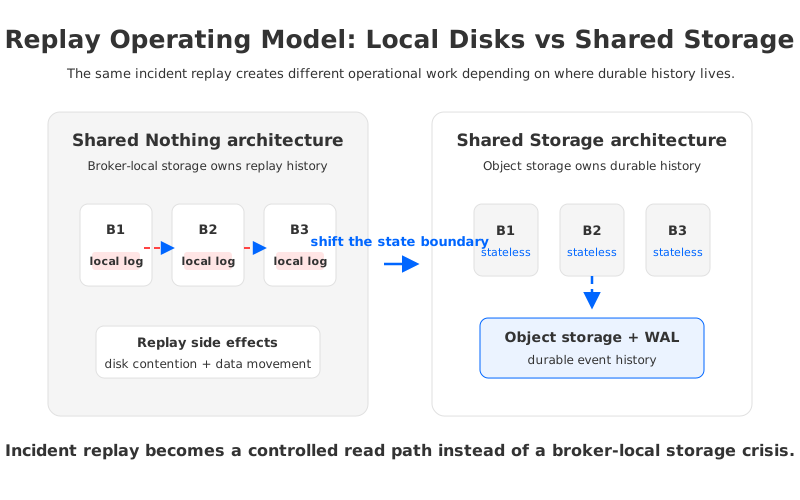
Tiered Storage improves part of this story by moving older segments to object storage while recent data remains on local broker storage. That can reduce long-retention pressure, but it does not remove the broker-local operating model. For replay playbooks, Tiered Storage is a retention tool, not a full answer to elastic replay.
The uncomfortable part is cost. Replay-heavy systems retain more data than steady-state processing requires and create irregular read spikes. In multi-AZ cloud deployments, teams must account for replication traffic, client-to-Broker placement, cross-AZ data transfer, object storage requests, and sink-side write amplification. A playbook that ignores these costs may pass a functional test and still fail a FinOps review.
Governance is the other constraint that tends to arrive late. Replaying a Topic can reprocess personal data, re-trigger side effects, regenerate invoices, or overwrite manual corrections. Kafka offsets are positions in a log, not a governance model. The playbook has to wrap those positions in approval, identity, audit trails, and target isolation.
3Architecture Options and Trade-Offs
There is no single incident replay architecture that fits every Kafka estate. A small cluster with short retention can use a simple offset-reset workflow. A regulated platform with CDC feeds, lakehouse sinks, and ML consumers needs a more explicit recovery model. The question is not "Can Kafka replay?" Kafka can. The question is which risks appear when replay becomes a regular production motion.
| Option | What it optimizes | What to test before relying on it |
|---|---|---|
| Offset reset | Fast single-group recovery | Idempotency, target writes, lag, permissions |
| Shadow Consumer group | Validation before promotion | Extra read load, schema drift, cleanup |
| Kafka Connect rebuild | Rebuilding derived state | Connector offsets, sink throughput, retries |
| Tiered Storage | Longer historical window | Fetch latency, object requests, local boundary |
| Shared Storage architecture | History outside Broker-local disks | Kafka compatibility, WAL, cache, tooling |
The table hides an important sequencing rule: start with application correctness before platform tuning. If the replaying consumer is not idempotent, faster infrastructure makes the mistake happen faster. Once idempotency, schema compatibility, and target isolation are handled, the platform team can focus on history and replay load.
An incident replay playbook should also define what "done" means. Offset completion is not enough. A Consumer can reach the end of a Topic while a sink rejected records or a transform skipped invalid payloads. Completion should combine Kafka progress, target validation, and evidence capture.
The safest replay is boring: bounded offset range, isolated target, visible lag, explicit owner, reversible promotion, and a written record of what changed.
That standard is easier to meet when the streaming platform exposes the right boundaries. Durable history should be independent from short-lived Broker replacement. Replay compute should scale without forcing permanent overprovisioning. Governance should attach to the operation, not depend on tribal memory.
4Evaluation Checklist for Platform Teams
A useful checklist has to be concrete enough for an SRE to run and broad enough for an architect to use in a platform decision.
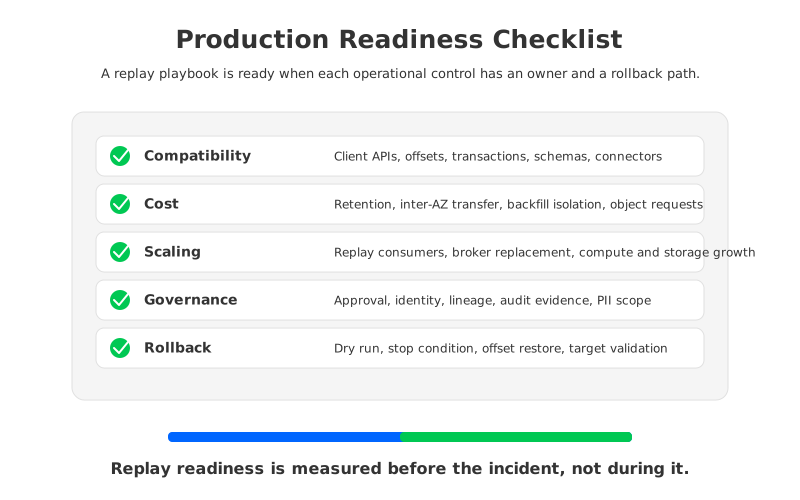
Compatibility. Confirm client versions, Consumer group behavior, transactions, idempotent producers, schema rules, and connector offsets. Apache Kafka's documentation is the baseline for Consumer groups, offsets, transactions, replication, and retention. A Kafka-compatible platform should preserve these expectations closely enough that the playbook does not become a client migration project.
Cost. Estimate the retained history needed for likely incident windows, then test the cost of reading it back. Include Broker storage, object storage, request costs, inter-AZ transfer, sink writes, and temporary replay targets.
Elasticity. Decide whether replay capacity comes from always-on headroom, temporary compute, or a recovery cluster. Temporary compute is efficient only if the platform can add capacity without long data movement.
Governance. Define who can authorize offset resets, start a replay job, approve data classes, and store evidence. The audit record should include Topic, Partition, offset range, timestamp range, requester, approver, target, validation result, and rollback decision.
Rollback. Every replay should have a stop condition and a rollback path. Append-only targets may need compensating events. Mutable targets may need a snapshot restore or shadow-table swap. External side effects may require a simulation path.
Observability. Watch more than Consumer lag. A replay dashboard should include fetch latency, broker CPU, disk or object storage reads, network egress, connector retries, sink latency, rejected records, and validation counters. OpenTelemetry can help standardize this evidence.
5How AutoMQ Changes the Operating Model
The architecture pressure points above lead to a specific requirement: keep Kafka-compatible semantics while reducing durable history tied to Broker-local disks. That is where AutoMQ becomes relevant. AutoMQ is a Kafka-compatible, cloud-native streaming platform that preserves the Kafka protocol and ecosystem while replacing Kafka's local log storage with S3Stream, a shared streaming storage layer built on object storage plus WAL storage.
In AutoMQ's Shared Storage architecture, persistent stream data is stored in S3-compatible object storage, while AutoMQ Brokers focus on Kafka protocol handling, request routing, caching, and scheduling. WAL storage absorbs fresh writes before data is uploaded to object storage, and data caching helps serve hot and historical reads. Durable event history is no longer primarily a Broker-local disk planning problem.
That does not remove the need for replay discipline. Teams still need idempotent consumers, schema governance, target isolation, and approval workflow. What changes is capacity and recovery. Stateless brokers can be replaced or scaled with less dependence on local partition data movement. Long retention becomes an object-storage-backed history requirement rather than a permanent expansion of Broker disks.
AutoMQ also matters for cloud network economics. Its S3-based shared storage design is documented as a way to reduce inter-zone traffic by avoiding traditional inter-broker replica replication and routing clients to local-zone paths when configured. For replay playbooks, this shifts part of the cost review from replica traffic to reads from shared storage, cache, and downstream targets.
Migration is where platform decisions become real. AutoMQ Linking for Kafka is designed for Kafka migration with byte-level message synchronization, offset consistency, Consumer group progress synchronization, and producer traffic proxying during switchover. Those capabilities let teams test a replay-oriented operating model without forcing every application team to rewrite clients first.
The most important product boundary is data ownership. In AutoMQ BYOC, the control plane and data plane run in the customer's cloud account and VPC, and customer message data remains in the customer environment. That boundary matters because replay often touches sensitive production data.
6A Practical Incident Replay Playbook
The playbook should be strict enough for an on-call team to execute under stress and a platform review board to audit later.
- Declare the incident window. Record timestamps, affected Topics, schemas, Consumer groups, downstream systems, and owner. Convert timestamps into candidate offset ranges, but keep both forms.
- Classify replay mode. Choose consumer-local replay, pipeline replay, or forensic replay. This decides target isolation and approval level.
- Freeze the evidence. Capture Consumer group offsets, Topic configs, schema versions, connector configs, deployment versions, and target row counts.
- Run a bounded dry run. Replay a small offset range into a shadow target. Validate counts, errors, schema behavior, idempotency, and sink throughput.
- Scale and isolate. Add replay capacity or route to a recovery environment. Watch live producer latency and normal consumer lag.
- Promote or compensate. Swap the corrected target, write compensating events, or let the repaired consumer resume from the chosen offset.
- Close the loop. Archive offset ranges, validation evidence, approver identity, commands, dashboards, and lessons learned.
This sequence looks procedural, but each step encodes an architectural assumption. If the platform cannot retain enough history, step 1 fails. If it cannot isolate target writes, step 4 fails. If replay capacity requires days of Broker data movement, step 5 fails.
For teams evaluating Kafka-compatible infrastructure, that is the main value of an incident replay playbook. It turns a vague reliability promise into observable requirements: history, compatibility, elasticity, governance, and recovery evidence.
If your team is evaluating whether replay should remain a Broker-local storage problem or become part of a cloud-native streaming operating model, start with the AutoMQ architecture and migration documentation: https://docs.automq.com/automq-cloud/getting-started/overview?utm_source=blog&utm_medium=cta&utm_campaign=incident-replay-playbook-kafka. The next step is to test one bounded replay workflow against your own retention, offset, governance, and cost assumptions.
7References
- Apache Kafka documentation: https://kafka.apache.org/documentation/
- Apache Kafka KRaft documentation: https://kafka.apache.org/documentation/#kraft
- Apache Kafka Tiered Storage documentation: https://kafka.apache.org/documentation/#tiered_storage
- AutoMQ Kafka compatibility: https://docs.automq.com/automq/what-is-automq/compatibility-with-apache-kafka
- AutoMQ Shared Storage architecture: https://docs.automq.com/automq/architecture/overview
- AutoMQ WAL storage: https://docs.automq.com/automq/architecture/s3stream-shared-streaming-storage/wal-storage
- AutoMQ Zero cross-AZ traffic documentation: https://docs.automq.com/automq/eliminate-inter-zone-traffics/overview
- AutoMQ migration with AutoMQ Linking for Kafka: https://docs.automq.com/automq-cloud/migrate-to-automq/overview
- AWS data transfer pricing: https://aws.amazon.com/ec2/pricing/on-demand/#Data_Transfer
- OpenTelemetry documentation: https://opentelemetry.io/docs/
8FAQ
8.1What is an incident replay playbook for Kafka?
An incident replay playbook is a documented recovery process for using Kafka retained events to rebuild or verify downstream state. It should define Topic and offset ranges, Consumer groups, schemas, approvals, target isolation, observability, validation evidence, and rollback criteria.
8.2Is replay the same as resetting Consumer group offsets?
No. Resetting offsets is one Kafka operation inside a replay workflow. A production replay also needs target idempotency, schema compatibility, dry-run validation, capacity planning, and audit evidence.
8.3How much retention should a Kafka incident replay strategy keep?
Retention should cover the longest credible detection, investigation, and repair window. The decision should include storage cost, replay speed, legal requirements, and downstream rebuild time.
8.4Does Tiered Storage solve incident replay?
Tiered Storage can make longer retention more practical by offloading older data to object storage, but it does not automatically solve replay isolation, governance, or Broker-local operational coupling.
8.5Where does AutoMQ fit in incident replay architecture?
AutoMQ fits when a team wants Kafka-compatible APIs while shifting durable event history into Shared Storage architecture backed by object storage. That can make retention, Broker replacement, scaling, and replay-heavy operations easier to reason about.
8.6Should replay happen in production or a separate recovery environment?
Small, well-bounded replays can run in production if the target is isolated and the cluster has capacity. Large, regulated, or side-effect-heavy replays are safer in a recovery environment or shadow target.


