
Table of Contents
Table of Contents
A streaming incident rarely starts with a clean diagnosis. It starts with a page that says consumer lag is rising, produce latency is noisy, a stateful job is falling behind, or downstream data is stale enough that business teams notice. The first mistake is to treat that page as the root cause. Lag is not a cause; it is the visible symptom of a system that has lost balance somewhere between producers, brokers, storage, networks, stream processors, schemas, and downstream dependencies.
That distinction changes the incident response posture. A team that treats lag as the problem usually reaches for blunt tools: add partitions, restart consumers, increase broker count, pause producers, or scale a stream processor without knowing which stage is saturated. Sometimes that works. Sometimes it moves the queue from one service to another and destroys the evidence needed for a clean post-incident review. Production streaming platforms need a response model that starts from lag but quickly builds a root cause tree.
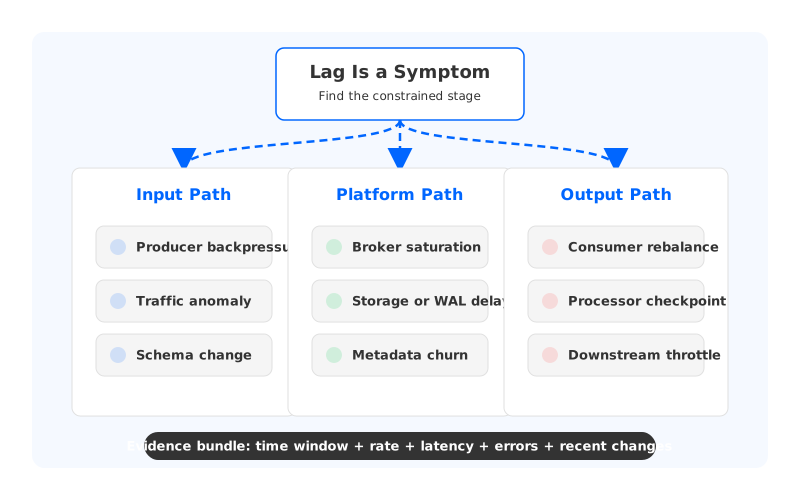
The useful question during an incident is not "How do we make lag go down?" It is "Which component stopped preserving the expected relationship between input rate, processing rate, storage durability, and downstream commit progress?" Once the team frames the incident that way, mitigation becomes more precise. You can protect the user-facing system first, collect the evidence that will survive the next restart, and choose recovery actions that do not create a second incident.
1Severity starts with business staleness, not broker noise
Streaming systems make severity classification tricky because a cluster can look busy while applications still meet their freshness objective. A broker CPU spike is not automatically a Sev-1. A consumer lag spike is not automatically harmless. The severity should be tied to data staleness, loss risk, customer impact, and recovery time under the current backlog growth rate.
A practical severity model asks whether data is still accepted durably, whether freshness has breached a business objective, whether the backlog is growing faster than the platform can drain it, and whether recovery is constrained by capacity, storage, or coordination. This keeps the incident commander from overreacting to noisy infrastructure metrics while still respecting how quickly streaming incidents compound. A small produce-side slowdown can become a stream processor checkpoint problem, which can become a downstream write storm after recovery. Severity should follow the blast radius and recovery envelope, not a single metric threshold.
In practice, Sev-1 means writes are failing, critical freshness is breached, or there is no safe recovery path. Sev-2 means backlog is growing for important workloads while durable ingestion still works. Sev-3 and Sev-4 should stay localized: restore the owner-facing SLO, validate headroom, and prevent escalation.
2Build the root cause tree before touching the system
The root cause tree for a Kafka-compatible platform should cover the whole data path. A producer can slow down because its own dependency is saturated, because batching changed, because compression became expensive, or because acknowledgments are waiting on broker-side storage. A consumer can lag because it has too few partitions to parallelize, because a rebalance loop keeps revoking ownership, because deserialization fails on a poison record, or because its downstream database is throttling writes. The same surface metric can describe very different failures.
During the first 10 to 15 minutes, the responder should gather evidence across layers before starting broad restarts. The producer path needs request rate, error rate, acknowledgment latency, retry rate, batching, compression, deployment changes, and upstream traffic anomalies. The broker and storage path needs produce and fetch latency, network throughput, disk or WAL latency, leadership changes, controller events, object storage health, and retention or compaction pressure. The consumer and sink path needs lag by partition, rebalance frequency, commit latency, poll loop duration, deserialization errors, checkpoint duration, sink queue depth, database throttling, and dead-letter volume.
This breadth is what makes streaming incident response different from a normal service restart. The platform is a shared dependency. A hasty restart can redistribute load, trigger rebalances, invalidate caches, and make the backlog drain slower. A root cause tree gives the incident commander a map of where a mitigation can help and where it will only make the graph look different.
3Evidence collection should be boring and repeatable
The strongest incident teams make evidence collection boring. They encode the first evidence bundle into a runbook: topic, consumer group, producer application, broker, controller, storage, network, stream processor, sink, and incident time window. "Lag started at 09:12" is often more useful than the absolute lag value.
Three correlations usually pay off quickly. Compare producer input rate to consumer output rate, broker request latency to storage and network signals, and deployments or schema changes against the incident start time. Schema failures often masquerade as capacity problems because they create retry loops, poison records, or downstream rejection. Record what did not change as well, because that prevents the review from becoming a memory contest.
4Mitigation is a control problem
Once the likely constrained stage is known, mitigation should reduce pressure while preserving recovery options. In streaming systems, the wrong mitigation can improve one chart and worsen the incident. Scaling consumers helps only if there are enough partitions and the downstream sink can accept more writes. Adding brokers helps only if the bottleneck is compute or network rather than storage, controller churn, or local disk capacity. Pausing producers protects downstream systems but may push backpressure into user-facing applications.
The right mitigation is usually one of five controls: throttle non-critical producers, scale the constrained consumer or processor after checking partition parallelism and sink capacity, add broker or network capacity when those are the leading signals, isolate poison records, or roll back the smallest recent change that lines up with the start time. Rollback deserves care because offsets, checkpoints, schemas, and retained data keep moving. A safe plan defines valid offsets, idempotent output behavior, duplicate detection, and downstream side effects.
5Broker-local storage changes the recovery envelope
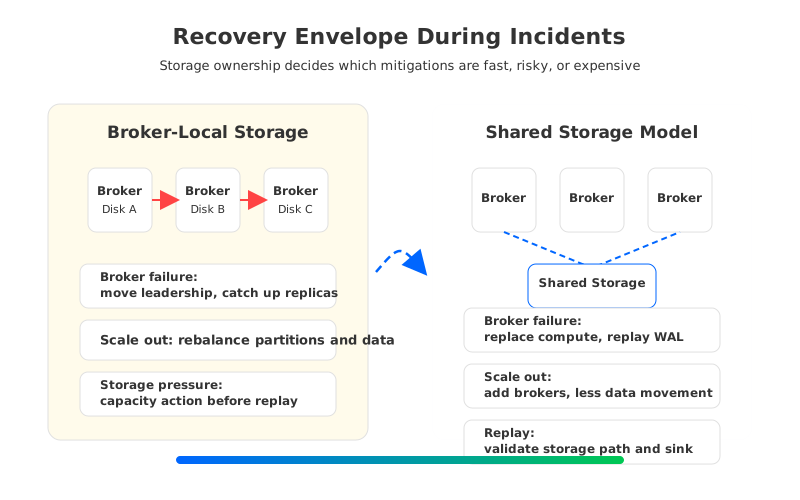
Classic Kafka deployments bind partition data to broker-local storage. That design is robust and well understood, but it shapes incident response in ways platform teams should make explicit. If a broker fails, recovery depends on replica health and leadership movement. If the cluster needs more capacity, partition reassignment can involve moving data across brokers. If storage is near full, the fastest safe action may be retention adjustment, topic-level isolation, or emergency capacity expansion rather than graceful rebalancing.
These constraints are not edge cases. They decide what an on-call team can safely do at 02:00. A local-disk broker model makes storage ownership part of the failure domain, so the operator must consider where every hot partition lives and how much data movement each mitigation creates. Even when the platform has tiered storage, many designs still keep the hot log and broker ownership on local disks. Tiered storage can reduce long-retention pressure, but it does not automatically make broker replacement or hot partition movement stateless.
Shared-storage Kafka-compatible architectures change that operating model by separating durable stream data from broker compute. Instead of treating the broker as both request handler and data owner, the platform stores persistent data in a shared storage layer and lets brokers act more like elastic compute. The incident response benefit is not magic. The team still has to validate latency, durability, metadata, client compatibility, observability, and failure modes. The difference is that recovery actions such as broker replacement or capacity scaling can be evaluated without assuming large partition data movement as the default cost.
6Where AutoMQ fits in the evaluation
By this point, the architectural requirement is clear: the platform should preserve Kafka-compatible behavior while reducing the operational coupling between broker compute and durable storage. AutoMQ fits into that category as a Kafka-compatible streaming platform built around shared storage and stateless brokers. Its public documentation describes S3Stream shared storage, a WAL path for durable writes, Kafka API compatibility, and deployment models such as BYOC where the data plane can run in the customer's cloud environment.
That does not mean every incident disappears. Consumer bugs, schema mistakes, bad deploys, downstream throttling, and traffic anomalies still need the same operational discipline. AutoMQ changes the parts of the runbook that are tied to broker-local data ownership: broker replacement, scaling, partition movement, storage expansion, and cross-AZ replication cost. For platform teams, the useful evaluation question is not "Can this product reduce incident count?" It is "Which recovery actions become safer, faster, or cheaper because durable data is no longer bound to individual broker disks?"
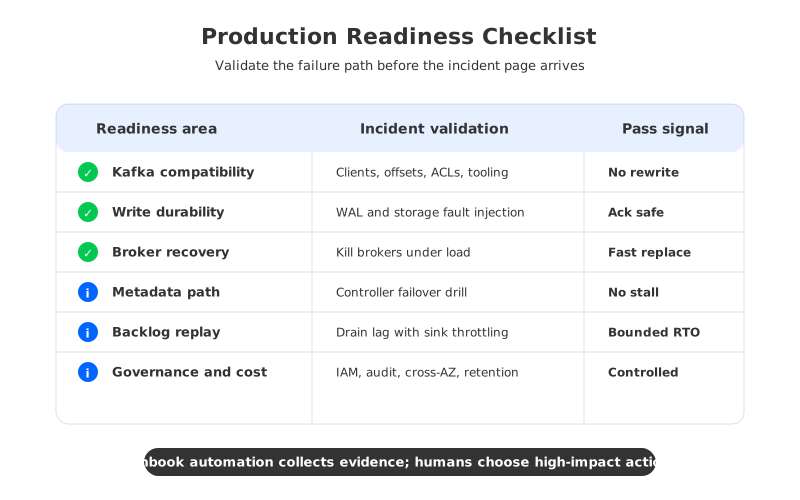
The validation checklist should stay vendor-neutral. Test existing producers, consumers, transactions, ACLs, offsets, and tools; WAL behavior and acknowledgment semantics; broker replacement under load; backlog replay with sink throttling; controller or metadata failover; cross-AZ traffic and retention cost; and BYOC governance boundaries such as VPC, IAM, audit logs, encryption, and observability export. Object storage durability and economics are attractive, but the platform must prove the hot write path, WAL recovery, fetch behavior, and metadata coordination under real workload patterns.
7Automate the runbook, not the judgment
Runbook automation is valuable when it gathers evidence faster than humans can. It can snapshot dashboards, query consumer groups, collect logs, mark recent deployments, check schema changes, compare traffic against prior weeks, and suggest the most likely branch of the root cause tree.
The boundary is action. Automated mitigation should be narrow, reversible, and tied to explicit guardrails. Scaling a stateless processor within a known limit can be safe. Opening producer floodgates, changing retention, deleting offsets, moving partitions, or restarting a whole cluster should require human confirmation because those actions change the recovery surface. The automation should make the incident commander faster, not turn the platform into a system that performs high-blast-radius actions because a single metric crossed a threshold.
A good runbook separates observation, diagnosis, containment, and recovery. Observation can be automated. Diagnosis can be assisted by correlation. Containment can use preapproved throttles or bounded scaling. Recovery still needs human judgment because offsets, duplicate outputs, replay windows, and restart criteria are correctness decisions.
8Prevention is a design review after the incident
The post-incident review should not stop at "consumer lag alert fired too late." That may be true, but it is not enough. A streaming platform incident review should ask which control loop failed: capacity planning, traffic governance, schema compatibility, deployment safety, storage headroom, partition strategy, downstream backpressure, or architecture fit.
Several preventive controls are worth formalizing: freshness SLOs per stream, producer-to-sink backpressure contracts, schema gates, replay drills, broker and storage failure drills, and cost anomaly alerts. The last point is underrated. A cross-AZ failover, emergency replay, or duplicate pipeline can create a cost spike after the reliability page is closed.
9A practical incident response checklist
When the next lag page arrives, the response should follow a short sequence. Confirm business impact and severity. Freeze the time window and collect the evidence bundle. Determine whether the leading signal starts on the producer side, broker and storage path, consumer group, stream processor, or downstream sink. Apply the narrowest mitigation that stops backlog growth. Validate recovery with freshness, error rate, and downstream correctness rather than a single lag chart.
The deeper lesson is that streaming incident response is an architecture exercise under time pressure. Broker-local Kafka, tiered storage, shared-storage Kafka-compatible platforms, and BYOC deployment models all create different recovery envelopes. Teams that understand those envelopes before the incident can choose actions with fewer surprises.
That preparation also changes the tone of the review. Instead of asking why an operator did not know the perfect command during a page, the team can ask whether the platform made the safe command obvious. The best runbooks reduce judgment load during the incident and move deeper judgment into architecture reviews, failure drills, and deployment gates.
If your team is evaluating whether a Kafka-compatible shared-storage model changes that envelope, start with the tests that matter during failure: broker replacement under load, backlog replay, storage-path fault injection, metadata failover, client compatibility, and governance boundaries. AutoMQ is one option to include in that evaluation when Kafka compatibility, stateless brokers, shared storage, and customer-controlled deployment are part of the requirement set.
10References
- Apache Kafka documentation
- Apache Kafka monitoring documentation
- AutoMQ S3Stream shared storage overview
- AutoMQ stateless broker documentation
- AutoMQ Kafka compatibility documentation
- AWS EC2 data transfer pricing
11FAQ
11.1Is consumer lag always a Kafka broker problem?
No. Consumer lag is a symptom that can come from producers, brokers, storage, networks, consumer group behavior, stream processors, schema errors, or downstream throttling. Broker metrics matter, but they need application and sink context.
11.2What evidence should be captured first during a streaming incident?
Capture the time window, producer rate and errors, broker produce and fetch latency, storage or WAL health, controller events, lag by partition, rebalance events, checkpoint duration, downstream saturation, recent deployments, and schema changes.
11.3Does tiered storage make Kafka brokers stateless?
Not by itself. Tiered storage can offload older log segments to object storage, which helps retention and storage pressure. Many designs still keep the hot log and broker-local ownership model in place.
11.4How does shared storage change incident response?
Shared storage can reduce the durable data tied to a specific broker, making broker replacement, capacity scaling, and partition movement less dependent on large local transfers. Validate the benefit with write latency, backlog replay, metadata failover, and storage fault tests.
11.5Where does AutoMQ fit in a production incident response strategy?
AutoMQ is relevant when a team wants Kafka-compatible APIs while evaluating shared storage, stateless brokers, BYOC deployment, and reduced broker-local recovery constraints. It does not replace incident discipline, but it can change which recovery actions are practical.


